Sustainable Manufacturing: Techniques, Worked Examples and India's Rules
What sustainable manufacturing is, the eco-friendly production techniques that pay back fastest, and three worked plant calculations (a compressed-air leak, a fan VFD and a Scope 2 footprint) with Indian tariffs and the CEA grid factor. Plus what CBAM and India's carbon market mean for factories from 2026.
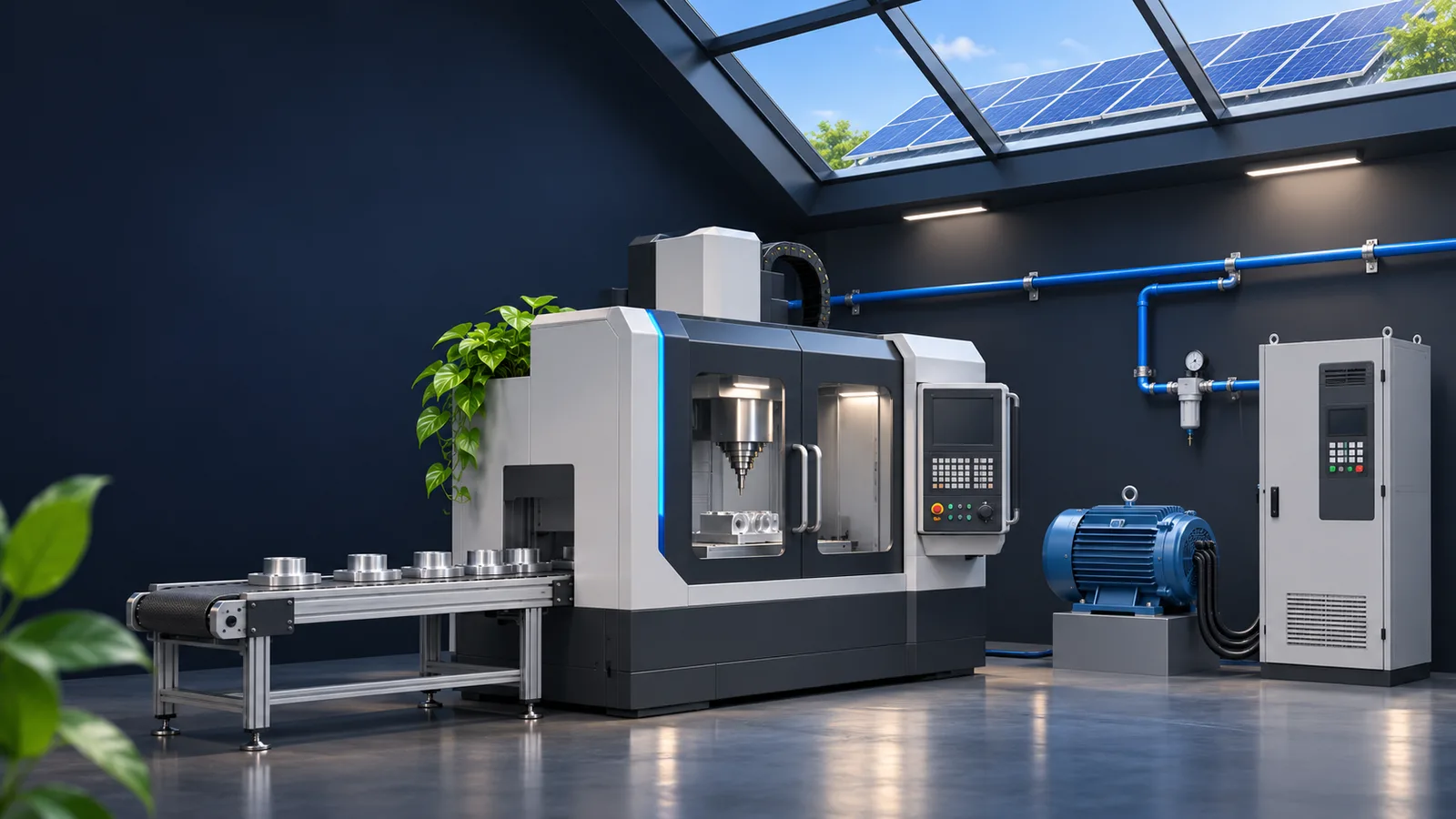
Sustainable manufacturing means making products with processes that cost less energy, water and material, and release less carbon and waste, while staying profitable. The US EPA defines it as "the creation of manufactured products through economically-sound processes that minimize negative environmental impacts while conserving energy and natural resources." In practice it starts with the plant's energy bill: compressed air, motors, heat and electricity sourcing.
For Indian manufacturers it stopped being optional in 2026. The EU's carbon border tax entered its definitive phase on 1 January 2026, and India's own carbon market now sets emission-intensity targets for 490 industrial plants. This guide explains the techniques that work, works through three plant calculations with Indian numbers, and shows how the savings show up in a carbon footprint.
Key takeaways
- EU CBAM is live: since 1 January 2026, importers of cement, iron and steel, aluminium, fertilisers, electricity and hydrogen into the EU need verified embedded-emission data. CBAM certificates go on sale in February 2027, and the first ones must be surrendered by 30 September 2027 (European Commission).
- India's carbon market has teeth: plant-level greenhouse-gas intensity targets now cover 490 obligated entities in eight sectors (PIB, 22 Jan 2026). A plant that misses its target pays twice the average carbon-credit price for the shortfall (G.S.R. 739(E), 8 Oct 2025).
- The grid is getting cleaner: each MWh from India's grid emitted 0.675 t of CO2 in FY 2025-26, down from 0.710 the year before and 0.774 in FY 2013-14 (CEA CO2 Baseline Database v22.0, Aug 2026).
- The cheapest wins are leaks and motors: leaks waste 20-30% of a typical compressor's output (US DOE). In Skill-Lync's worked example below, a single 3 mm leak at 7 bar costs about ₹1.24 lakh and 10.5 t of CO2 a year.
- Speed control pays: a fan or pump with no static head needs about half the power at 80% speed, because power falls with the cube of speed (US DOE motor sourcebook).
What is sustainable manufacturing?
Sustainable manufacturing is making goods with processes that use less energy and material, emit less carbon and waste, and keep workers and neighbours safe, without losing money. It is measured: energy per part, CO2 per tonne of product, water per unit and scrap rate. A factory is more sustainable when those numbers fall year on year at the same output.
Two ideas sit underneath it:
- Efficiency first: every kWh not used never needs to be generated, bought or offset. That makes energy efficiency the cheapest form of decarbonisation.
- Life cycle thinking: a part's footprint includes its raw material, the energy to make it, its use and its end of life. ISO 14001:2026, published in April 2026, puts more weight on this life-cycle perspective (DNV summary).
Why does sustainable manufacturing matter for Indian factories in 2026?
Since 2026, carbon has had a price for many Indian manufacturers. Exporters to the EU must report embedded emissions under CBAM, and from 2027 their buyers pay for them. Large plants in eight sectors have legal intensity targets under India's Carbon Credit Trading Scheme. Listed companies' suppliers are also being asked for emission data.
| Date | Rule | What it means for a plant |
|---|---|---|
| 28 Jun 2023 | Carbon Credit Trading Scheme notified (S.O. 2825(E)) | India's carbon market framework |
| Oct 2023 | EU CBAM transitional (reporting) phase begins | EU importers report embedded emissions, no payment |
| 8 Oct 2025 | First GHG intensity targets (G.S.R. 739(E)) | 282 plants in aluminium, cement, chlor-alkali, pulp and paper |
| 1 Jan 2026 | CBAM definitive regime | Embedded emissions of 2026 imports will have to be paid for |
| 13 Jan 2026 | Targets extended to refineries, petrochemicals, textiles, secondary aluminium | 208 more plants; 490 in total |
| FY 2026-27 | SEBI BRSR Core: assessment or assurance for the top 1,000 listed companies | Customers ask suppliers for audited data |
| Feb 2027 | CBAM certificates on sale; first surrender by 30 Sep 2027 | Real money for 2026 imports |
The cost is not abstract. The Commission published a CBAM certificate price of €82.32 per tonne of CO2 for the third quarter of 2026. The Global Trade Research Initiative (GTRI) estimated in December 2025 that Indian steel and aluminium exporters may have to cut prices by 15-22% to absorb the carbon cost EU importers pass back. Small importers are exempt below 50 tonnes of CBAM goods a year under the 2025 simplification, Regulation (EU) 2025/2083.
At home, the CCTS targets are plant-specific. UltraTech's Nathdwara cement plant must go from 0.5040 t CO2e per tonne of equivalent product (baseline FY 2023-24) to 0.4938 by FY 2026-27, a 2.0% cut. Vedanta's Jharsuguda smelter II must go from 13.8878 to 13.2965, a 4.3% cut. The scheme builds on BEE's Perform, Achieve and Trade (PAT) programme. BEE reports that PAT cycles I to VI saved 27.07 Mtoe of energy and about 115 million tonnes of CO2. Nationally, India's updated NDC commits to a 45% cut in the emission intensity of GDP by 2030 from 2005 levels, and the 2031-35 NDC raises that to 47% by 2035.
What are the main sustainable manufacturing techniques?
The techniques that deliver most fall into eight groups: fix compressed air, run motors efficiently with speed control, recover waste heat, switch to cleaner electricity, cut scrap with lean methods, use less material, close the loop through recycling and remanufacturing, and measure everything. The first three usually pay back fastest because they cut energy that is already being paid for.
| Technique | What you do | Typical evidence |
|---|---|---|
| Compressed-air management | Find and fix leaks, lower pressure, stop using air for cleaning and cooling | Leaks waste 20-30% of output; wire-to-work efficiency is about 10% (DOE) |
| Efficient motors and drives | Right-size motors, use higher-efficiency classes, fit VFDs on fans and pumps | Motors use about 70% of industrial energy (BIS); IEC 60034-30-1 Ed. 2 (Dec 2025) adds class IE5 |
| Heat recovery | Preheat combustion air, feed water or wash tanks with exhaust or compressor heat | Sized with an energy balance; try our air preheat fuel savings calculator |
| Cleaner electricity | Rooftop solar, open-access renewable power, green tariffs | Cuts Scope 2 at the grid factor of 0.675 t CO2/MWh avoided |
| Lean and quality | Cut scrap, rework and idle running | Every scrapped part carries all of its embedded energy |
| Material efficiency | Lightweight designs, near-net-shape processes, additive manufacturing for complex parts | Less raw material bought and machined away |
| Circularity | Recycled content, remanufacturing, take-back of scrap | Secondary aluminium is now itself a CCTS sector |
| Measurement and management systems | Sub-metering, ISO 50001 energy management, ISO 14001:2026, GHG inventory | What is not metered does not get fixed |
Green chemistry, the old post's other focus, still matters in process industries: replacing hazardous solvents and catalysts reduces both pollution and treatment cost. For machining, assembly and fabrication plants, though, energy is where the measurable gains are, so the worked examples below focus there.
Worked example 1: what does one compressed-air leak cost?
A 3 mm leak in a 7 bar compressed-air line wastes about 14.4 cfm of free air. Supplying it takes about 2.6 kW of compressor power around the clock. Over 6,000 operating hours at ₹8 per kWh, that is about ₹1.24 lakh and 10.5 tonnes of CO2 a year, from one small hole.
At 7 bar gauge (8.01 bar absolute), the pressure ratio across the hole is far above the 1.89 needed for choked flow, so air leaves at the speed of sound and the mass flow depends only on upstream pressure and hole area:
With (DOE's coefficient for a sharp-edged hole), , Pa, K, and :
That agrees within 4% with the US DOE leak table, which gives 25.22 cfm for a 1/8 inch hole at 100 psig before the 0.61 sharp-orifice factor, once scaled to 3 mm and 7 bar. DOE's rule of thumb of 18 kW per 100 cfm gives the compressor power:
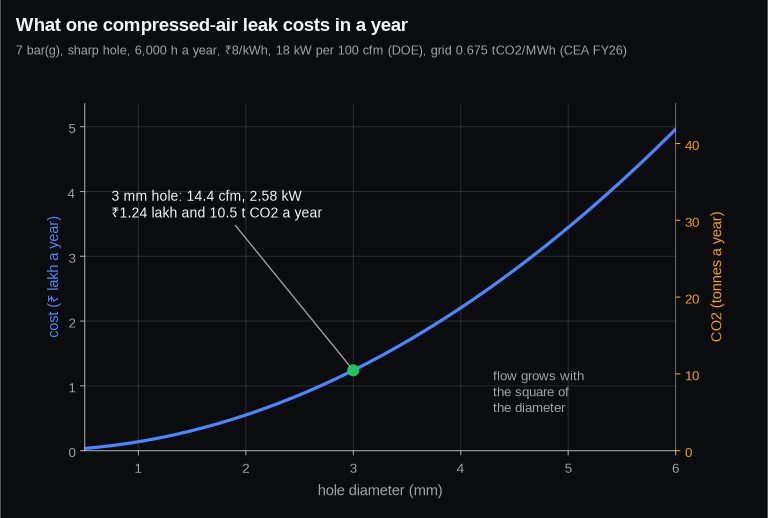
A plant with dozens of fittings, hoses and drains usually has many such leaks. The fix is an ultrasonic leak survey, a tag-and-repair routine and a lower header pressure. Skill-Lync's Hydraulics and Pneumatics book covers how compressed-air systems are sized.
Worked example 2: how much does a VFD save on a fan?
A variable frequency drive (VFD) saves energy on fans and pumps because shaft power falls with the cube of speed. Running a fan at 80% speed needs only about 51% of full power. When a process needs less air for most of the day, slowing the fan instead of throttling it cuts energy by a third or more.
The affinity laws for a centrifugal fan or pump with no static head are:
Take a 30 kW extraction fan that needs full flow 30% of the time, 80% flow for 40% of the time and 60% flow for 30% of the time, over 6,000 hours a year. With a 97%-efficient VFD:
| Flow (speed) | Share of hours | Input power with VFD |
|---|---|---|
| 100% | 30% | 30.9 kW |
| 80% | 40% | 15.8 kW |
| 60% | 30% | 6.7 kW |
Energy falls from 180,000 kWh a year (fan always at 30 kW) to 105,700 kWh, a saving of 74,300 kWh or 41%. That is about ₹5.9 lakh and 50 t of CO2 a year at the same tariff and grid factor.
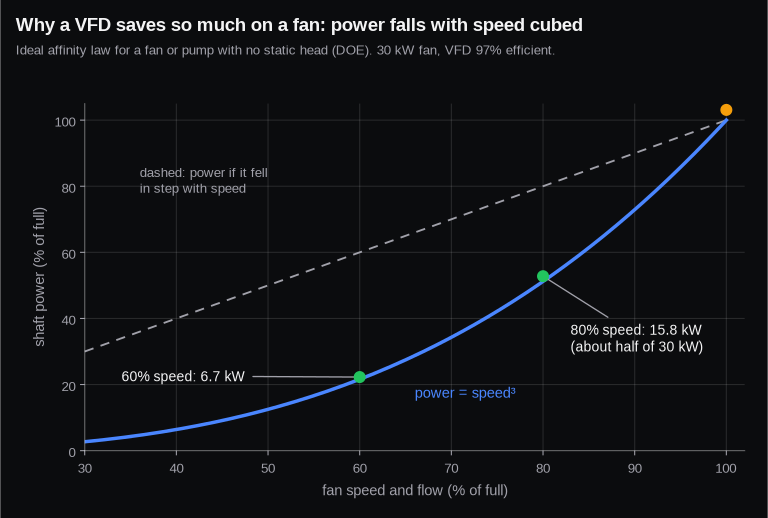
Here's the catch: 41% is an upper bound. A damper or inlet vane on the old fan also reduces power somewhat when throttled, and systems with static head (lifting water, overcoming a fixed back-pressure) do not follow the pure cube law. Measure the existing fan's power at each duty point before quoting a payback. Sizing drives and reading pump curves are covered in Skill-Lync's Electrical Drives book and centrifugal pump calculator.
Worked example 3: how do these savings show up in a plant's carbon footprint?
A plant's carbon footprint is split into three scopes. Scope 1 is fuel burned on site, Scope 2 is purchased electricity and Scope 3 is everything in the value chain (GHG Protocol). For most machining and assembly plants, Scope 2 dominates, so electricity savings convert directly into CO2 at the grid emission factor.
Take a mid-size machining plant using 2,400 MWh of grid electricity a year to make 3,000 tonnes of parts:
Fixing ten leaks like the one in example 1 and fitting one VFD as in example 2 saves 229 MWh, 9.6% of the plant's electricity. That is a bigger cut than the 2.0% and 4.3% CCTS targets quoted above, from two maintenance-level projects. Plants under CCTS must cut intensity by much more than that over time, but the first few percent are usually found this way.
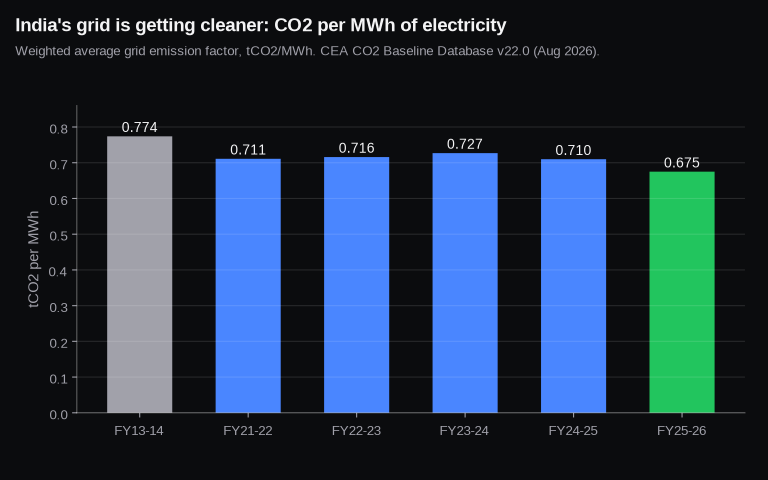
Two practical notes. First, use the grid factor for the year you report, and say which version you used, because CEA revises earlier years. Second, rooftop solar or renewable power purchase agreements cut Scope 2 further, but efficiency should come first: it shrinks the solar plant you need to buy.
How do companies measure and report sustainability?
Companies measure sustainability with an energy and greenhouse-gas inventory (GHG Protocol scopes), run it through a management system such as ISO 50001 for energy or ISO 14001 for environment, and report it. In India, listed companies report through SEBI's Business Responsibility and Sustainability Report, and exporters to the EU report CBAM embedded emissions.
- ISO 14001:2026 replaced the 2015 edition in April 2026. Certified sites must move to it before May 2029, according to DNV.
- SEBI BRSR Core must be assessed or assured by the top 150 listed companies from FY 2023-24, rising to the top 1,000 by FY 2026-27. Value-chain disclosures are voluntary for the top 250 from FY 2025-26 (SEBI circular, 28 Mar 2025). This is why MSME suppliers get emission questionnaires.
- CCTS plants report emission intensity per tonne of equivalent product against their notified baseline.
What are the challenges of sustainable manufacturing?
The main challenges are upfront cost, missing data, skills and uneven rules. Most energy projects pay back, but they still compete with production spending for capital. Many small plants have one electricity meter for the whole site, so they cannot see where energy goes. And carbon rules differ between the EU, India and customers' own targets.
- Capital and payback: a VFD or heat-recovery unit needs money now for savings later. Measured baselines make the case; estimates do not.
- Data: CBAM and BRSR need plant-level, verifiable numbers. Sub-metering compressors, furnaces and large motors is the first step.
- Physics limits: the cube law breaks down with static head, and heat can only be recovered if a nearby process can use it at that temperature.
- Rebound: cheaper running can lead to more running. Track intensity (kWh per part), not just total kWh.
- Skills: engineers who can do an energy balance, read a pump curve and build a carbon inventory are still scarce.
What skills do engineers need for sustainable manufacturing roles?
Engineers in sustainable manufacturing roles need thermodynamics and energy balances, knowledge of motors, drives and fluid systems, manufacturing process knowledge, and the ability to turn measurements into a carbon number. Titles include energy engineer, sustainability engineer, process engineer and manufacturing engineer with ESG responsibility.
- Manufacturing processes and design for manufacture: Skill-Lync's Post Graduate Program in Manufacturing Design and the Manufacturing Processes book. Our guide to the types of manufacturing processes is a good starting point.
- Energy balances: Foundations of Thermodynamics and its Industrial Applications.
- Material efficiency: Additive Manufacturing and 3D Printing using Ansys SpaceClaim.
- Clean power: the Renewable Energy book.
Want help choosing? Talk to a Skill-Lync counsellor.
Frequently asked questions
What is sustainable manufacturing in simple words?
Sustainable manufacturing is making products while using less energy, water and raw material, and producing less carbon, waste and pollution, without making the business unprofitable. It is tracked with numbers such as kWh per part, CO2 per tonne and scrap rate. A plant becomes more sustainable when those numbers fall while output stays the same.
What are examples of eco-friendly production techniques?
Common examples are fixing compressed-air leaks, fitting variable frequency drives on fans and pumps, recovering waste heat, installing rooftop solar, cutting scrap with lean methods, using recycled material, remanufacturing parts and replacing hazardous chemicals. In engineering plants, compressed air and motor systems usually give the fastest payback because they waste energy that is already paid for.
Does CBAM affect Indian exporters?
Yes. Since 1 January 2026, EU importers of iron and steel, aluminium, cement, fertilisers, hydrogen and electricity must account for the embedded emissions of those goods, and they will buy CBAM certificates from February 2027. Indian exporters who cannot supply verified emission data, or whose emissions are high, face pressure to cut prices.
What is India's Carbon Credit Trading Scheme?
India's Carbon Credit Trading Scheme, notified on 28 June 2023, sets greenhouse-gas emission-intensity targets for large industrial plants. Plants that beat their target earn carbon credit certificates they can sell, and plants that miss pay environmental compensation. As of January 2026 it covers 490 plants in eight sectors, with baseline year FY 2023-24.
How much CO2 does saving 1 kWh of electricity avoid in India?
Saving 1 kWh of grid electricity in India avoided about 0.675 kg of CO2 in FY 2025-26, using the Central Electricity Authority's weighted average grid emission factor of 0.675 t CO2 per MWh (CO2 Baseline Database version 22.0, August 2026). The factor was 0.710 in FY 2024-25 and falls as more renewable power joins the grid.
Is sustainable manufacturing more expensive?
Not usually over the life of a project. Leak repair, speed control and heat recovery typically cut operating costs, as the worked examples above show, although they need upfront spending. Costlier steps such as process changes for deep decarbonisation are increasingly driven by carbon prices under CBAM and CCTS rather than by energy savings alone.
Sources and further reading
- US EPA, Sustainable Manufacturing
- European Commission, Carbon Border Adjustment Mechanism; Price of CBAM certificates; CBAM news; CBAM simplifications published (20 Oct 2025)
- GTRI, CBAM report (31 Dec 2025)
- MoEFCC, Greenhouse Gases Emission Intensity Target Rules, G.S.R. 739(E) (8 Oct 2025)
- PIB, GHG intensity targets for four more sectors (22 Jan 2026); Carbon Credit Trading Scheme and PAT transition (9 Dec 2024); Updated NDC (3 Aug 2022)
- UNFCCC, India's NDC 2031-35 (Apr 2026)
- Central Electricity Authority, CO2 Baseline Database for the Indian Power Sector, v22.0 (Aug 2026)
- BEE, PAT scheme presentation (hosted by SEforALL, Feb 2026)
- SEBI, Circular on BRSR Core assurance and value chain (28 Mar 2025)
- US DOE, Improving Compressed Air System Performance: A Sourcebook; Tip Sheet 3: Minimize Compressed Air Leaks
- US DOE, Improving Motor and Drive System Performance: A Sourcebook for Industry
- IEC, IEC 60034-30-1:2025; BIS, Three-phase induction motors: performance and safety
- DNV, New edition of ISO 14001 published (2026)
- GHG Protocol, Corporate Standard