Week 9 Tension and Torsion test challenge
TENSION AND TORSION TEST
OBJECTIVE:
To perform a tension and torsional test on the given speciment by imparting a displacement of 18mm in the first case and providing an angular displacement of 1200deg in the second case thereby extracting the total deformation, equivalent stress and temperature of the specimen
PROCEDURE:
- Create a new explicit dynamic simulation
- Import non linear steel material from explicit materials as the desired material for all the components
- Import the geometry model from spaceclaim GUI
- Then the model module of explicit dynamics is again updated.
- Open the model in ansys mechanical module.
Mesh
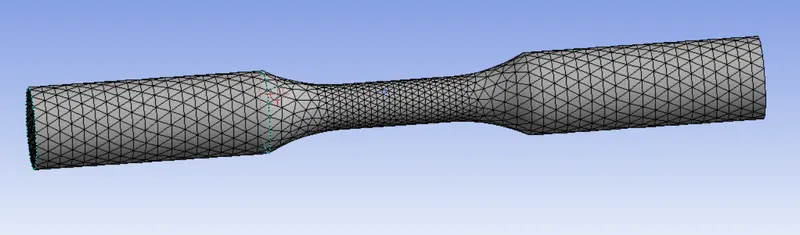
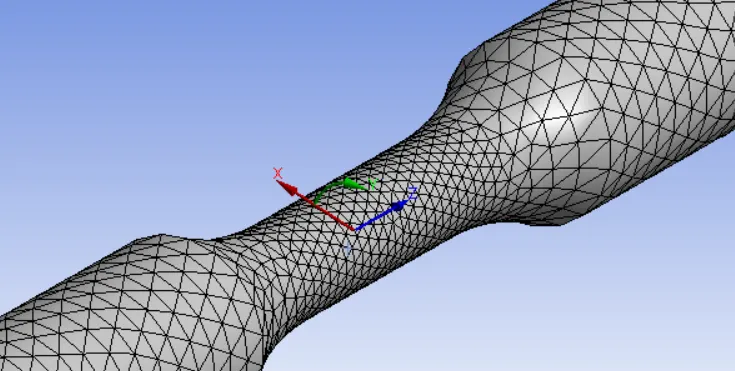
Define the mesh method as tetras
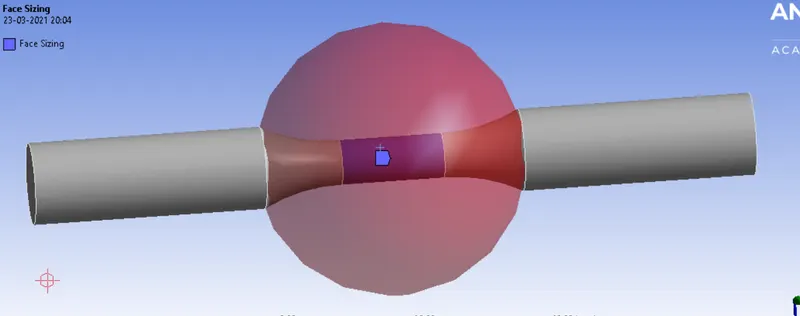
Since the mid portion of the comp is more suceptible to fracture, the mesh density in that region is increase using a sizing option and by definng a sphere of 20mm radius around it
Analysis settings
Specify the end time of the explicit dynamics model as 1e-3.
Loading condition (displacement)
Fix one end of the face to space
Specify a displacement of 18mm at the other end such that this displacement is gradually applied till the end time.

RESULTS:
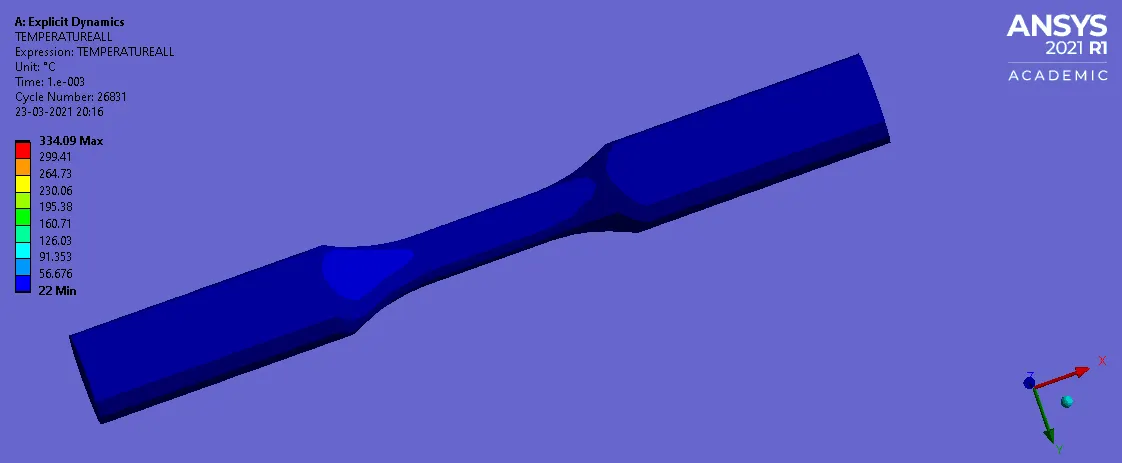
CASE 1: TENSION
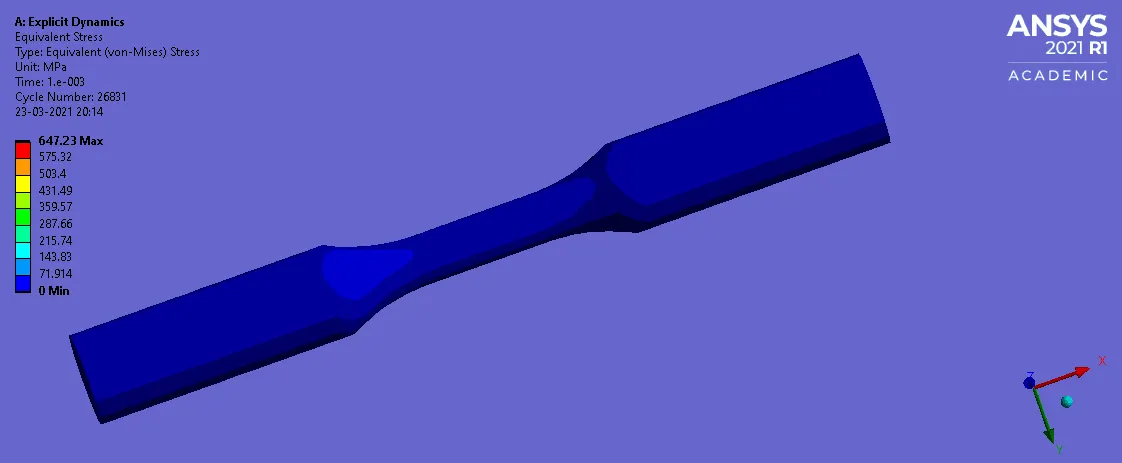
Equivalent stress
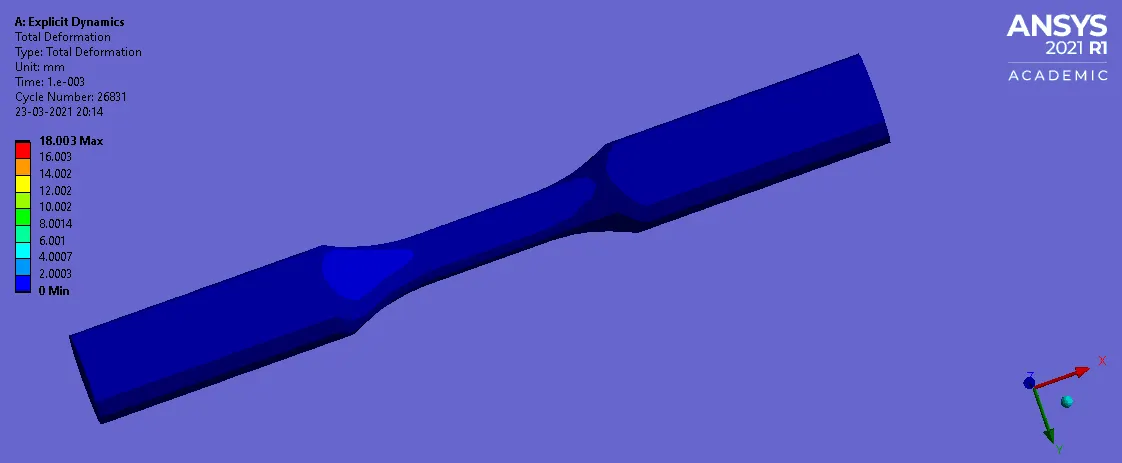
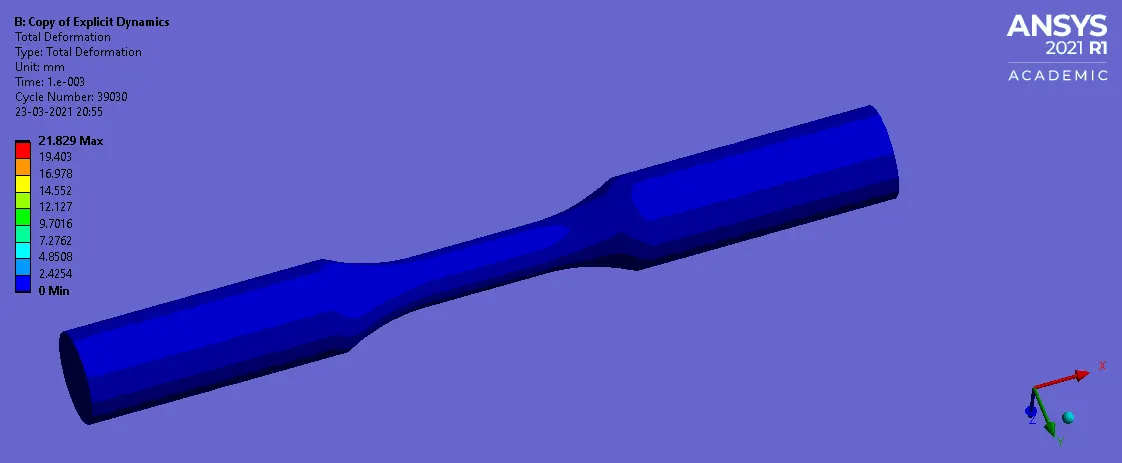
Total deformation
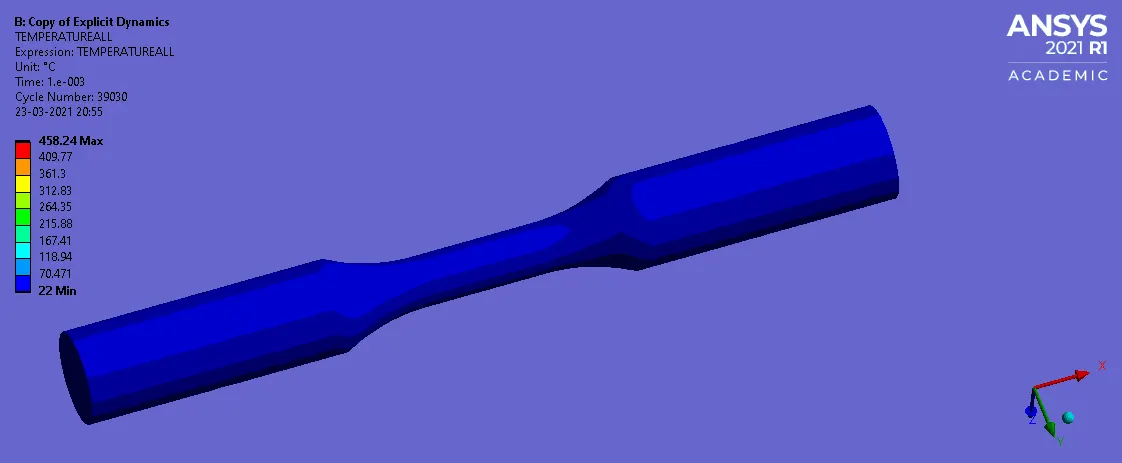
Temperature
CASE2: TORSION
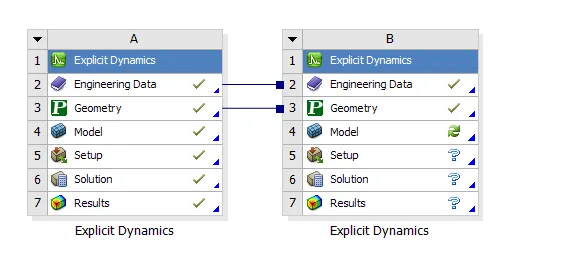
Transfer the material and geometry data onto a new explicit dynamics model
In addition a cylindrical coordinate system is defined for the component where the y-axis rotates about the local central z axis of the same component.
Using the same displacement (angular) a total of 1200 deg is defined for this CS
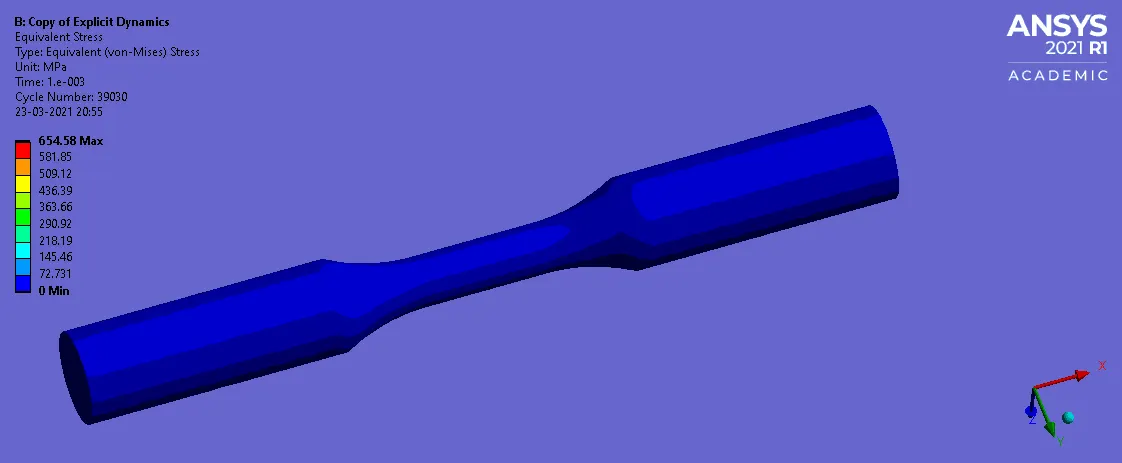
The following results were obtained
Equivalent stress
Total deformation
Temperature
CONCLUSION
Hence both the tension and torsion tests were performed on the given specimen and the extracted results were studied. From the above results we can conclude that the specimen modeled with a explicit steel material failed (fracture) at both the test cases. The fact that this fracture occured mid point of the simulation (time 5e-4) states that the applied load at a small fraction of time (1e-3) is too much for the mechanical strength of the specimen