Week 9:Super Charger Simulation Project
Super charger simulation Simulation
Introduction:
A supercharger is a device that supplies more air inside the engine cylinder by pressuring it & thus produce greater combustion & greater power. The supercharger is a mechanical device that is driven by the engine by means of a belt or gear. As the supercharger is connected to the engine it can respond immediately without delay based on the method by which air supplied by the supercharger can be classified into two main types which as follows:
- Positive displacement supercharger
- Dynamic compressor supercharger
Positive displacement supercharger: This type of supercharger supplies an equal amount of air at all conditions here the volume of air which is supplied by the supercharger will be constant at all engine speed this type of supercharger can be further classified into two types:
- Roots-type
- Twin Screw type
Dynamic compressor supercharger: This type of supercharger supplies more air into the cylinder by accelerating the air to a greater speed the most commonly used dynamic compressor supercharger is the centrifugal supercharger.
Aim:
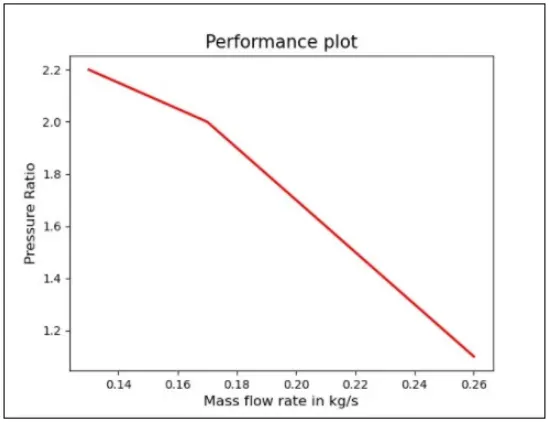
- Get Supercharger performance data (i.e total pressure ratio vs mass flow rate)
- Array of Pressure Ratio = [ 1.1 1.5 2.0 2.2]
- i.e for these 4 values of Pressure ratio get the mass flow rate and plot the graph between the total pressure ratio and mass flow rate for these 4 values.
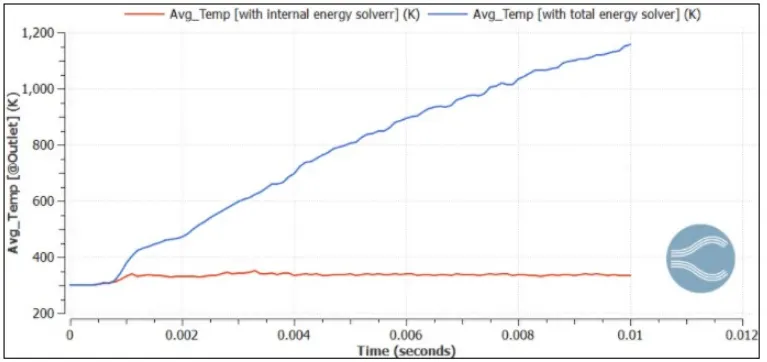
- Compare results with and without total_energy_solver
- Check if mass is conserved.
- Make use of MS EXCEL to check whether mass is conserved or not.
- Import the data of mass flow rate at Inlet and Outlet and add them up.
- After adding, ideally it should be zero for mass to be conserved but it will not be exactly zero.
- The difference should not be more than 2e-4 kg/s.
Geometry:
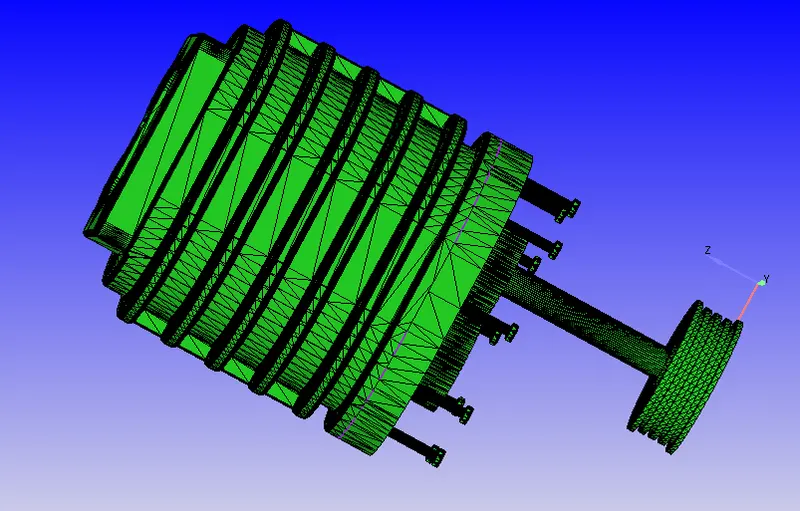
The Super charger geometry was imported into the Converge and then the cad clean up and diagnosis was done.
Grid Control:
- Element size:dx = 0.002m, dy = 0.002m & dz = 0.002m
Case setup:
- Application: General Flow
- Solver: Transient solver
- Simulation type : Gas
- Material: Air
- Species: O2 and N2
- Simulation mode: Full hydrodynamic
- Simulation time parameters:
Start time:0 sec
End time: 0.01 sec - Region & Initialization:
Created a region for initializing the setup - Boundary conditions
Inlet - Inflow - Pressure -1 bar at 300k
Outlet - Outflow - Pressure - 1.1,1.5,2 and 2.2 at 300k
Left lobe - Wall - Rotating wall - 216000deg/s, centre 0 @z axis.
Right lobe - Wall - Rotating wall - 216000deg/s, centre of left lobe @z axis.
Casing - Wall - Law of wall @300k - Turbulence Model - K epsilon
- The time interval for writing 3D output data files: 6e-5 sec
- The time interval for writing text output:1e-6 sec
- The time interval for writing restarting output:6e-5
- Maximum number of restart file saved:3
Results:
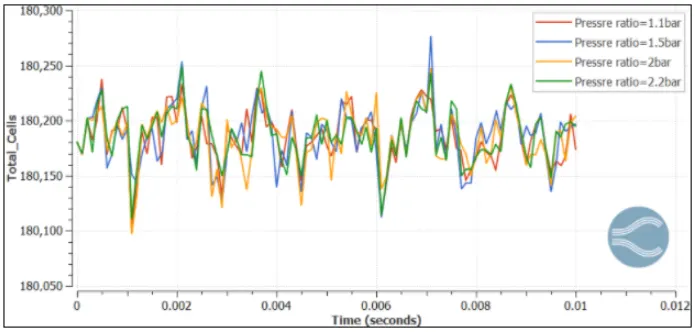
Total cell count:
Temperature:
Mass convergence:
| Pressure ratio | Mass flow rate at inlet kg/s | Mass flow rate at outlet kg/s | Error |
| 1.1 | -0.29 | 0.26 | -0.03 |
| 1.5 | -0.22 | 0.24 | 0.02 |
| 2 | -0.12 | 0.15 | 0.03 |
| 2.2 | -0.1 | 0.136 | 0.036 |
Performance report:
Conclusion:
Supercharger simulation was done successfully.