Week - 9 Material Modeling from Raw Data
Aim:
To validate the material model with a dogbone specimen
Case setup:
We are going to use mm, ms, g units.
The given Material curve image (True stress vs strain %) is digitized using a software and the data is copied to excel. Stress and strain units are in ksi and % respectively. Stress units are converted to MPa and strain to Effective plastic strain using the formula
Effective plastic strain = True Strain – True stress/E
The point where the Effective plastic strain data starts increasing in positive direction can be used as origin. Now draw a graph of Effective Stress vs Effective plastic strain and make trendline using Logarithm and Power options and check their R squared value. R squared value tells how much they match with the data. Power option provides K and N values to be used for building mat 18 material model.
Using the equation obtained from Logarithm and Power options, make equidistant points on Strain values and reconstruct Effective stress. It’s always better to input equidistant values to LS Dyna.
Now open the model in LS Dyna and start building it. We can start building keywords
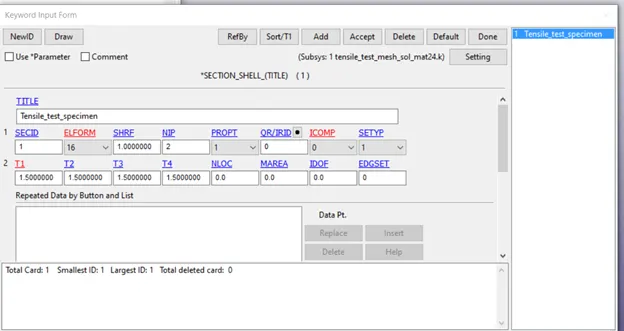
- Section: ELFORM 16, Thickness 1.5
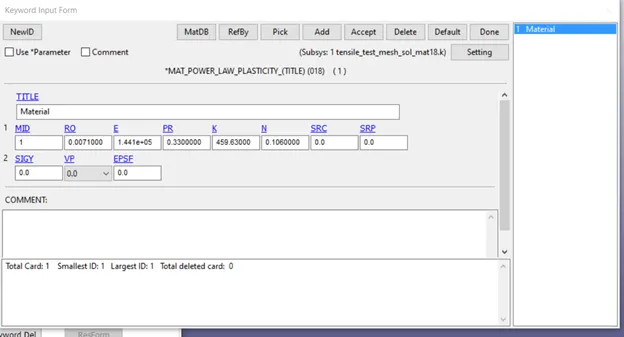
- Material: MAT18 and MAT24; RO 0.0071, E 1.441e+5, PR 0.3
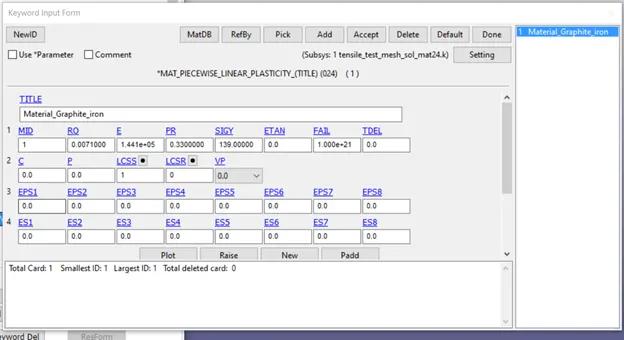
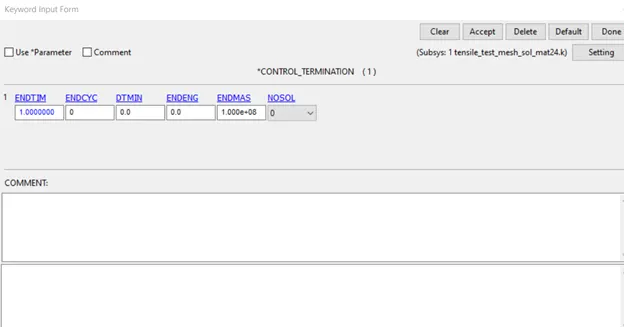
- Control: Termination 1ms
- Database: ASCII – Matsum, Glstat
Binary D3plot Dt 0.01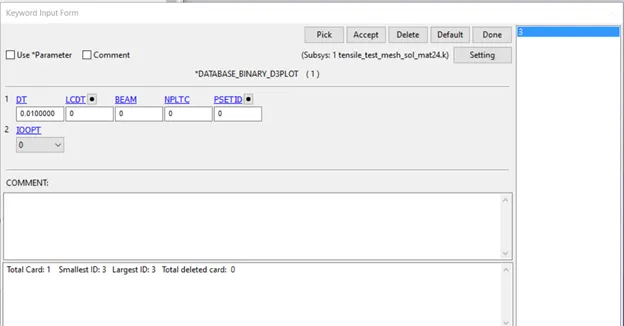
Extent Binary STRFLG 11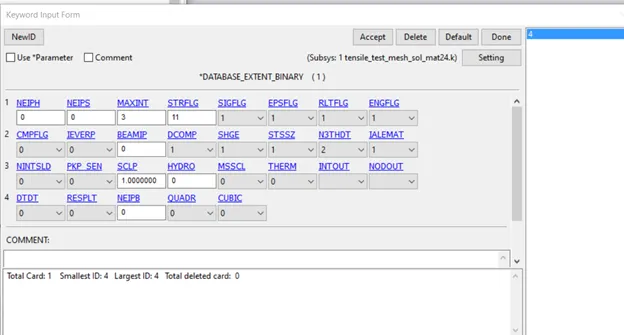
- Boundary: Prescribed Motion set: displacement on one end
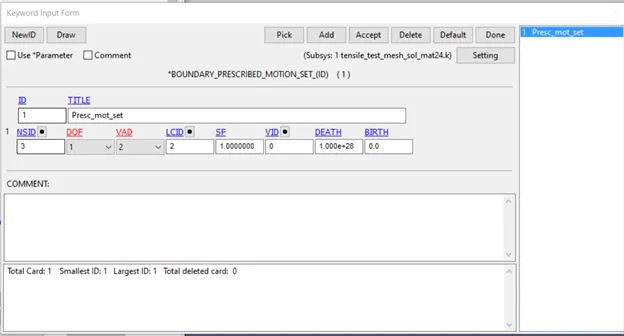
SPC set: Constraining both ends on Y direction and one end on Z direction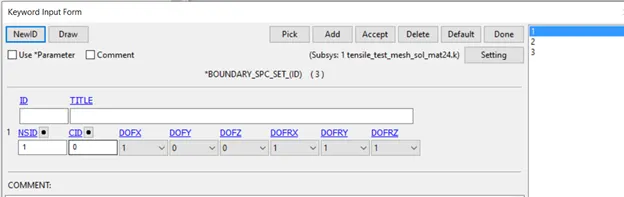
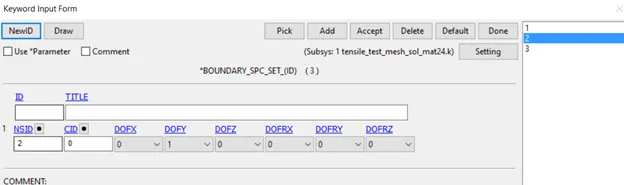
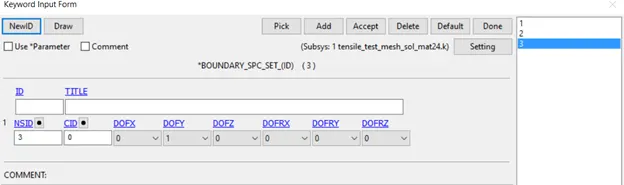
Now we can run the models (one with mat18 and one with mat24) and analyse Effective stress vs Effective plastic strain on an element at the middle and see which matches well with the material data provided.
Using the crossplot option, Effective stress vs Effective plastic strain on an element at the middle is obtained for both the model and data is copied to the same excel sheet where we have the original material data.
On comparing, Mat24 model matches well with the original material data and should be considered for this model.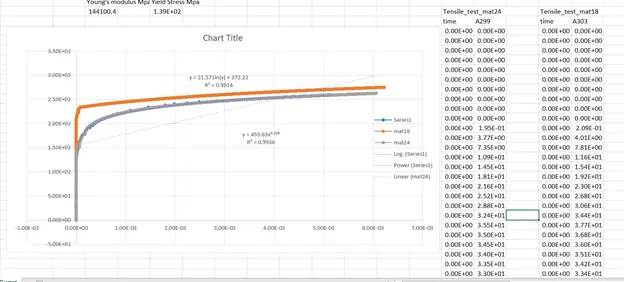
Conclusion:
It’s always a trial and error with choosing the correct material model for a part and material. It’s always better to validate all the suitable material model and validate it. For our experiment, Mat24 matches well with the data