Week 9 Machining with Planer Challenge
Machining with a Planer Report
Aim: You will have to perform an explicit dynamics simulation to find out the Equivalent Stress, Total Deformation and insert a User defined result to calculate the temperature of the body. You need to perform this for 2 cases. One will be with a cutting velocity of 20000mm/s and the other will be with a cutting velocity of 15000mm/s.
Procedure:
Case 1: Velocity of Cutting Tool = 20,000 mm/sec
- Select Explicit Dynamics, drag and drop into Project Schematic.
- Steel 1006 is chosen under Engineering Data.
- Under geometry tab, import the given geometry, double-click to open Space Claim to register the model.
- Body Interactions were set to frictionless.
- Mesh size was set to default.
- The mesh method was set to tetrahedrons for the cutting tool.
- An edge sizing of 10 was given to the workpiece
- Under explicit dynamics tab, we set the analysis to 1 step with end time 7.5e-4s.
- Velocity of 20000mm/sec is given to the cutting tool.
- The workpiece is fixed.
- Equivalent plastic strain of workpiece, total deformation, temperature (user defined from Solutionsà worksheet) and Equivalent Stress plots are requested from the solver as outputs.
- Run the simulation by clicking on “solve”.
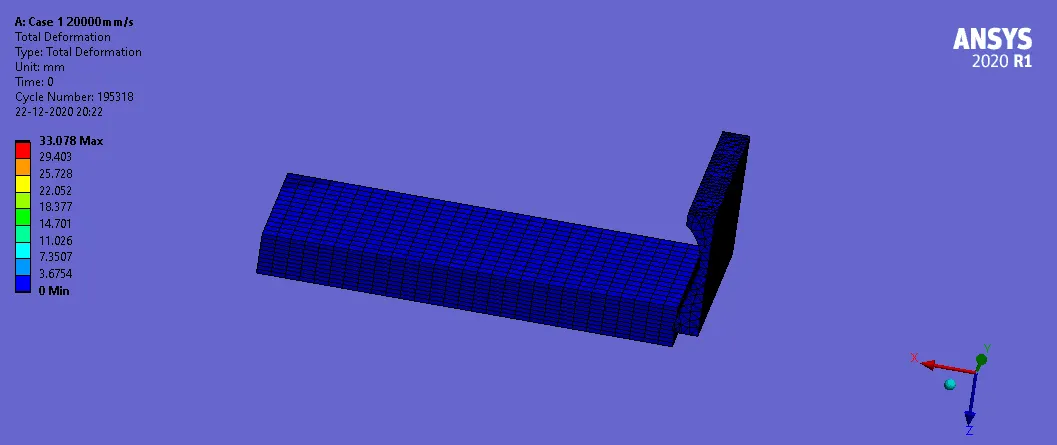
Total Deformation:
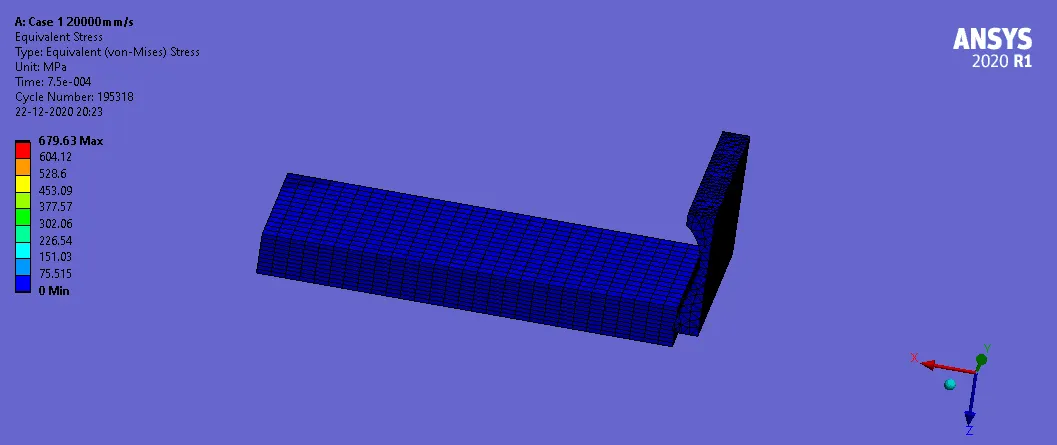
Eq. Stress:
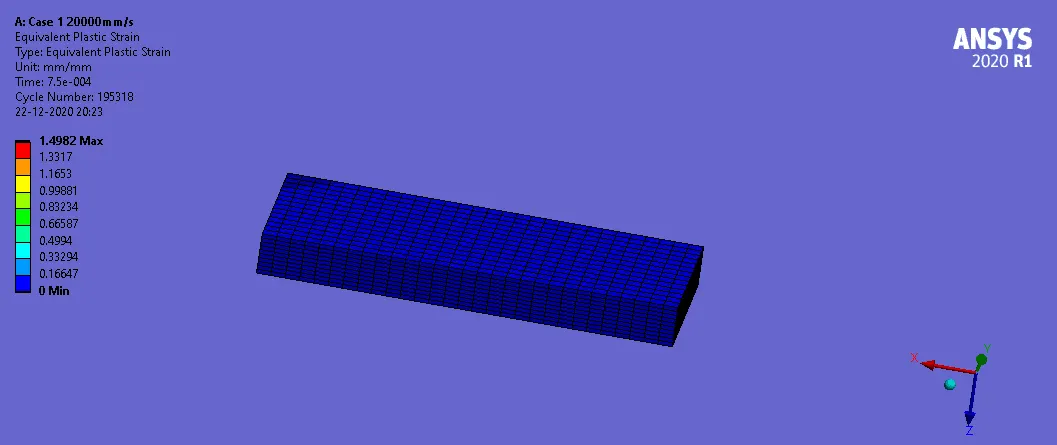
Eq. Plastic strain:
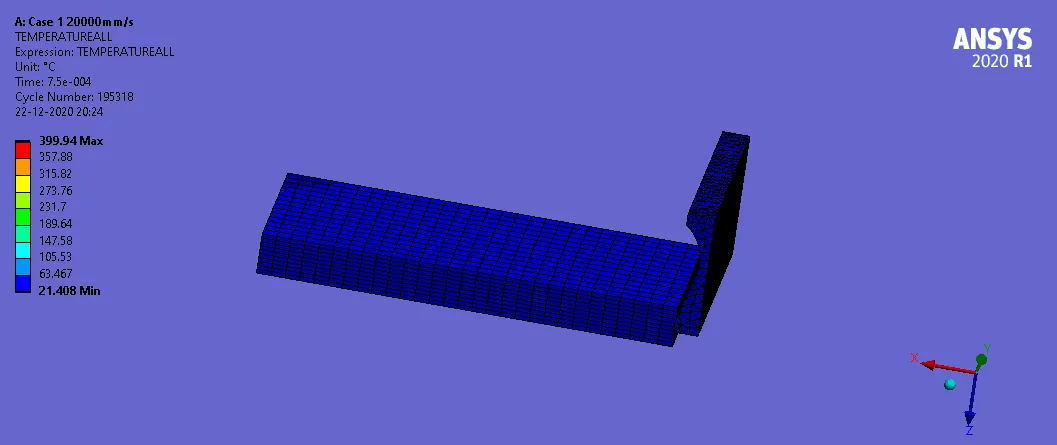
Temperature:
Case 2: Velocity of cutting tool = 15000mm/sec
- Select Explicit Dynamics, drag and drop into Project Schematic.
- Steel 1006 is chosen under Engineering Data.
- Under geometry tab, import the given geometry, double-click to open Space Claim to register the model.
- Body Interactions were set to frictionless.
- Mesh size was set to default.
- The mesh method was set to tetrahedrons for the cutting tool.
- An edge sizing of 10 was given to the workpiece
- Under explicit dynamics tab, we set the analysis to 1 step with end time 7.5e-4s.
- Velocity of 15000 mm/sec is given to the cutting tool.
- The workpiece is fixed.
- Equivalent plastic strain of workpiece, total deformation, temperature (user defined from Solutionsà worksheet) and Equivalent Stress plots are requested from the solver as outputs.
- Run the simulation by clicking on “solve”.
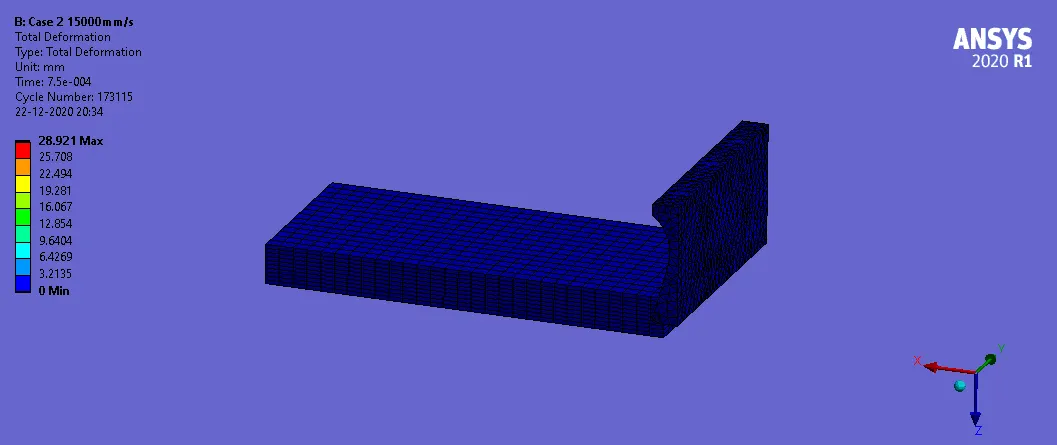
Total Deformation:
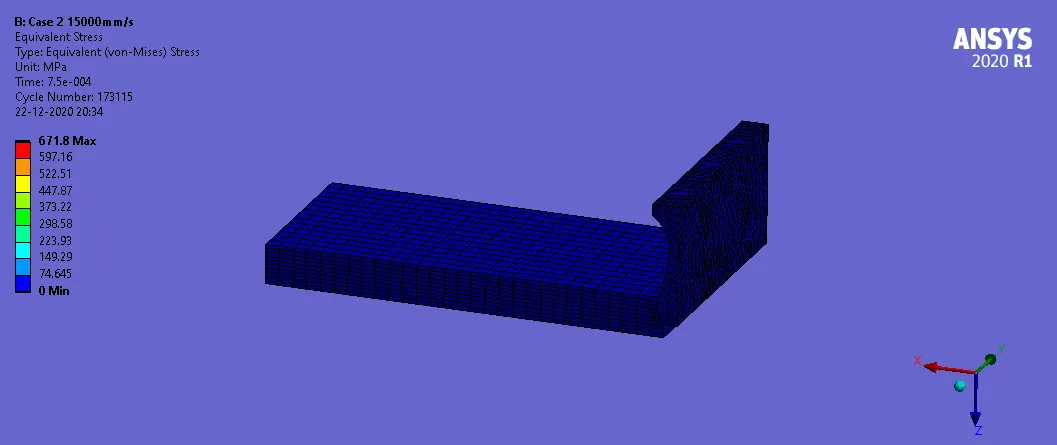
Eq. Stress:
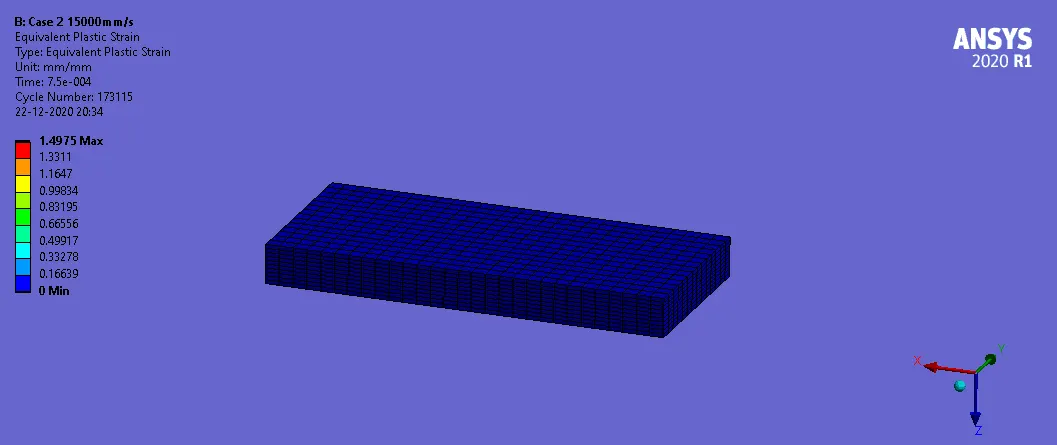
Eq. Plastic strain:
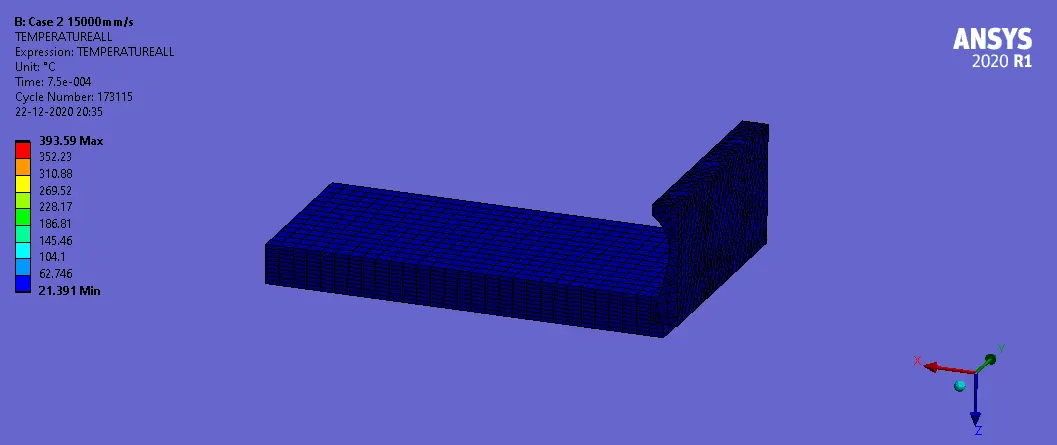
Temperature:
Conclusion:
From the above simulations, here is the inference:
|
Case: Velocity |
Eq. Stress (MPa) |
Tot. Deformation (mm) |
Eq. Plastic Strain |
Temperature (deg C) |
|
Case 1: 20,000mm/sec |
679.63 |
33.078 |
1.4982 |
399.94 |
|
Case 2: 15,000mm/sec |
671.8 |
28.921 |
1.4975 |
393.59 |
We can observe that the deformation in case 2 is lower owing to the difference in velocities. The cutting tool traveling at 20,000 mm/sec deforms the workpiece much more than that at 15,000 mm/sec.