Explicit Dynamics Analysis for a Machining Planer
Aim:
To perform an explicit dynamics simulation on a Planner Machining to find out the
- Equivalent Stress.
- Total Deformation.
- Insert a User-defined result to calculate the temperature of the body.
We need to perform 2-cases.
- One will be with a cutting velocity of 20000mm/s
- The other will be with a cutting velocity of 15000mm/s.
Introduction:
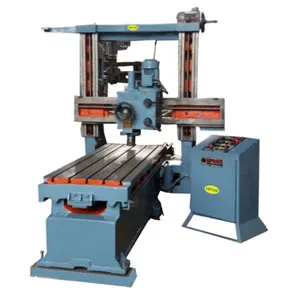
A planer is a type of metalworking machine tool that uses the linear relative motion between the workpiece and a single-point cutting tool to cut the workpiece. A planer is similar to a shaper but larger, and with workpiece moving, whereas in a shaper the cutting tool moves.
Linear planning:
The most common applications of planers and shapers are linear-toolpath ones, such as:
- Generating accurate flat surfaces. (While not as precise as grinding, a planer can remove a tremendous amount of material in one pass with high accuracy.)
- Cutting slots (such as keyways).
- It is even possible to do work that might now be done by wire EDM in some cases. Starting from a drilled or cored hole, a planer with a boring-bar type tool can cut internal features that don't lend themselves to milling or boring (such as irregularly shaped holes with tight corners).
Helical planing:
Although the archetypal toolpath of a planer is linear, helical cutting can be accomplished by coupling the table's linear motion to the simultaneous rotation. The helical planning idea is similar to both helical milling and single point screw cutting.
Current usage:
Planers and shapers are now Obsolecent because other machine tools (such as milling machines, Broaching machines, and grinding machines) have mostly eclipsed them as the tools of choice for doing such work. However, they have not yet disappeared from the metalworking world. Planers are used by smaller tool and die shops within larger production facilities to maintain and repair large stamping dies and plastic injection molds. Additional uses include any other task where an abnormally large (usually in the range of 4'×8' or more) block of metal must be squared when a (quite massive) horizontal grinder or flour mill is unavailable, too expensive, or otherwise impractical in a given situation. As usual in the selection of machine tools, an old machine that is in hand, still works, and is long since paid-for has a substantial cost advantage over a newer machine that would need to be purchased. This principle easily explains why "old-fashioned" techniques often have a long period of gradual obsolescence in industrial contexts, rather than a sharp drop-off of prevalence such as is seen in mass-consumer technology fashions.
Geometry:
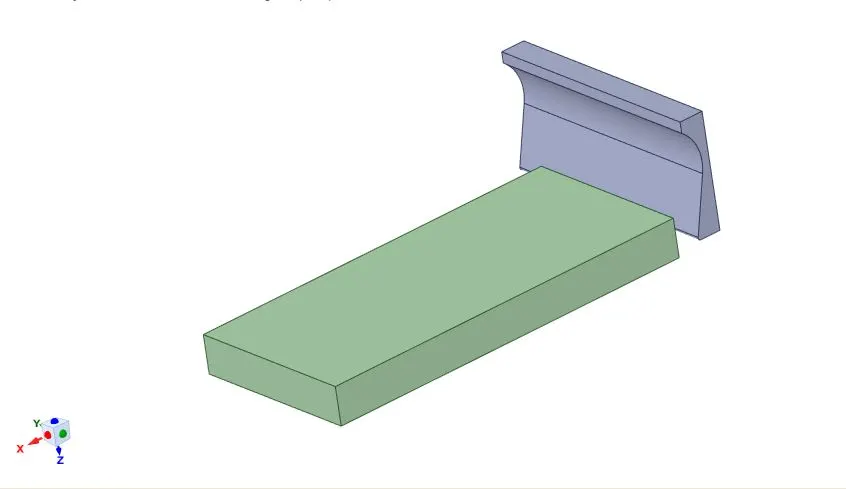
Then we have to import into ansys, import the model, and open it in space claim so that ansys will read it and checked for any errors.
Rigid body:
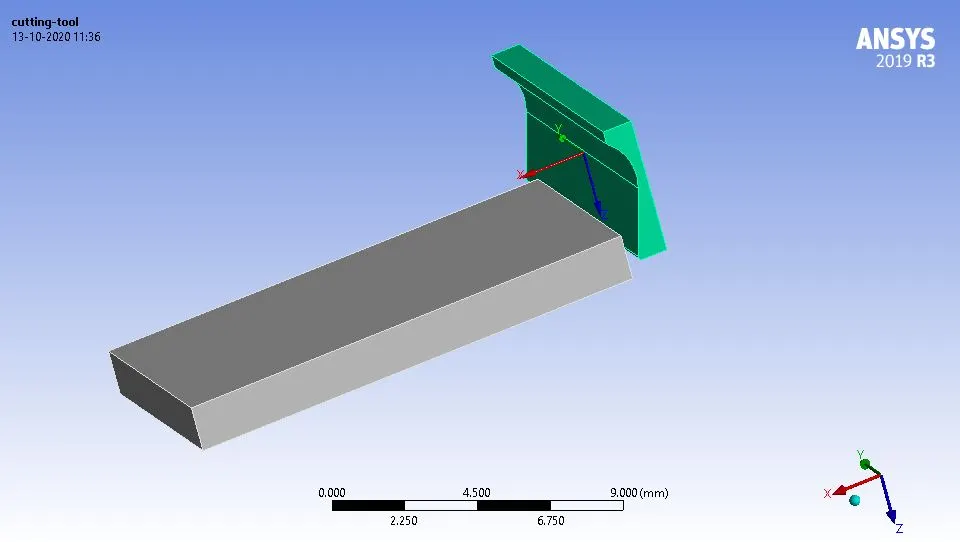
The Rigid body is applied to the cutting tool.
Material:
Work-piece material used in the simulation.
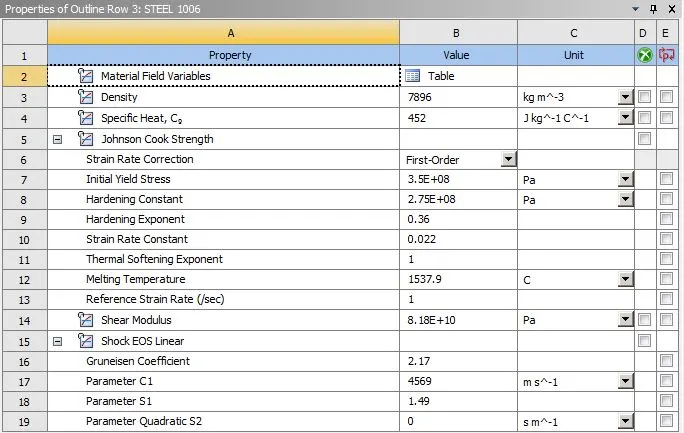
Steel 1006 is used as material for the specimen and its properties are defined above.
Cutting tool material used in the simulation:
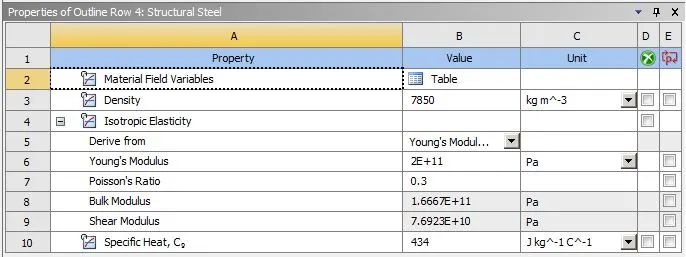
Stainless steel is used as material for the Cutting tool and its properties are defined above.
Meshing:
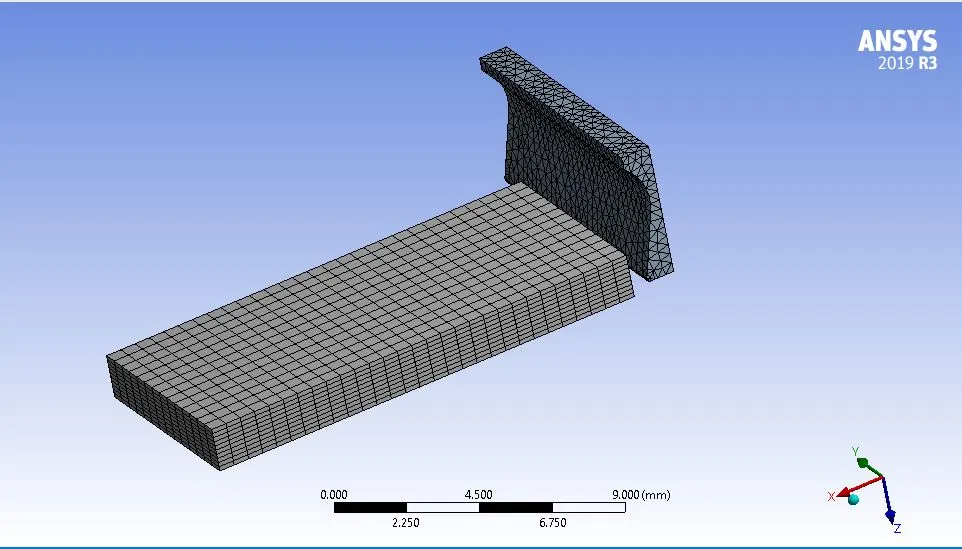
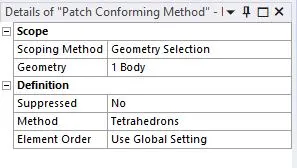
At certain locations, the mesh should be refined so we have used the element size as shown below.
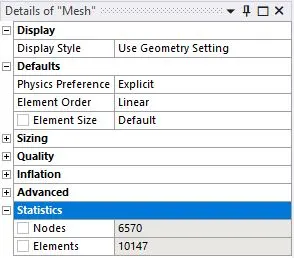
The mesh statistics for the given model:
The meshed model image and mesh metric graph can be seen below:
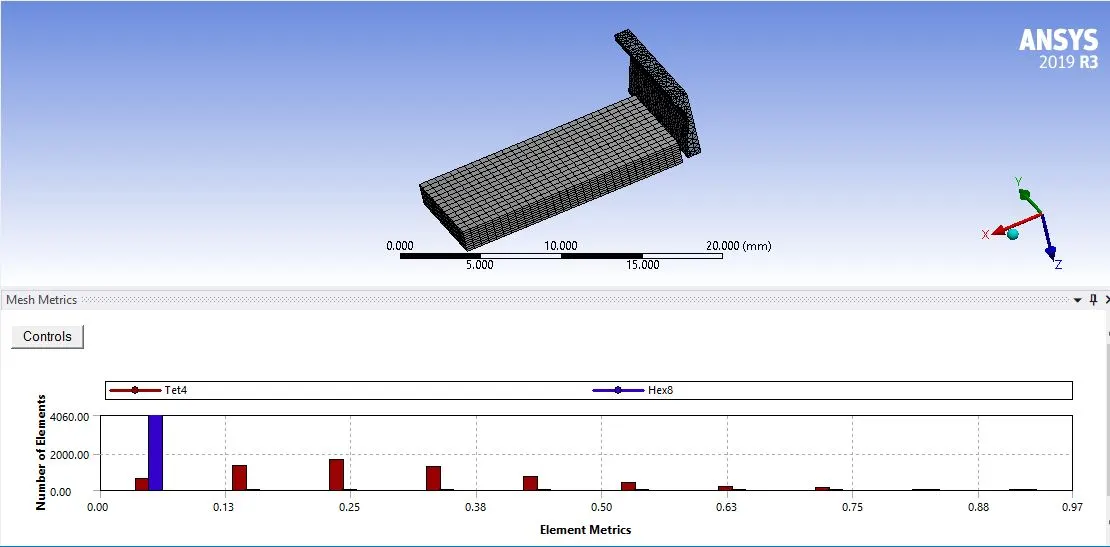
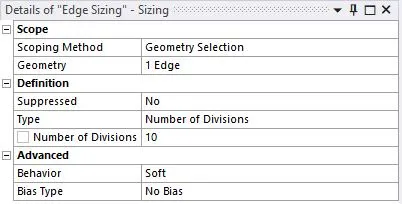
However, regions of a particular surface for the specimen are meshed using Edge sizing with a mesh element size as required.
The mesh metric is utilized to identify the elements according to their quality using skewness. The quality of the mesh is acceptable as most of the elements lie within a high-quality range.
Analytical Settings:
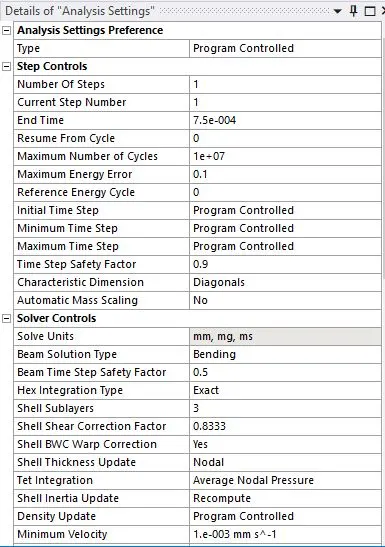
The analysis settings were used as per the requirement in the simulation.
Boundary Conditions:
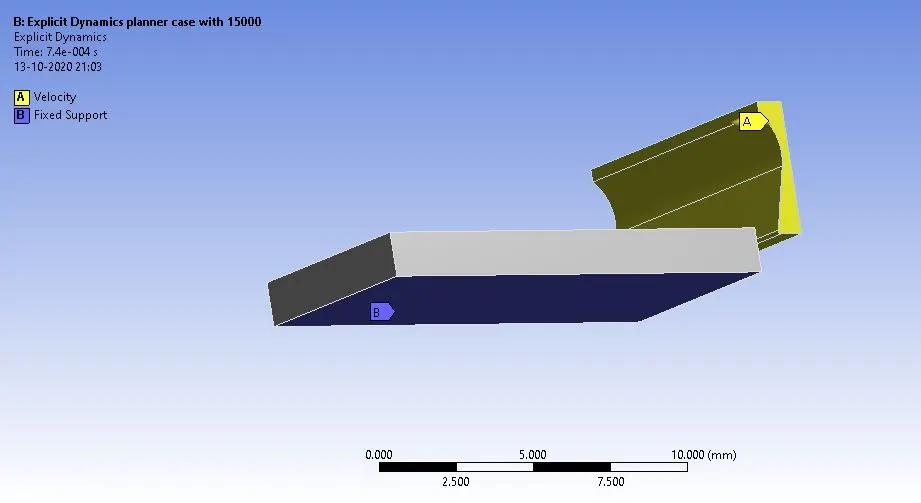
The fixed support on the work piece and velocity on the cutting toool shown below.
Fixed support for the Work-plate:
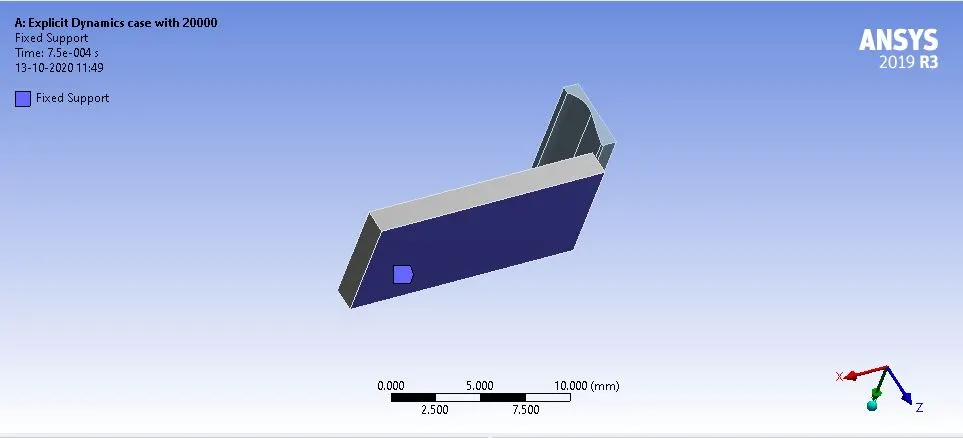
The Bottom surface of the specimen is been applied with fixed support as shown above.
Velocity for the cutting tool:
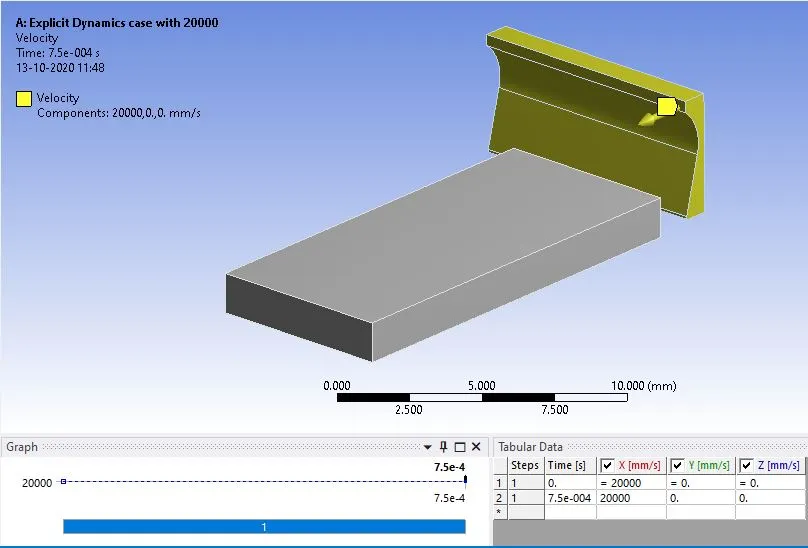
A Velocity of 20000mm/sec is applied at the cutting tool to travel the required distance.
Result:
Case-1 cutting velocity of 20000mm/s:
Total deformation for the Planner Mechanism:
The specimen reaches a maximum deformation of 29.27 mm as shown below.
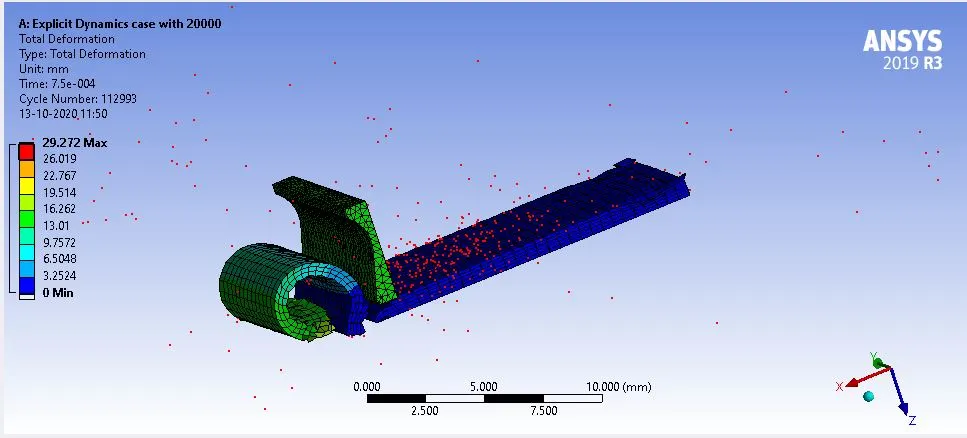
Animation of the Total deformation for the Planner Mechanism:
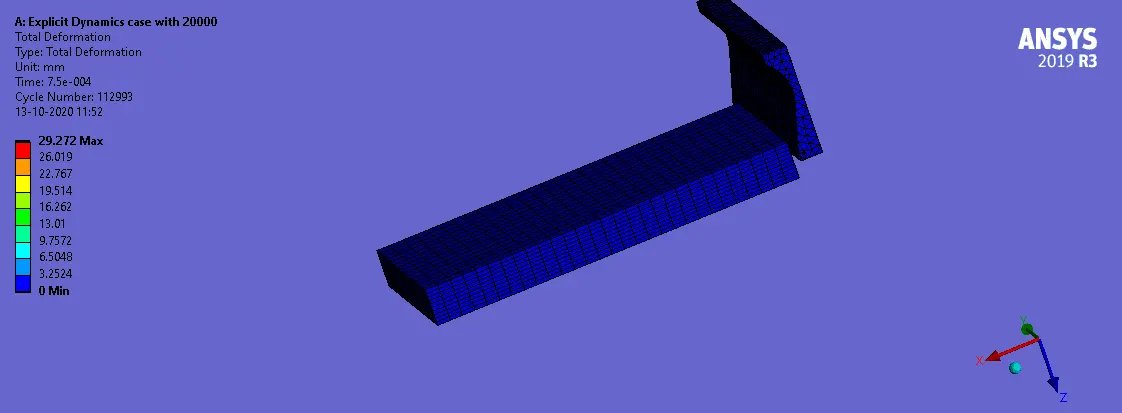
The animation on the specimen for the Total deformation is shown above.
Equivalent stress for the Planner Mechanism:
The specimen has reached the Equivalent stress of 492.64 Mpa as shown below.
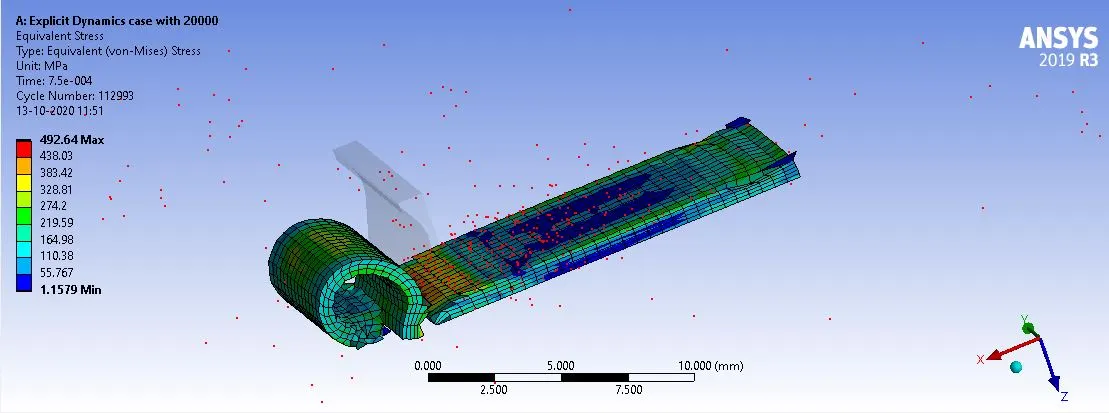
Animation of the Equivalent stress for the Planner Mechanism:
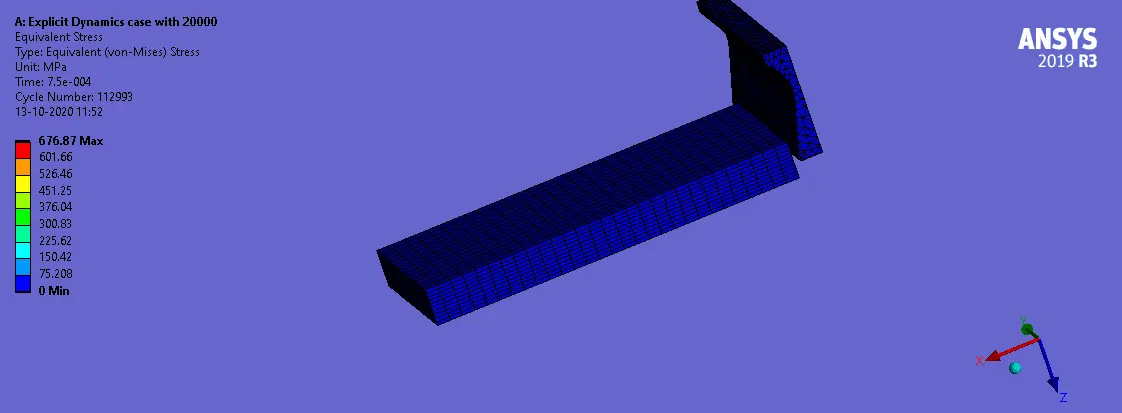
The animation on the specimen for the Equivalent stress is shown above.
The Temperature for the Planner Mechanism:
The specimen has reached the Maximum temperature of 376.9 as shown below
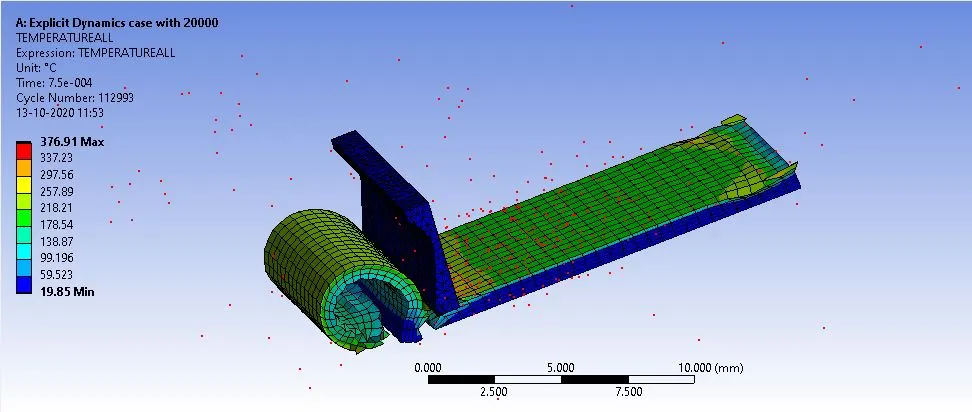
Animation of the Temperature for the Planner Mechanism:
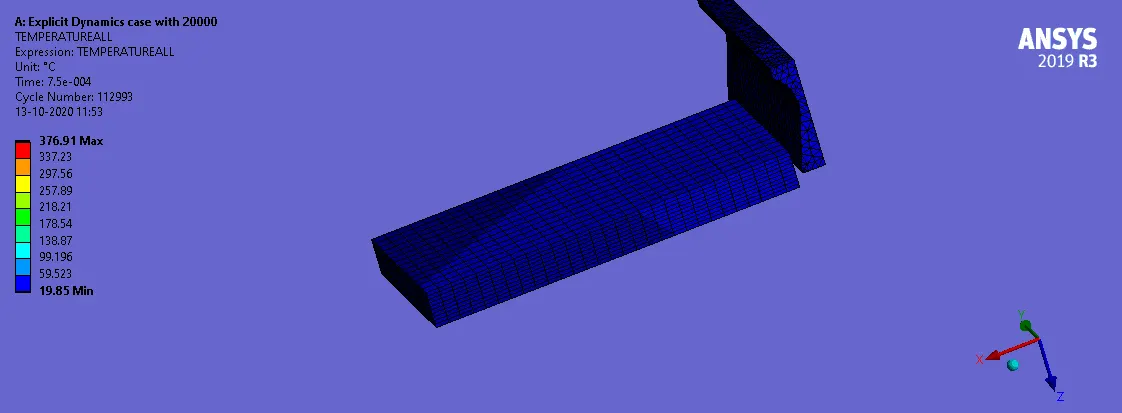
The animation on the specimen for the Maximum temperature is shown above.
Case-2 cutting velocity of 15000mm/s:
Total deformation for the Planner Mechanism:
The specimen reaches a maximum deformation of 22.8 mm as shown below.
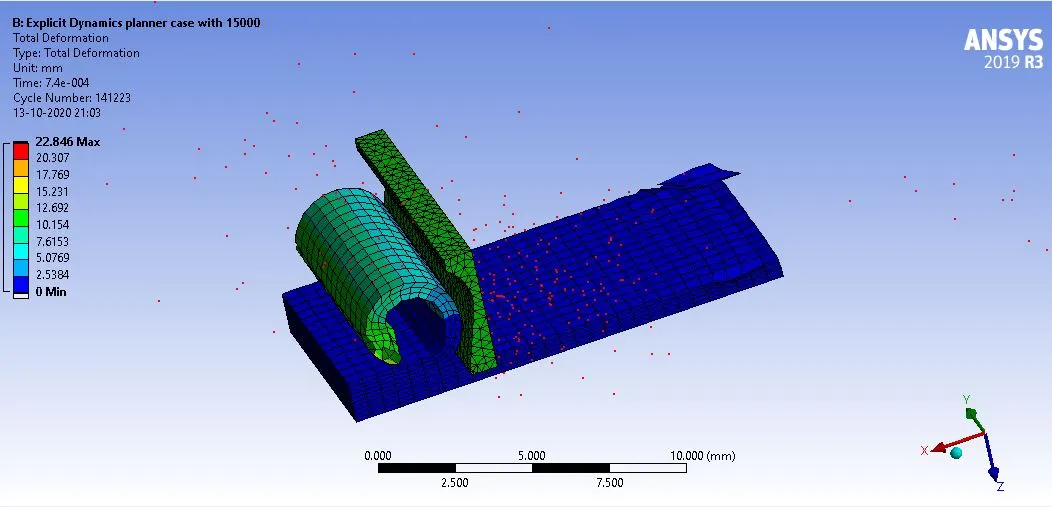
Animation of the Total deformation for the Planner Mechanism:
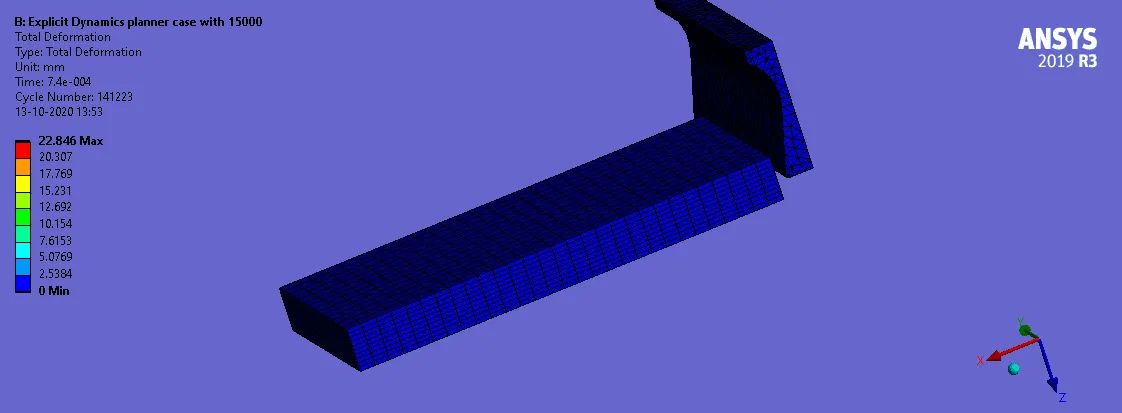
The animation on the specimen for the Total deformation is shown above.
The Equivalent stress for the Planner Mechanism:
The specimen has reached the Equivalent stress of 671.51 Mpa as shown below.
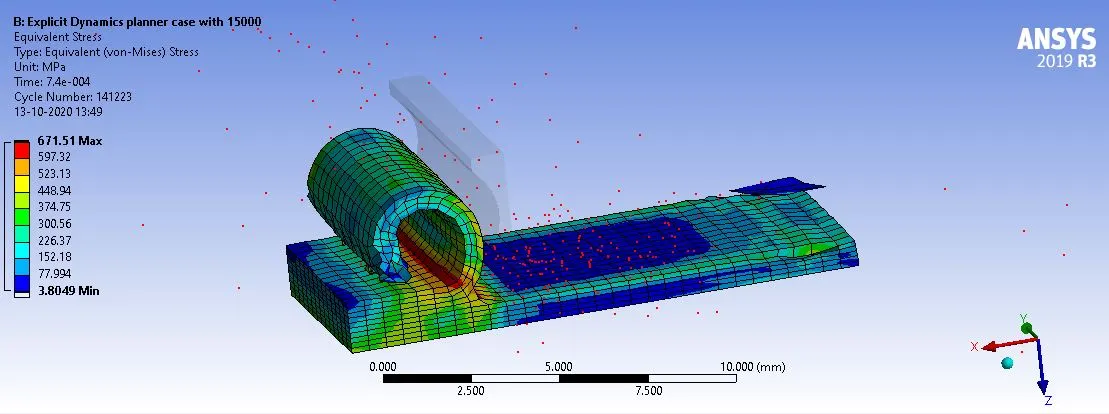
Animation of the Equivalent stress for the Planner Mechanism:
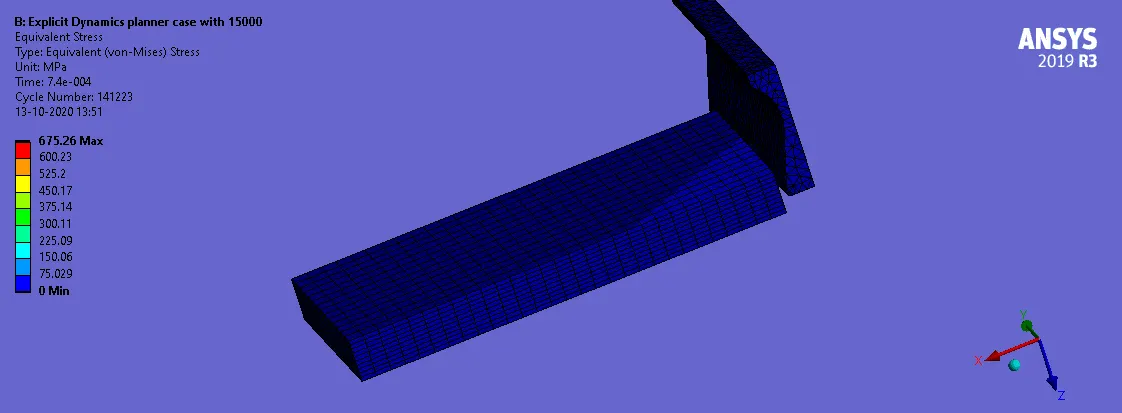
The animation on the specimen for the Equivalent stress is shown above.
The Temperature for the Planner Mechanism:
The specimen has reached the Maximum temperature of 363.5 as shown below.
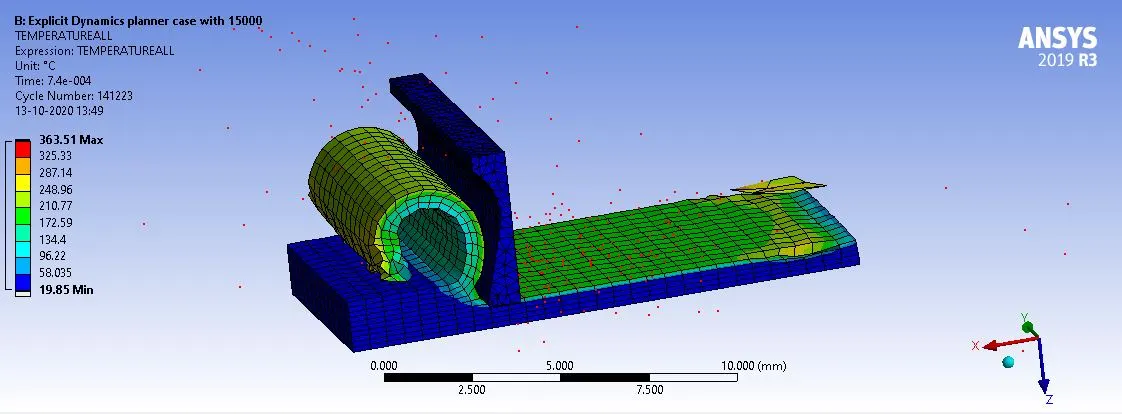
Animation of the Temperature for the Planner Mechanism:
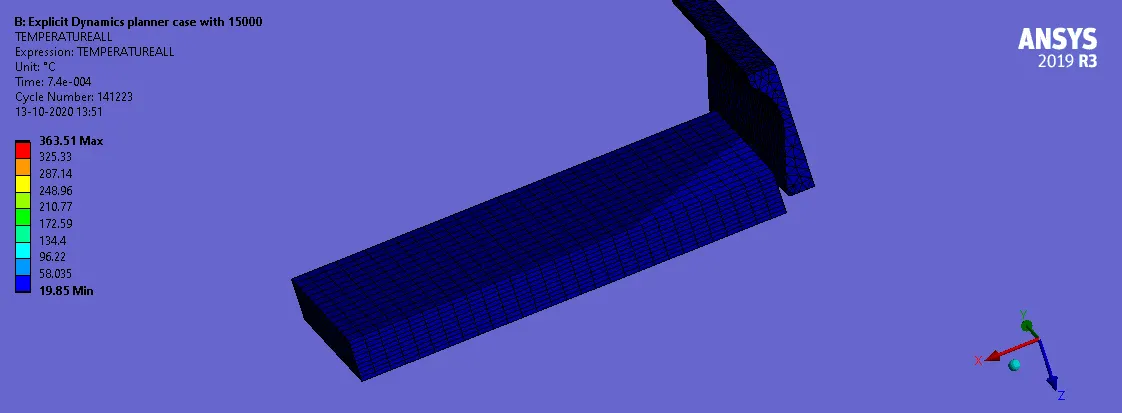
The animation on the specimen for the Maximum temperature is shown above.
Conclusion:
| S.No | Total deformation(mm) | Equivalent stress(Mpa) | Temperature Generated by the body(Deg Celsius) |
|
Case-1 |
29.2 | 676.8 {this can be seen in animation} | 376.9 |
| Case-2 | 22.8 | 675.2 {this can be seen in animation} | 363.5 |
From the above Table comparison, it is seen that the Total-deformation, Equivalent stress, Temperature of the body is raised in the case-1 as compared with the case-2.