Week 9 - FVM Literature Review
AIM:-
What is Finite Volume Method(FVM), Write down the major difference between FDM& FVM. Also ,describe the need for interpolations and flux limiters in FVM.You can use the 1D linear heat conduction equation as exaple
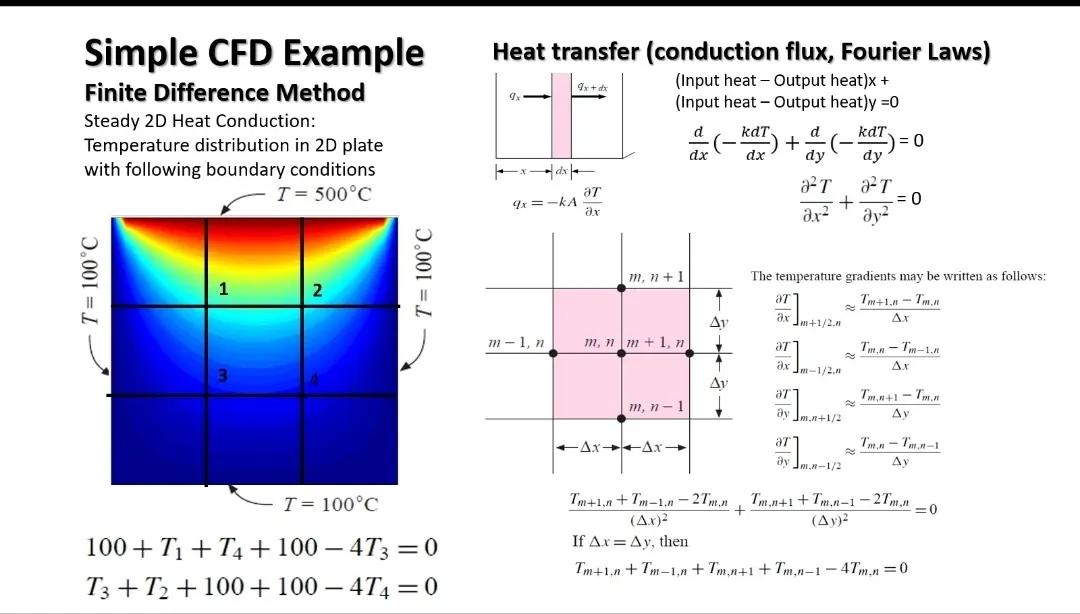
The finite difference method (FDM) and the finite volume method (FVM) are both discretization approaches used in computational fluid dynamics (CFD), but they differ in several ways:
Grid definition: FDM is usually defined on a regular grid, while FVM can handle both structured and unstructured meshes.
Flexibility: FDM is simpler to implement but less flexible for complex geometries, while FVM is flexible for complex geometries while still being simple for structured grids.
Dependent variable storage: In FDM, dependent variable values are stored at the nodes, while in FVM, they are stored in the center of the finite volume.
Conservation properties: FVM generally provides better conservation properties.
Basis: FDM is based on the differential form of governing equations. FVM is based on integral forms of partial differential equations.
Natural choice: FVM is a natural choice for CFD problems.
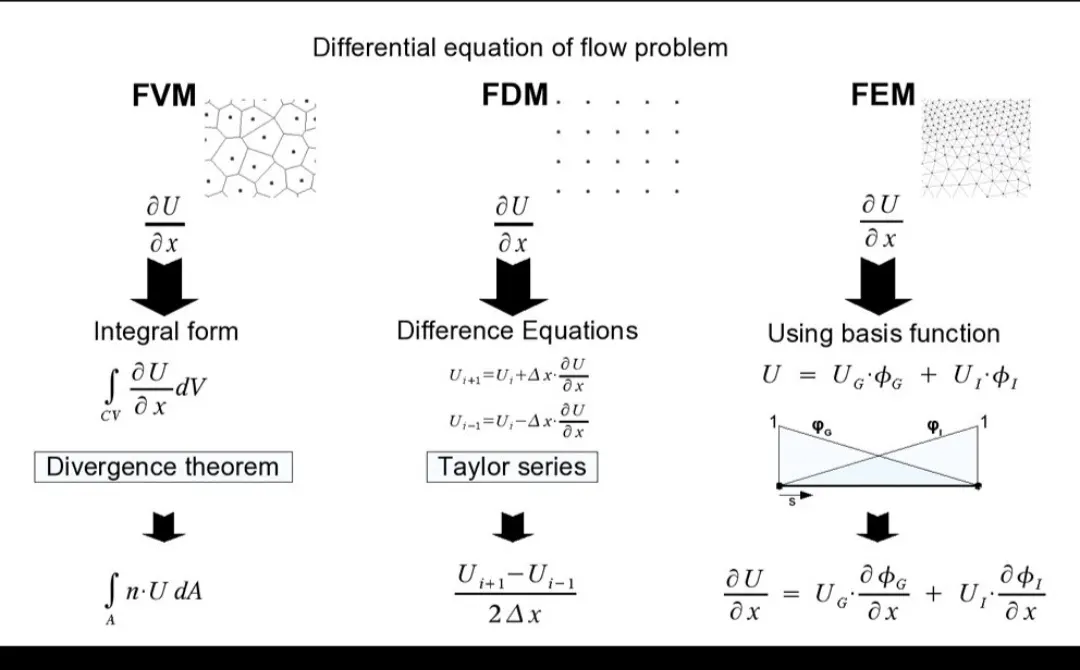
Finite Element Method (FEM), Finite Difference Method (FDM), and Finite Volume Method (FVM) are numerical techniques commonly used in fluid dynamics and hydraulic simulations. Here's a comparison of these methods:
Mathematical Formulation
FEM: FEM formulates the problem by discretizing the domain into finite elements and approximating the solution using piecewise polynomial functions over these elements.
FDM: FDM discretizes the domain in a regular grid, replacing derivatives with finite difference approximations.
FVM: FVM divides the domain into control volumes and approximates the solution by integrating the governing equations over these volumes
Conservation Laws:
FEM: FEM naturally conserves mass, momentum, and energy due to its variational formulation.
FDM: FDM can directly handle conservation laws by discretizing the derivatives in the governing equations.
FVM: FVM is inherently conservative as it integrates the governing equations over control volumes, ensuring conservation.
Mesh:
FEM: FEM allows for flexible mesh generation, enabling the use of unstructured meshes. This makes it suitable for complex geometries.
FDM: FDM typically uses structured meshes with a uniform grid, which makes it simpler to implement but less flexible for complex geometries.
FVM: FVM can handle both structured and unstructured meshes, providing flexibility for complex geometries while maintaining simplicity for structured grids
Accuracy and Convergence:
FEM: FEM generally provides higher accuracy due to its ability to use higher-order polynomial approximations. It can achieve high convergence rates.
FDM: FDM accuracy depends on the choice of grid spacing, and it typically has lower convergence rates than FEM.
FVM: FVM accuracy depends on the control volume size and the accuracy of flux calculations. It can achieve moderate convergence rates.
Conservation of Solution Features:
FEM: FEM can accurately capture solution features like shocks and discontinuities, but it may require special techniques like shock-capturing formulations.
FDM: FDM can struggle to accurately capture sharp solution features unless special treatments like upwinding or flux limiters are employed.
FVM: FVM can handle shocks and discontinuities reasonably well due to its conservative nature, but additional techniques may be needed for higher accuracy.
The choice of method depends on the specific problem, available resources, and desired accuracy. FEM is often favored for complex geometries, FDM for simplicity and low computational cost, and FVM for its inherent conservation properties and flexibility