Week 9 - FVM Literature Review
1.)Central differencing scheme:
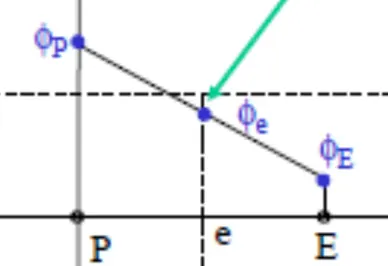
T(e)=kT(E)+(1-k)T(P) here k=(X(e)-X(P))/(X(E)-X(P))
this is a second order scheme and it may produce oscillations and cannot be used if the scalar distribution is quadratic in nature.
2.)Upwind differencing scheme:
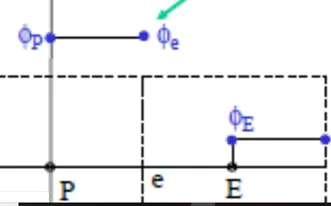
T(e)=T(P) if (u.n>0) (mass outflux)
T(e)=T(E) if (u.n<0) (mass influx)
Unconditionally stable( no oscillations)
This scheme is dependent on direction of the flow.
The scheme is diffusive(numerically)
QUICK Scheme:
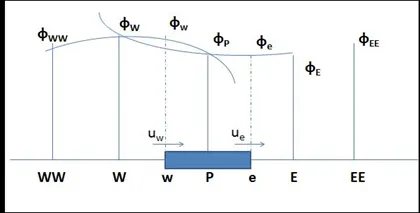
The quadratic interpolation upwind scheme uses a three point upstream wieghted quadratc interpolation for cell face values.
T(face)=(6/8)*(T(i-1))+(3/8)*(T(i))-(1/8)*(T(i-2))
The above formula is usd for interpolation.
Third order approximation
image source: google images.
Flux Limiters:
The low order schemes in fvm are mostly accurate in nature and dissapative around the points of discontinuity. The high order schemes are comparitively oscillatory in nature.Flux limiters are constructed to work for high order schemes the function is to decrease the unstability of the high orer scheme so as to achieve high order accuracy and smooth flow in region and to achieve a first order accuracy when around a discontinuos point.
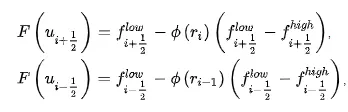
function ph is the flux limiter.