Week 9 - Attachment Feature Creation (Ribs & Screw Boss) - Challenge 1
AIM:-
To make the Core and Cavity Design
In this model we have to consider the following things:-
Tooling axis
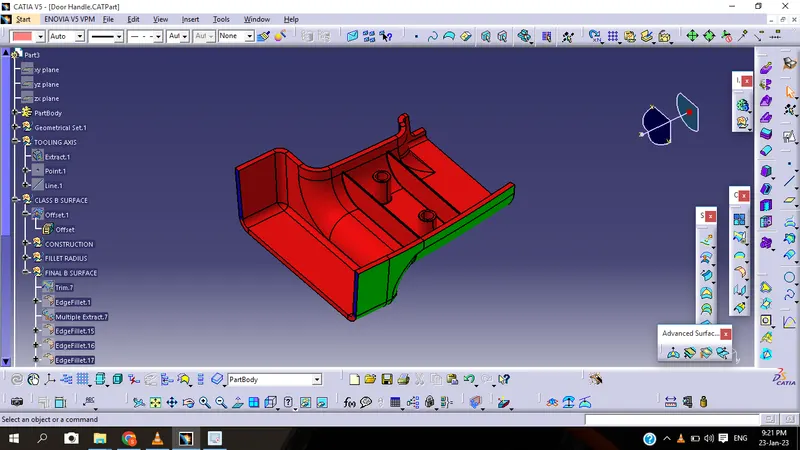
Draft analysis
Class-A surface
Class- B surface
Class-C surface
Rib Design
Screw Boss Design
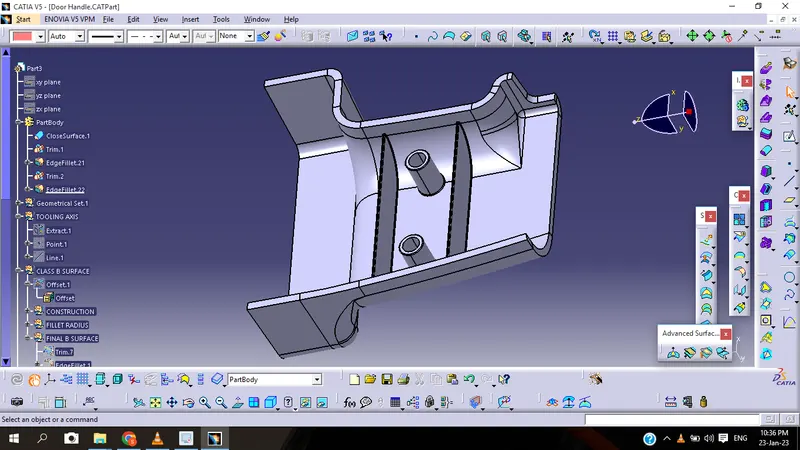
Making a solid model from the surface.
TOOLING AXIS:-
Tooling axis is the defined axis to perform the manufacturing process within the injection molding according to its direction.
CREATION OF TOOLING AXIS:-
First of all analyze the given input surface to see which direction is suitable for creating the tooling axis.
In this model to create the tooling axis we have a flat base surface and tapered side wall surfaces.
Extract the base surface from class A surface
Create a point at the center of the extracted surface.
Fix an existing perpendicular side face to the base surface as a reference to create the tooling axis.
Sketch a line using the point direction option with reference to the yz direction.
Final sketched line is called as tooling axis.
DRAFT ANALYSIS:-
The analyzing of the model should maintain the nominal 3-degree draft angle to the tooling axis.
Draft should be given to the plastic component to reduce the wear and tear and improve the production quality and accuracy while ejecting the part from the mold cavity.
How to perform the draft analysis
1. Go to insert < analysis< feature draft analysis.
2. Align the tooling axis with a compass.
3. Click on the surface to see whether it is in permissible limit draft values or not.
4. The entire surface should be green in colour.
CLASS- A SURFACE:-
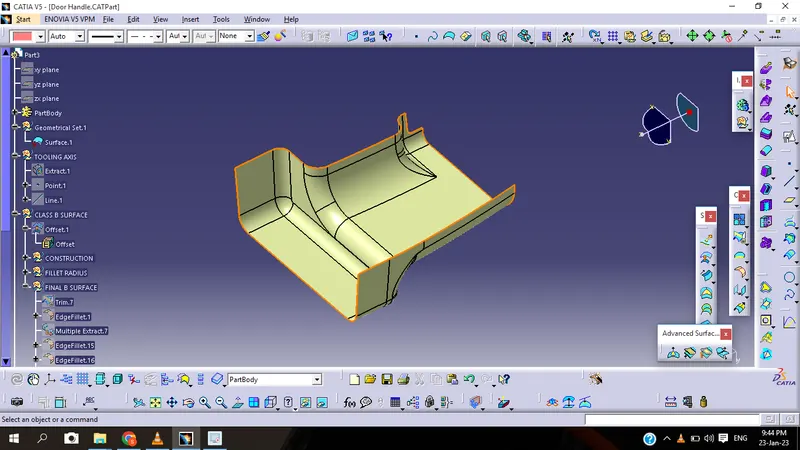
Class-A surface is given as an input surface by designers.
Generally the class-A surfaces have the tangent continuity
Class-A surface is the outermost aesthetic surface.
CLASS-B SURFACE:-
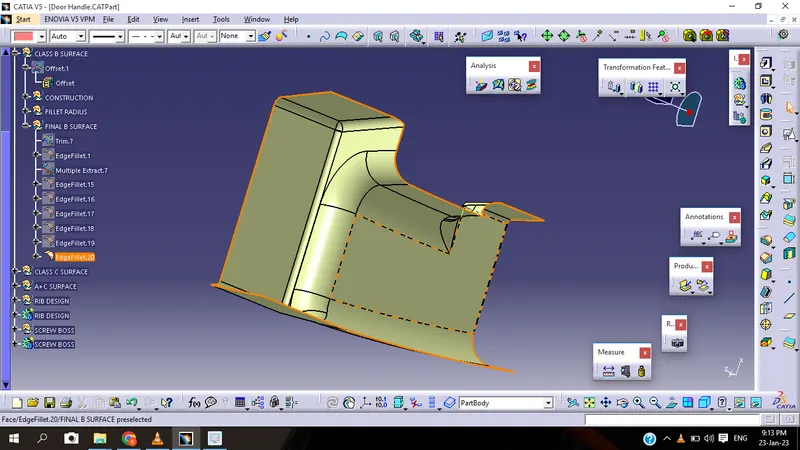
The extraction of the Class-A surface is the class-B surface.
Untrimmed the extracted surfaces from class A.
The untrimmed surfaces are offset to the required thickness.
After offsetting, all the surfaces are trimmed into the required shape.
Give the fillets on the edges, especially given fillet radius values should maintain the uniform wall thickness.
The class B fillet radius value=outer radius value + thickness.
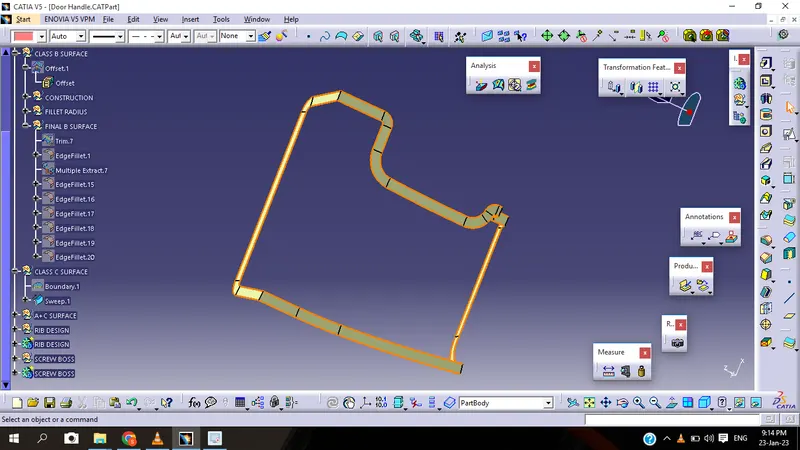
CLASS C SURFACE:-
Class C surface is the closing surface of class A and class B surfaces.
It is the extraction of the boundary of class A surface.
Apply the sweep feature to create the class c surface, For guide reference click the extracted boundary and for the drafting reference option click the tooling axis and give a 3-degree draft angle
RIB DESIGN:-
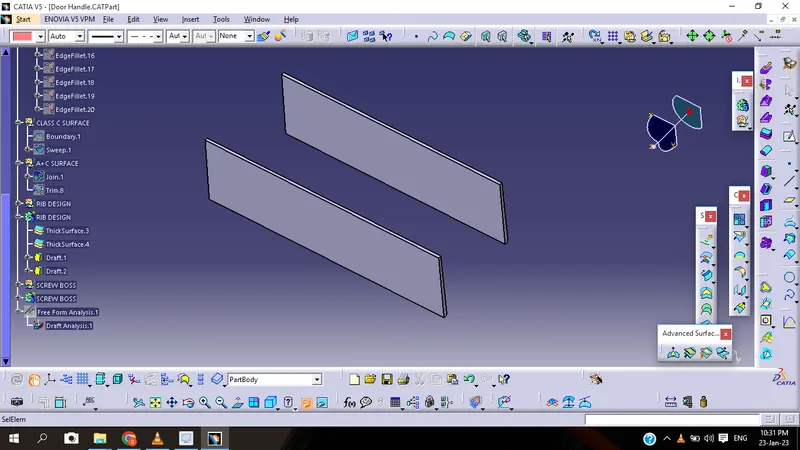
Ribs provide a means to economical stiffness and strength in molded parts without increasing overall wall thickness.
They also facilitate
- Locating and arresting components of an assembly
- Providing alignment in mating parts
- Acting as stops or guides for mechanisms.
For designing the rib first we have to take two points at several distance. Then we have to creat a line which will pass through the point. After that we have to extrude the line in both the direction for seversl distance.
Then we have to insert a new part body, so that we can do the hight thickness draft angle and edge fillet operation.
For height we have to adjust the extrude height by considering the design rules as =5t. For this challange the base thickness(t) is 2.5 so rib height is 5*2.5=12.5mm.
For thickness we have to consider the extrudes as the object to offset and give the offset length by considering the design rules as 0.4*t. For this challange the base thickness(t) is 2.5 so rib thickness is 0.4*2.5=1mm.
The draft angle should be lessor equal to 0.5, so draft angle is 0.5deg.
The edge fillet should be in between the radius of 0.25 to 0.5mm, so the edge fillet is 0.25.
SCREW BOSS DESIGN:-
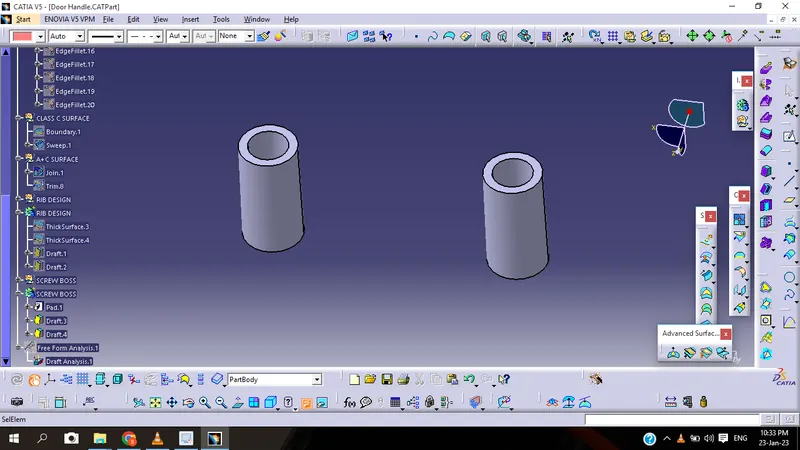
Create the Screw boss for the Drill Handle considering the design rules mentioned in the video.
General Guidelines for Bosses:
- Draft - 0.5 degrees on the walls of boss
- Thickness - Typically 40%* of the nominal wall at the base.
- Height to Diameter Ratio - 3:1
- Radii - 0.25mm maximum radii.
FINAL COMPONENT:-
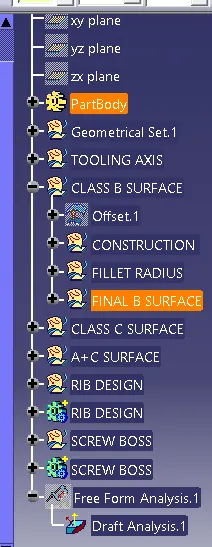
TREE STRUCTURE:-