Week 9 - Attachment Feature Creation - Challenge 2
AIM:-
To make the Core and Cavity Design
In this model we have to consider the following things:-
Tooling axis
Draft analysis
Class-A surface
Class- B surface
Class-C surface
Dog house design
Making a solid model from the surface.
TOOLING AXIS:-
Tooling axis is the defined axis to perform the manufacturing process within the injection molding according to its direction.
CREATION OF TOOLING AXIS:-
First of all analyze the given input surface to see which direction is suitable for creating the tooling axis.
In this model to create the tooling axis we have a flat base surface and tapered side wall surfaces.
Extract the base surface from class A surface
Create a point at the center of the extracted surface.
Fix an existing perpendicular side face to the base surface as a reference to create the tooling axis.
Sketch a line using the point direction option with reference to the yz direction.
Final sketched line is called as tooling axis.
DRAFT ANALYSIS:-
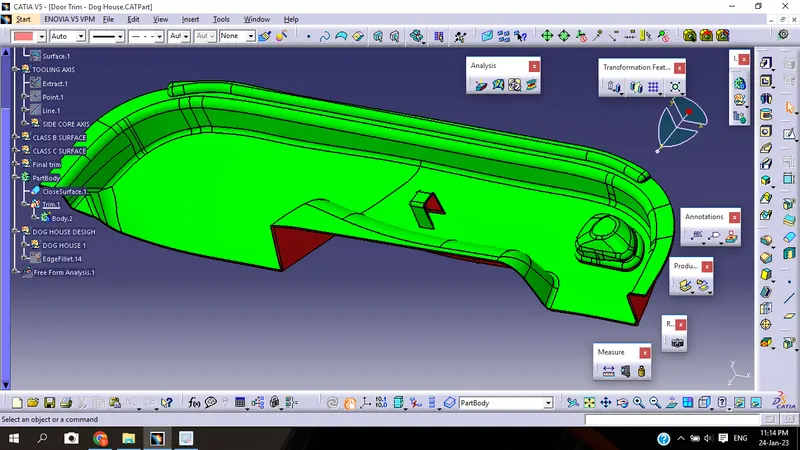
The analyzing of the model should maintain the nominal 3-degree draft angle to the tooling axis.
Draft should be given to the plastic component to reduce the wear and tear and improve the production quality and accuracy while ejecting the part from the mold cavity.
How to perform the draft analysis
1. Go to insert < analysis< feature draft analysis.
2. Align the tooling axis with a compass.
3. Click on the surface to see whether it is in permissible limit draft values or not.
4. The entire surface should be green in colour.
CLASS- A SURFACE:-
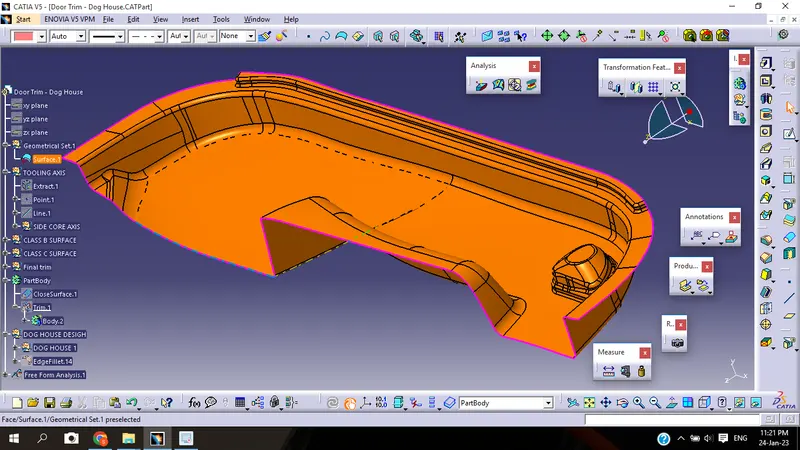
Class-A surface is given as an input surface by designers.
Generally the class-A surfaces have the tangent continuity
Class-A surface is the outermost aesthetic surface.
CLASS-B SURFACE:-
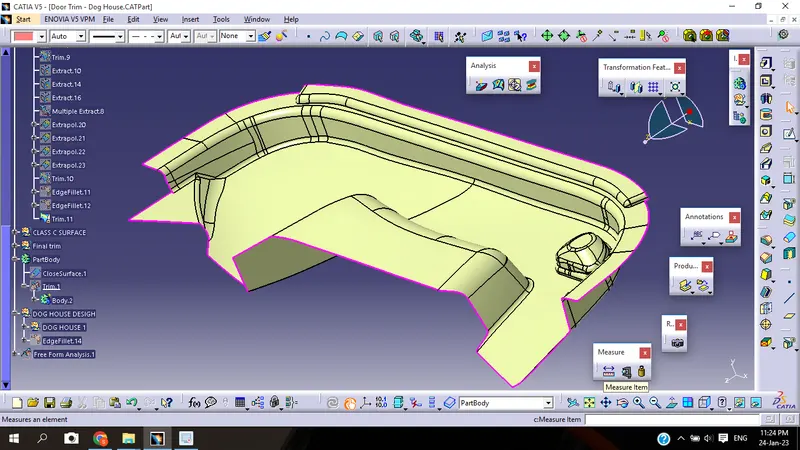
The extraction of the Class-A surface is the class-B surface.
Untrimmed the extracted surfaces from class A.
The untrimmed surfaces are offset to the required thickness.
After offsetting, all the surfaces are trimmed into the required shape.
Give the fillets on the edges, especially given fillet radius values should maintain the uniform wall thickness.
The class B fillet radius value=outer radius value + thickness.
CLASS C SURFACE:-
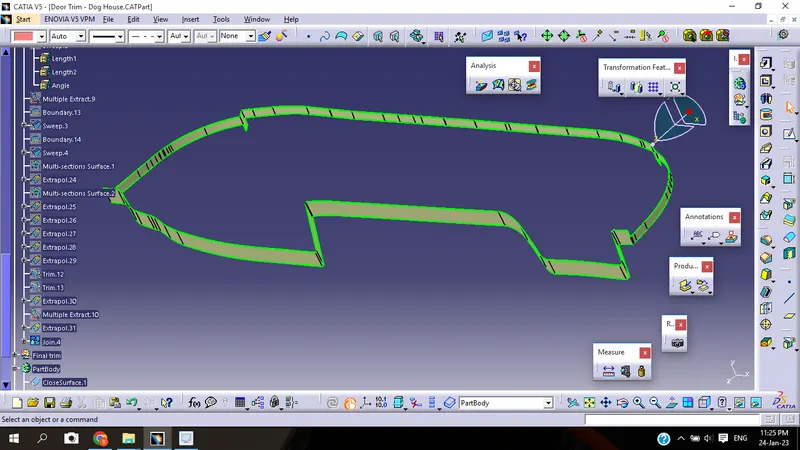
Class C surface is the closing surface of class A and class B surfaces.
It is the extraction of the boundary of class A surface.
Apply the sweep feature to create the class c surface, For guide reference click the extracted boundary and for the drafting reference option click the tooling axis and give a 93-degree draft angle
DOG HOUSE DESIGN:-
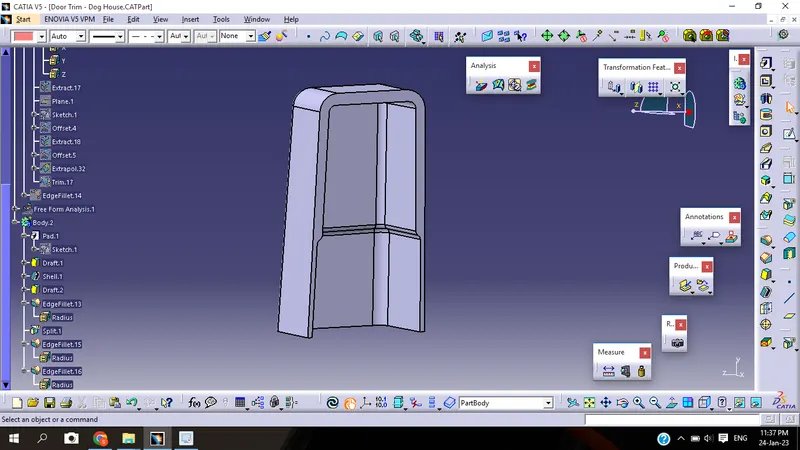
Dog house is an engineering feature used in plastic trim design. Dog houses are used as supporting feature. Sometimes other engineering features like snaps; locators etc. are mounded on them to increase their strength. It is subjected to draft analysis to prevent breakage of the component during ejection from mould cavity. Dog house and other engineering components are built on B-surface.
To creat dog house the following steps to be followed.
First we have to creat the plane so that we can take the sketch. Then we have to draw the rectangle on it. Then pad it to certain limit. After that draft it at certain angle. Then use shell comand to remove one surface. For shell give the thickness of 2.5mm.
After that we have to generate the wall thickness(C) and height (B).
For that first we have to extract the base surface then offset it for the setain limit. Then we have to take the inner surface of shell witch we have created and offset it for 0.4*wall thickness. After that we have to trim both the offset.
Then give the edgefillet where it is required and also the draft command.
After that use the split comand between the shell and the above trim.
Then by using Boolean Operation we have to trim it with solid body.
The following design rules should follow given below.
Doghouse wall thickness at the intersection of the part wall ( C ) should be 40% or less than the main wall stock ( T ).
The height of ( B ) should be between 3.0 – 6.0 mm
FINAL COMPONENT:-
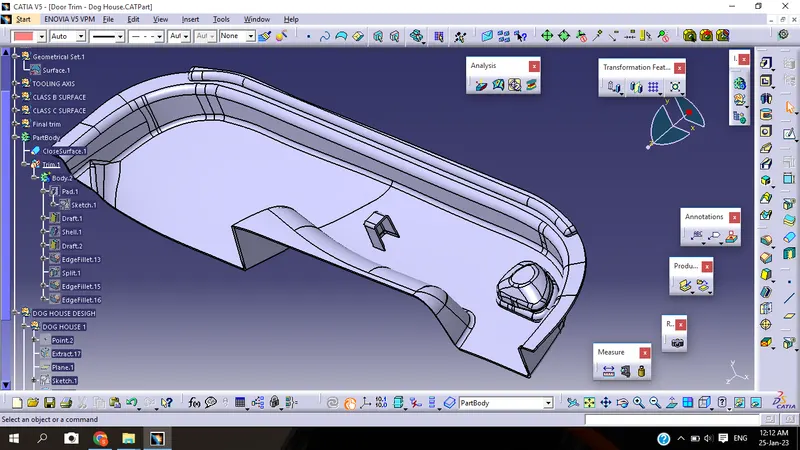
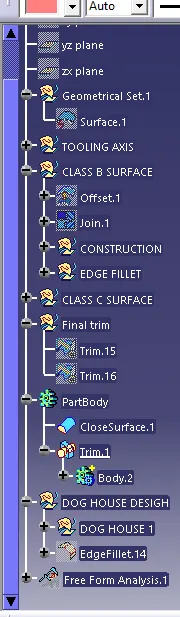
TREE STRUCTURE:-