Week 8 - Universal Joint
Universal Joint Report
Aim: For this challenge, you will have to perform a transient structural analysis on a double universal joint with a spring using three different materials: Structural Steel, Stainless Steel and Titanium alloy(They can all be found in the General Materials section) The three materials must be used on the joint with the springs alone. Use a refined mesh if possible, for the academic license. You need to obtain the Equivalent stress and total deformation for all the three cases and compare them. Submit a report regarding the same.
Procedure:
- Select Transient Structural, drag and drop into Project Schematic.
- Structural Steel, Stainless steel and Titanium alloy are chosen under Engineering Data.
- Change the material type of the joint with spring.
- Case 1: Joint with spring is of Structural Steel.
- Case 2: Joint with spring is of Stainless Steel.
- Case 3: Joint with spring is of Titanium alloy.
- Under geometry tab, import the given geometry, double-click to open Space Claim to register the model.
- A fixed joint was assigned to the end of the spring.
- A revolute joint (body-ground) was given to either ends of the universal joints.
- Revolute joints (body-body) were given to all the pin-to-joint interfaces.
- The mesh size was set to 2.6mm after adaptive sizing was switched off.
- Under transient structural tab, we set the analysis to 5 steps with timestep defined by time.
- A joint load is given to the revolute joint, with rotation in increments of 30deg.
- Equivalent Strain, total deformation and Equivalent Stress plots are requested from the solver as outputs.
- Run the simulation by clicking on “solve”.
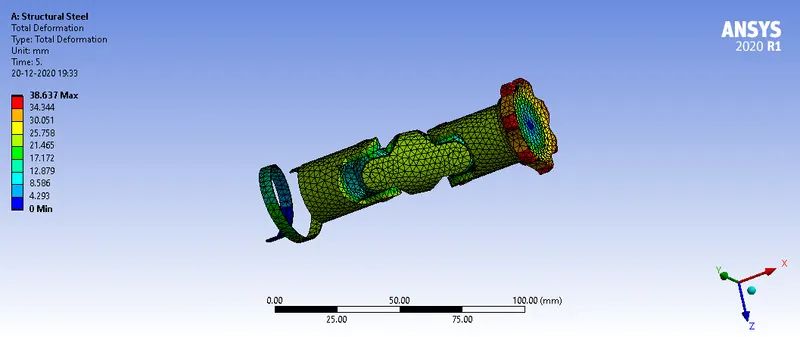
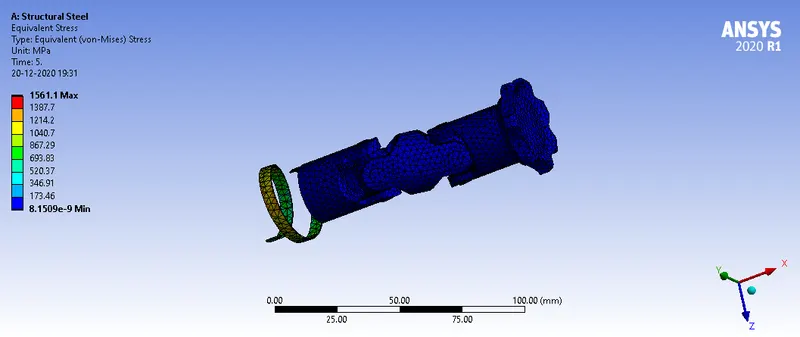
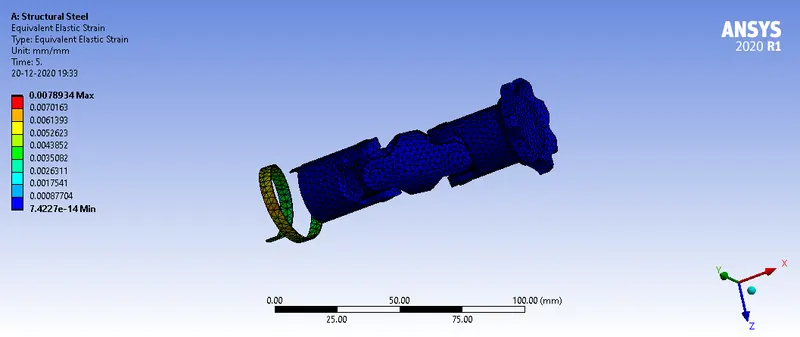
Case1: Joint with spring is of Structural Steel
Total Deformation:
Eq. Stress:
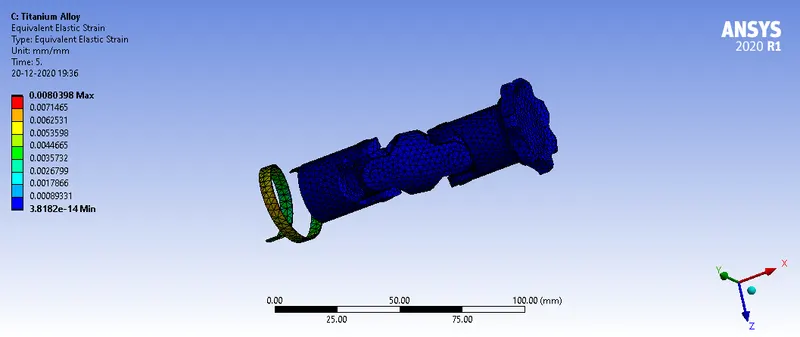
Eq. Elastic strain:
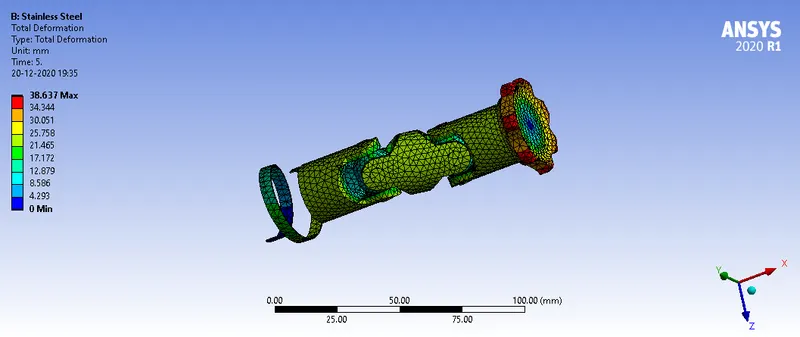
Case2: Joint with spring is of Stainless Steel
Total Deformation:
Eq. Stress:
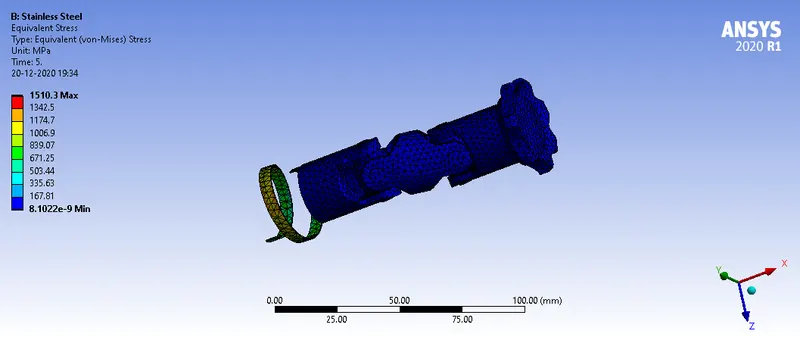
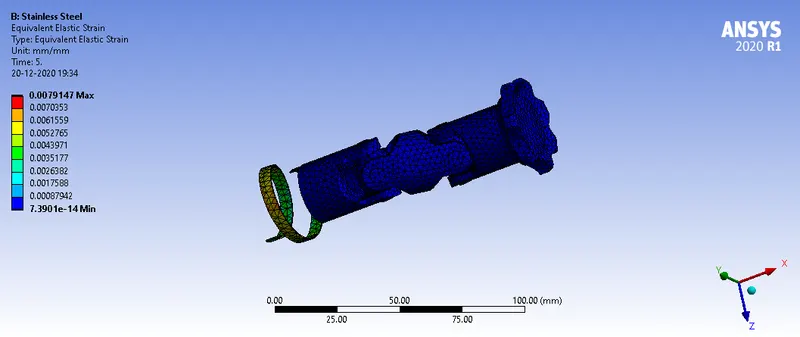
Eq. Elastic strain:
Case3: Joint with spring is of Titanium alloy
Total Deformation:
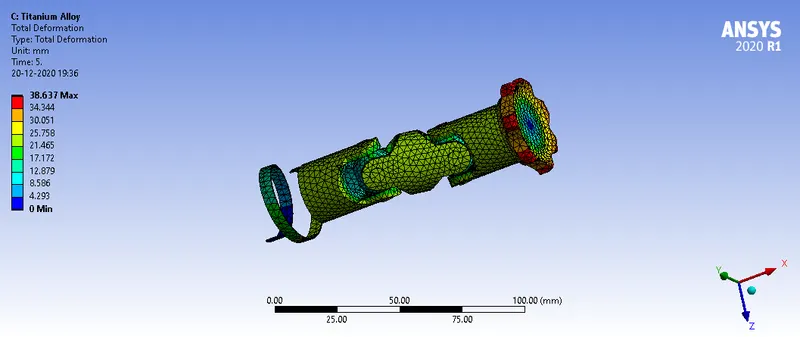
Eq. Stress:
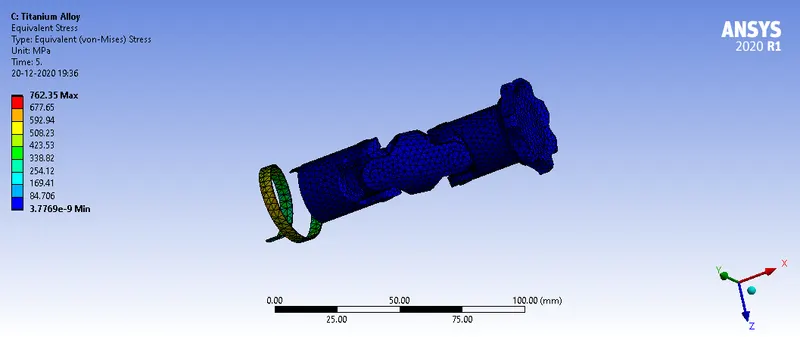
Eq. Elastic strain:
Conclusion:
From the above cases, here is the inference:
|
Case |
Material of joint w/ spring |
Eq. Stress (MPa) |
Tot. Deformation (mm) |
Eq. Strain |
|
1 |
Structural Steel |
1561.1 |
38.637 |
0.0078934 |
|
2 |
Stainless Steel |
1510.3 |
38.637 |
0.0079147 |
|
3 |
Titanium alloy |
762.35 |
38.637 |
0.0080398 |
- We can observe the stress is maximum for case 1 where the joint w/ spring is made structural steel and is the least in case 3 where it is made of titanium alloy.
- Total deformation is independent of materials.
- Stainless and Structural steel will fail as the stress undergone is much greater than their tensile ultimate strength.