Week- 8 - Solid meshing
Meshing of Rear-View mirror of a car
Aim: To mesh the entire rear-view mirror and its support using Tetra mesh for simulation.
Procedure:
- Start with the geometric clean up of the entire elements using topo.
This model has many single cons, which needs to be stitched. The point where two surfaces meet each other has to be a yellow con, hence, we have to do geometric cleanup. And convert the red cons to yellow cons.
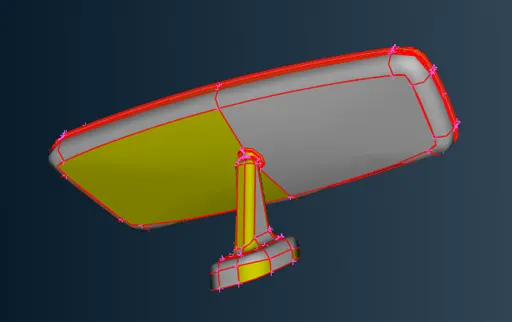
In order to do the geometric cleanup as mentioned up in the first point we firstly do geometric cleanups.
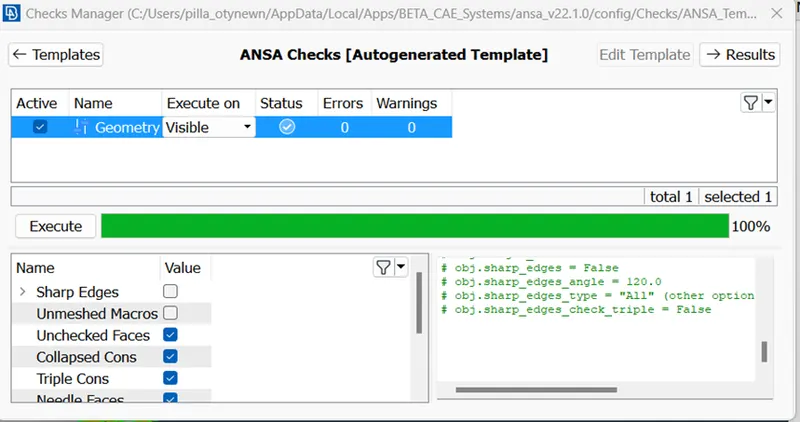
This task is performed so that all he cons are stitched and geometric cleanup is performed. The comparison of the initial and final geometry is shown below.
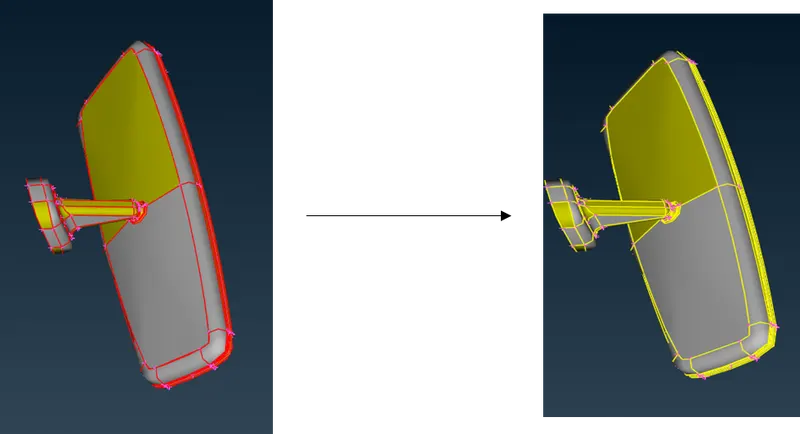
All the geometrical cons are cleaned up and red single cons are converted to yellow double cons which is geometrically correct.
- Deleting of cons for maintaining mesh quality:
There are intricate parts in the model in which the mesh quality will be failing if the cons structures are corrected. In order to achieve the mesh quality either the cons to be pasted or deleted.
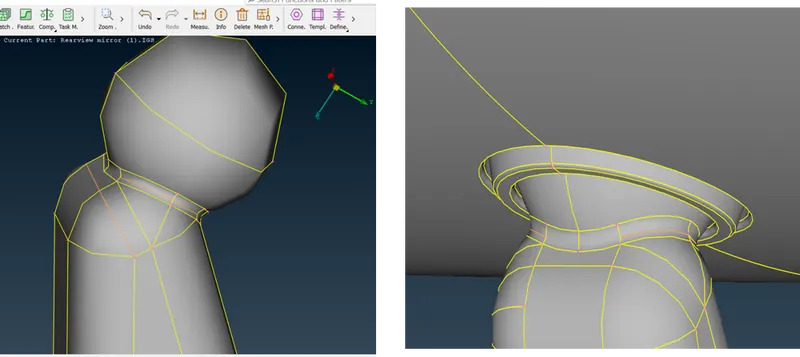
- Structure of the geometry
The geometry has four different parts
- Mirror
- Mirror support
- Ball Support
- Support stand
All the four properties have to be cleaned separately as if they given topo command by selecting all together then the cons from two different properties gets pasted with each other which will not be a effective and accurate geometry clean up.
- Mesh Type used:
The Structure model is a solid and thickness of the model is more than 5mm. Hence, this model can be meshed using the mid surfacing technique. Also, as the model has these curvature structures, we here go for the Tetra meshing.
Even in tetra meshing there are two mesh types available:
- Tria mesh.
- Ortho Tria mesh.
Mostly ortho tria mesh is used in the regions where the curvatures are present. As the ortho tria can easily trace the curved faces as compared to normal tria.
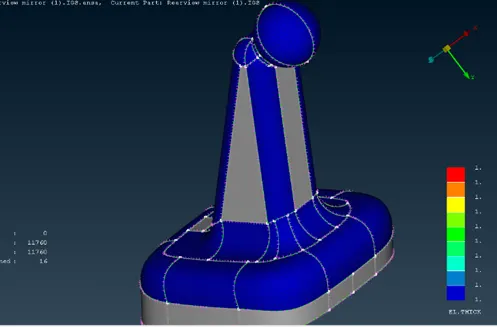
As shown in the adjoining structure all the curved surfaces are captured using ortho tria mesh type.
All other regions which are having planar regions are captured by the tria mesh.
- Surface to volume mesh:
The model here is not a hollow structure in reality but solid. However, if the not command is used the property, then we can see the hollow structure of the geometry.
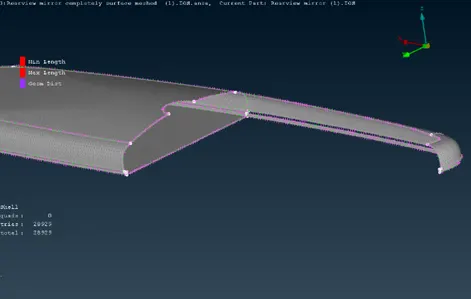
However, the meshed formed should be solid.
For this purpose, initially the meshes are formed on the surface of the model and then the entire volume mesh is created.
This Volume mesh can be defined and generated by:
- Tetra Rapid algorithm
- Tetra FEM algorithm
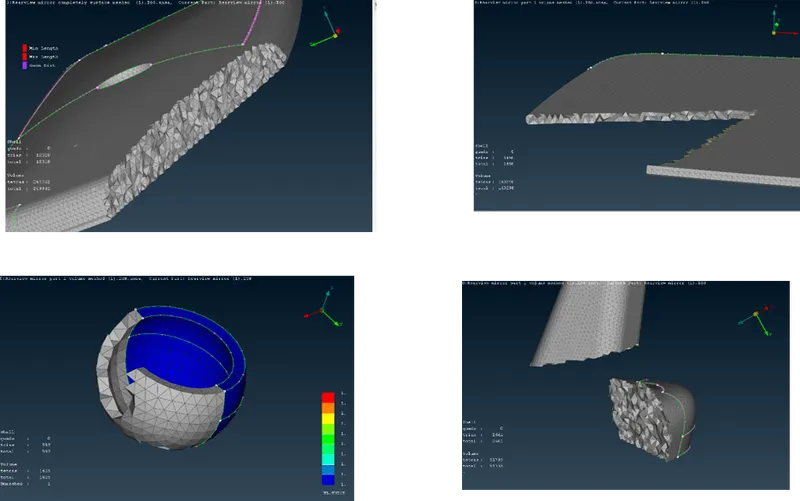
All the above mentioned are the volume mesh generated out of the surface mesh
- Learning Outcomes:While geometric clean up we cannot directly topo the entire surface together as it might cause error in the geometry.Each property of the model can be meshed separately which is simpler way to understand the geometry.As far as tetra mesh is considered we have to go for the geometric property called as tet collapse.
- Conclusion:
Tetra mesh is less complicated and less time-consuming meshing type and also it has two different meshes tria and ortho tria with the help of which we can capture the curves as well as planar regions of the geometry. Using Tetra Rapid or Tetra FEM algorithm the surface tetra mesh can be converted to volume mesh.