Week 8 - Simulating Cyclone separator with Discrete Phase Modelling
Cyclone-Separator Challenge
4 Emperical methods used to calculate the Cyclone-Separator Efficiency
Research Paper used: http://dspace.unimap.edu.my/xmlui/bitstream/handle/123456789/13571/054-058_empirical%20models.pdf?sequence=1
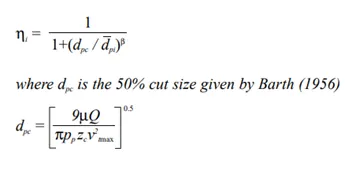
- Iozia and Leith Model
It is model based on modification of barth model. It assumes that particle is carried out by 2 forces, centrifugal force and resistance.
Dpi = particle size
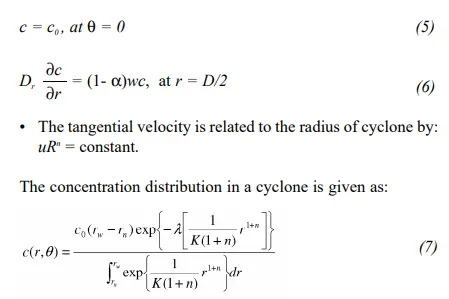
- Li and Wang Model
This includes particle bounce , re-entrainment, turbulent diffusion at the wall.
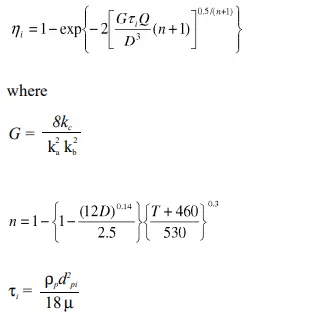
- Koch and licht Model
They recognised the inherently turbulent nature of cyclones and distribution of gas residence times within the cyclone. The tangential velocity is related to radius of cyclone as uRn=constant.
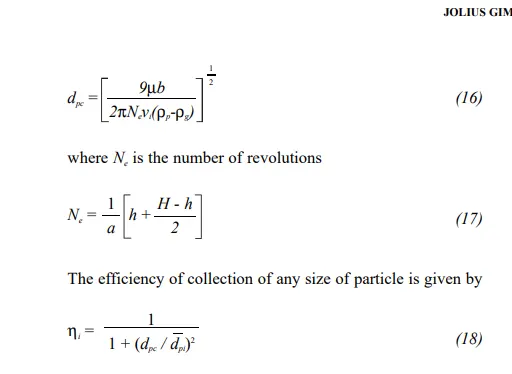
4. Lapple Model
It is based on force balance without considering flow resistance. The particle that leaves from inlet half width to wall is collected with 50 percent efficiency. Calculating a 50 % cut diameter dpc as:
Geometry
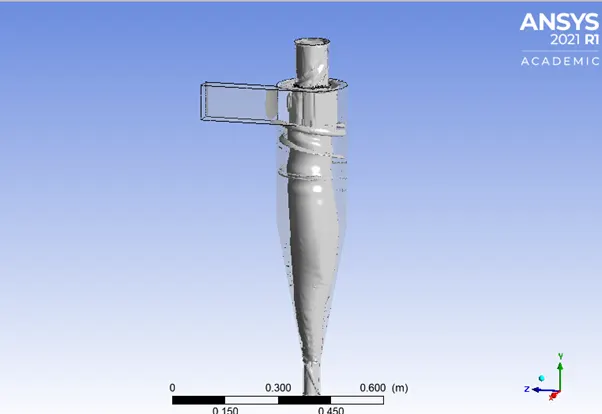
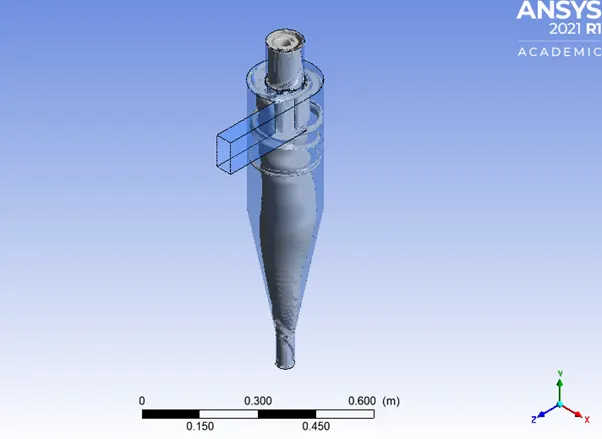
Load geometry, extract fluid volume, remove outerline edges on inlet and outlet, suppress solid volume for physics.
Mesh
Element size-5mm
Mesh> Insert Method> cartesian method for a structured mesh
Always clear generated data first if you change mesh settings.
Set-Up:
Steady state simulation, pressure based solver, gravity enabled field in y direction =-9.81 m/s2
Model- RNG K-epsilon, swirl dominated flow
Setup the discrete phase modelling:
Injection- material type- anthracite at inlet, type-surface, input velocity in x direction as direction is the one normal to our chosen surface(here inlet). Input the particle size as per case also.
Boundary conditions –
Inlet- input velocity, DPM- reflect
Outlet-1(top)= DPM-escape
Outlet-2(bottom)= DPM-trap
Wall-reflect
Solution –
Scheme- Coupled
Second order upwind scheme used.
Initialize>standard>options
Compute from-inlet > check velocities for x,y,z direction
Uncheck for convergence.
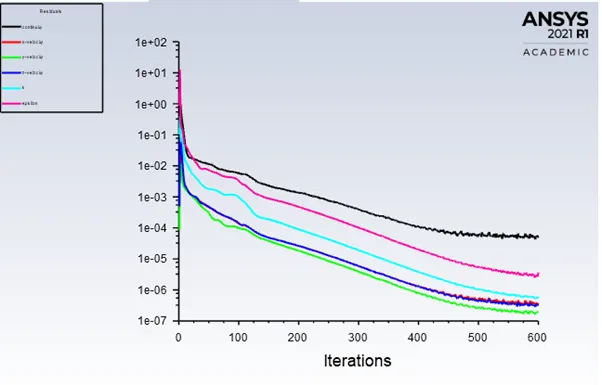
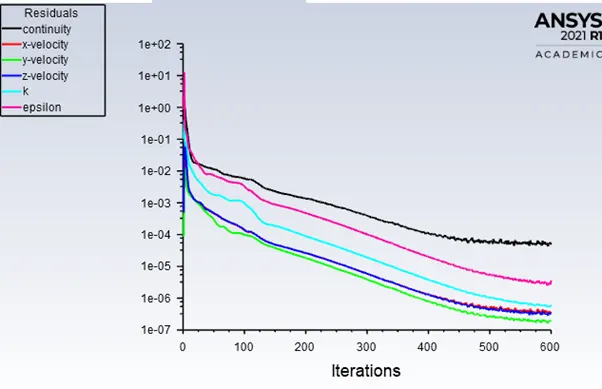
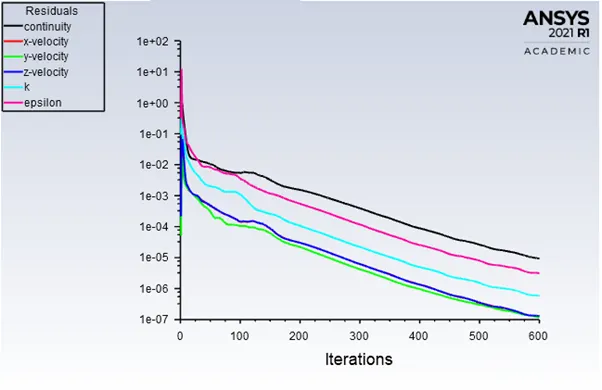
Run calculation for 600 iterations and create report definition for pressure at inlet and bottom outlet.
Export the particle history data and import it while you are in cfd post.
Post-Processing
Case1: Particle size= 1e-6 and velocity=3m/s
Residual:
|
Particle Tracked |
378 |
|
Particle Trapped |
146 |
|
Particle escaped |
162 |
|
incomplete |
70 |
|
Efficiency |
38.62% |
|
Pressure inlet |
28.122 |
|
Pressure outlet |
-0.011 |
|
Pressure Drop |
28.133 |
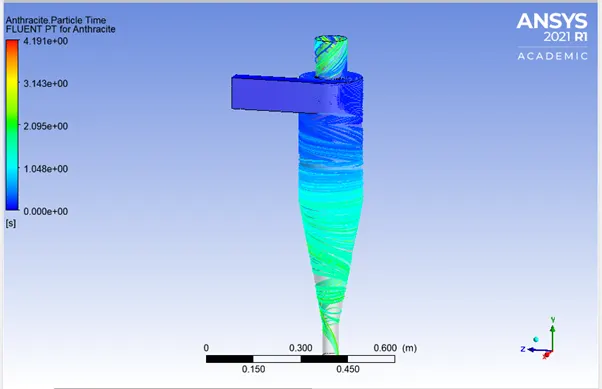
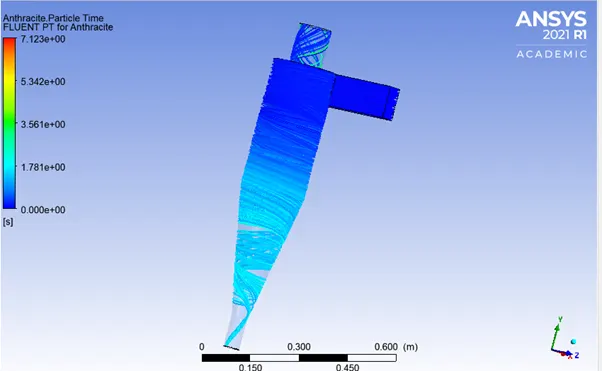
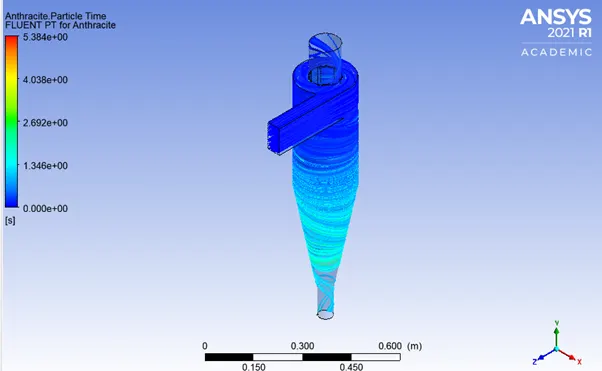
Anthracite particle time:
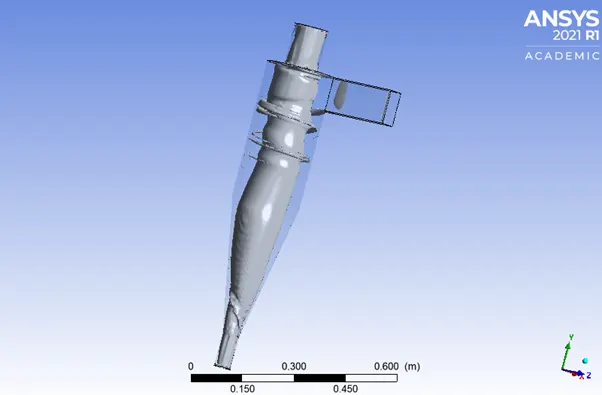
Case2: Particle size= 3e-6 and velocity=3m/s
|
Particle Tracked |
378 |
|
Particle Trapped |
150 |
|
Particle escaped |
87 |
|
incomplete |
141 |
|
Efficiency |
39.6% |
|
Pressure inlet |
28.122 |
|
Pressure outlet |
-0.011 |
|
Pressure Drop |
28.133 |
Case3: Particle size= 5e-6 and velocity=3m/s
|
Particle Tracked |
378 |
|
Particle Trapped |
291 |
|
Particle escaped |
62 |
|
incomplete |
25 |
|
Efficiency |
76.9% |
|
Pressure inlet |
27.42 |
|
Pressure outlet |
-0.01 |
|
Pressure Drop |
27.43 |
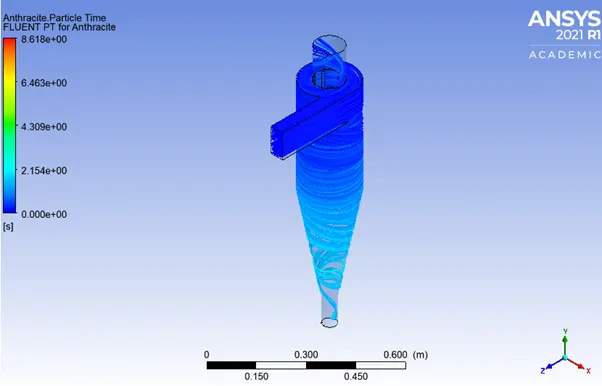
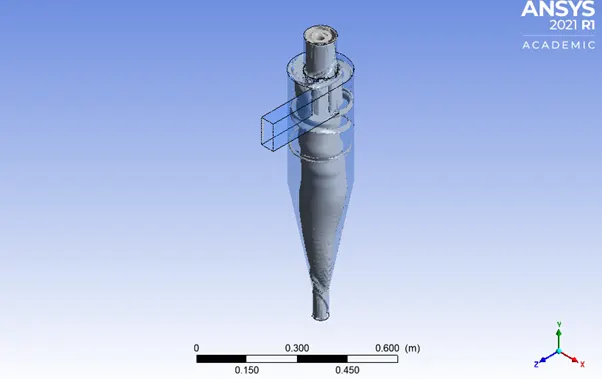
Case4: Particle size= 5e-6 and velocity=1m/s
|
Particle Tracked |
378 |
|
Particle Trapped |
10 |
|
Particle escaped |
106 |
|
incomplete |
262 |
|
Efficiency |
2.6% |
|
Pressure inlet |
2.45 |
|
Pressure outlet |
-0.0001 |
|
Pressure Drop |
2.45 |
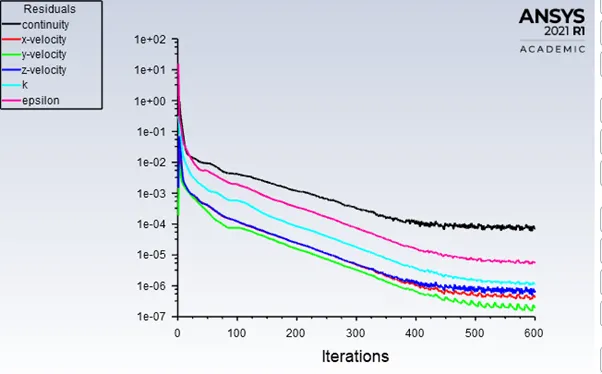
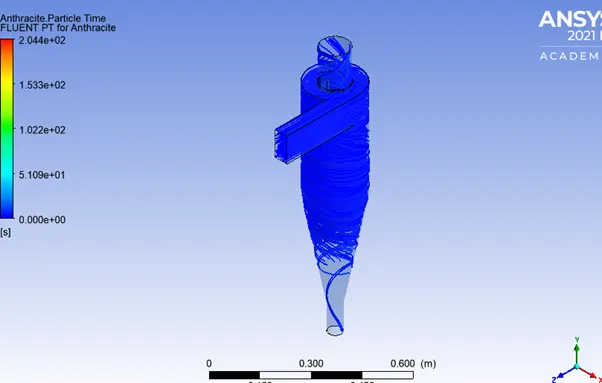
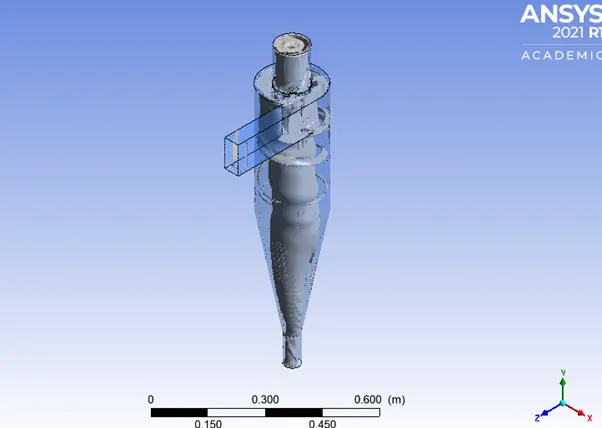
Case5: Particle size= 5e-6 and velocity=5m/s
|
Particle Tracked |
378 |
|
Particle Trapped |
232 |
|
Particle escaped |
66 |
|
incomplete |
80 |
|
Efficiency |
61.3% |
|
Pressure inlet |
82.2 |
|
Pressure outlet |
-0.03 |
|
Pressure Drop |
82.2 |
Conclusion:
|
Particle size(v=3) |
Efficiency |
|
1e-6 |
38.6% |
|
3e-6 |
39.6% |
|
5e-6 |
76.9% |
As particle size increases , the separator efficiency for cyclone separator increases drastically. With a particle size of 5 micron, efficiency is 76.9 which is very high. This is the case when velocity is same i.e 3 m/s for all cases. Pressure drop in all the 3 cases remain same.
|
Particle velocity(size=5e-6) |
Efficiency |
|
1m/s |
2.6% |
|
3m/s |
76.9% |
|
5m/s |
61.3% |
We can see that when particle size is kept same and the velocity is varied, the efficiency drastically increases even with a little increase velocity.