Multi cell Battery Pack
A large number of cells connected together in series and parallel patterns consitute a battery. In order to extract the electricity from the battery efficiently, all the cells should be same category and should have same voltage while discharging and charging.
However, in the battery pack it is not the case. Not all cells have the same voltage necessarily. This is because of the charecteristics of the cells, Internal resistance, and many such parametrs.
The cell which has lower voltage and has reached lower SOC, forces the BMS to not use more from the battery, as it will deteriorate or fail the particular cell.
Also, the cell with higher voltage than others, hence at higher SOC, leads the BMS to stop charging other cells, as the higher voltage cell may explode due to overcharging.
Hence, these weak cells result in making compromises and inefficient use of the whole battery. So, it is said that the weak cells governs the battery.
Now, lets discuss the case of cells with lower voltage than others. In this type of imbalace, the lower voltrage cells or the weaker cells limit the usable capacity of the battery. If the voltage of 90 cells is 3V and that of the weaker 10 cells is 2V. And the cut-off voltage of the cells is 2V. The BMS is designed is such a way that the cells does not go below the cut-off voltage, as it may result any thermal breakdown or explosion. Hence, because of 10 weaker cells, all the other 90 usable cells are not used. Not just for 10 cells, but even if the number of weaker cells is 1, the BMS will stop further discharge of the battery(all cells).
Solution:
The imbalance in the cells causes this underutilization if the cells or the battery. Hence, the only thing to do is to balance out the cells with equal voltage.
Balancing the cell means reducing the voltage of the cell (cell having higher voltage than other) to the voltage equal to all cells. Also, increasing the cells voltage of the lower voltage cell equal to other cells. Maintaining the voltage of all cells equal is called balancing.
There are two types of balancing techniques used:
1. Active cell balancing
2. Passive cell balancing
Active cell balancing: In order to balance the cells, there must be an imbalance in the cells, i.e. it should have cells of higher voltage and also of lower voltage. So, to balance these cells, we can remoce the charge from the higher voltage cells or add charge to the lower voltage cells. In active balancing, both of this strategies are applied. The charge from the higher voltage cells is removed and it is provided in the lower voltage cells. This is called as active balancing.
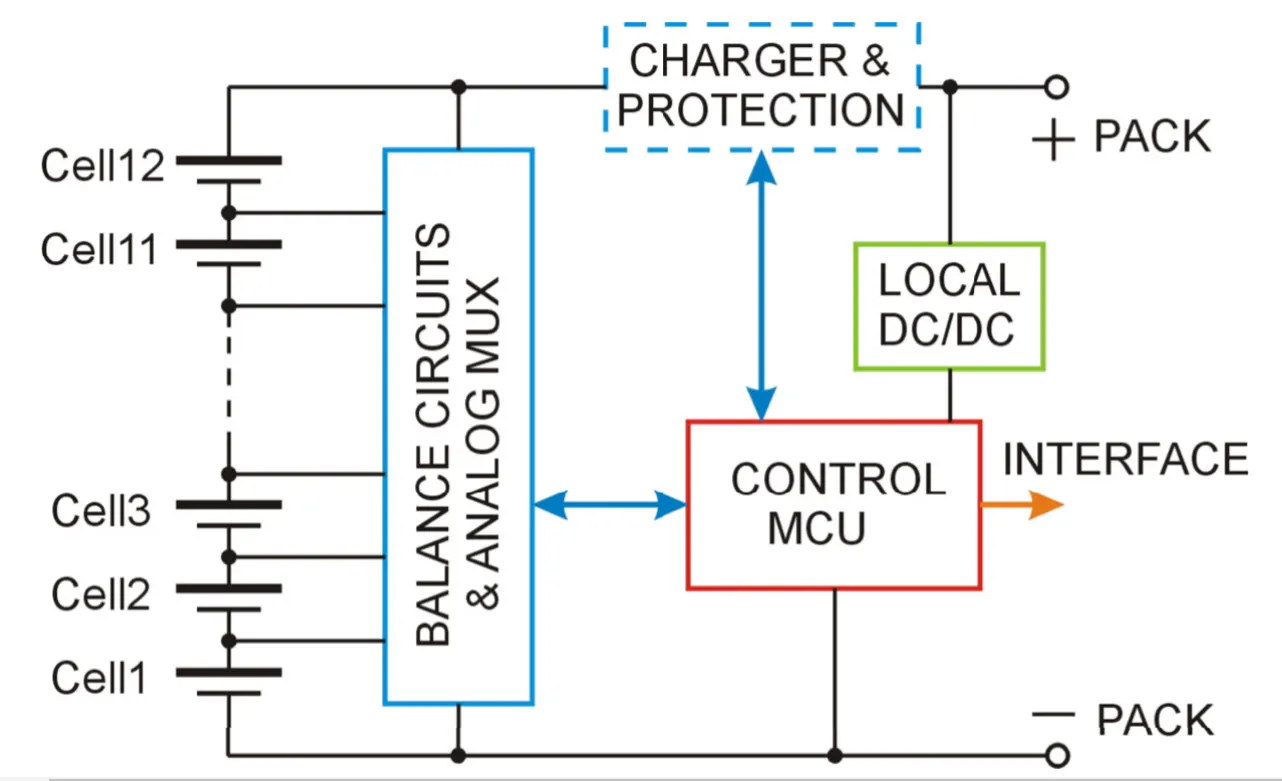
From the figure we can see that the balancing circuit is connected to more than one cell. This means it removes the charge from higher capacity cells and supplu it to the lower ones. The balancing circuit is simply a DC-DC converter that works on a duty cycle and transistors. The duty cycle depends on the difference between the voltages. Higher the difference, higher os the duty cycle and vice versa.
Passive cell balancing: In passive balancing, discharging of the higher voltage cells is done, but the removed charge is not supplied to lower voltage cells. They are discharged till their voltage values are equal to the lower voltage cells. The removed charge is wasted as heat.
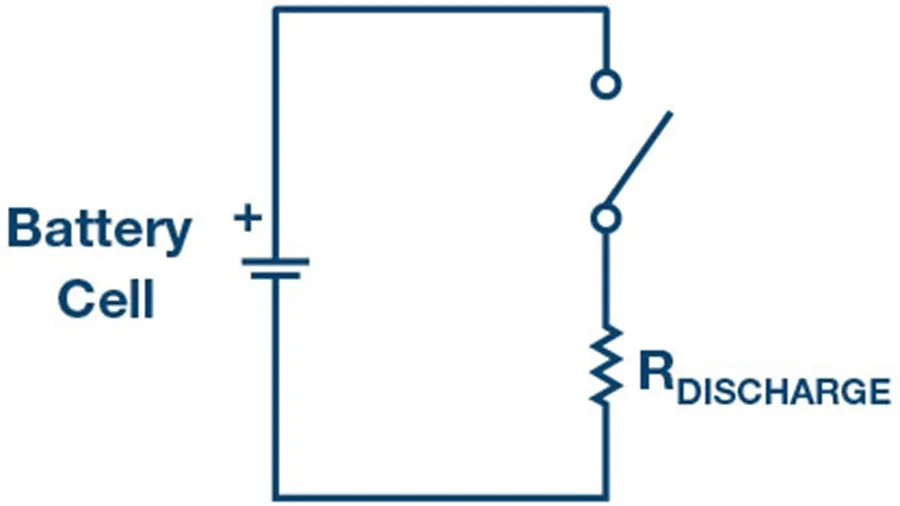
The high SoC cell is bled off (power is dissipated in the resistor) so that charging can continue until all cells are fully charged. Passive balancing allows all batteries to have the same SoC, but it does not improve the run-time of a battery-powered system. It provides a fairly low cost method for balancing the cells, but it wastes energy in the process due to the discharge resistor. Passive balancing can also correct for long-term mismatch in self discharge current from cell to cell.