Week - 8 Mass Scaling
Effect of time-step value on run-time during simulation in explicit and implicit analysis and understanding the Mass Scaling during simulation
One of the most important techniques in CAE industry to reduce the run time of an explicit FE analysis is 'Mass Seating'.
The main objective of this report is to make use of mass scaling technique to effectively reduce the simulation run time and to ensure the stability of mass scaling.
"With a mass scaling percentage limit of 8 and by optimizing the mass scaling parameters 'Time-step' and 'TSSFAC' (Time-step scaling factor) , many trials have been undergone to achieve reduction in simulation run time."
"Also, to perform an implicit analysis simulation for the same model and to compare the running time between explicit and implicit “methods.
The difference between using a positive or negative number for DT2MS in*CONTROL_TIMESTEP is as follows:
"When DT2MS is less than zero, LS-DYNA adds mass of each element whose time-step is below abs(DT2MS) such that the element's" updated DT is equal to abs(DT2MS).
"When DT2MS is greater than zero, LS-DYNA adds mass to elements who’s DT is below abs (DT2MS) and ""removes"" mass from elements whose DT is greater than zero."
Negative: Mass is added to only those elements whose time-step would otherwise be less than TSSF*abs (DT2MS). When mass scaling is appropriate, I recommend this method.
DT2MS>O is seldom used while DTM2<0 is frequently used for overcoming the smallest computed time-step.
Positive: Mass is added or taken away from elements so that the time-step of every element is the same. My opinion is there is no advantage to using this method over the negative DT2MS method and I find it harder to rationalize.
Care must be taken when using DT2MS<O to ensure that the added mass does not have an adverse effect on the simulation accuracy
The parameter MS1ST in *CONTROL_TIMESTEP controls whether mass is added only once during initialization (MS1ST=1) or anytime as necessary to maintain the desired time-step specified via DT2MS (MS1ST=0).
You can use ENDMAS in *CONTROL_TERMINATION to stop the calculation after a certain amount of mass has been added (active for automatic mass scaling only).
These are used from other source as Picture
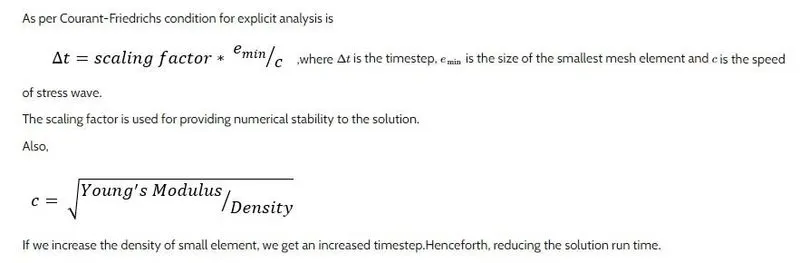
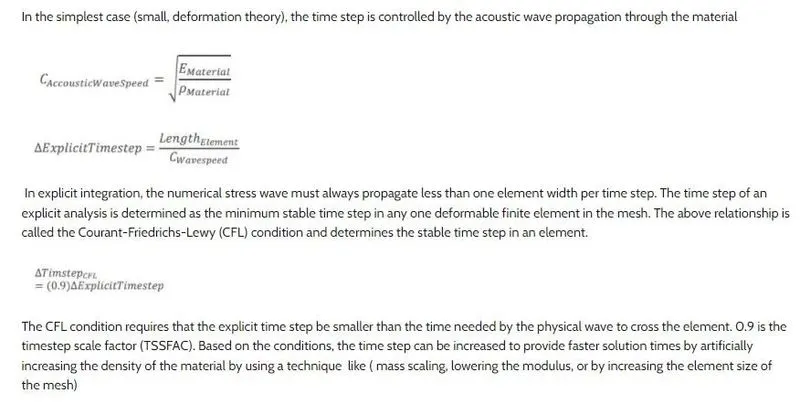
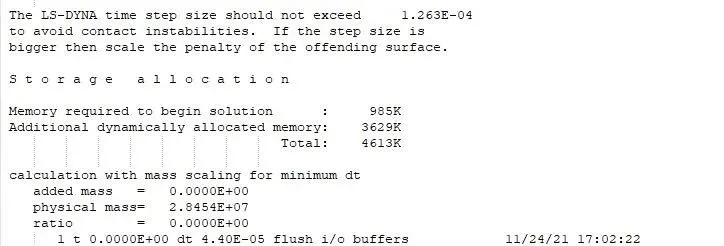
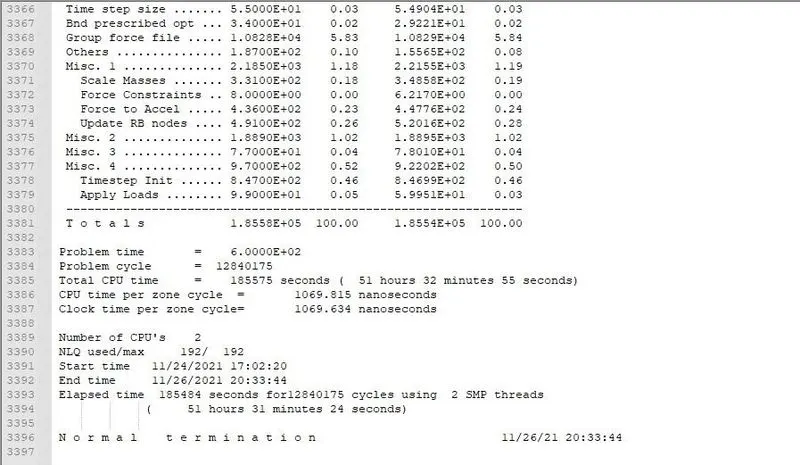
TSSFAC: 0.9
DT2MS: 0.00
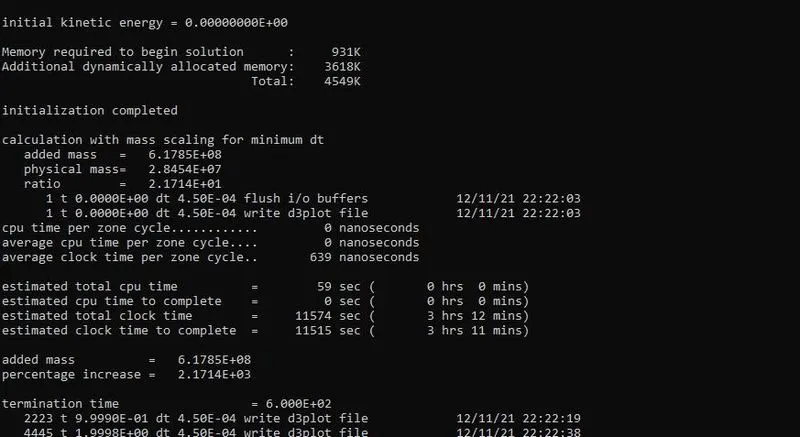
Here we consider the CONTROL_TIMESTEP as zero.it found that the run time is 185484 sec which is 51.5 hours. Run time is huge time period for the simulation run.
Here we can observe the mass scaling added mass is zero and percentage is also zero
Mass scaling procedure in LS-DYNA:
LS-DYNA allows two different types of mass-scaling using the DT2MS parameter from *CONTROL_TI MESTEP with the default set to no mass-scaling.
"When DT2MS is less than zero, LS-DYNA adds mass of each element whose time step is below abs(DT2MS) such that the element's").
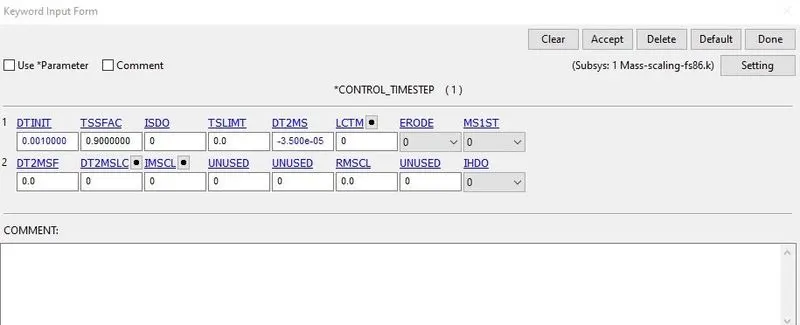
TSSFAC: 0.9
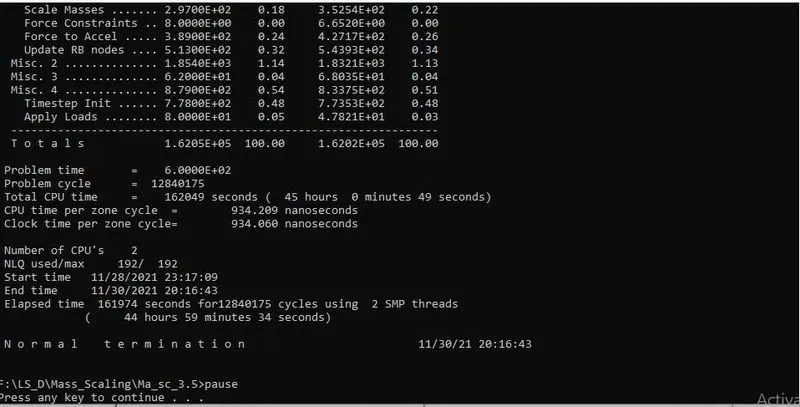
DT2MS: -3.500e-05
Here we consider the CONTROL_TIMESTEP as zero.it found that the run time is 185484 sec which is 44 hours. Run time is huge time period for the simulation run.
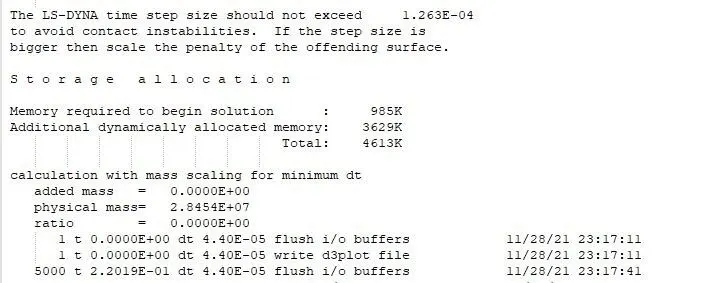
Here we can observe the mass scaling, added mass is zero and percentage is also zero
TSSFAC: 0.9
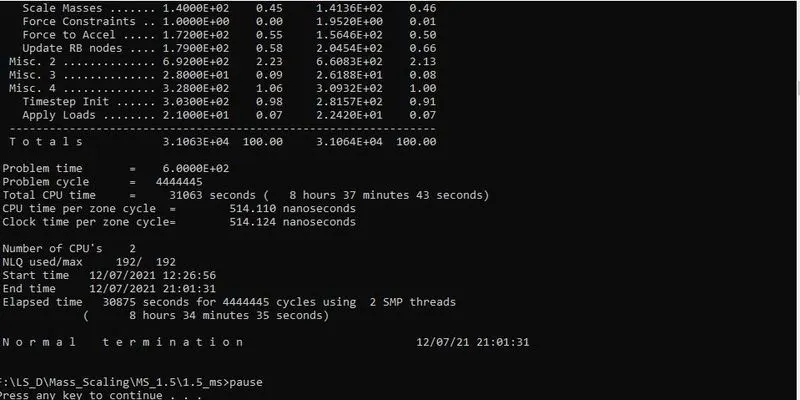
DT2MS: -1.500e-04
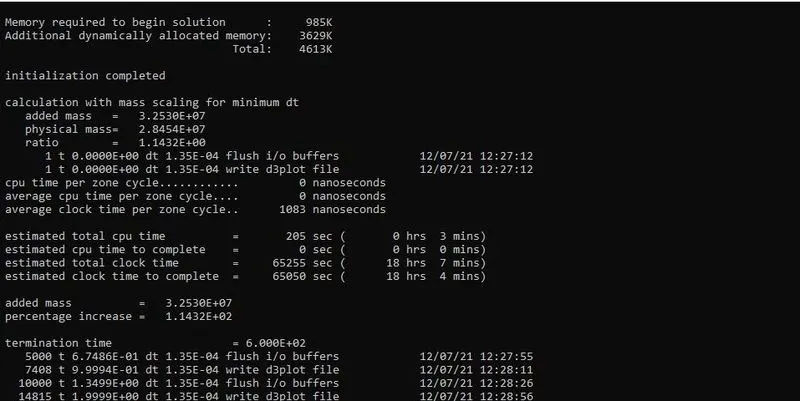
below image we can see the added mass and percentage mass is 1.14 .elapsed time is 30875 sec which is 8 hours 35 minutes .here we can is running time reduced drastically from previous value of DT2MS and TSSFAC is constant for both the values of DT2MS.
TSSFAC: 0.9
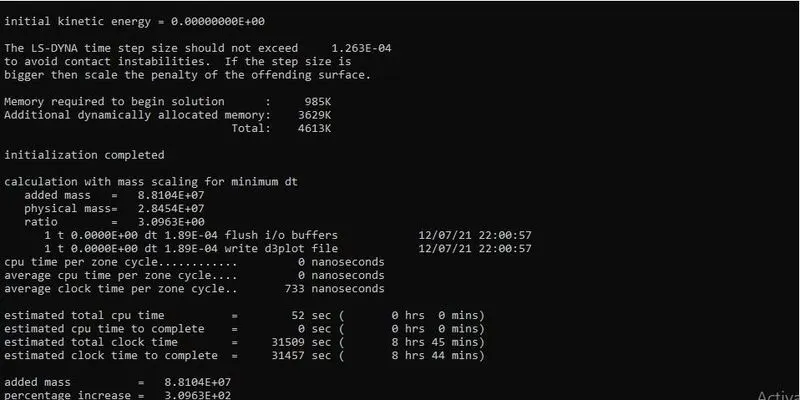
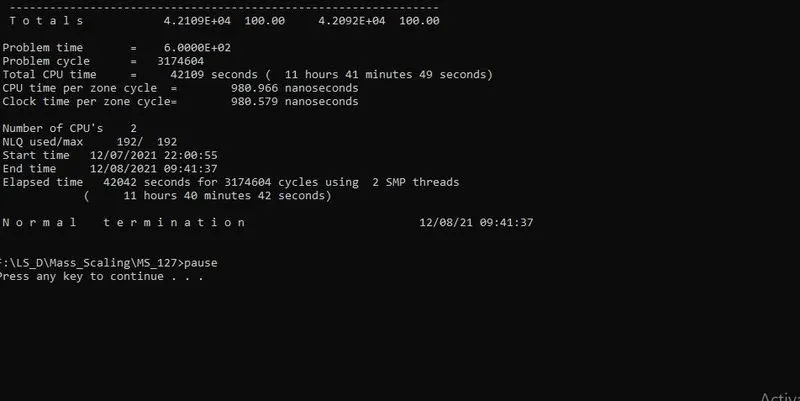
DT2MS: -2.100e-04
Given image we can see the added mass and percentage mass is 1.14 .elapsed time is 30875 sec which is 8 hours 35 minutes .here we can is running time reduced drastically from previous value of DT2MS and TSSFAC is constant for both the values of DT2MS.
TSSFAC: 0.9
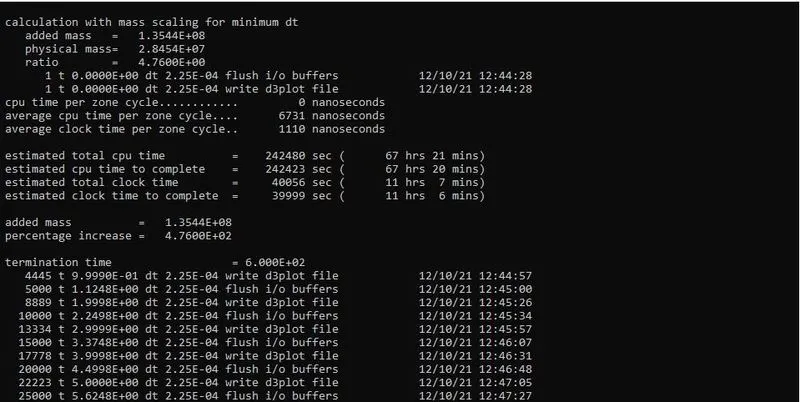
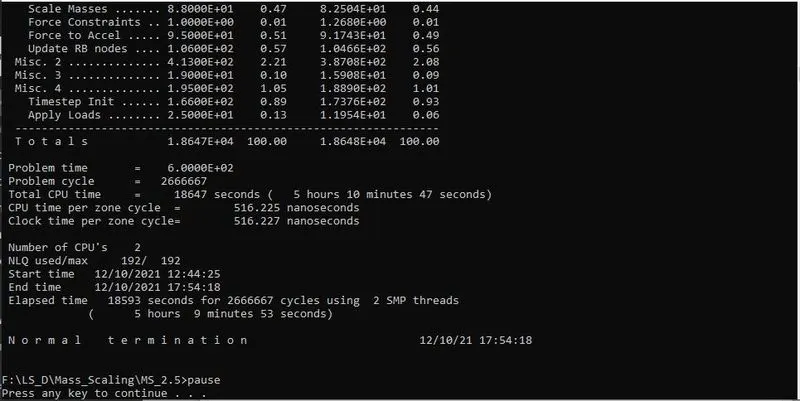
DT2MS: -2.500e-04
Given image we can see the added mass and percentage mass is 4.76 elapsed time is 18593 sec which is 5 hours 9 minutes .here we can is running time reduced drastically from previous value of DT2MS and TSSFAC is constant for both the values of DT2MS.
TSSFAC: 0.9
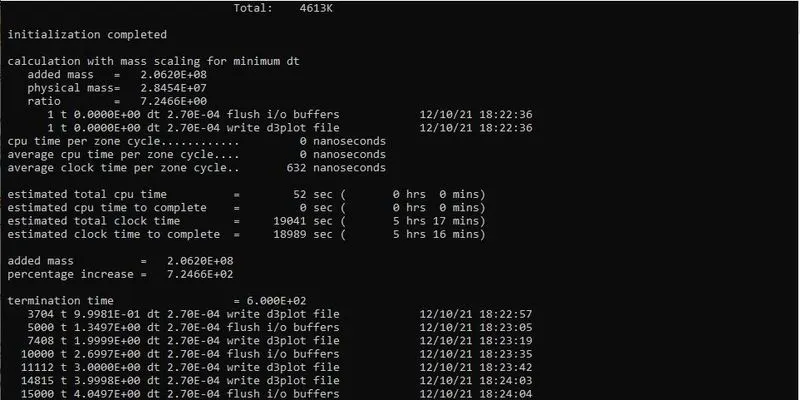
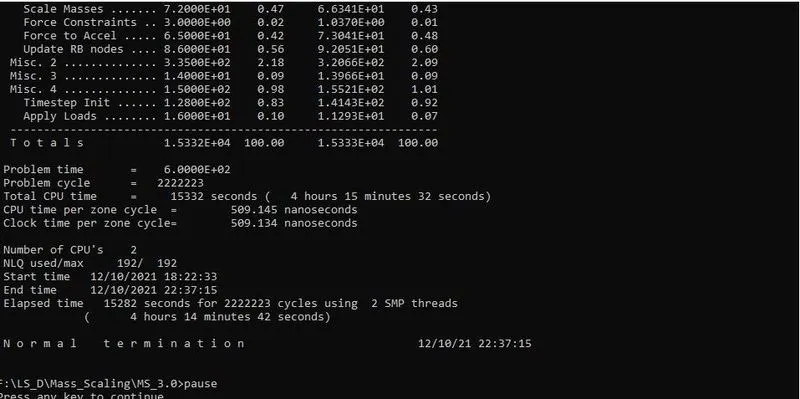
DT2MS: -3.00e-04
Given image we can see the added mass and percentage mass is 7.24 elapsed time is 15282 sec which is 4 hours 14 minutes .here we can is running time reduced drastically from previous value of DT2MS and TSSFAC is constant for both the values of DT2MS.
TSSFAC: 0.9
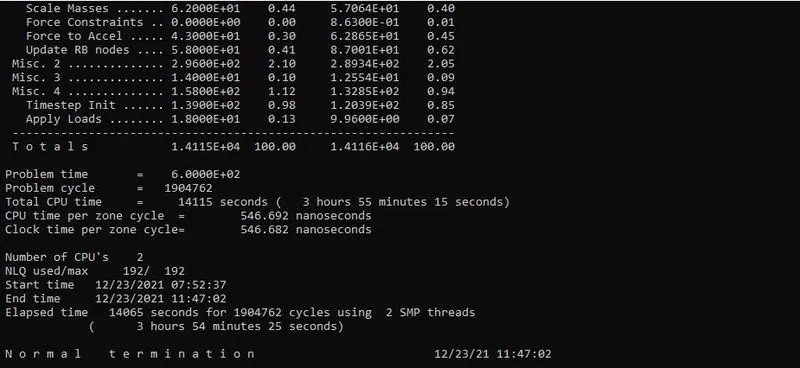
DT2MS: -3.500e-04
Given image we can see the added mass and percentage mass is 1.014 .elapsed time is 14065 sec which is 3 hours 54 minutes .here we can is running time reduced drastically from previous value of DT2MS and TSSFAC is constant for both the values of DT2MS.
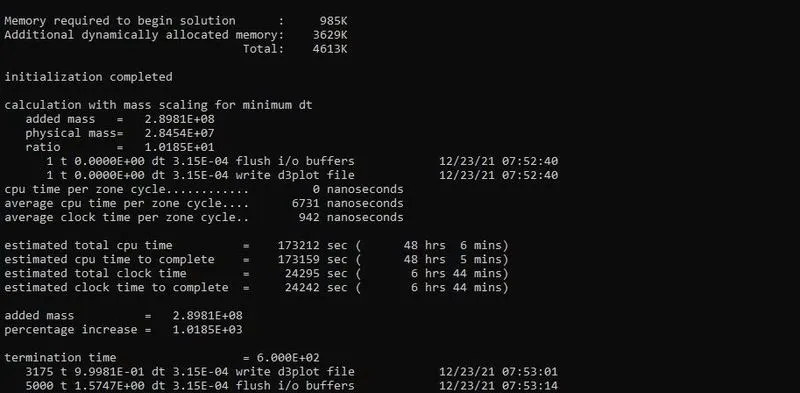
TSSFAC: 0.9
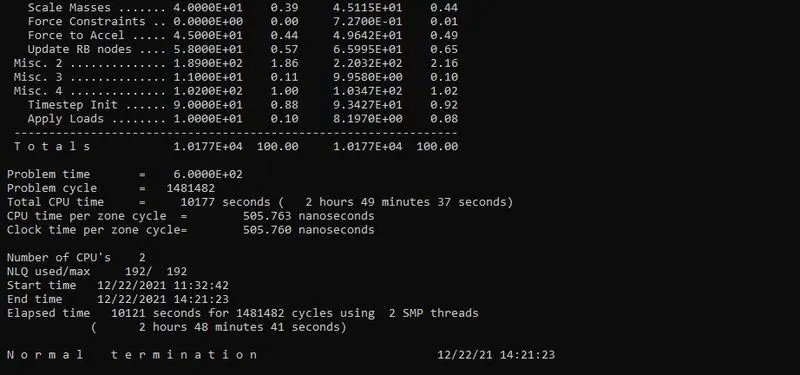
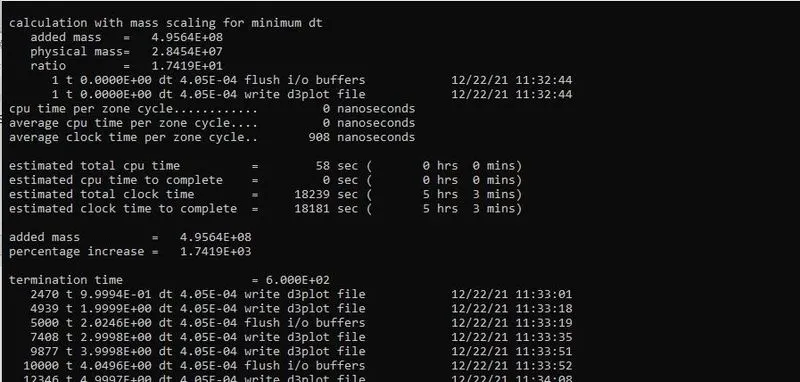
DT2MS: -4.5e-04
Given image we can see the added mass and percentage mass is 1.741 elapsed time is 10121 sec which is 2 hours 48 minutes .here we can is running time reduced drastically from previous value of DT2MS and TSSFAC is constant for both the values of DT2MS.
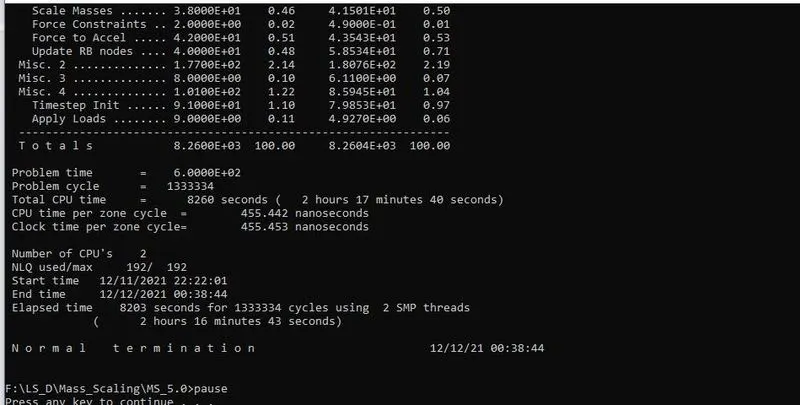
TSSFAC: 0.9
DT2MS: -5.0e-04
Given image we can see the added mass and percentage mass is 2.17 elapsed time is 8203 sec which is 2 hours 16 minutes .here we can is running time reduced drastically from previous value of DT2MS and TSSFAC is constant for both the values of DT2MS.
Implicit analysis:
"In Implicit analysis, each time step has to converge, but we can set pretty long time steps and it is based on iterations. Explicit on the other hand doesn't have to converge each time step, but for the solution to be accurate time steps must be super small. Though the running time for implicit analysis is shorter than the explicit analysis method because the time-step is defined larger in implicit compare to explicit analysis" and we have used constant time-step formulation.
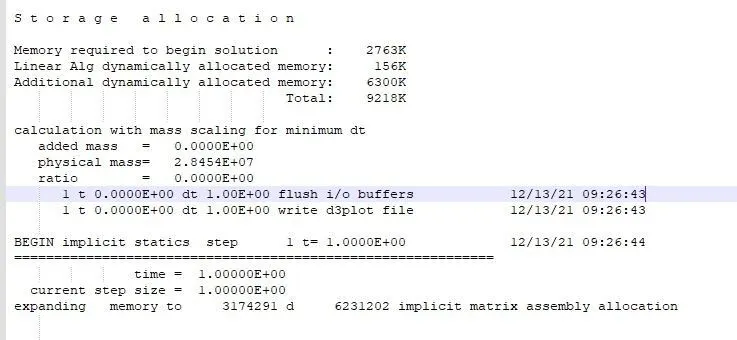
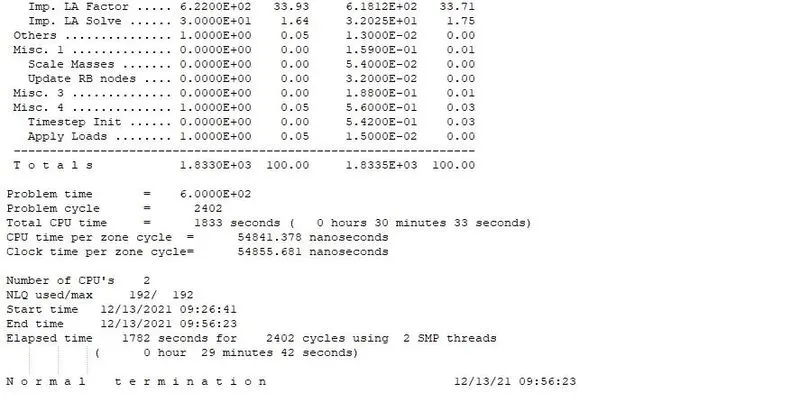
Implicit analysis is independent on mass scaling and depends on number of iterations.
Results and discussion:
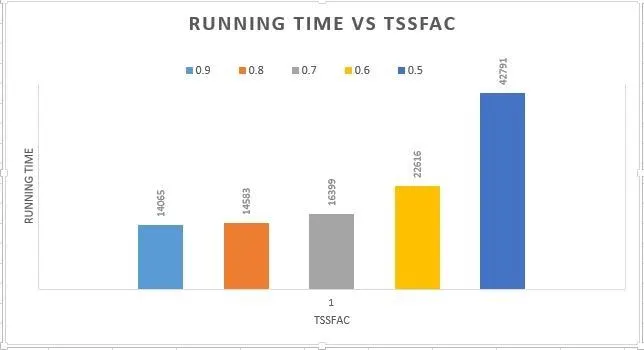
The final analysis of the graph we can understand it that time step value which is DT2MS is increased and also mass increased. Due to the increase of mass simulation time reduced. We have kept TSSFAC is constant. Here in explicit analysis effect mass influence the simulation time.
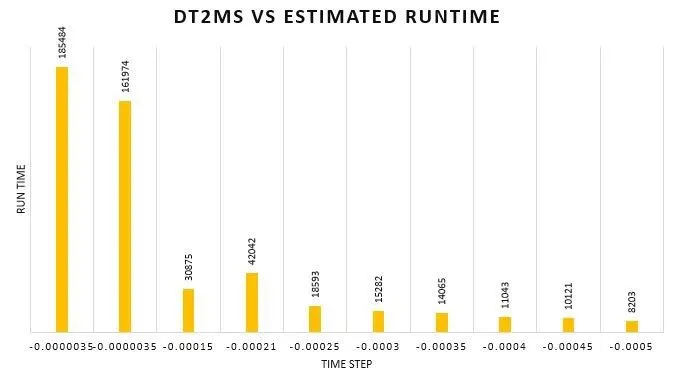
From below figure we can understand that running or estimated time for simulation varied with variable TSSFAC
CONCLUSION:
Mass scaling refers to a technique whereby a non-physical mass is added to a structure in order to achieve a larger explicit time-step.
Mass- scaling is basically to understand the mass of the elements to adjust its time step in explicit analysis.
We can understand the influence of mass-scaling effect on time step analysis in both explicit and implicit analysis.
Plotted histogram by comparing the TSSFAC and variable DT2MS in both explicit and implicit analysis.
Computing time is varying when we change the DT2MS by keeping the TSSFAC constant in each case.