Week - 8 Mass Scaling
Aim:
To understand mass scaling parameters and to compare Implcit and explicit runtime with hardlimit on mass scaling (8%)
Case setup:
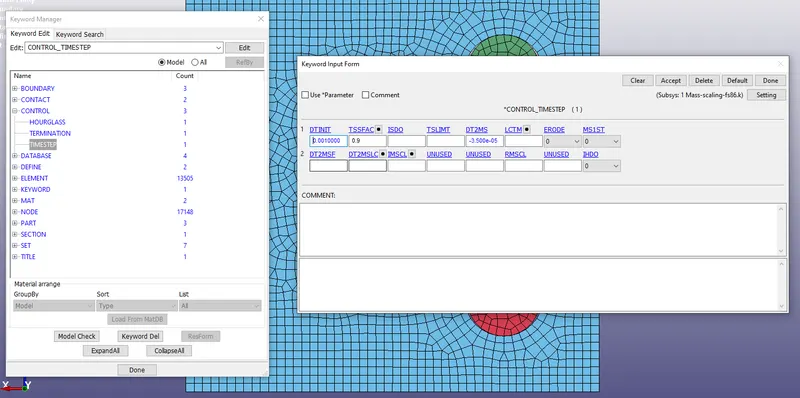
These are the keywords already present in the LS Dyna file. CONTROL_TIMESTEP card is used. DT2MS and TSSFAC are set at -3.5e-5 and 0.9 respectively. Negative TSSFAC brings all the nodes below TSSFAC time step value to DT2MS by artificially adding mass to it. Positive TSSFAC value brings all the nodal time step value to DT2MS irrespective of their initial time step value. TSSFAC is a scale factor for computed time step, used to be on a conservative side.
Time step = Length of the element/Speed of sound wave in the medium
Speed of sound wave = Sqrt()
E – Young’s Modulus
Ρ – Density of the medium
If mass is increased, density gets increased which reduces speed of sound in the medium. This in turn increases Time step.
The model is run with the provided DT2MS to understand the effect of lower DT2MS value. And then DT2MS value is gradually increased to speed up the simulation with a hard limit set at 8% for mass added.
Without mass scaling
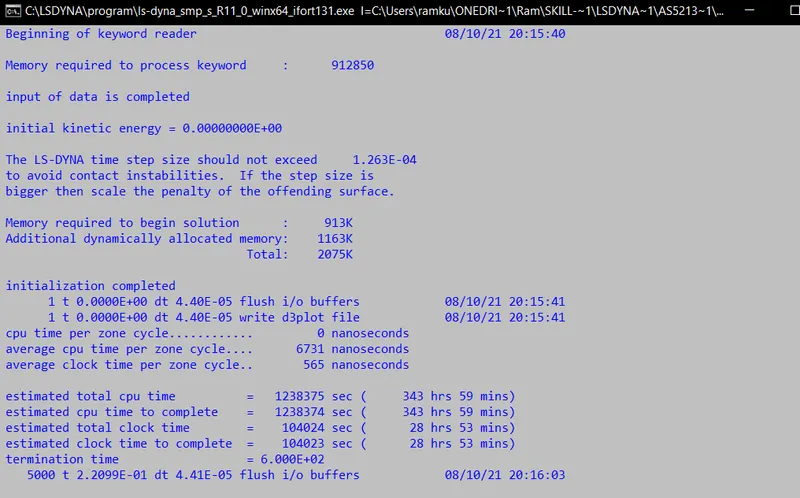
DT2MS = -4.5e-5
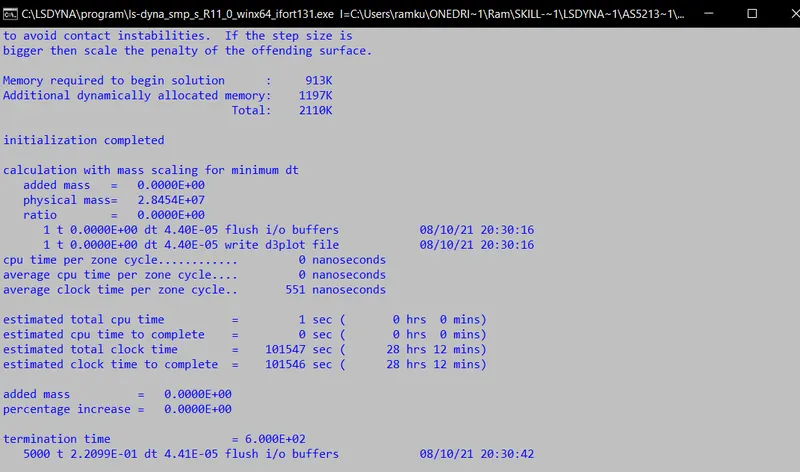
DT2MS = -8.5e-5
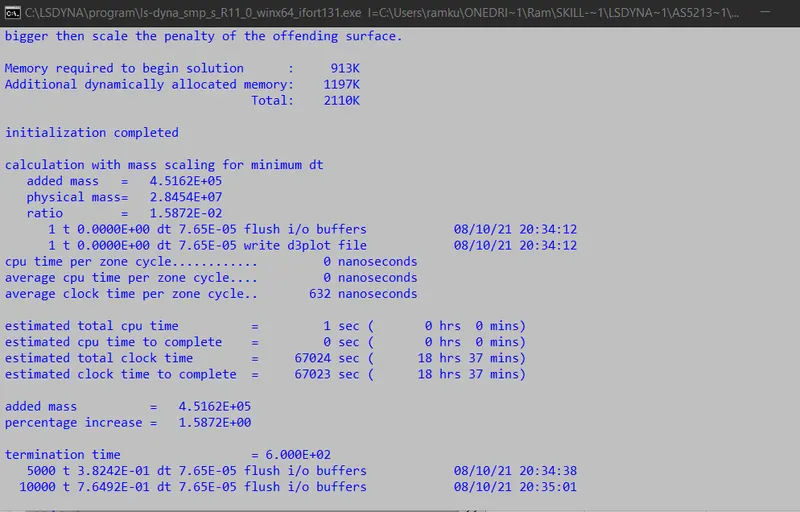
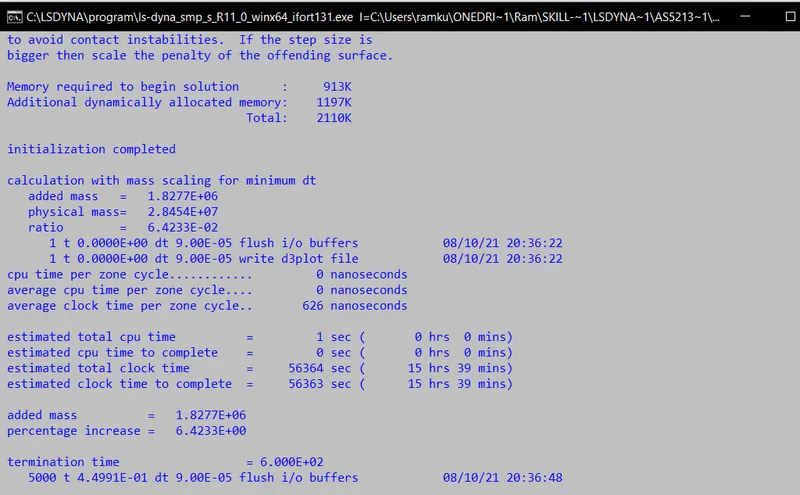
DT2MS = -10e-5
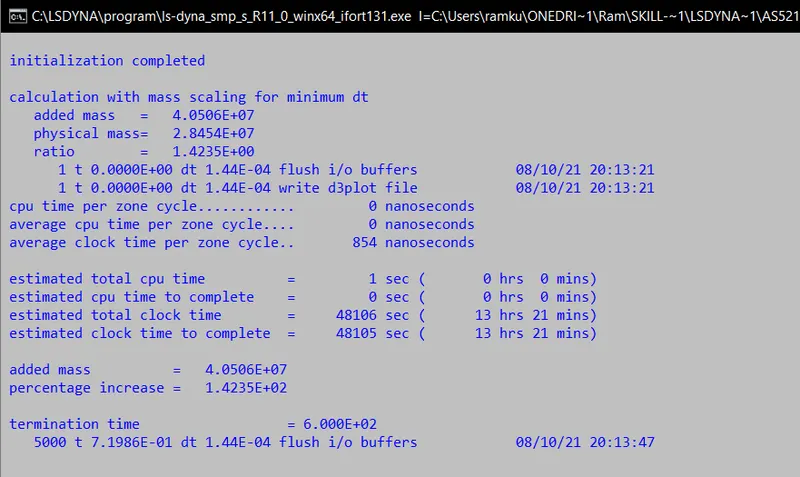
DT2MS = -16e-5
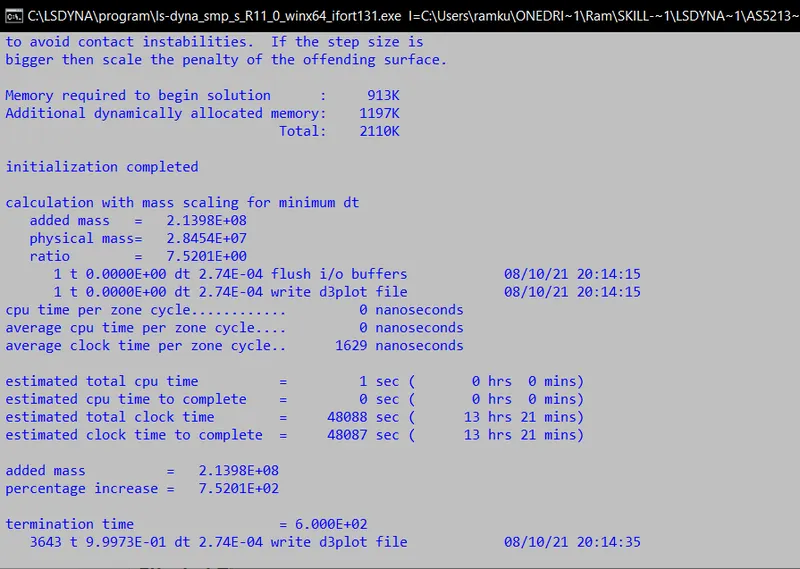
DT2MS = -30e-5
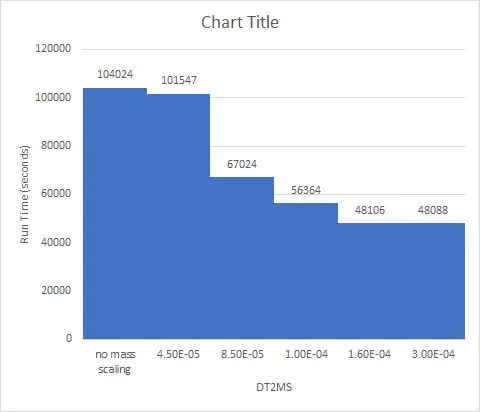
Effect of TSSFAC on runtime
We need to stop at DT2MS=-10e-5 as the run time is lower and added mass is within permissible value 8%
| DT2MS | Run Time (seconds) | Added Mass(%) |
| no mass scaling | 104024 | 0 |
| -4.50E-05 | 101547 | 0 |
| -8.50E-05 | 67024 | 1.587 |
| -1.00E-04 | 56364 | 6.423 |
| -1.60E-04 | 48106 | 142 |
| -3.00E-04 | 48088 | 752 |
IMPLICIT Solver
The model is then run using Implicit solver to understand the effect of runtime.
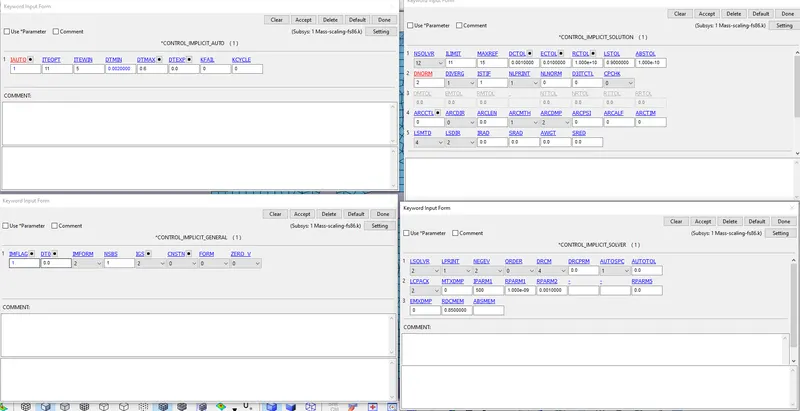
These are the keywords used for the Implicit solver.
Implicit General – invokes implicit solver
Implicit Auto – Automatically adjust time step size
Implicit Solution – Non linear solution method for implicit analysis
Implicit Solver – Linear equation solver method
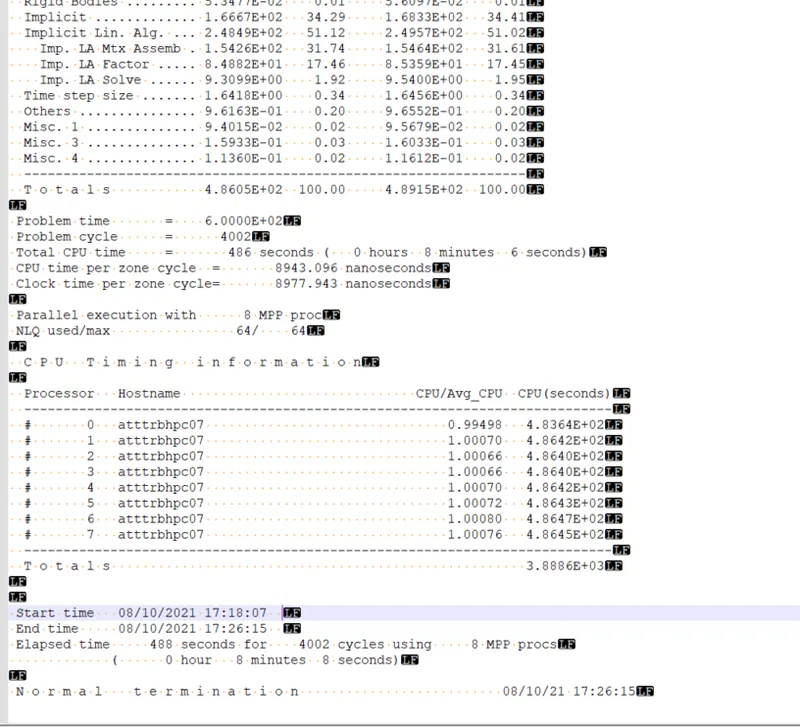
Total CPU time for Implicit analysis is 3888 seconds which is way less than that in explicit analysis. This is because of the fact Implicit analysis uses constant time step and solves for displacement using stiffness matrix inversion. We can see all the steps solutions converged within 2 iterations indicating a healthy calculation.
Conclusion:
Mass scaling greatly influences the run time as well as the accuracy of the simulation. Adding artificial mass more than 8% of the original total mass changes the system and should be kept as a hard limit. Implicit solver is way faster than explicit in this case as this doesn’t involve a lot a contact non linearity.