Week - 8 Mass Scaling
OBJECTIVE:
- To understand the behaviour and stability of a simulation with and without mass scaling.
- To compare the effect of mass scaling in LS-DYNA
- To compare the run time of the same simulation using explicit and implicit methods.
CASE 1: WITH NO CONTROL_TIMESTEP CARD:- NO MASS SCALING:
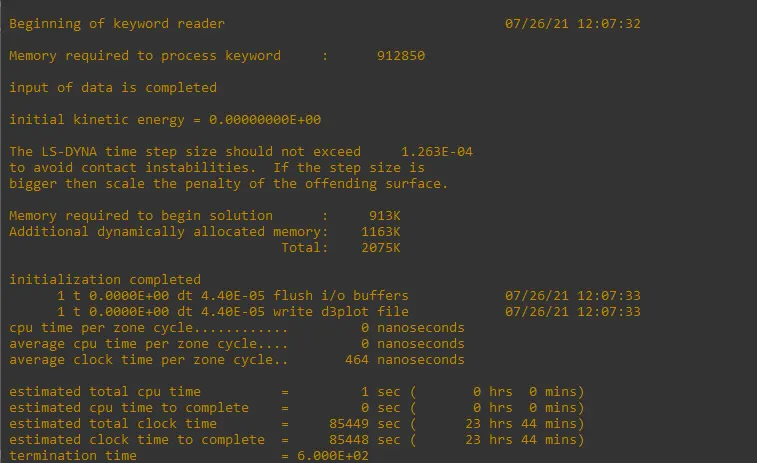
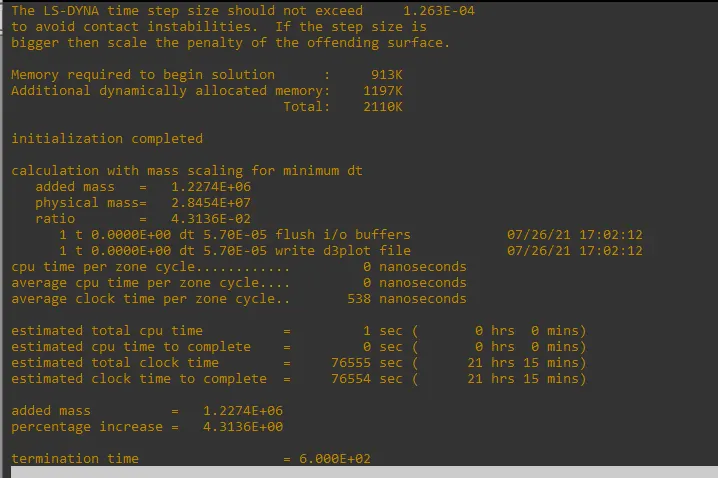
CASE 2: WITH MASS SCALING -DT2MS=-3.500e-05 AND TSSFAC=0.9:
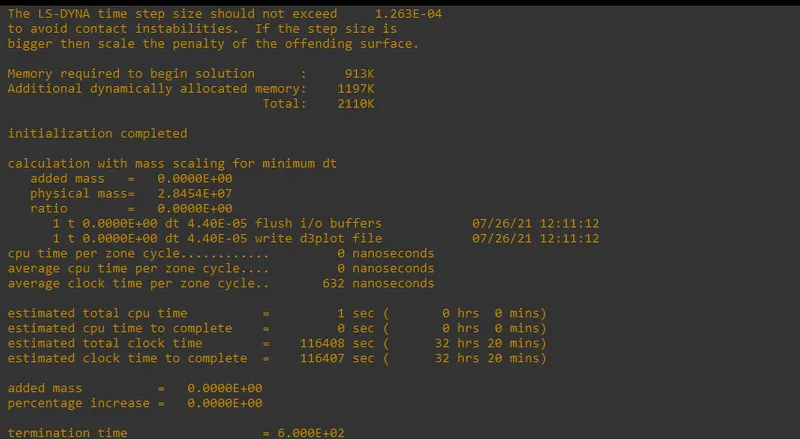
CASE 3: WITH MASS SCALING -DT2MS=-9.500e-05 AND TSSFAC=0.9:
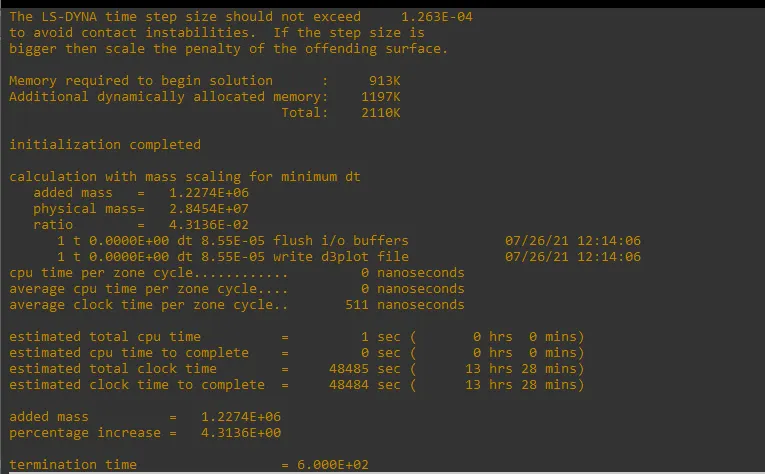
CASE 4: WITH MASS SCALING -DT2MS=-1.00e-04 AND TSSFAC=0.9:
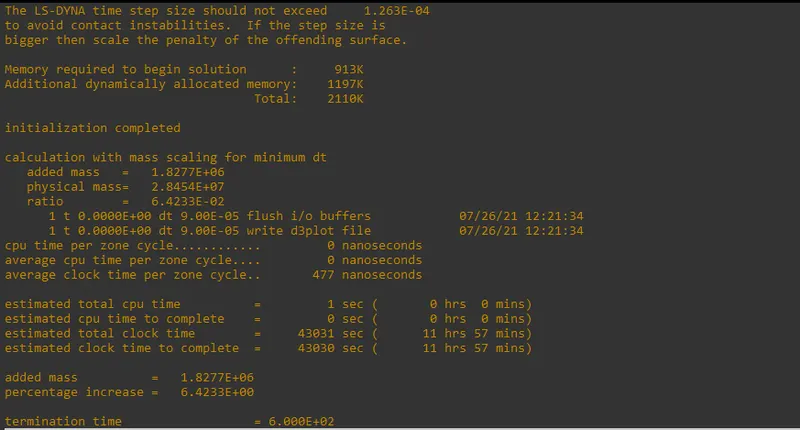
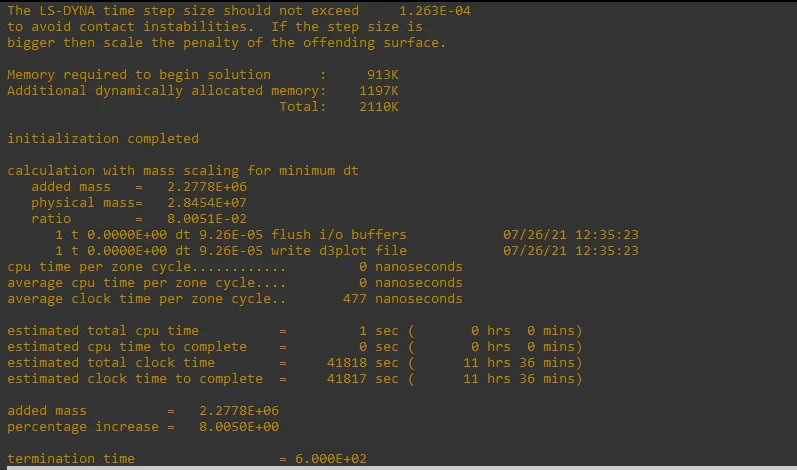
CASE 5: WITH MASS SCALING -DT2MS=-1.029e-04 AND TSSFAC=0.9
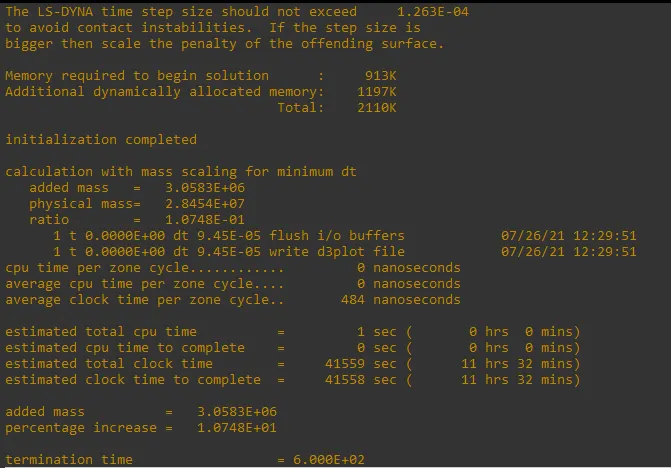
CASE 6: WITH MASS SCALING -DT2MS=-1.05e-04 AND TSSFAC=0.9
COMPARISON BETWEEN ESTIMATED RUN TIME AND DT2MS
Here run time is not the termination time.
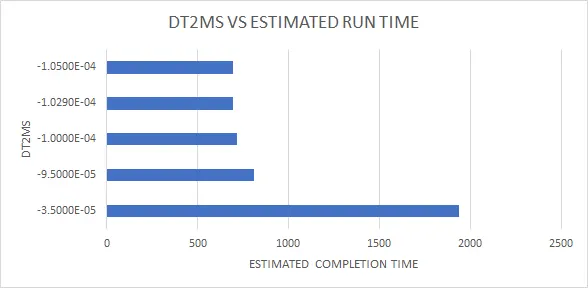
Time is in minutes
Here run time is not the termination time. It is the time taken by ls-dyna to calculate the solution for the given problem.
Higher values of DT2MS significantly reduces the simulation run time. It affects the added mass as well as the timestep.
COMPARISON BETWEEN ADDED MASS PERCENTAGE AND DT2MS
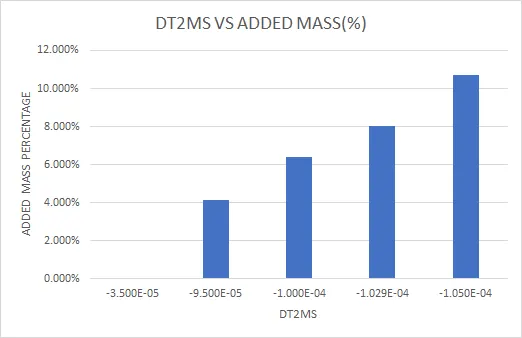
The negative value of DT2MS means, the mass will be added artificially to those elements whose timestep is less than the required value i.e, TSSFAC*abs(DT2MS). This will regulate the timestep and reduces the run time. It is not recommended to use it especially higher values of DT2MS which may induce drastic changes in the solution compared to the ideal solution. Here mass scaling is limited to 8% of the total mass.
This artificially added mass significantly reduces the simulation run time which can be clearly seen from the graph
CASE 7: WITH MASS SCALING -DT2MS=-3.50e-05 AND TSSFAC=0.8
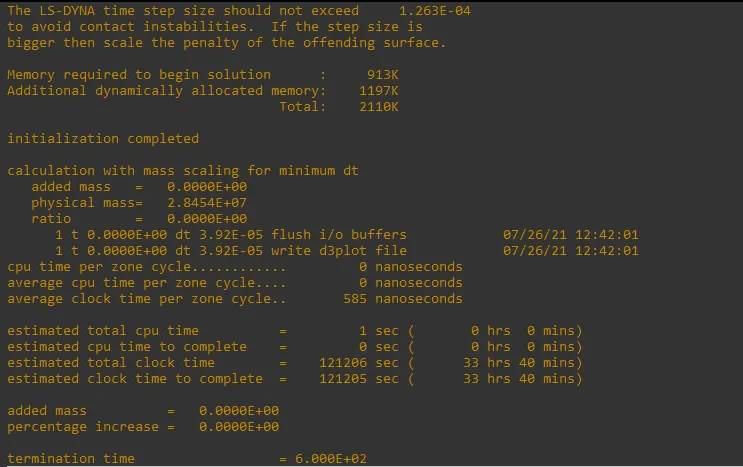
CASE 8: WITH MASS SCALING -DT2MS=-3.50e-05 AND TSSFAC=0.7
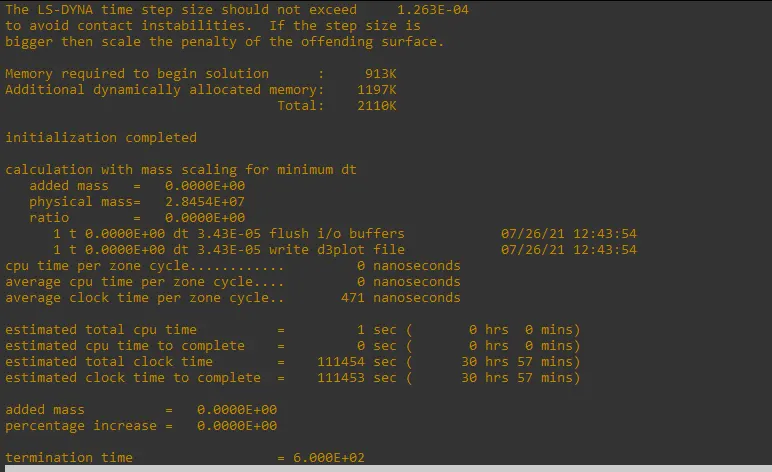
CASE 9: WITH MASS SCALING -DT2MS=-9.50e-05 AND TSSFAC=0.8
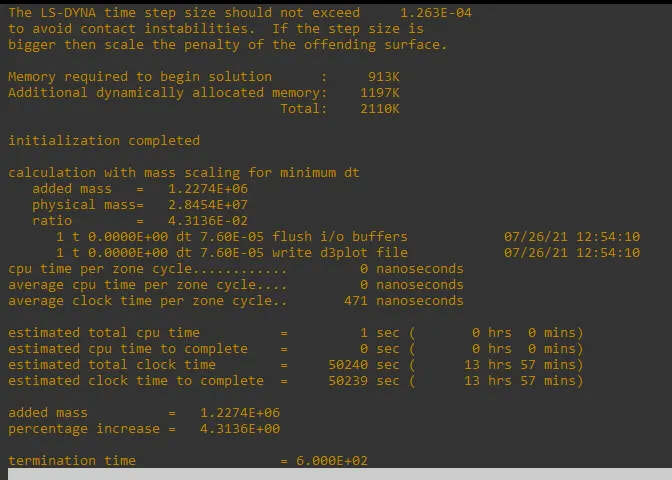
CASE 10: WITH MASS SCALING -DT2MS=-9.50e-05 AND TSSFAC=0.7
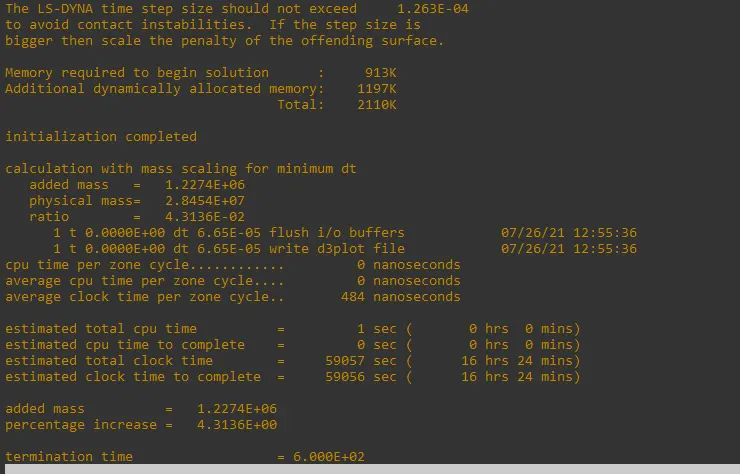
CASE 11: WITH MASS SCALING -DT2MS=-9.50e-05 AND TSSFAC=0.6
COMPARISON BETWEEN ESTIMATED RUN TIME AND TSSFAC:
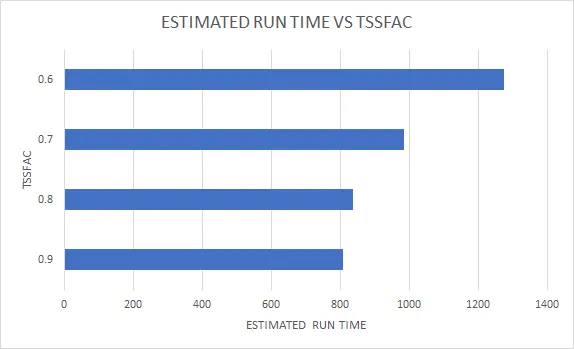
Time is in minutes
The run time is significantly reduced by higher values of the Timestep scale factor. This does not affect the added mass or the DT2MS but only scales the time step. The added Mass remains constant for different values of TSSFAC.
IMPLICIT vs EXPLICIT METHOD:
To convert it into an implicit analysis, *CONTROL_IMPLICIT_AUTO, *CONTROL_IMPLICIT_SOLVER, *CONTROL_IMPLICIT_SOLUTION, and *CONTROL_IMPLICIT_GENERAL cards were added.
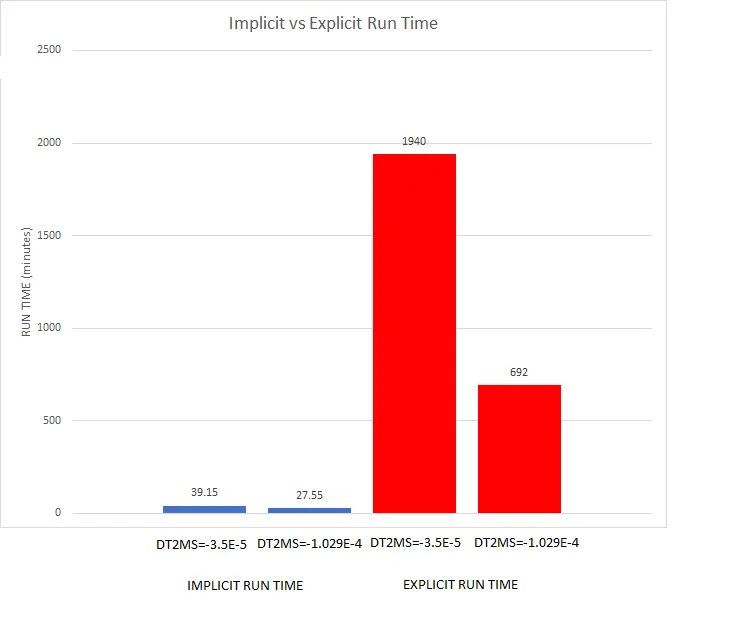
There is a huge difference between the run time of implicit and explicit analysis. The implicit method solves much faster than the explicit method for this particular setup. Higher values of DT2MS decrease the run time of both implicit and explicit methods.
CONCLUSION:
Here, CASE 2 is ideally expected to have a lower run time compared to case 1. This error could be due to the system configuration, background tasks, plugged in or not etc., at the time of the experiment.
- DT2MS significantly affects the run time of a simulation. The higher the value of DT2MS, the lower will be the run time of the simulation.
- DT2MS affects the mass and timestep whereas TSSFAC only affects the timestep.
- Higher values of DT2MS and lower values of TSSFAC may cause drastic changes in the solution.
- If required, increase the value of DT2MS and reduce the value of TSSFAC proportionally to increase the timestep. A larger timestep equals lower solution time.
- The run time of an Implicit solver is very much less than the explicit solver for this case. Higher DT2MS and lower TSSFAC will reduce the run time for both the solvers.
- The percentage of the artificially added mass has to be kept between 5 to 10 percentage of the total mass.