Week - 8 Mass Scaling
Objective:
To perform the mass scaling to reduce the runtime of a model and ensure the stability of mass scaling. The hard limit on mass scaling is 8% and stability should be completely intact.Mass is added by changing DT2MS as well as TSSFAC.Once the mass scaling objective is reached, a histogram should be plotted to compare the runtime with mass scaling trials.
Procedure:
Nonphysical mass to increase the timestep in a dynamic analysis, you affect the results (think of F=m*a). Sometimes the effect is insignificant and in those cases adding nonphysical mass is justifiable. Examples of such cases may include the addition of mass to just a few small elements in a noncritical area or quasi-static simulations where the velocity is low and the kinetic energy is very small relative to the peak internal energy. In the end, it's up to the judgement of the analyst to gage the affect of mass scaling. You may have to reduce or eliminate mass scaling in a second run to gage the sensitivity of the results to the amount of mass added.
One can employ mass scaling in a selective manner by artificially increasing material density of the parts you want to mass-scale. This manual form of mass scaling is done independently of the automatic mass scaling invoked with DT2MS in *CONTROL_TIMESTEP.
When DT2MS is input as a negative value, mass is added only to those elements whose timestep would otherwise be less the |DT2MS|. By adding mass to these elements, their timestep becomes equal to |DT2MS|. An infinite number of combinations of TSSFAC and DT2MS will give the same product, i.e., timestep but the added mass will be different for each of those combinations. The trend is that the bigger |DT2MS| (and the smaller TSSFAC while TSSFAC*|DT2MS|=const), the greater the added mass. In return, stability may improve as TSSFAC is reduced (just as in non-mass-scaled solutions). If stability is a problem with the default TSSFAC of 0.9. If you reduce TSSFAC, you can increase |DT2MS| proportionally so that their product, and hence timestep, is unchanged.
The difference between using a positive or negative number for DT2MS in*CONTROL_TIMESTEP is as follows:
Negative: Mass is added to only those elements whose timestep would otherwise be less than TSSF*abs(DT2MS). When mass scaling is appropriate, I recommend this method.
Positive: Mass is added or taken away from elements so that the timestep of every element is the same. My opinion is there is no advantage to using this method over the negative DT2MS method and I find it harder to rationalize.
The parameter MS1ST in *CONTROL_TIMESTEP controls whether mass is added only once during initialization (MS1ST=1) or anytime as necessary to maintain the desired timestep specified via DT2MS (MS1ST=0).
You can use ENDMAS in *CONTROL_TERMINATION to stop the calculation aftera certain amount of mass has been added (active for automatic mass scaling only).
Trial 1:
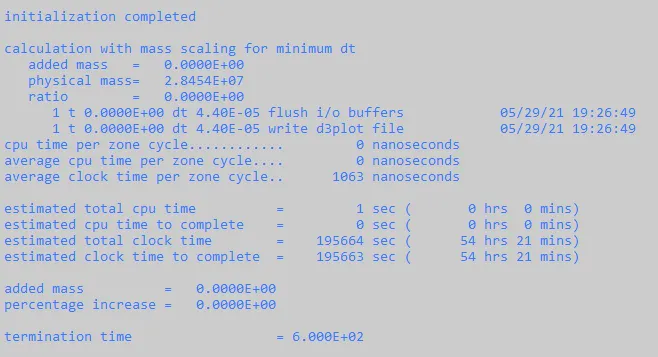
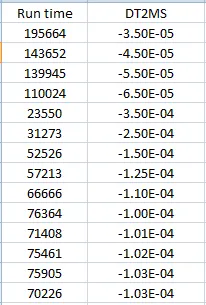
The model has TSSFAC and DT2MS values are 0.9 as default and -3.5e-05 as default in the given model.run the model ,finially the estimated time is 54hrs 21mins.(195663sec)
Trial 2:
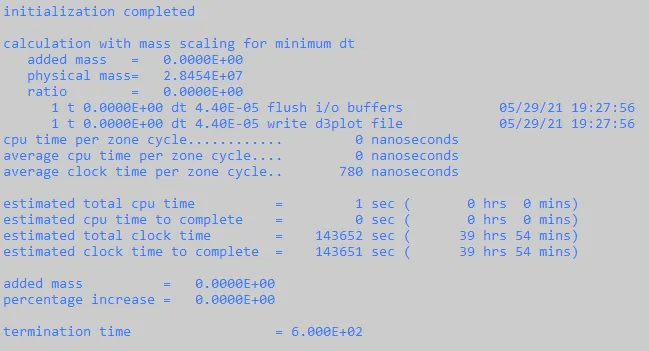
The model have TSSFAC and DT2MS values are 0.9 and -4.5e-05 ,the estimated run simulation time is 39hrs 54mins (143652 sec)
Trial 3:
The model have TSSFAC and DT2MS values are 0.9 and -5.5e-05 ,the estimated run simulation time is 39hrs 54mins (139944 sec)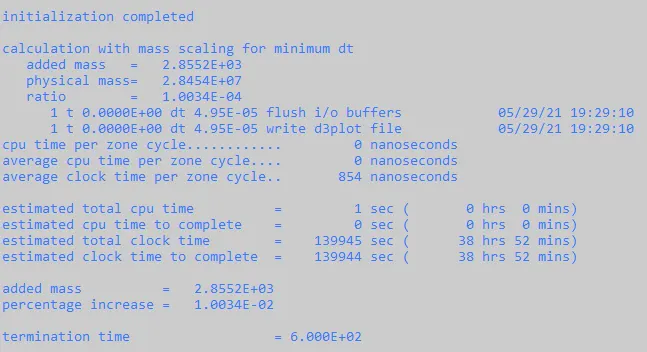
Trial 4:
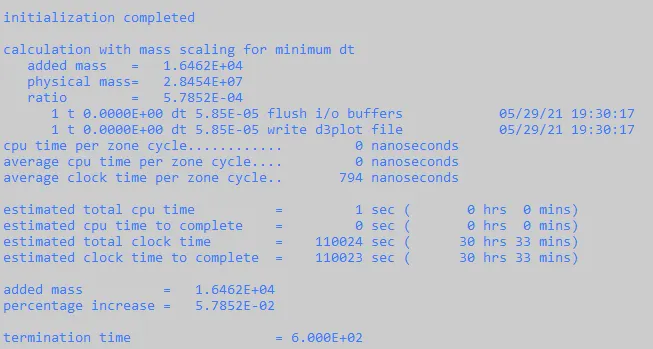
The model have TSSFAC and DT2MS values are 0.9 and -6.5e-05 ,the estimated run simulation time is 30hrs 33mins (110024 sec)
Trial 5:
The model have TSSFAC and DT2MS values are 0.9 and -3.5e-04 ,the estimated run simulation time is 39hrs 54mins (23550 sec)
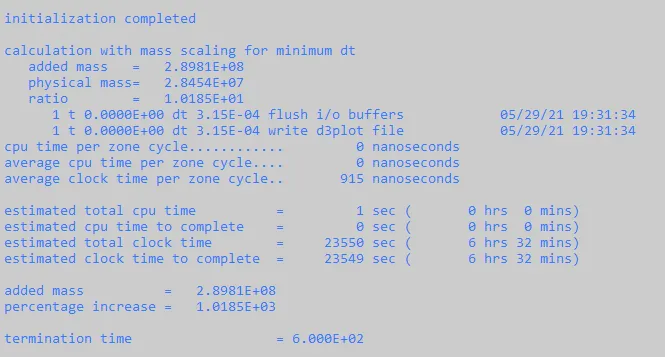
Trial 6:
The model have TSSFAC and DT2MS values are 0.9 and -2.5e-04 ,the estimated run simulation time is 8hrs 41mins (31272 sec)
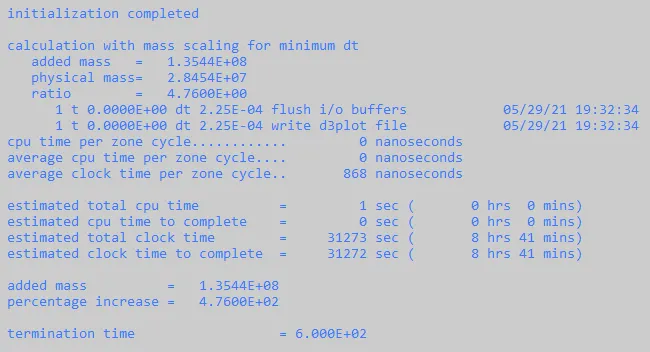
Trial 7:
The model have TSSFAC and DT2MS values are 0.9 and -1.5e-04 ,the estimated run simulation time is 14hrs 35mins (52525 sec)
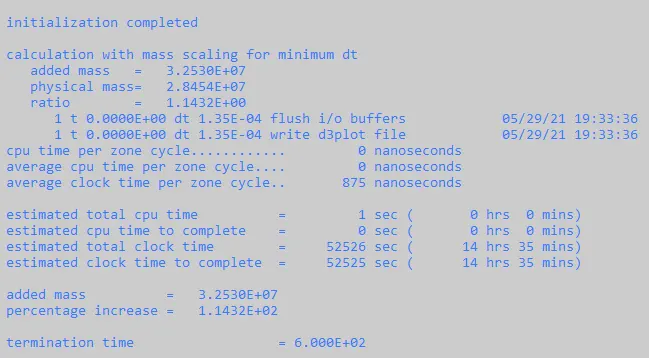
Trial 8:
The model have TSSFAC and DT2MS values are 0.9 and -1.25e-04 ,the estimated run simulation time is 15hrs 53mins (57212 sec)
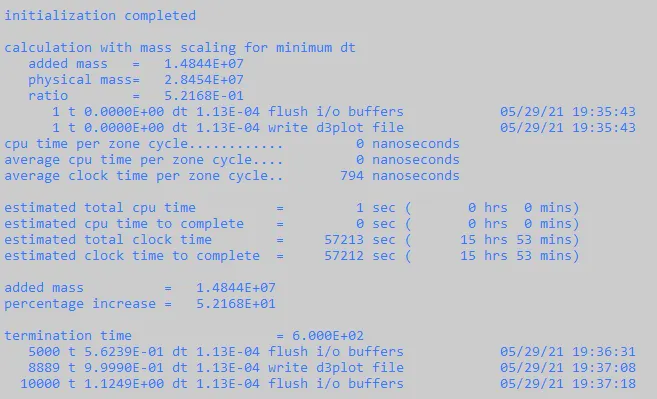
Trial 9:
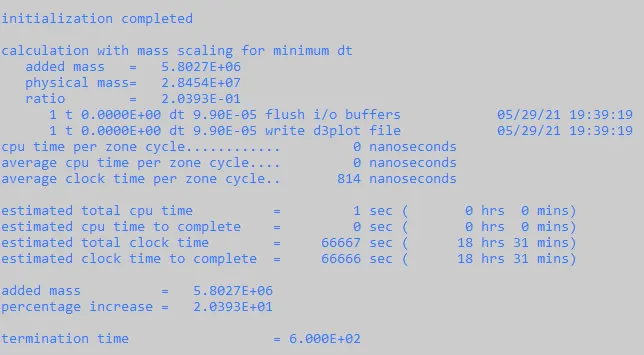
The model have TSSFAC and DT2MS values are 0.9 and -1.1e-04 ,the estimated run simulation time is 18hrs 31mins (66667 sec)
Trial 10:
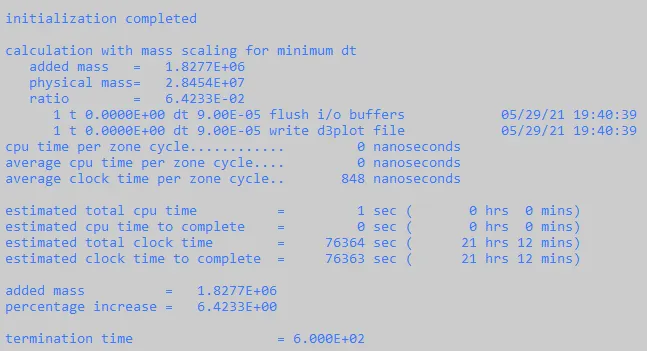
The model have TSSFAC and DT2MS values are 0.9 and -1e-04 ,the estimated run simulation time is 21hrs 12mins (76364 sec)
Trial 11:
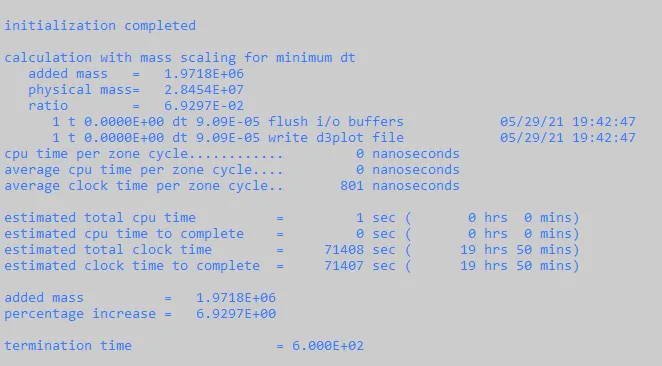
The model have TSSFAC and DT2MS values are 0.9 and -1.01e-04 ,the estimated run simulation time is 19hrs 50mins (71408 sec)
Trial 12:
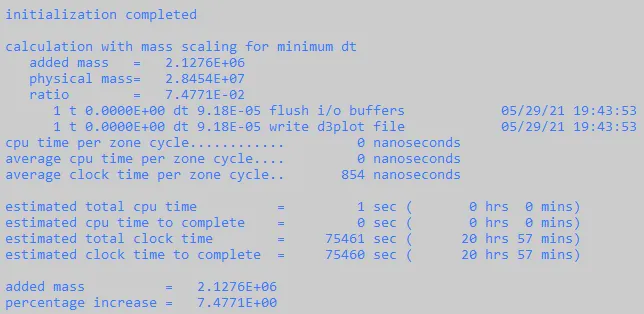
The model have TSSFAC and DT2MS values are 0.9 and -1.02e-04 ,the estimated run simulation time is 20hrs 50mins (75461 sec)
Trial 13:
The model have TSSFAC and DT2MS values are 0.9 and -1.03e-04 ,the estimated run simulation time is 21 hrs 5mins (75905 sec)
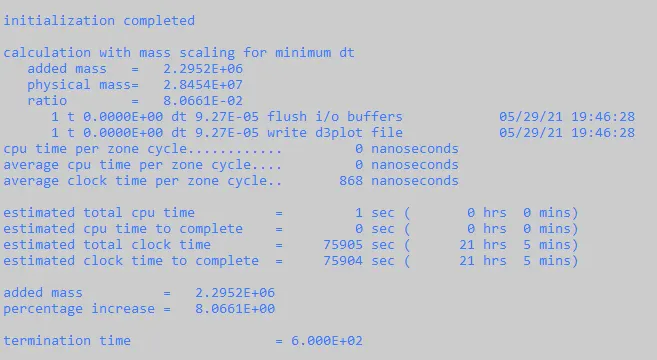
Trial 14:
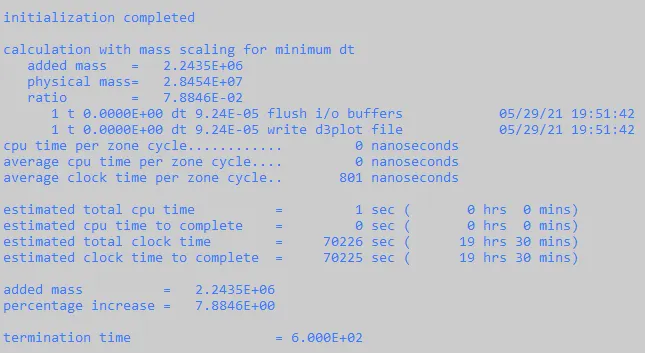
The model have TSSFAC and DT2MS values are 0.9 and -1.027e-04 ,the estimated run simulation time is 19hrs 30mins (70225 sec)
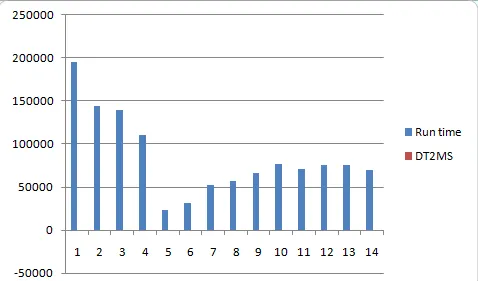
Histogram:
Runtime with mass scaling trials
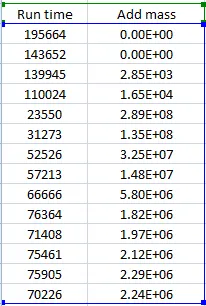
Runtime vs Addedmass
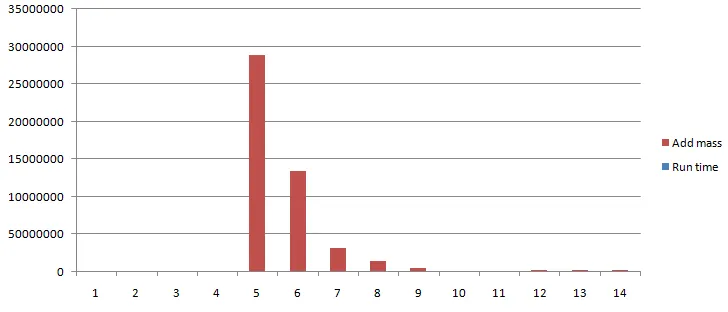
Runtime vs DT2MS
Implicit Analysis:
These model is run with implicit analysis and run time
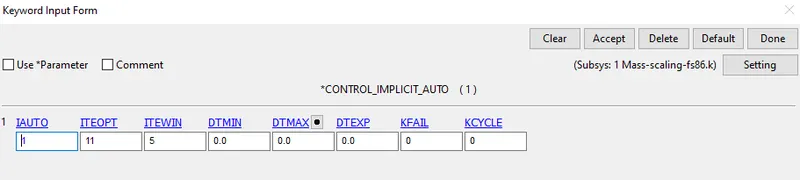
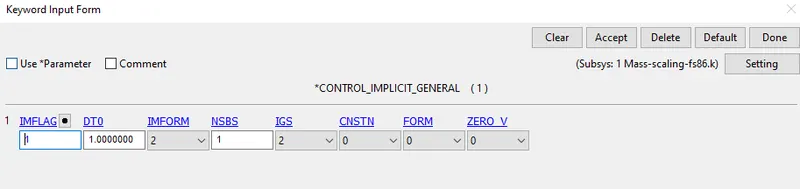
Control cards are been implicit analysis are followed below
*CONTROL_IMPLICIT_AUTO,*CONTROL_IMPLICIT_GENERAL,*CONTROL_IMPLICIT_SOLUTION,*CONTROL_IMPLICIT_SOLVER.
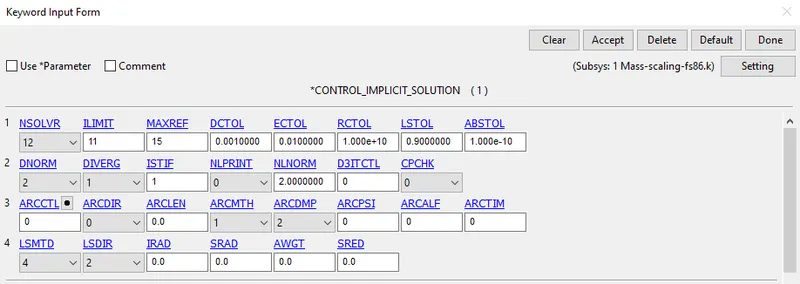
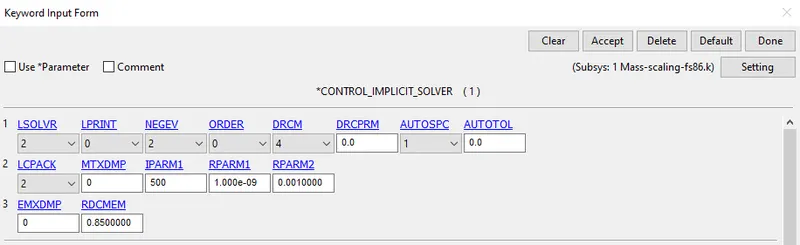
Trial 1:
The model have TSSFAC and DT2MS values are 0.9 and -3.500e-05 ,the estimated run simulation time is 3mins 18sec (198 sec)
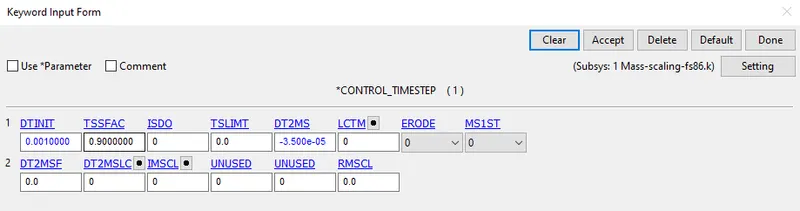
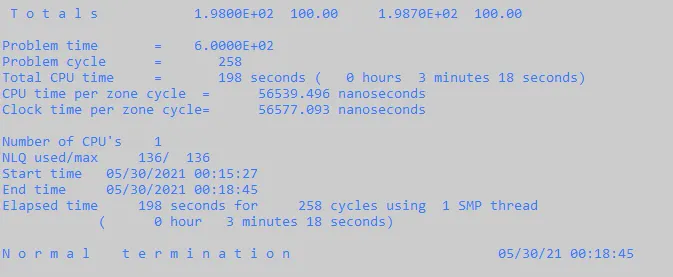
Trial 2:
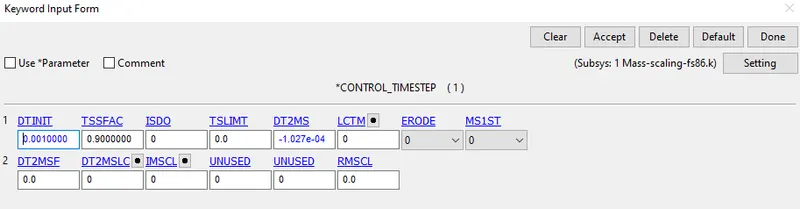
The model have TSSFAC and DT2MS values are 0.9 and -1.027e-04 ,the estimated run simulation time is 2mins 50sec (170 sec)
.
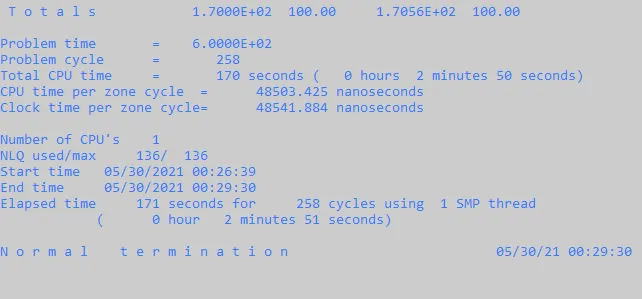
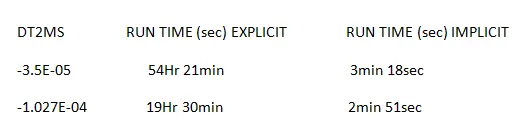
From the above timestep we have observed run times during the implicit analysis, below the runtime of implicit ans explicit ,DT2MS is attached
Conclusion:
Mass scaling for a given model is carried through the timestep by varies value of DT2MS and TSSFAC using varies trial runs.
The hard limit on mass scaling is 8%,it is stable at DT2MS is -1.027E-4 and TSSFAC is 0.9,the runtime for completing the simulation is 19hr30mins.
Implicit analysis requires a numerical solver to invert the stiffness matrix once or even several times over the course of a load/time step. This matrix inversion is an expensive operation, especially for large models. Explicit doesn't require this step.
The mass scaling for implicit case the DT2MS and TSSFAC are -3.5e-5 and 0.9 with runtime 3min 18sec,
DT2MS and TSSFAC for implicit problem for -1.027E-04 and 0.9 with runtime 2min 51sec.
Time step can be controlled by using mass of the simulation, the mass scaling is only useful for explicit simulation.it can be maintain by changing DT2MS and TSSFAC parameters.
The implicit method should be used slower and effects of stress strain rates.