Week - 8 Mass Scaling
Objective
To study the effects of mass scaling on the run-time and the accuracy of the model, while keeping the percentage of mass addition less than 8%.
Step 1: Explicit Analysis
The given model is opened in LS-Dyna and simulated first with default parameters. The unit system is kg-m-sec.
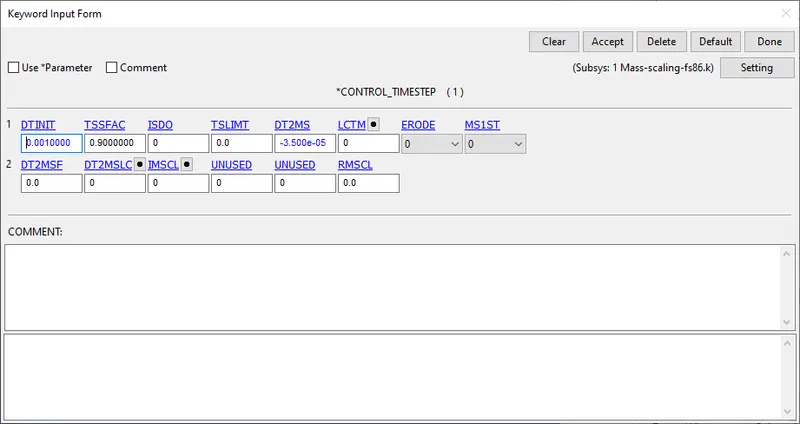
The parameters of the CONTROL_TIMESTEP card control the mass scaling in the model.
If DT2MS > 0, all elements are mass scaled to the given timestep value.
If DT2MS < 0, only the elements having a lower timestep than DT2MS are mass scaled, thereby improving the efficiency of the simulation by making it faster.
TSSFAC is a scaling factor for the DT2MS to ensure that the simulation remains stable, by scaling the time step down according to the given value. The normal range of TSSFAC is 0.6-0.9.
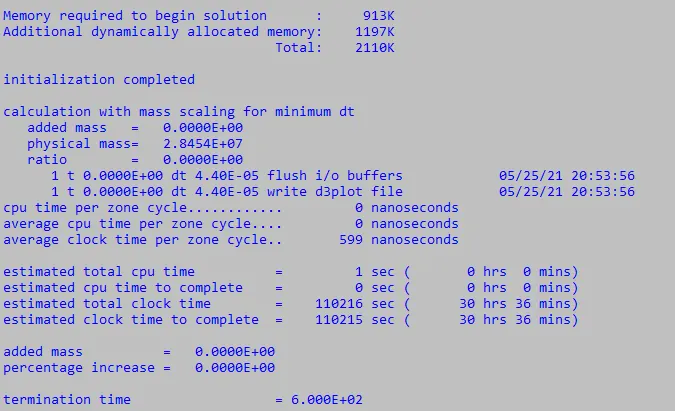
Iteration 1: DT2MS = -3.5e-5
TSSFAC = 0.9
TSSFAC = 0.8
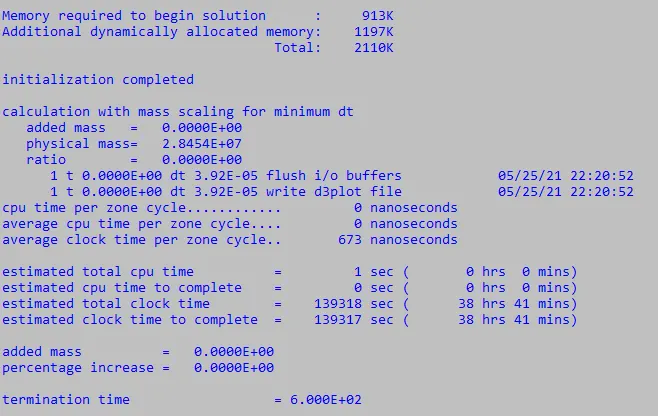
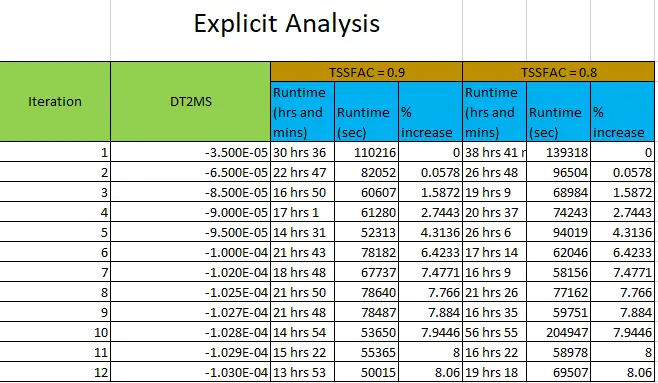
For a DT2MS of -3.5e-5, the run time with TSSFAC of 0.9 and 0.8 are 30 hrs and 36 mins and 38 hrs 41 mins, respectively. The percentage increase is 0 in both cases, since the TSSFAC does not vary the added mass.
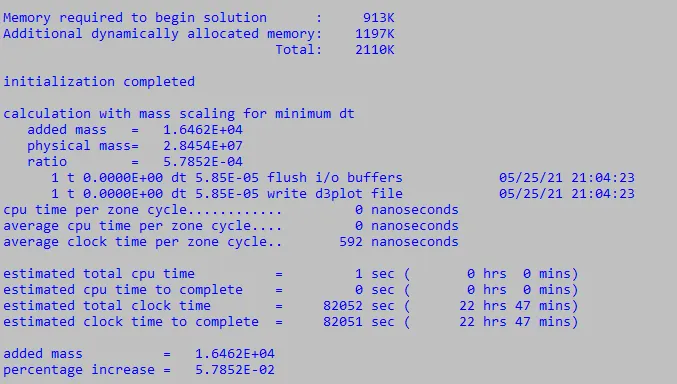
Iteration 2: DT2MS = -6.5e-5
TSSFAC = 0.9
TSSFAC = 0.8
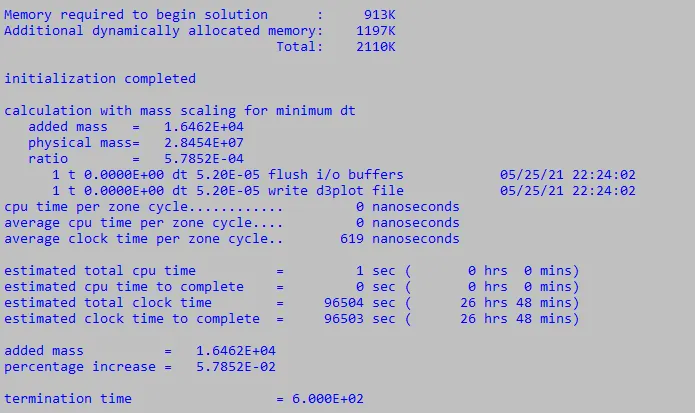
For a DT2MS of -6.5e-5, the run time with TSSFAC of 0.9 and 0.8 are 22 hrs and 47 mins and 26 hrs 48 mins, respectively. The percentage increase is 0.0578 in both cases, since the TSSFAC does not vary the added mass.
Iteration 3: DT2MS = -8.5e-5
TSSFAC = 0.9
TSSFAC = 0.8
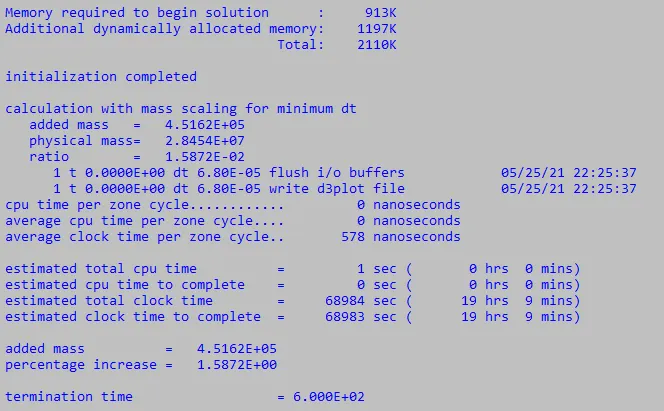
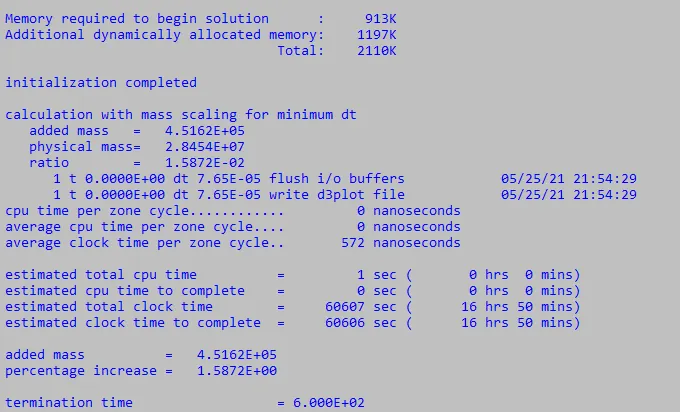
For a DT2MS of -8.5e-5, the run time with TSSFAC of 0.9 and 0.8 are 16 hrs and 50 mins and 19 hrs 9 mins, respectively. The percentage increase is 1.5872 in both cases, since the TSSFAC does not vary the added mass.
Iteration 4: DT2MS = -9e-5
TSSFAC = 0.9
TSSFAC = 0.8
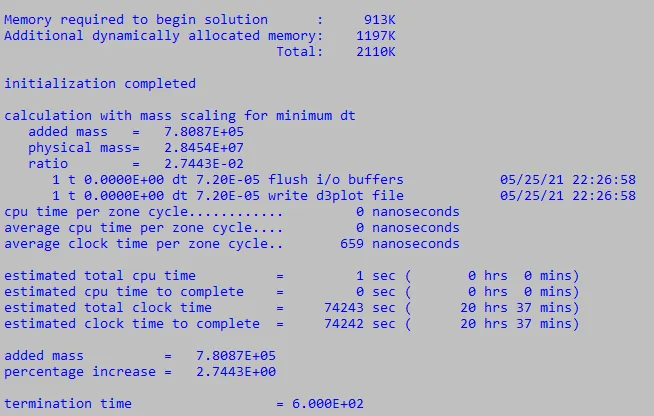
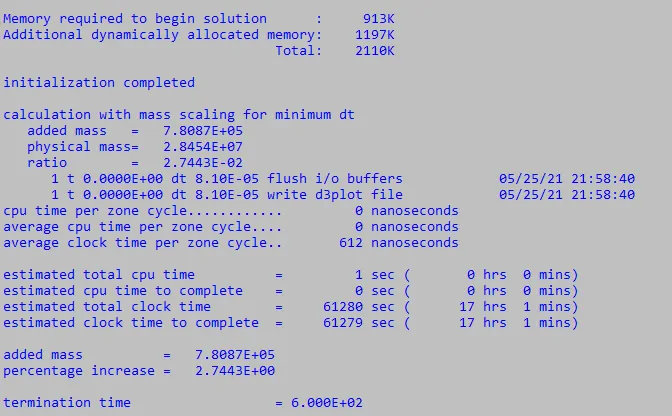
For a DT2MS of -9e-5, the run time with TSSFAC of 0.9 and 0.8 are 17 hrs and 1 mins and 20 hrs 37 mins, respectively. The percentage increase is 2.7443 in both cases, since the TSSFAC does not vary the added mass.
Iteration 5: DT2MS = -9.5e-5
TSSFAC = 0.9
TSSFAC = 0.8
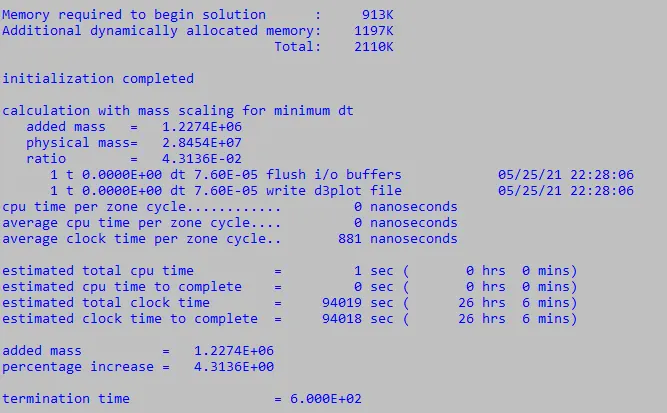
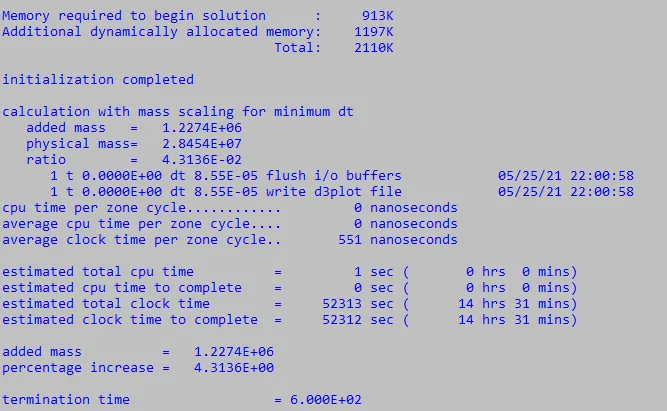
For a DT2MS of -9.5e-5, the run time with TSSFAC of 0.9 and 0.8 are 14 hrs and 37 mins and 26 hrs 6 mins, respectively. The percentage increase is 4.3136 in both cases, since the TSSFAC does not vary the added mass.
Iteration 6: DT2MS = -10e-5
TSSFAC = 0.9
TSSFAC = 0.8
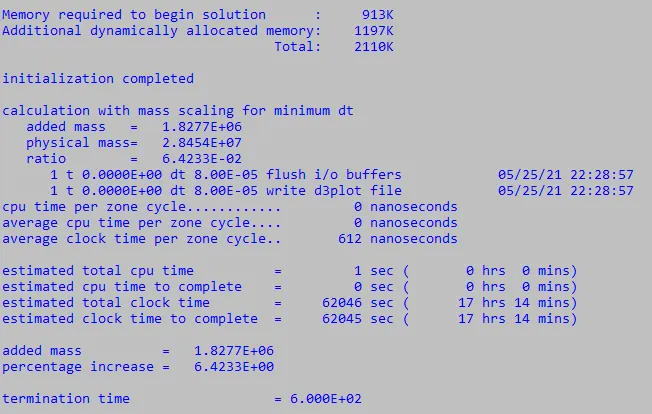
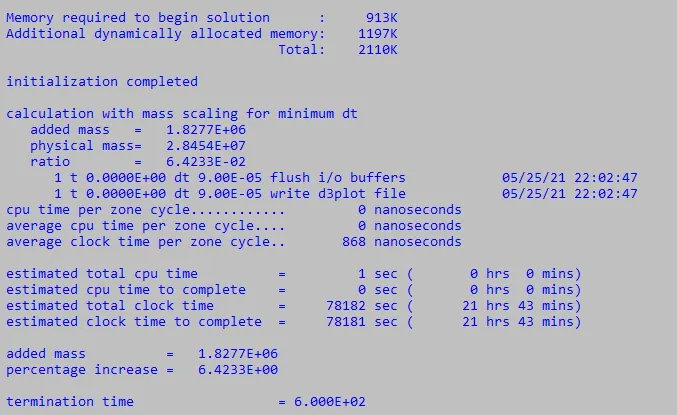
For a DT2MS of -10e-5, the run time with TSSFAC of 0.9 and 0.8 are 21 hrs and 43 mins and 17 hrs 14 mins, respectively. The percentage increase is 6.4233 in both cases, since the TSSFAC does not vary the added mass.
Since the percentage increase is already close to 6.5, the increments in the timestep are reduced from the next iteration.
Iteration 7: DT2MS = -10.2e-5
TSSFAC = 0.9
TSSFAC = 0.8
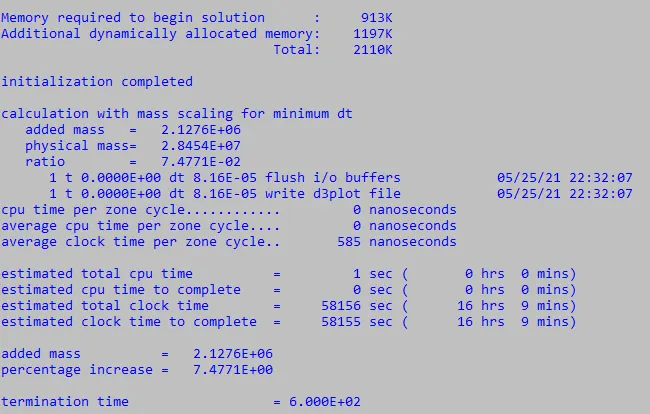
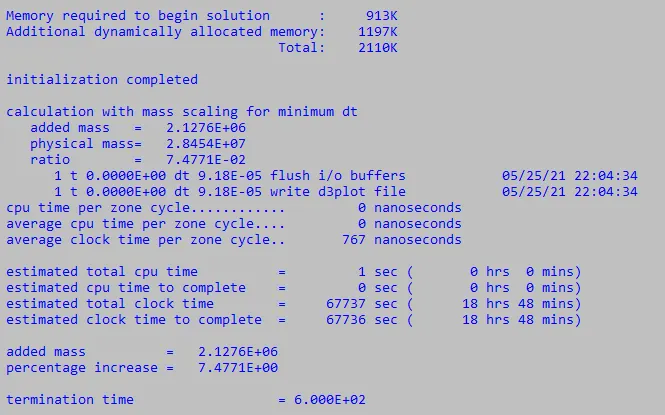
For a DT2MS of -10.2e-5, the run time with TSSFAC of 0.9 and 0.8 are 18 hrs and 48 mins and 16 hrs 9 mins, respectively. The percentage increase is 7.4771 in both cases, since the TSSFAC does not vary the added mass.
Iteration 8: DT2MS = -10.25e-5
TSSFAC = 0.9
TSSFAC = 0.8
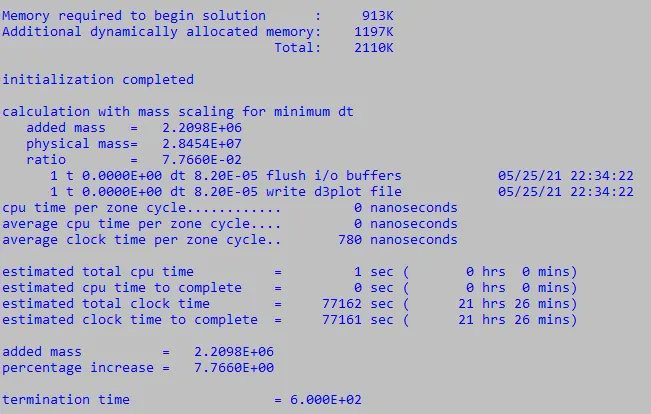
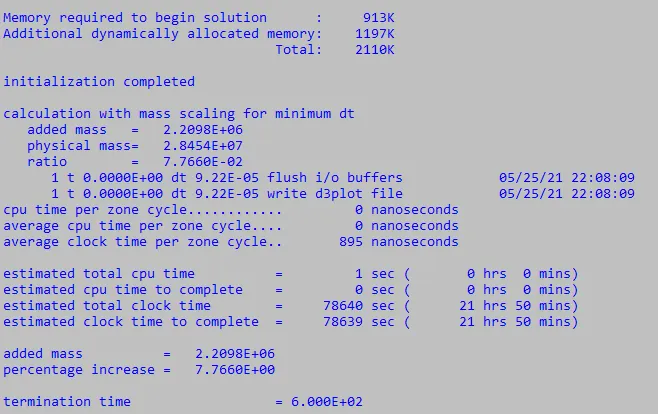
For a DT2MS of -10.25e-5, the run time with TSSFAC of 0.9 and 0.8 are 21 hrs and 50 mins and 21 hrs 26 mins, respectively. The percentage increase is 7.766 in both cases, since the TSSFAC does not vary the added mass.
Iteration 9: DT2MS = -10.27e-5
TSSFAC = 0.9
TSSFAC = 0.8
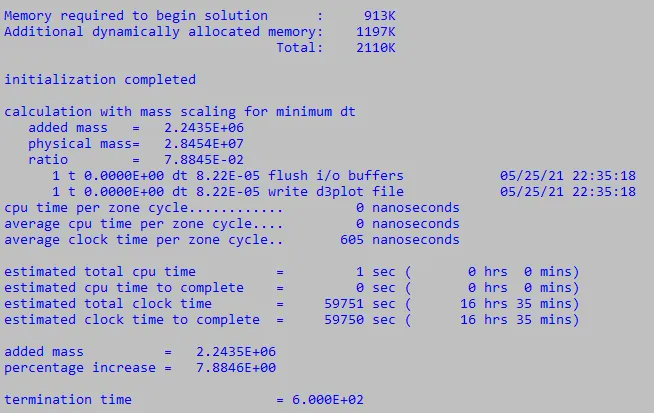
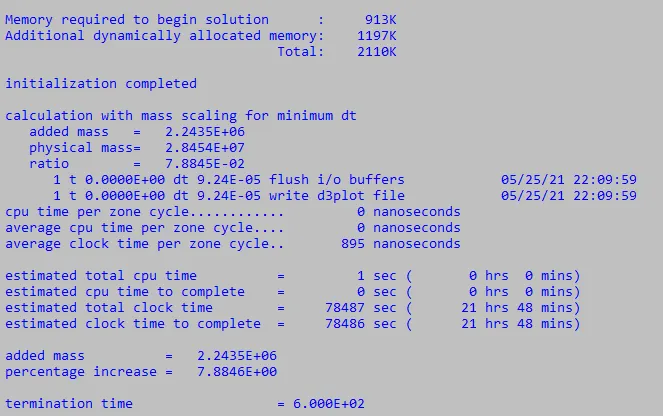
For a DT2MS of -10.27e-5, the run time with TSSFAC of 0.9 and 0.8 are 21 hrs and 48 mins and 16 hrs 35 mins, respectively. The percentage increase is 7.8846 in both cases, since the TSSFAC does not vary the added mass.
The percentage increase now is very close to 8; therefore the timestep increment has to be further reduced in the next iterations.
Iteration 10: DT2MS = -10.28e-5
TSSFAC = 0.9
TSSFAC = 0.8
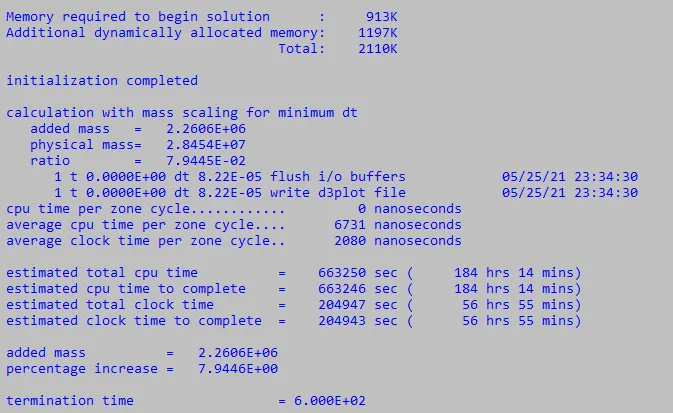
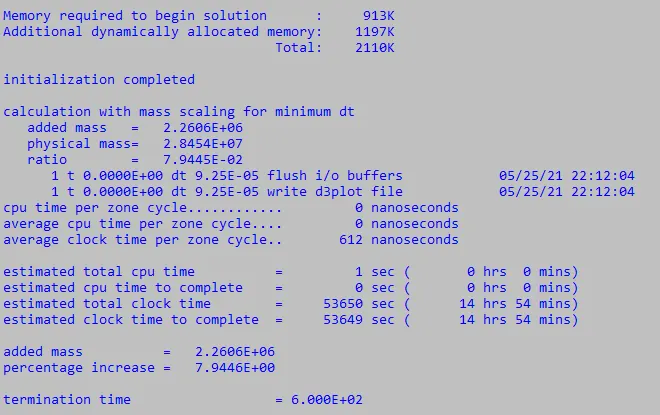
For a DT2MS of -10.28e-5, the run time with TSSFAC of 0.9 and 0.8 are 14 hrs and 54 mins and 56 hrs 55 mins, respectively. The percentage increase is 7.9446 in both cases, since the TSSFAC does not vary the added mass.
Iteration 11: DT2MS = -10.29e-5
TSSFAC = 0.9
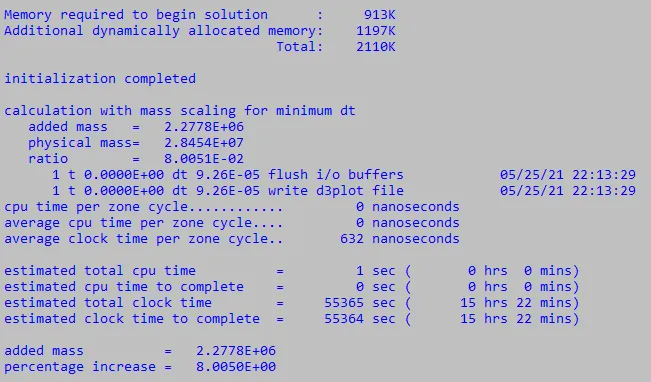
TSSFAC = 0.8
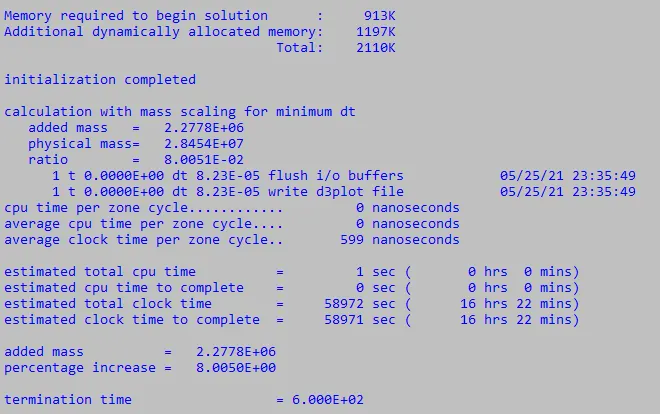
For a DT2MS of -10.29e-5, the run time with TSSFAC of 0.9 and 0.8 are 15 hrs and 22 mins and 16 hrs 22 mins, respectively. The percentage increase is 8.00 in both cases, since the TSSFAC does not vary the added mass.
The acceptable limit for the percentage increase in mass of 8% has been reached. Increasing the timestep any more will result in a percentage increase higher than the acceptable threshold, which is shown in the next iteration.
Iteration 12: DT2MS = -10.3e-5
TSSFAC = 0.9
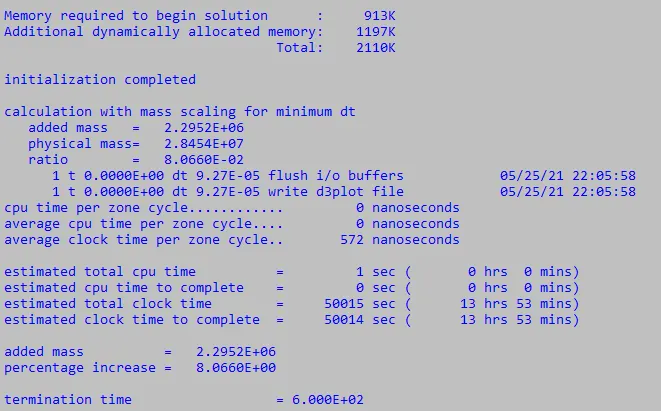
TSSFAC: 0.8
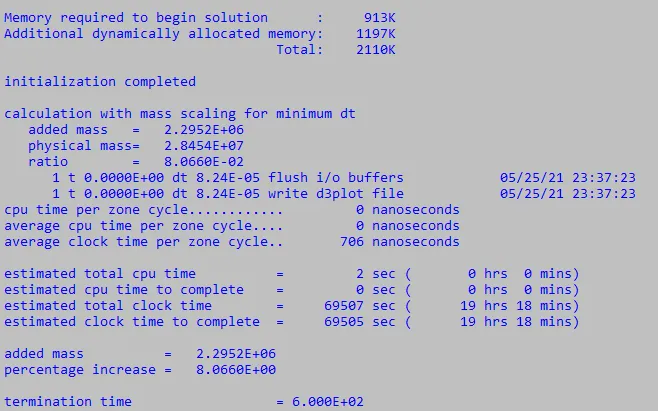
For a DT2MS of -10.3e-5, the run time with TSSFAC of 0.9 and 0.8 are 13 hrs and 53 mins and 19 hrs 18 mins, respectively. The percentage increase is 8.06 in both cases, since the TSSFAC does not vary the added mass.
Step 2: Implicit analysis
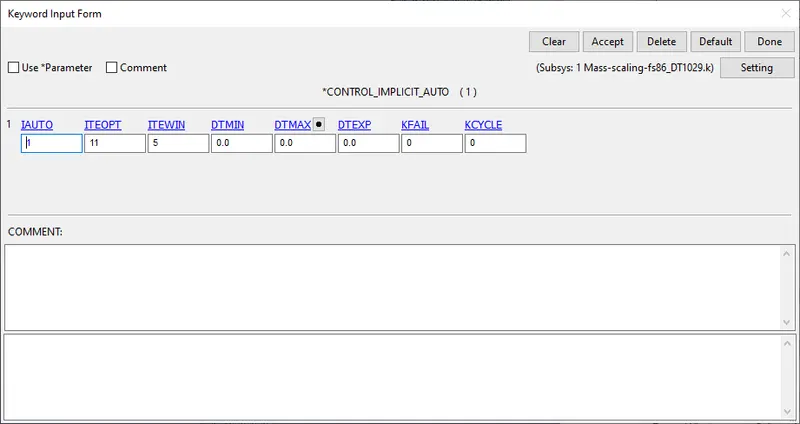
The following control cards are defined, to run the model using an implicit scheme.
CONTROL_IMPLICIT_AUTO
CONTROL_IMPLICIT_GENERAL
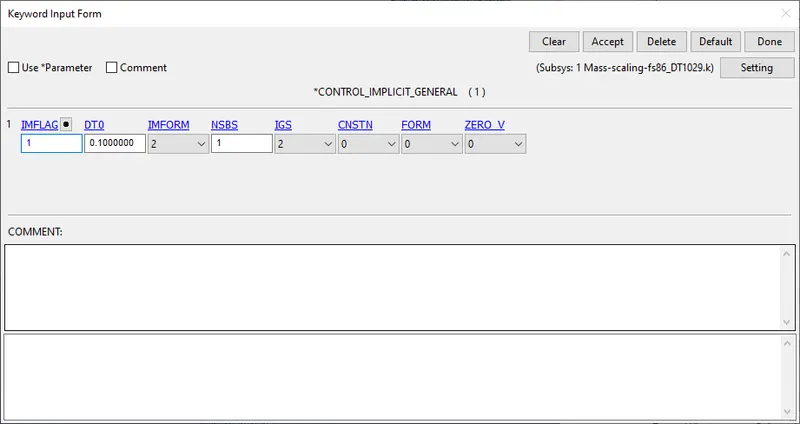
The IMFLAG is set to 1 and the DT0 value is given as 0.1.
Iteration 1: DT2MS : -3.5e-5, TSSFAC:0.9
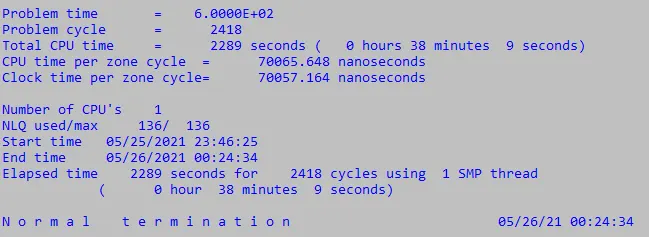
Iteration 2: DT2MS : -10.29e-5, TSSFAC:0.9
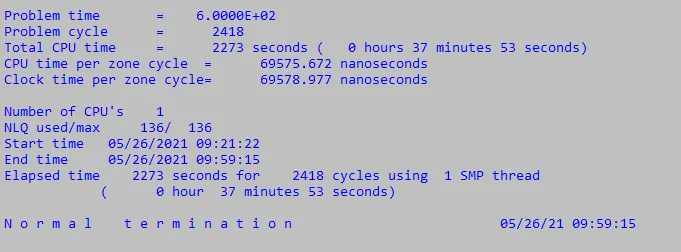
The results of the implicit and explicit analysis are discussed in the results section.
Results
Explicit analysis
The values of the runtime and added mass for each iteration is entered in an excel sheet and plotted.
Data values
Histogram
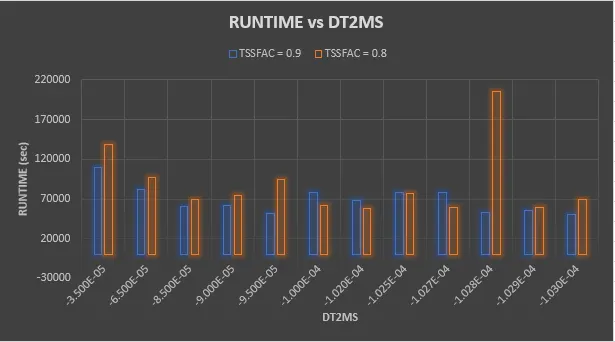
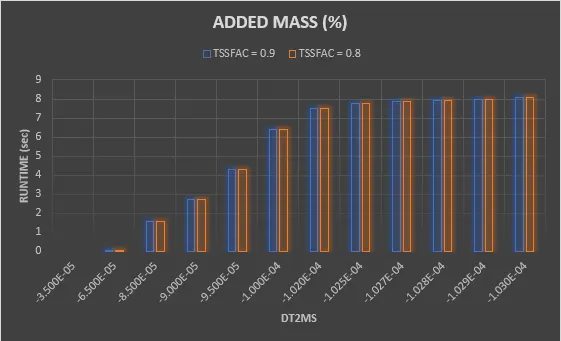
From the above figure, the runtime for a DT2MS value of -3.5e-5 and TSSFAC of 0.9 is 110216 sec and the added mass percentage is 0. When the DT2MS value is -10.29 e-5, the runtime is 55365 sec and the added mass percentage is 8.00.
Therefore, this is the largest possible value of DT2MS.
Implicit analysis
The two iterations of the implicit analysis are shown in the figure below.
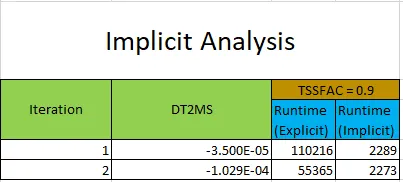
The values of the runtime for the explicit and the implicit analysis are compared. The implicit analysis is much faster than the explicit irrespective of the DT2MS value. The timestep in an implicit simulation does not influence the actual simulation time, since every step in iterated until convergence is reached.
The percentage of added mass is not reported in the implicit simulation.
Conclusion
Thus the mass scaling for the given model for both explicit and implicit simulation is performed and the results are analyzed.
The excel sheet with the results and the model of the implicit analysis can be found under the link below.
https://drive.google.com/drive/folders/1a9zIOZiSKLwT30PdcgWU_k9Br5amLDSb?usp=sharing