Week - 8 Mass Scaling
MASS SCALING:
OBJECTIVE:
To reduce this time consumed by the solver processors by implementing the concept of MASS SCALING. Using this criterion, elements that are either beyond or far lower from the nominal time step is either increased/decreased to meet this criterion.
Hence by mass scaling the model, we can establish a solver time of relatively low while simultaneously not affecting the desired output results that could occur if the model was made to run using the default solver settings.
MASS SCALING:
- Mass scaling refers to a technique whereby a non-physical mass is added to a structure in order to achieve a larger explicit time-step.
- The run time of an FE simulation is mainly a function of the model size and size of the solution step.
- As the size of the model is not in our control, we can vary the timesteps. Thus bigger the timestep, the faster simulation is.
- But, fixing the range of a bigger time step depends on the sensitivity of the model and the accuracy required.
As per Courant-Friedrichs condition for explicit analysis is `Deltat_min=L/c`, where `DeltaT_min` is the timestep, 'L' is the size of the smallest mesh element, and 'c' is the speed of the stress wave.
- The scaling factor is used for providing numerical stability to the solution.
- Also, If we increase the density of a small element, we get an increased timestep. Hence reducing the solution run time.
LS-DYNA Mass scaling procedure :
- LS-DYNA allows two different types of mass-scaling using the DT2MS parameter from *CONTROL_TIMESTEP with the default set to no mass-scaling.
- When DT2MS is less than zero, LS-DYNA adds a mass of each element whose timestep is below abs(DT2MS) such that the element's updated DT is equal to abs(DT2MS).
- When DT2MS is greater than zero, LS-DYNA adds mass to elements whose DT is below abs(DT2MS) and "removes" mass from elements whose DT is greater than zero.
- DT2MS>0 is seldom used while DTM2<0 is frequently used for overcoming the smallest computed timestep.
- Care must be taken when using DT2MS<0 to ensure that the added mass does not have an adverse effect on the simulation accuracy.
- And, to add stability to the model TSSFAC can be used to reduce timestep without adding mass and increase stability so that runtime will be reduced
CRITERIA:
The mass scaling feature is accessed through the *CONTROL_TIMESTEP card. While mass scaling elements come at a cost of"scaling the mass", generally this scaling is set to a tolerance level of 5% but for this model, it is given that it can go up to 8% i.e the computational time is effectively reduced by generating fictitious mass on the elements while this fictitious mass is maintained well within 5% of change.
The tssfac (TimeStep Scale Factor) parameter of *CONTROL_TIMESTEP is kept at a constant of 0.9 thereby imparting a considerable amount of weight to the time step which will be changed for each trial to get the desired value.
Mass scaling is advised to keep within 5%, but for this model, we can have a hard limit of 8%. so we are going to use 5% as criteria and if its slightly above 5% we can use the results provided that it is below 8%
PROCEDURE:
Initially, the simulation is computed without the *CONTROL_TIMESTEP card. This simulation would give us the default value of the estimated time of completion by the solver based on the complexity of the problem and the amount of processor memory used by the solver.
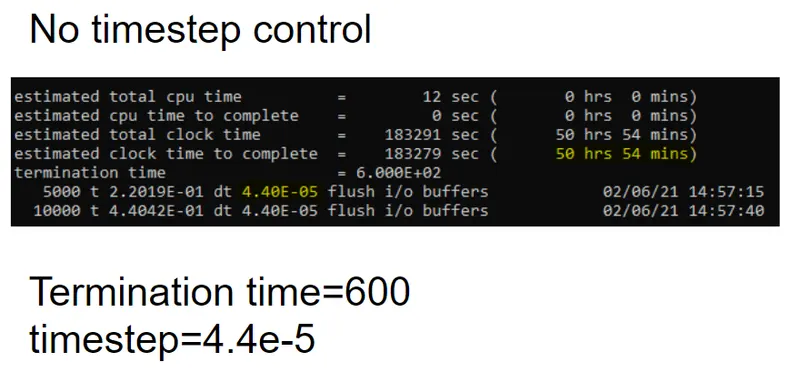
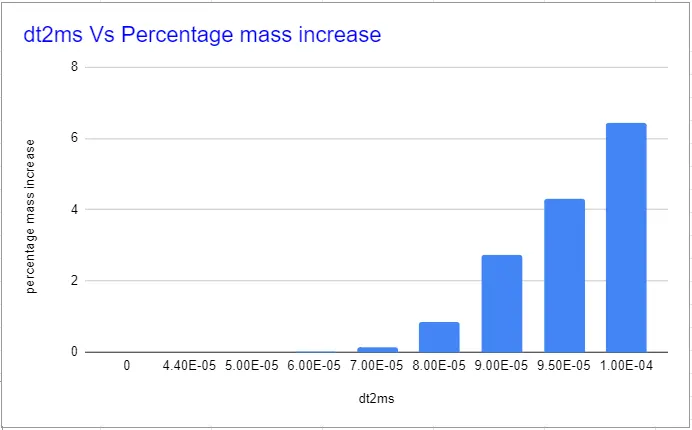
without mass scaling the timestep is 4.4E-5 so DT2MS is increased from 4.4E-5 till we get a mass increase percentage of 8%
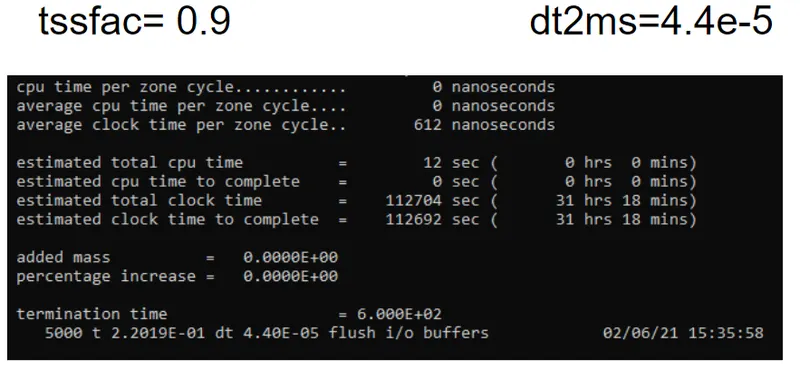
Further analysis, carried out with different values of dt2ms and tssfac is listed below.
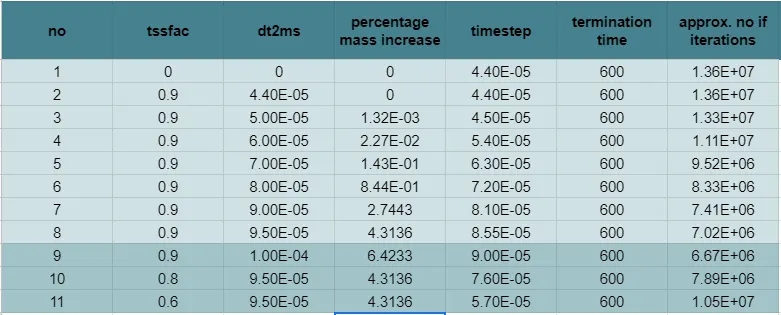
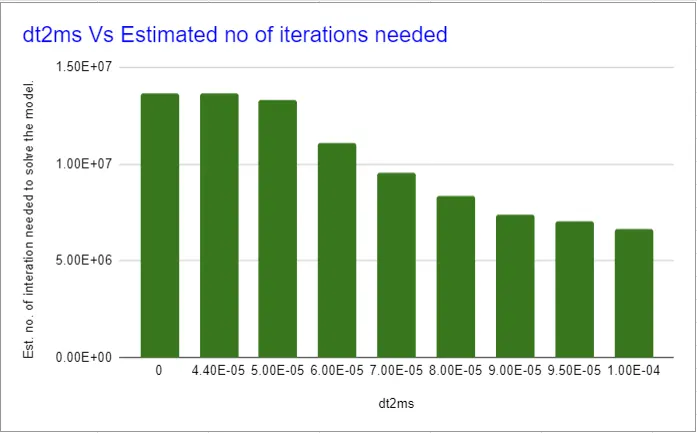
Approx. no. of iteration to solve the model is an approximate measure of time required to solve the model.
-------------------------------------------------------------------------------------------------------------------------------------------------------------
DT2MS
1.it can be seen that with an increase in dt2ms, time step also increases which will help us in solving the model quicker
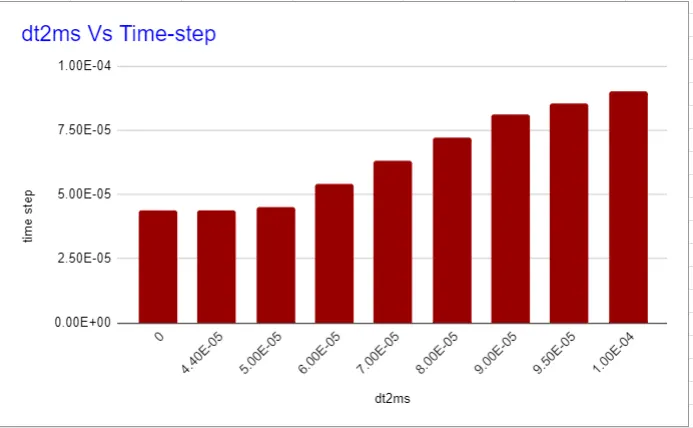
2. Also with an increase in dt2ms, added mass also increases , thereby increasing the timestep.
3. As dt2ms in increased, time step increases, which helps us in reducing the cumulative no of iteration to solve the model.
-------------------------------------------------------------------------------------------------------------------------------------------------------------
TSSFAC:
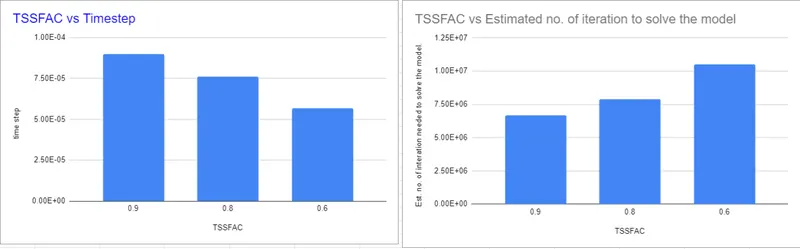
Decreasing the tssfac will increase the time step, so cumulative no of iteration to solve the model is also increased but will help in increasing the stability of the model and increase accuracy
CONCLUSION:
we can conclude that a balance between the reduction in computation time and the added mass(dt2ms) can be maintained with tssfac. This balance is based on the analysis criteria where allowable scaled mass tolerance of about 5% or a hard-limit of 8% is used thereby not affecting the end result.
While any value for dt2ms after -9E-5 has a significant reduction in computational time, it comes at a cost of addition of fictitious mass to the system which is above 5%. This fictitious mass for each element could be rather alarming as it could affect the end result of the simulation.
Hence a dt2ms of -9E-5 would be the ideal value reason being it has significantly reduced the computational time of the simulation while maintaining the percentage of added mass well within its criteria. But time step in increased considerably so a TSSFAC value of 0.8 will help us in obtaining a more accurate solution and increase the stability of the model.