Week - 8 Mass Scaling
MASS SCALING IN LS-DYNA
OBJECTIVES:
To perform the mass scaling techniques for a simulation by trial and error and compare the run time results. Later perform the same simulation with the implicit technique and compare the run time.
PROCEDURE :
1. Import the mass scaling.k file with LS-Dyna.
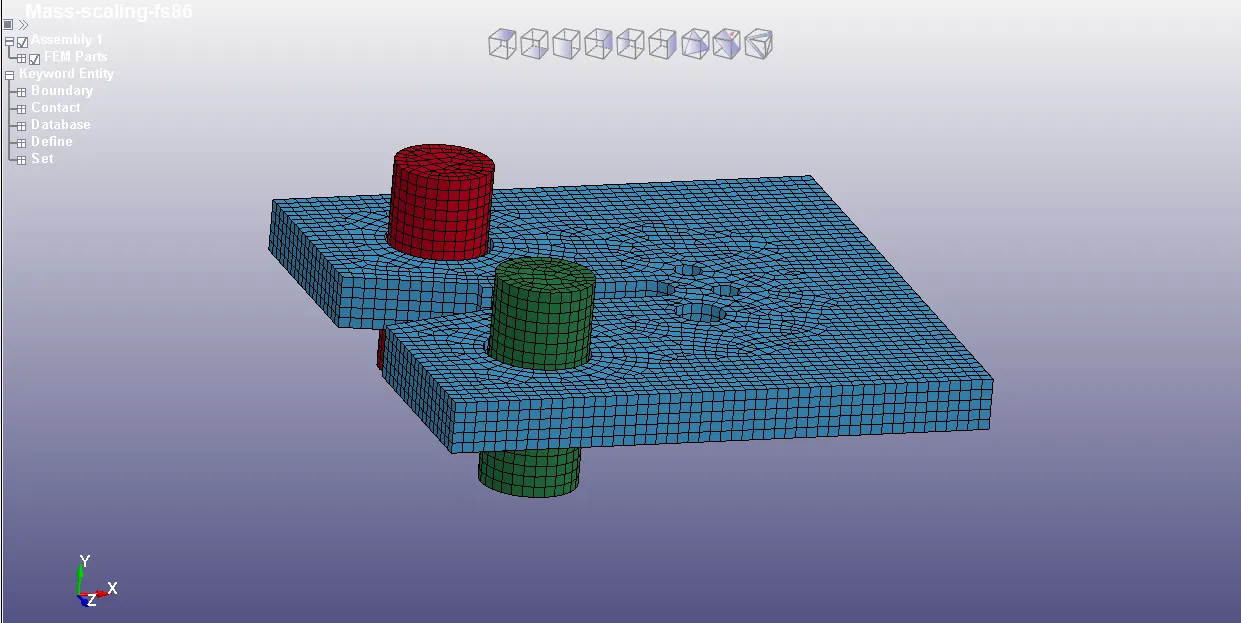
2. The Mass scaling technique is primarily done to decrease the run time for explicit simulations while attaining convergence to the simulation. We have to change the timestep using trial and error method to get the reduced run time and a bigger timestep value aids that.
Δt ^(n+1) = TSSFAC × min{Δt1, Δt2 , . . . , ΔtN }
Couran-Friendrich's condition for explicit analysis is Δt = scaling factor x (emin / c ) where is the timestep, emin is the size of smallest element, c= √(E/ρ) is the speed of stress wave. The scaling factor plovides a numerical stability for the solution.
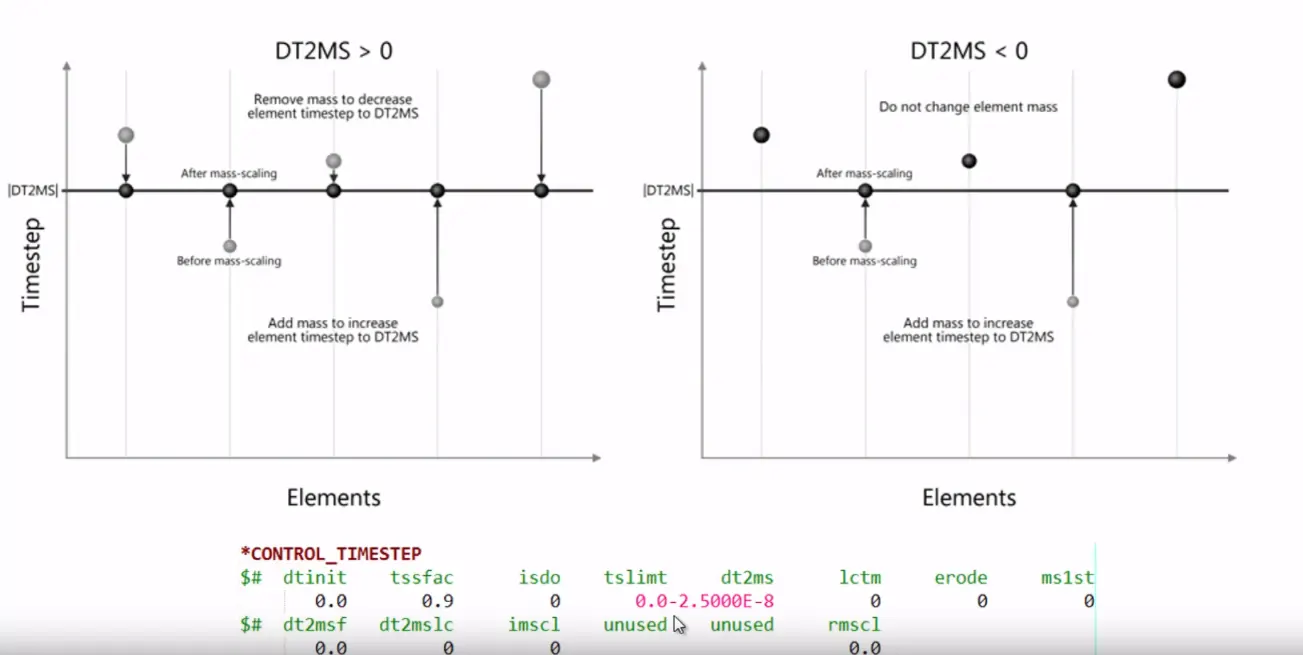
The recommended mass scaling should be less than 8% of total mass of the simulation to avoid numerical instabilities. The tssfac (scaling factor) and dt2ms (minimum timestep) are the values to be changed under Control_Timestep for effective mass scaling.
3. Simulation with no mass scaling:
- The default tssfac = 0.9 and dt2ms = -3.5e+5 is set in CONTROL_TIMESTEP, dt2ms is <0 so the mass is added to element which have less timestep to achieve a faster simulation result.
- If dt2ms > 0, then the elements adds on mass grater than absolute value but is seldom used as it creates numerical instabilities.
- Run the simulation after checking the model for errors.
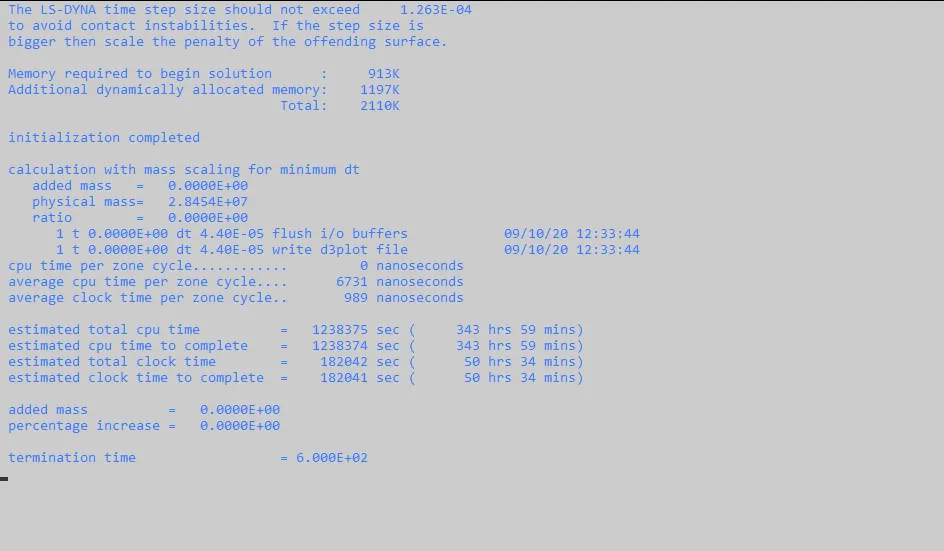
- From the run, we can observe that added mass = 0, mass scaling= 0%, total run time = 182042 sec = 50hrs 34min. The run is too high when no mass is added.
- Now the dt2ms value is changed by trial and error to achive minimum simulation time until mass scaling reaches 8% of total mass.
For tssfac = 0.9 and dt2ms = -3.135e+4
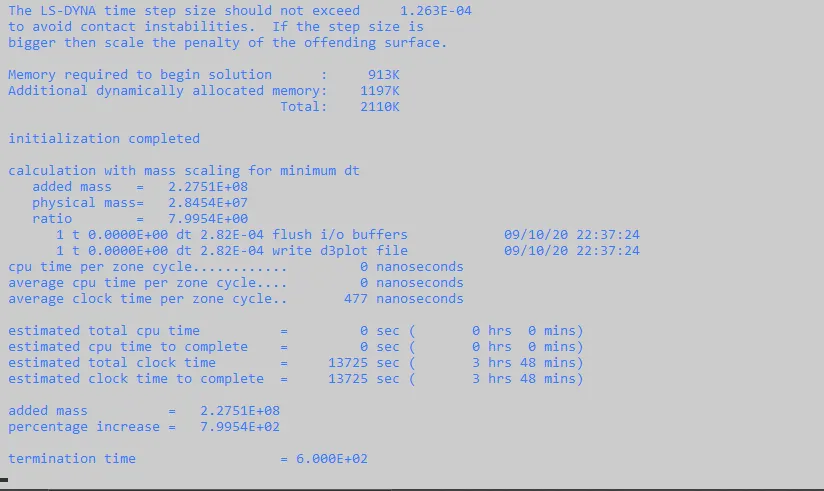
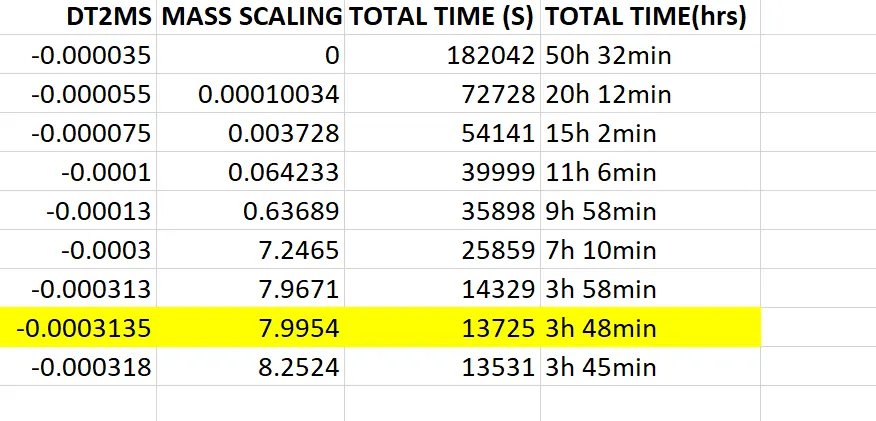
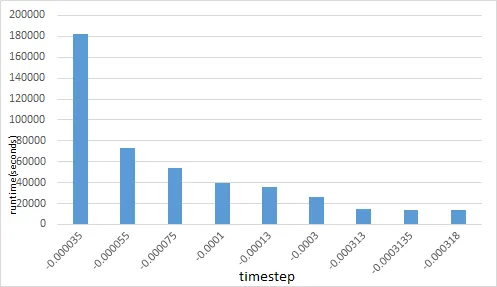
- The Dt2ms value of -3.135E-4 with approximately 8% mass scaling gives a simulation run time of 3hrs 48min and saved around 45hrs of run time.
4. Now with same dt2ms= -3.135E-4, tssfac value is changed to 0.8 and 0.7 and simulation is compared.
| TSSFAC | DT2MS | MASS SCALING | RUN TIME (s) | RUN TIME(hrs) |
| 0.8 | -0.0003135 | 7.9954 | 44988 | 4h 13min |
| 0.7 | -0.0003135 | 7.9954 | 15223 | 12h 29min |
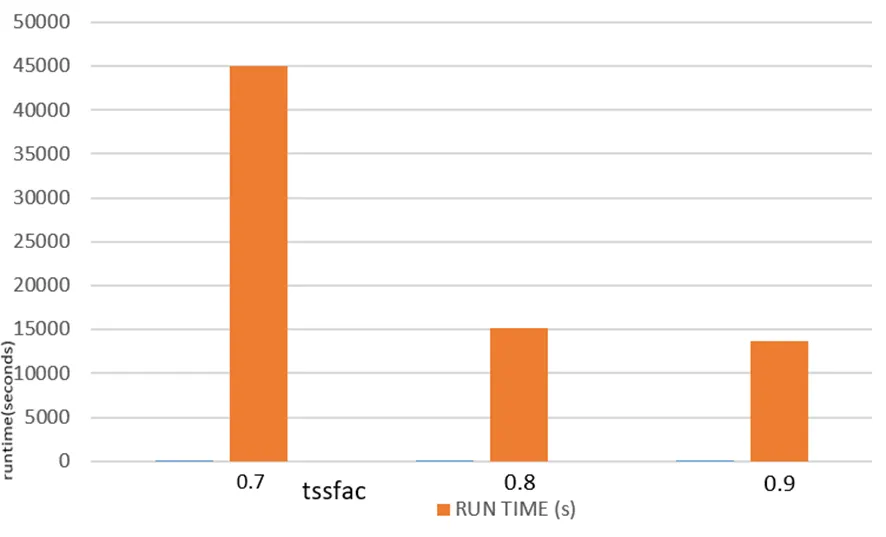
5. The tssfac = 0.9(default) gives lowest run time for the simulation at -3.5E+4 dt2ms value.
IMPLICIT SIMULATION:
1. The same file is set up for implicit simulation by adding IMPLICIT_AUTO, IMPLICIT GENERAL. IMFLAG = 1 initiates implicit analysis whereas IAUTO = 1 initiates automatic timestep control.

2. The Implicit_auto keyword heps to automatically control the timestep in implicit analysis thus controlling the simulation time optimizing the run time. The total simulation time taken in implicit analysis is 3min 8sec.
Link for implicit file : https://drive.google.com/drive/folders/1wG1x78ofnbfj9FgUXJUF39--rwvS0pqu?usp=sharing
CONCLUSION :
1. The mass scaling is carried out in explicit method and observed that for a simple simulation like this the total run time can be significantly reduced from aproximately 50hrs to 4hrs.
2. The tssfac value is changed and compared with default value.
3. The Explicit and implicit run time for the same simulation is executed. It is found that implicit can automatically change timestep using implicit auto keyword and drastically reduce the simulation run time.
Implicit run time = 3min 8min
Explicit run time = 3hr 48 min
Based on the type of problem to be solved implicit and explicit simulations are chosen.