Week - 8 Mass Scaling
Week - 8 Mass Scaling
Aim
Reduce the runtime of the given model using mass scaling parameters such as DT and TSSFAC.
Explanation
Mass scaling is a method to increase the time step in explicit analysis where non-physical mass is added to the structure.
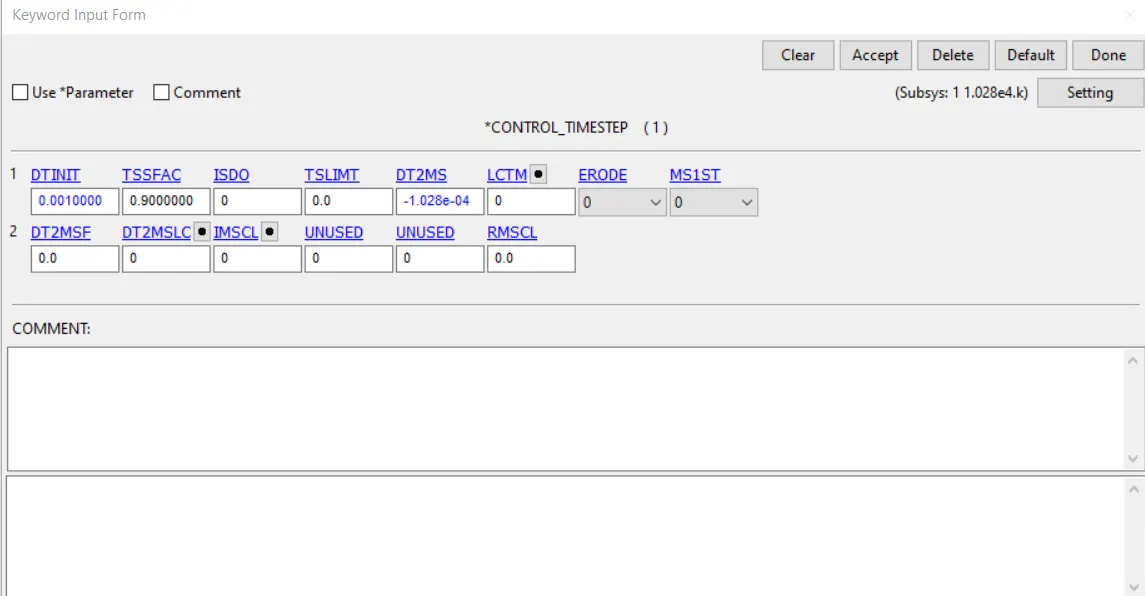
In LS DYNA mass scaling is done using Control Time step card (D2TMS – time step controlled by this parameter). When D2TMS is set to negative, mass is added to those elements whose time step is less than given D2TMS.
Hence their time step will become equal to the given D2TMS and thereby reducing the computation time. TSSFAC - Scale factor for computed time step is a parameter used to be more precautious.
Mass is added or taken away from elements so that the time step of every element is the same in case of positive D2TMS.
Courant-Friedrichs-Levy condition which gives the stable time step for explicit analysis
= smallest element length / speed of sound through the material
Speed is inversely related to the density of the material, hence by increasing density (mass) we can decrease the speed and thereby increasing the time step.
Procedure
Run : without control timestep card
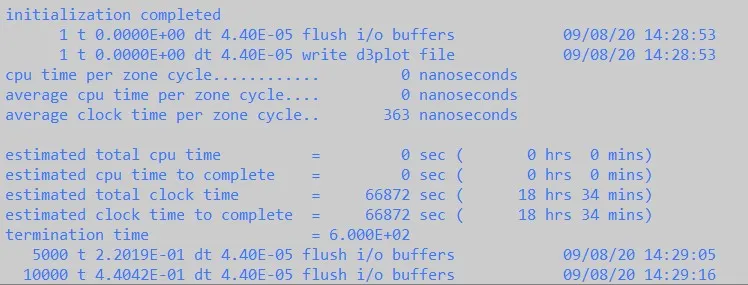
Without Mass scaling the run time is 18hrs 34 min.
Runs with TSSFAC = 0.9
With D2TMS = -3.5E-05
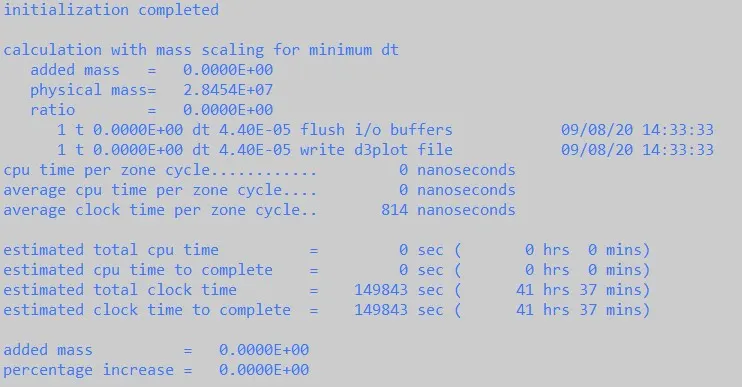
This run does not add any mass because the smallest element size is well within 3.5E-05 time step and run time is 41hr and 37min.
With D2TMS = -5.5E-05
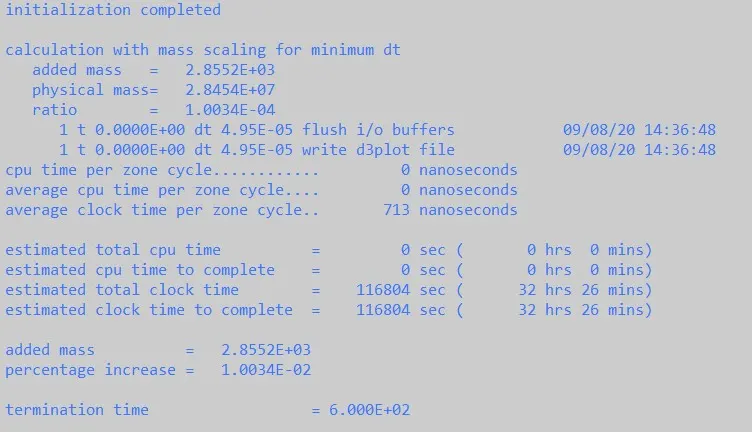
Mass additon of 1.0034E-02 percent happens in this case and 32hr and 26min is the run time.
With D2TMS = -7.5E-05
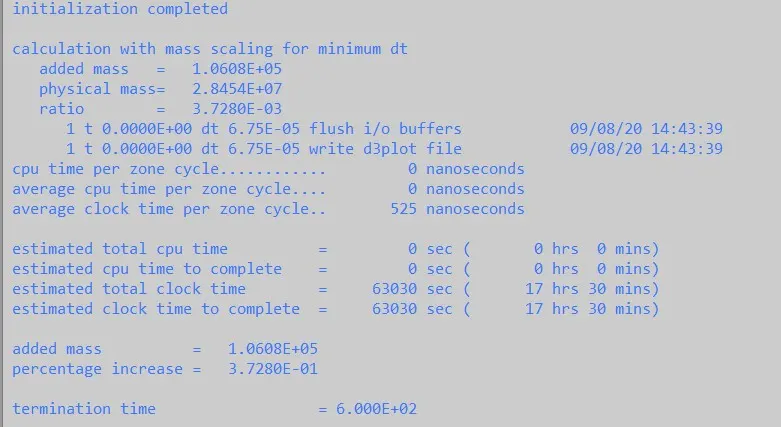
Mass additon of 3.7280E-01 percent happens in this case and 17hr and 30min is the run time.
Similary the time step is increased and the TSSFAC is reduced to 0.8 for comparison till 8% mass scale limit.
| TSSFAC = 0.9 | TSSFAC = 0.8 | ||||||
| Dt2ms | Cpu time | Added mass | % of Added Mass | Cpu time | Added mass | % of Added Mass | |
| -0.000035 | 41.61 | 0 | 0 | 31.73 | 0 | 0 | |
| -0.000055 | 32.43 | 2855.2 | 0.010034 | 29.26 | 2855.2 | 0.010034 | |
| -0.000075 | 17.5 | 106080 | 0.3728 | 28.26 | 106080 | 0.3728 | |
| -0.000095 | 16.3 | 1227400 | 4.3136 | 21.31 | 1227400 | 4.3136 | |
| -0.0001 | 18.85 | 1827700 | 6.4233 | 19.88 | 1827700 | 6.4233 | |
| -0.0001025 | 14.45 | 2209800 | 7.766 | 17.73 | 2209800 | 7.766 | |
| -0.000103 | 17.5 | 2295200 | 8.0661 | 16.53 | 2295200 | 8.0661 | |
| -0.0001028 | 16.5 | 2252000 | 7.9145 | 15 | 2243500 | 7.8846 | |
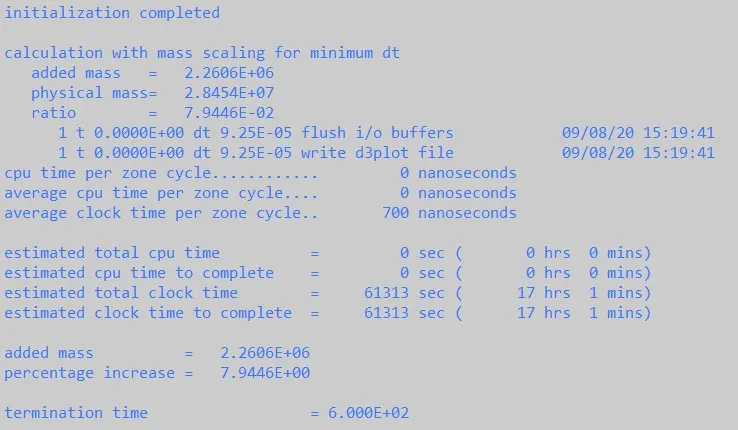
| -0.0001028 | 17 | 2260600 | 7.9446 | 17.5 | 2260600 | 7.9446 | |
| -0.0001029 | 17.16 | 2277800 | 8.005 | 16.91 | 2277800 | 8.005 | |
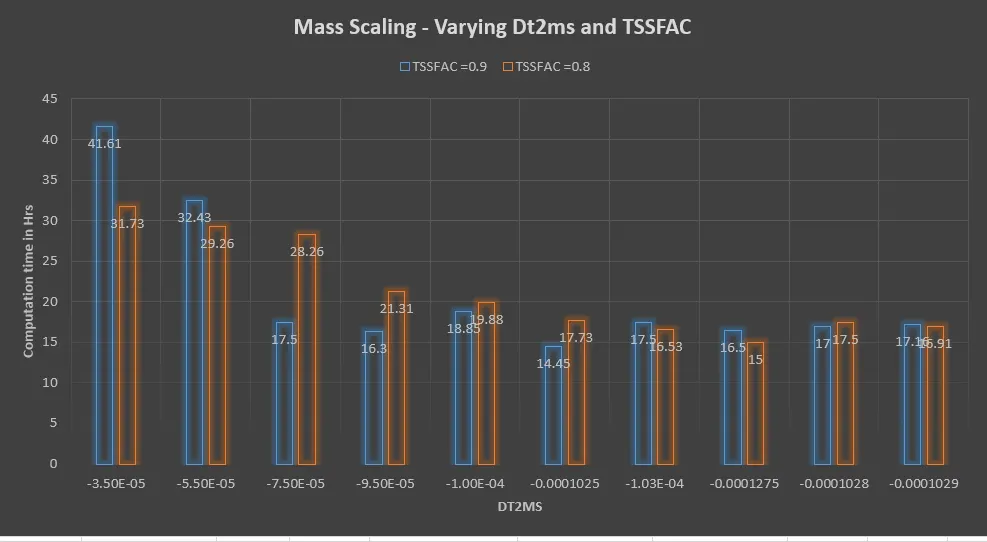
The closest the time step to reach the mass scaling limit of 8% is -0.0001028 , there is no much variation in the addition of mass by variation of the TSSFAC from 0.9 to 0.8.
And the CPU time for this case is 17hrs. Care needs to be taken mass scaling does not effect the analysis stability.
The Graph below shows the comparison of Mass Scaling by varying time step and TSSFAC.
Run : Implicit Analysis
For this run we add Implicit cards - Auto, general , solution and solver.
Auto card - IAUTO = 1 , automatically adjusted time step size flag with Minimum time step as 0.001s and DTMAX = 3.
General card - IMFLAG =1 for implicit analysis and intial time step = 0.1.
Run time for the same simulation in implicit is 12min and 38 sec , there is no effect of mass scaling in case of implicit as the time step are larger than explicit.( Need to make sure that the during these large time step important contact or other factors are not missed out).
For process which happens at slower rate implicit method is better as the run time is drastically reduced.
Conclusion
- Mass scaling is done until the 8% added mass limit is reached.
- DT2MS and TSSFAC parameters are varied , trial and error was done.
- Even though -0.0001028 s DT2MS is the closest to 8% added mass limit but -0.0001025 s with added mass limit 7.766% has lowest computation time 14 hrs and 27 mins.