State of charge estimation
State Of Charge estimation is a key factor for correct and safe battery management, particularly for the development of the Battery Management System (BMS). In general, the SOC of a battery is defined as the ratio of its current capacity to the nominal capacity. The nominal capacity is given by the manufacturer and represents the maximum amount of charge that can be stored in the battery.
`SOC=(Q(t))/(Qn)`
The various mathematical methods of estimation are classified according to methodology. The classification of SOC is done into the following four categories.
1.Direct measurement: this method uses physical battery properties, such as the voltage and impedance of the battery. Many different direct methods have been employed: open circuit voltage method, terminal voltage method, impedance measurement method, and impedance spectroscopy method.
2.Book-keeping estimation: this method uses discharging current as the input and integrates the discharging current over time to calculate the SOC. This method permits to include some internal battery effects as self-discharge, capacity-loss, and discharging efficiency. Two kinds of book-keeping estimation methods have been employed: Coulomb counting method and modified Coulomb counting method.
3.Adaptive systems: the adaptive systems are self-designing and can automatically adjust the SOC for different discharging conditions. Various new adaptive systems for SOC estimation have been developed.
4.Hybrid methods: the hybrid models benefit from the advantages of each SOC estimation method and allow a globally optimal estimation performance. The literature shows that the hybrid methods generally produce good estimation of SOC, compared to individual methods.
Open Circuit Voltage Method:
There is approximately a linear relationship between the SOC of the lead-acid battery and its open circuit voltage (OCV) given by
`Voc(t)=a1*SOC(t) + a0`
where SOC(t) is the SOC of the battery at t, a0 is the battery terminal voltage when SOC = 0%, and a1 is obtained from knowing the value of a0 and Voc(t) at SOC = 100%. Hence the estimation of the SOC is equivalent to the estimation of its OCV. The OCV method based on the OCV of batteries is proportional to the SOC when they are disconnected from the loads for a period longer than two hours. However, such a long disconnection time may be too long to be implemented for battery.
Unlike the lead-acid battery, the Li-ion battery does not have a linear relationship between the OCV and SOC. The relationship between the OCV and SOC cannot be exactly the same for all batteries. Because the conventional OCV-SOC differs among batteries, there is a problem in that the relationship of the OCV-SOC should be measured to estimate accurately the SOC. The SOC and the capacity of a lithium-ion battery are estimated using the dual extended Kalman filter with the proposed method.
Coulomb Counting Method:
The Coulomb counting method measures the discharging current of a battery and integrates the current over time in order to estimate SOC. Coulomb counting method is done to estimate the SOC(t) , which is estimated from the discharging current, I(t) , and previously estimated SOC values, SOC(t-1) . SOC is calculated by the following equation:
`SOC(t)=SOC(t-1) + (I(t))/(Qn).DeltaT`
But there are several factors that affect the accuracy of Coulomb counting method including temperature, battery history, discharge current, and cycle life.
Modified Coulomb Counting Method:
To improve the Coulomb counting method, a new technique called modified Coulomb counting method is proposed. The modified Coulomb counting method uses the corrected current to improve the accuracy of estimation.
The corrected current is the function of discharging current. There is a quadratic relationship between the corrected current and discharging current of battery. By practice of experimental data, corrected current is calculated by the following form:
`Ic(t)=k2.I(t)^2+k1I(t)+k0`
where , k2, k1 and k0 are constant values obtained from the practice experimental data.
In modified Coulomb counting method, SOC is calculated by the following equation:
`SOC(t)=SOC(t-1) + (Ic(t))/(Qn).DeltaT`
The accuracy of the modified Coulomb counting method is superior to the conventional Coulomb counting method.
Kalman Filter Method:
Using real-time measurement road data to estimate the SOC of battery would normally be difficult or expensive to measure. The application of the Kalman filter method provides verifiable estimations of SOC for the battery via the real-time state estimation.
In later advancements, a Kalman filter based SOC estimation method was presented for lithium-ion batteries. Experimental results validate the effectiveness of Kalman filter during the online application. Ongoing, an extended Kalman filter (EKF) method was presented to estimate the concentrations of the main chemical species which are averaged on the thickness of the active material in order to obtain the SOC of the battery, by using the terminal current and voltage measurements.
Based on unscented Kalman filter (UKF) theory and a comprehensive battery model, the results show that UKF method is superior to extended Kalman filter method in SOC estimation for battery. An adaptive UKF method was presented to estimate SOC of a lithium-ion battery for battery electric vehicles. The adaptive adjustment of the noise covariance in the SOC estimation process is implemented by an idea of covariance matching in the UKF context.
How BMS implements coulomb counting for SOC estimation?
Coulomb-counting is based on exploiting its eqution by quantifying the charge delivered by the battery through
sensing its input and output current. Yet, there are some inefficiencies when using this method. First of all, the
access to the initial SOC is not guaranteed. Secondly, selfdischarge may distort the real SOC value after a long storage period and finally the reference capacity Qrated must be updated in terms of battery ageing.
Furthermore, an SOC estimation is performed at varying ambient temperature which should be taken into account.
The enhanced Coulomb-counting algorithms which allow the determination of the initial SOC using the SOC-OCV curve, takes into account self-discharge losses and performs a recalibration at fully and empty stages.
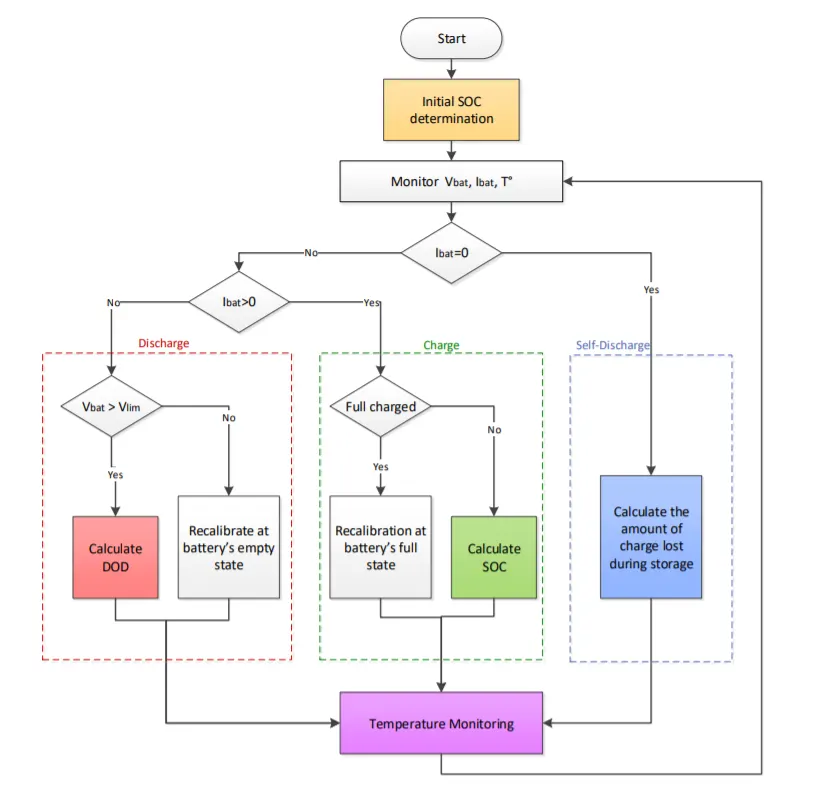
Figure gives the flowchart of the propopsed algorithm used to manage the battery monitoring by switching from a
battery operating mode to another in accordance with transition conditions.