Week 7-Long Piston With Cam
Long Piston with Cam Report
Aim: For this challenge, you will have to perform a transient analysis on a piston and cam mechanism model that has been provided to you. You need to run the analysis with Frictionless contact, Frictional with 0.1 and 0.2 as the frictional contact for a total of 3 cases.
Find out the Equivalent Stress, Directional Deformation and Equivalent Elastic Strain and compare them for all the three cases. Give an inference as to why the results vary between cases
Procedure:
- Select Transient Structural, drag and drop into Project Schematic.
- Let the default material be chosen under Engineering Data.
- Under geometry tab, import the given geometry, double-click to open Space Claim to register the model.
- Based on the case, assign a frictionless/frictional connection between the barrel & cam as well as the cam & follower.
- The frictional co-efficient is 0.1 for case 2 and 0.2 for case 3.
- A fixed joint was assigned to the barrel.
- A revolute joint was given to the cam.
- A translational joint was given to the cam follower, within the barrel.
- The mesh size was set to default, however, the faces of the cam and follower that come in contact were given a face sizing of 3mm.
- Under transient structural tab, we set the analysis to 9 steps with timestep defined by time.
- A joint load is given to the revolute joint, with rotation in increments of 30deg.
- Directional Deformation in X-axis, Equivalent Strain and Equivalent Stress plots are requested from the solver as outputs.
- Run the simulation by clicking on “solve”.
Case 1: Frictionless contact between Barrel & Follower and Follower & Cam
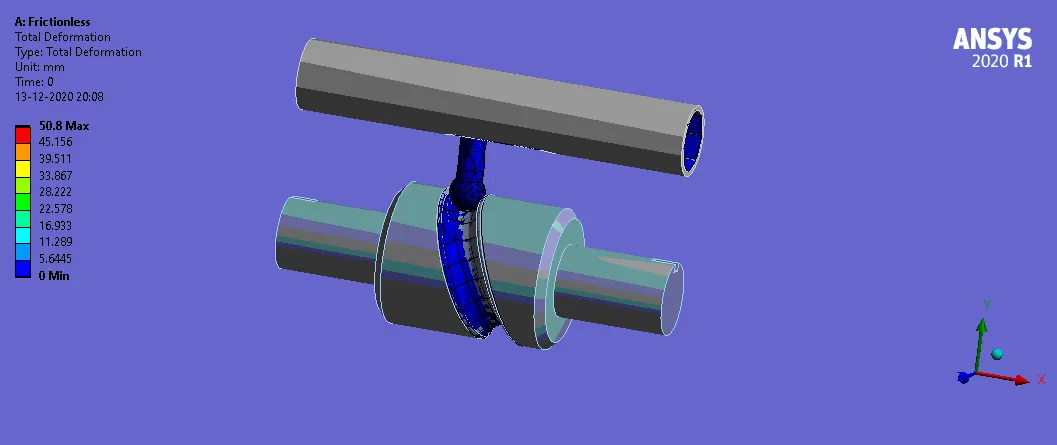
Case 2: Frictional contact between Barrel & Follower and Follower & Cam with frictional coefficient = 0.1
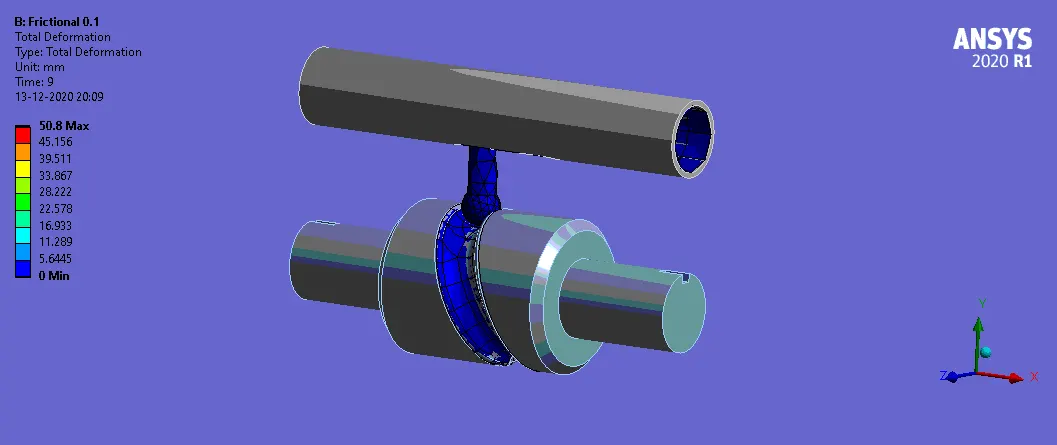
Case 3: Frictional contact between Barrel & Follower and Follower & Cam with frictional coefficient = 0.2
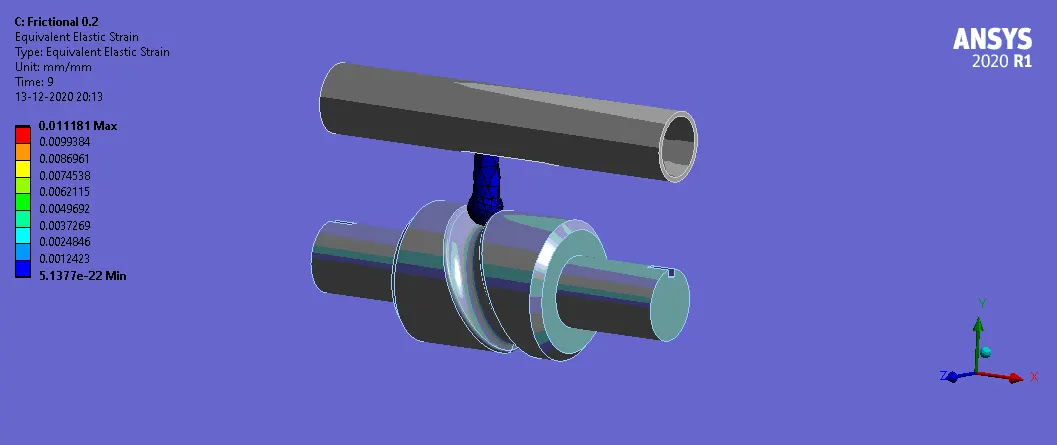
Conclusion:
From the three cases, here is the inference:
|
Case |
Frictional Co-efficient |
Eq. Stress (MPa) |
Eq. Strain |
Directional Def. (mm) |
|
1 |
0 |
1759.9 |
0.008846 |
11.097 |
|
2 |
0.1 |
1815.4 |
0.009428 |
11.223 |
|
3 |
0.2 |
2160.8 |
0.011181 |
11.264 |
From the above table it is clear that as friction increases between Barrel & Follower and Follower & Cam the Eq. stress, eq. strain and the directional deformation increases. This is due to the resistance in motion because of friction. The system tries to overcome that resistance and in that process the stress, strain and deformation increases.