Week 7-Long Piston With Cam
Aim: To conduct a transient analysis on a piston can cal for three cases, frictionless, 0.1 Coeff. of friction and 0.2 coeff. of friction.
Procedure:
Materials: All the materials here are Structural Steel.
Geometry: Drag and drop the geometry in space claim to upload it.
Setup:
Components: As the barrel and the barrel cam is not under observation, so we can change them to rigid bodies.
Connections:
- Contacts
- Create a contact between the follower and the barrel (target). Depending on the case assign the friction.
- Create another contact between the follower and the barrel cam (target). Depending on the case assign the friction.
- Joints
- Add a body to the ground revolute joint to one of the cylindrical faces of the barrel cam.
- Add a body to body translation joint to the follower as mobile and the barrel as the reference body.
- Finally, add a fixed joint to the cylindrical surface of the barrel.
Mesh: Add a face sizing to the follower tip and the cam motion region. Make sure that adaptive sizing is off.
Analysis Settings:
- Numer of time steps is 9
- Adaptive time-stepping is on.
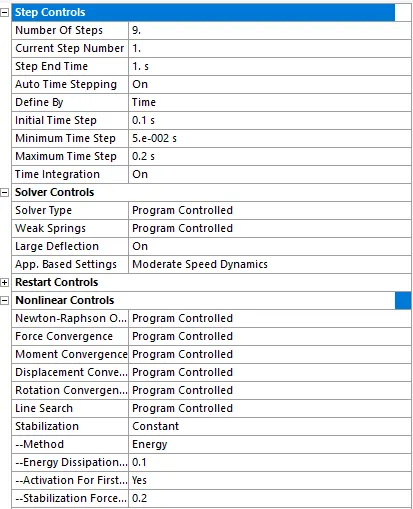
Load Settings: Add a joint load at the created revolute joint. Then apply a rotation with an increment of 30 degrees every second.
Solution: Directional deformation, von mises stress, and equivalent elastic strain for the follower were obtained for three different cases.
Results & Discussion:
Case 1 (Frictionless)
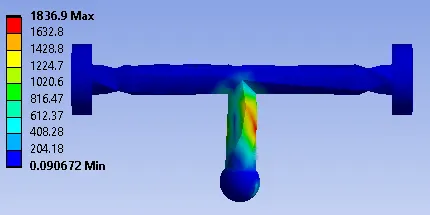
The maximum stress experienced is 1742.5 MPa.
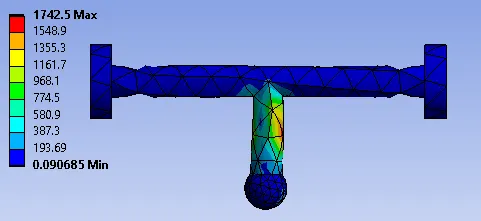
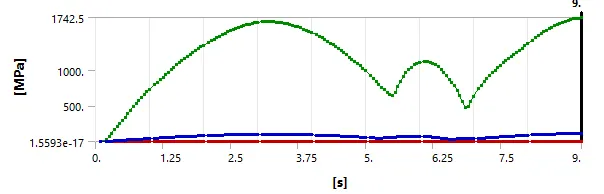
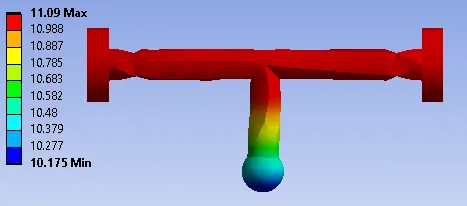
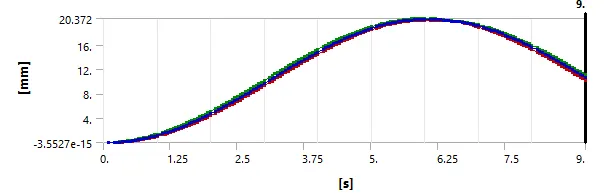
The maximum directional deformation is 11.09mm.
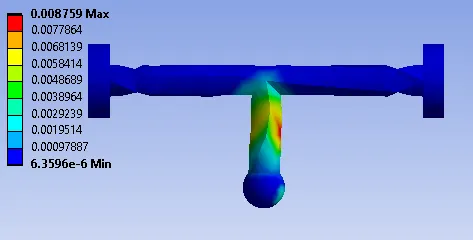
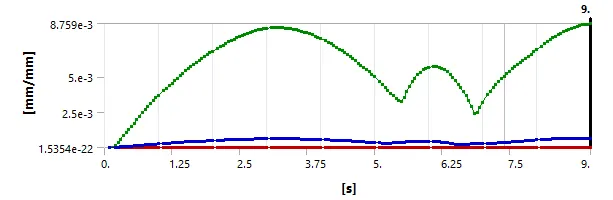
The maximum strain is experienced in the same position as the maximum stress and it is 8.75e-03.
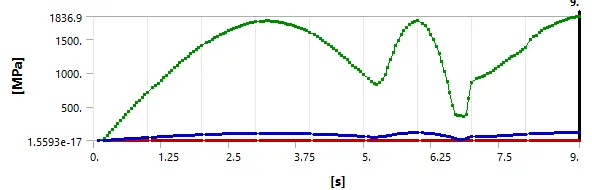
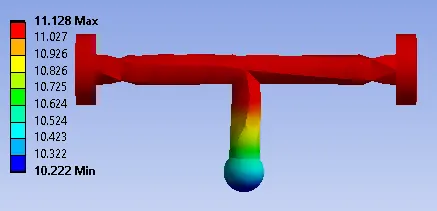
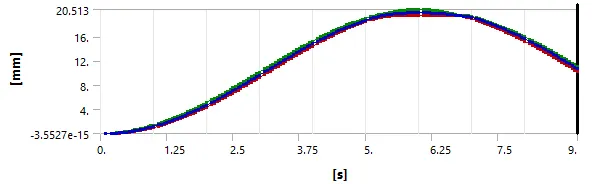
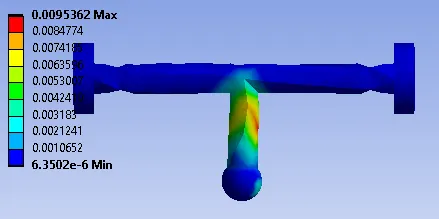
Case 2 (Cf = 0.1)
The maximum stress experienced is 1983.9 MPa.
The maximum directional deformation is 11.128mm.
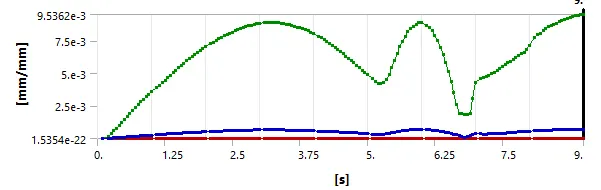
The maximum strain is experienced in the same position as the maximum stress and it is 9.53e-03.
Case 3 (Cf = 0.2)
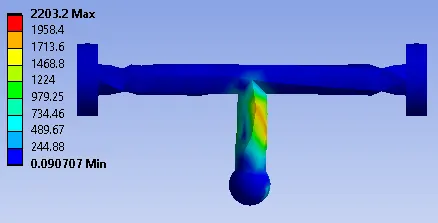
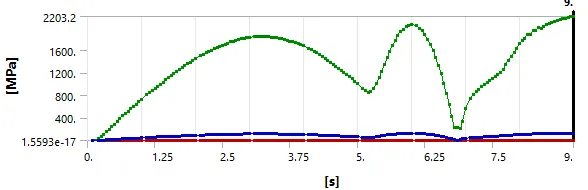
The maximum stress experienced is 2203.2 MPa.
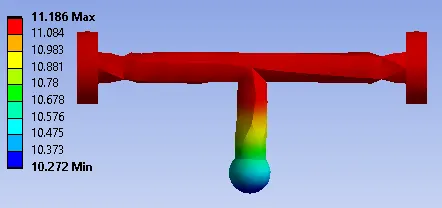
The maximum directional deformation is 11.186mm.
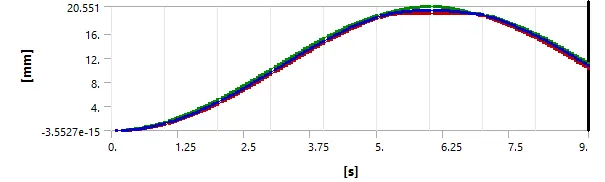
The maximum strain is experienced in the same position as the maximum stress and it is 1.14e-02.
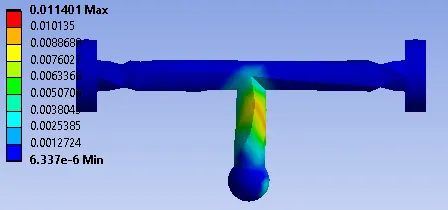
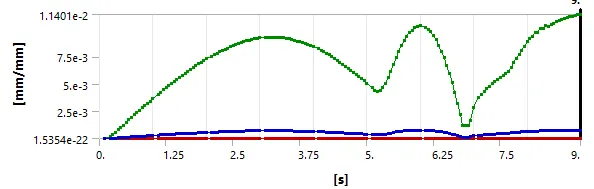
Conclusion: With an increase in the coefficient of friction the stress experienced by the follower increases. This is why the maximum strain is greater for the 0.2 Cf at 2203.2 MPa and the frictionless case is 1742.5 MPa. This variation is the same for the strain experienced by the follower.