Week-7 Head Impact
Objective: The main of this project is to conduct head impact by using Simple spherical head model , Child headfoam impacting against Rigid wall and Child headfoam impacting against hood of a car.
Procedure:
CASE - I :- Simple Head impacting against Rigid wall
Model:
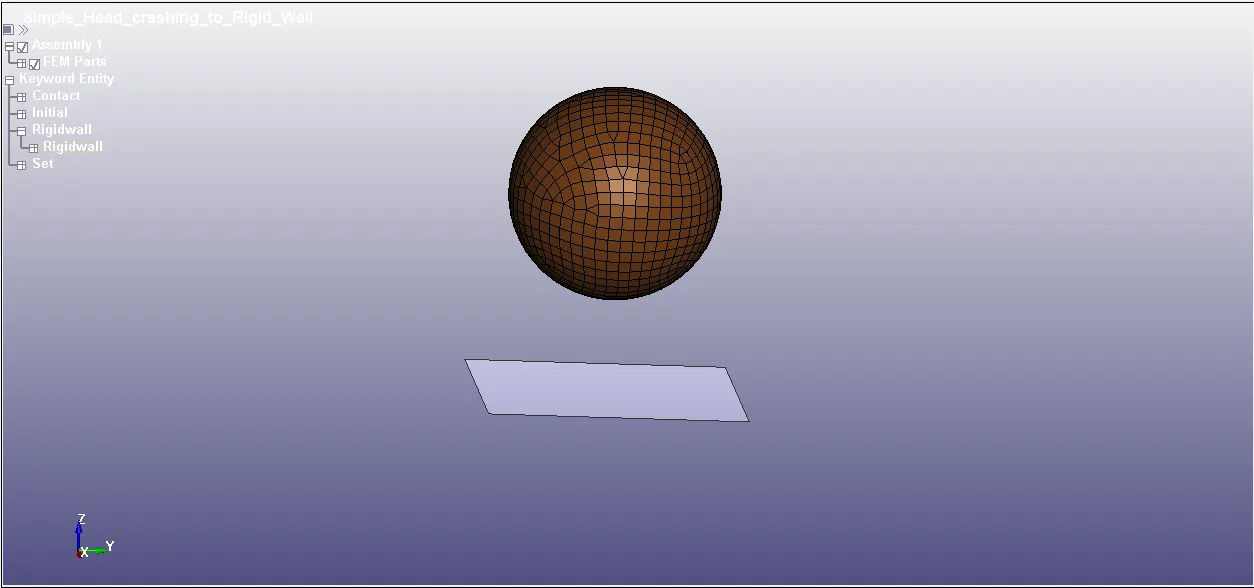
Simple head model
Section:
Section_Shell created for our simple head model with Element formulation of ELFORM=16 with thickness of 14mm.
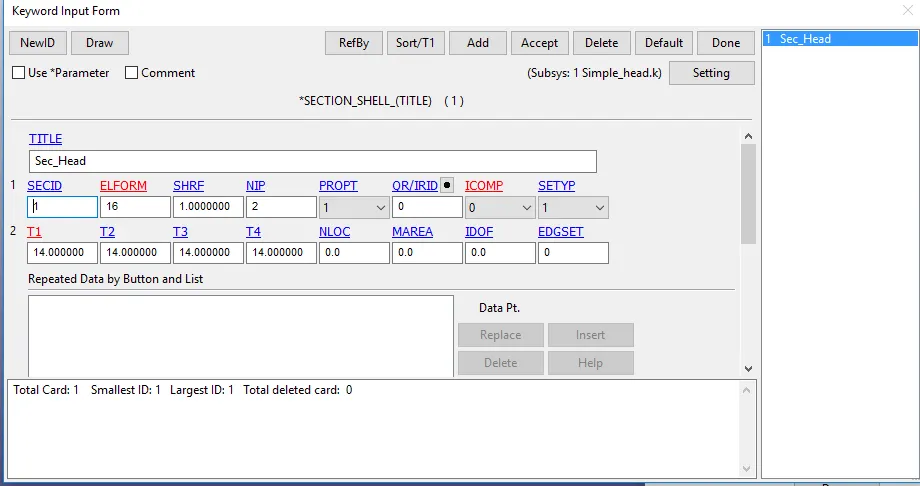
Section Shell card
Material:
MAT_ELASTIC is created for our model.
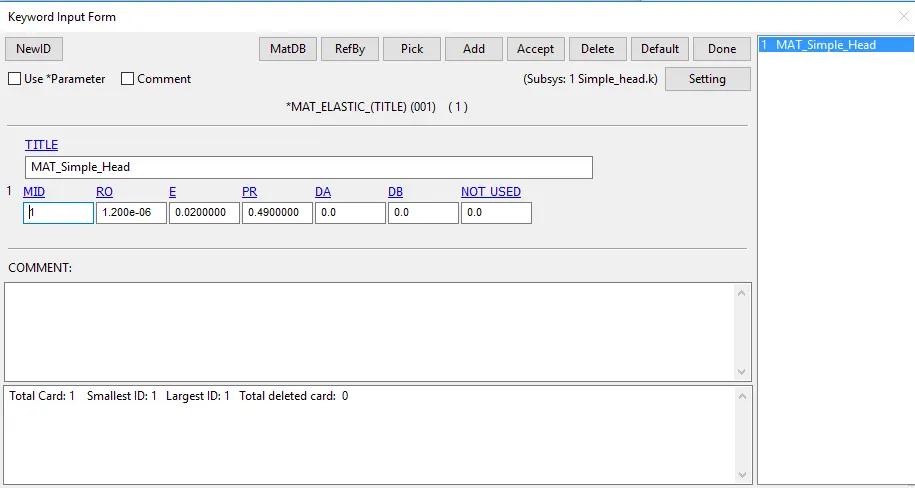
Mat Elastic card
Part:
In part both section material is assigned by the help of its ID.
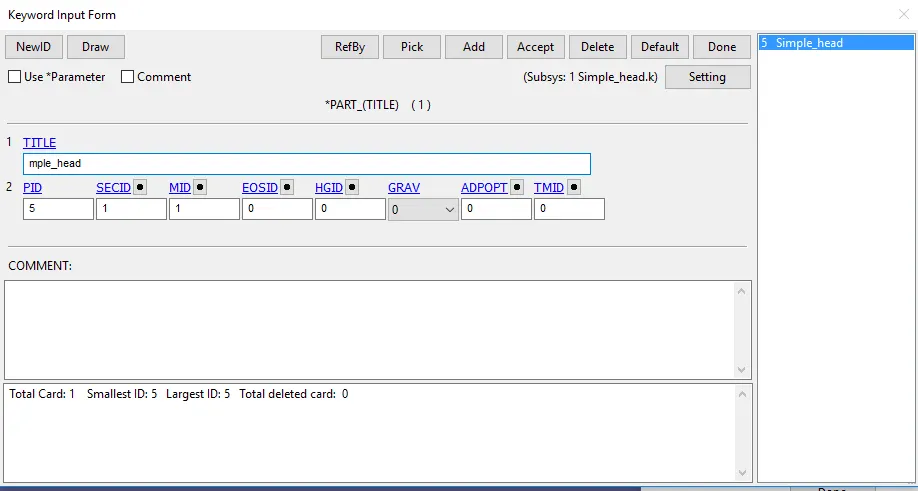
Part card
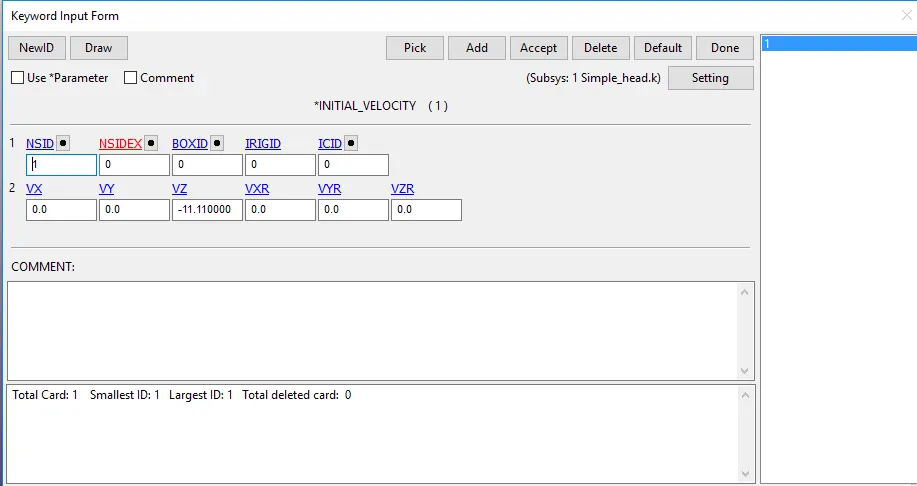
Initial velocity:
Initial velocity of 11.11 mm/ms is given by selecting all nodes of head in negative z direction.
Initial velocity card
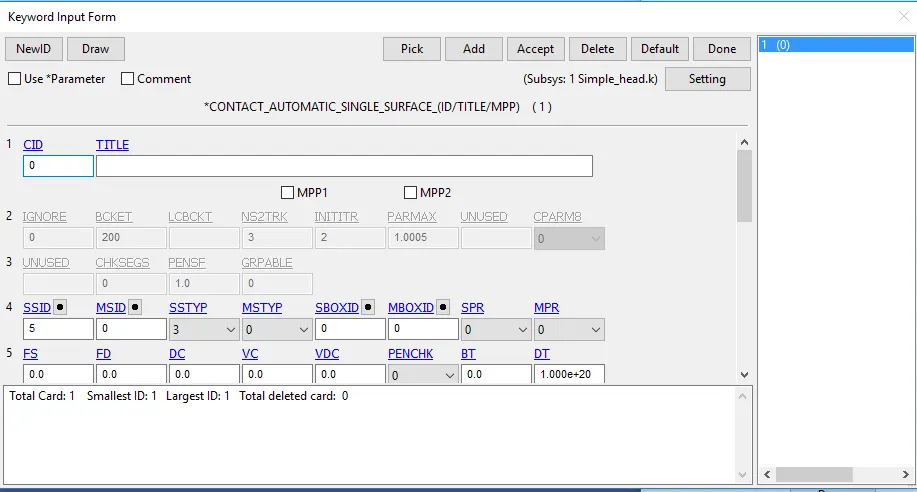
Contact:
Contact automatic single surface is created for head.
Contact card
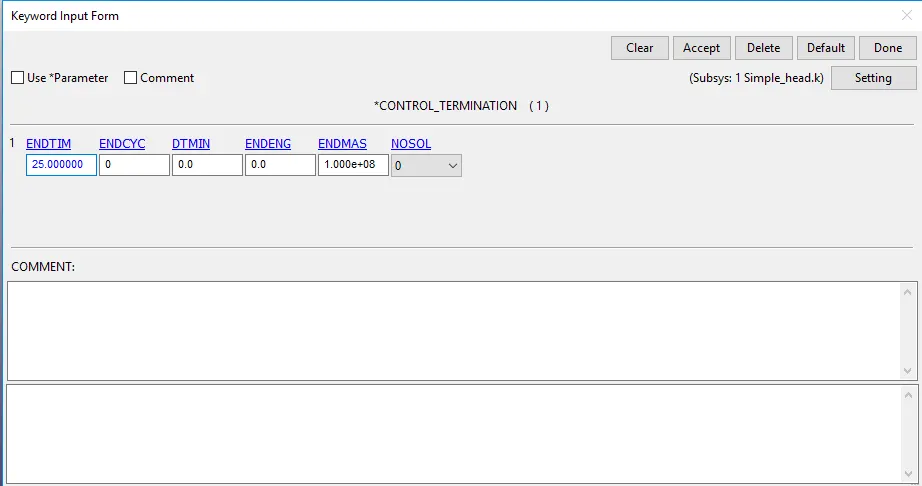
Control Termination:
End time of 25 ms is given for simulation
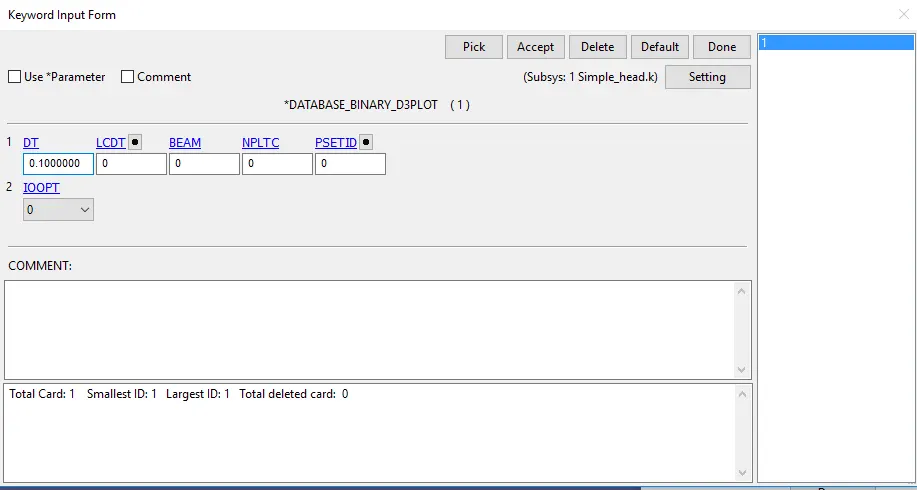
Database D3PLOT:
Animation of simulation:
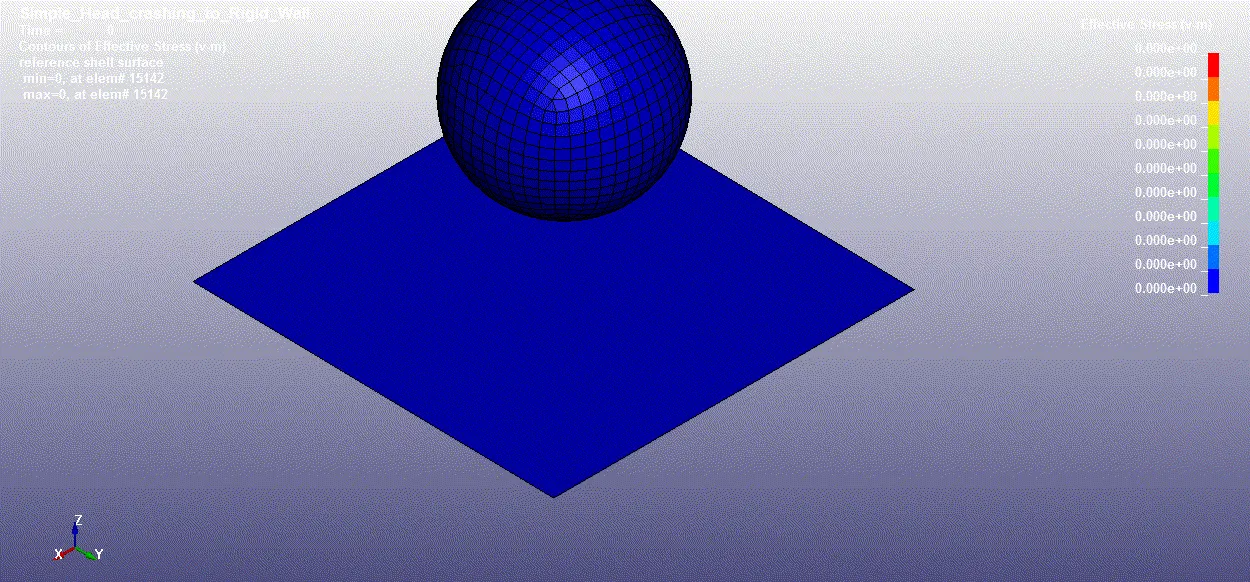
CASE - II : Child Headfoam impacting against Rigid wall:
In this case we will rotate our child headfoam model along Y with rotation degree as 50 degree which is of following EURONCAP.
In order to rotate our headform we need to define transformation which is done by DEFINE_TRANSFORMATION with creation of TRANSID and then with use of this TRANSID we will include our transformation by INCLUDE>TRANSFORM>Browse(.k file which is to be rotated)> Provide TRANSID > Accept> Done.
After completing transform save the file as new .k file with new name.
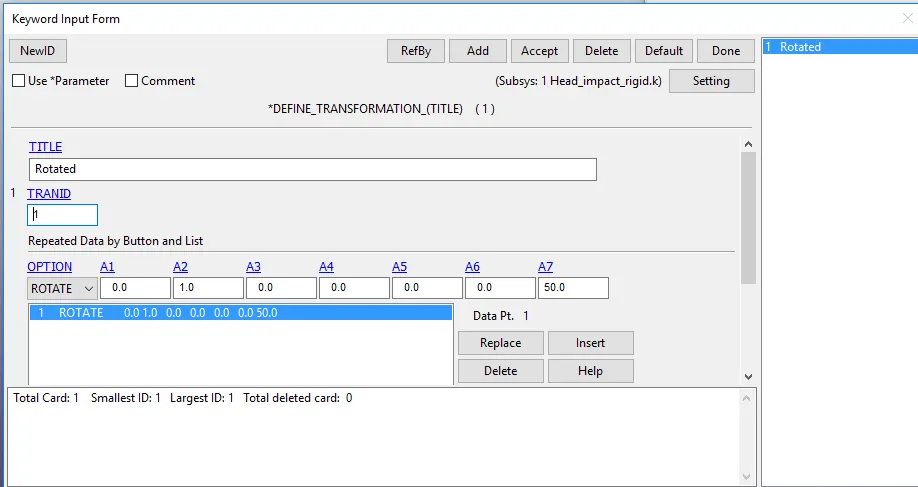
Define Transformation card
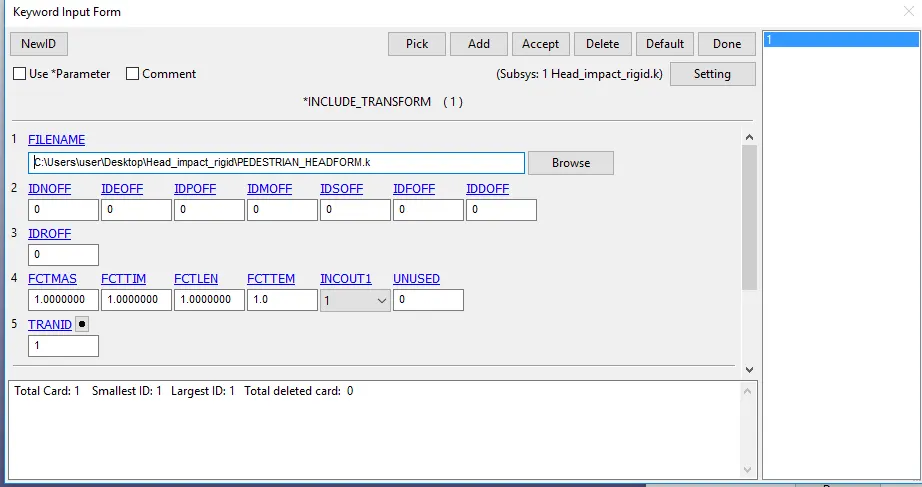
Include Transform card
Before transform:
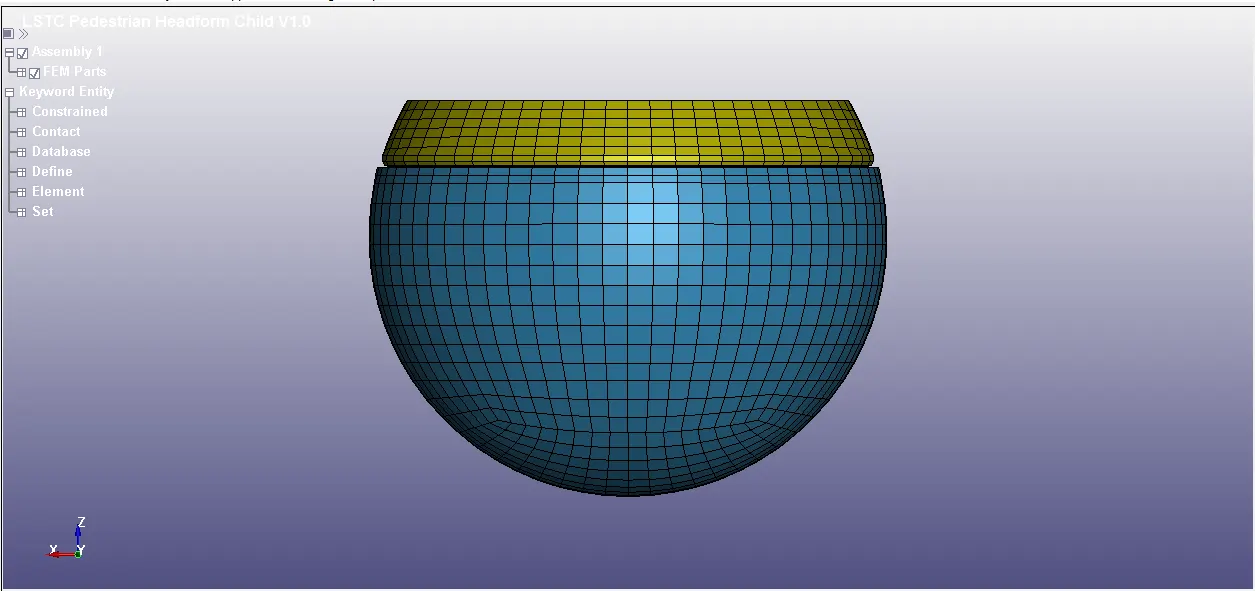
After transform:
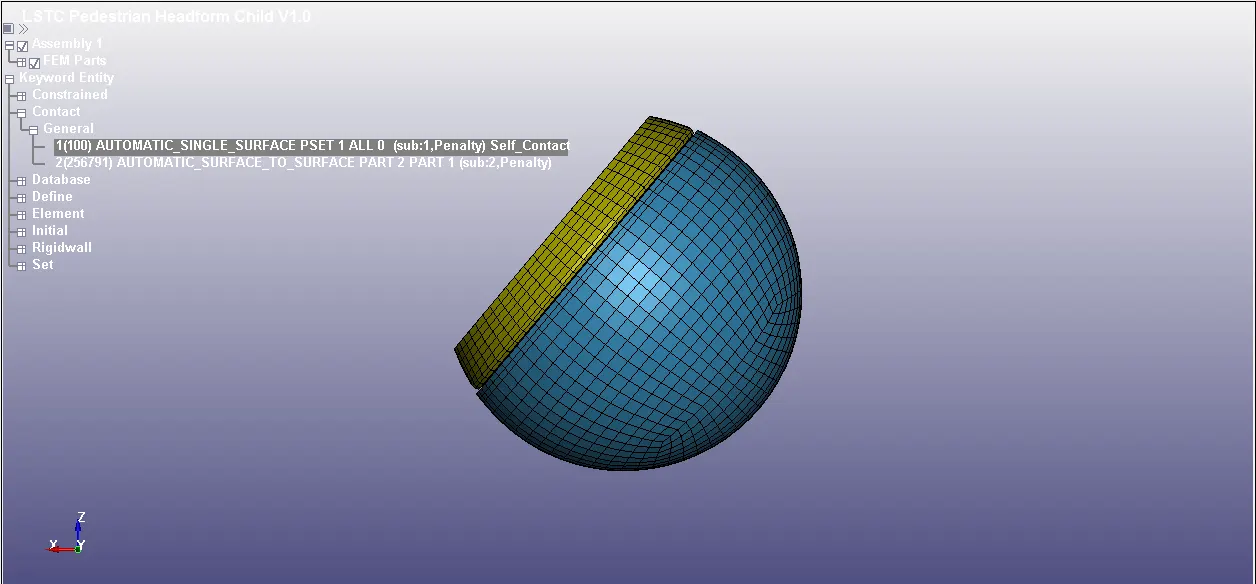
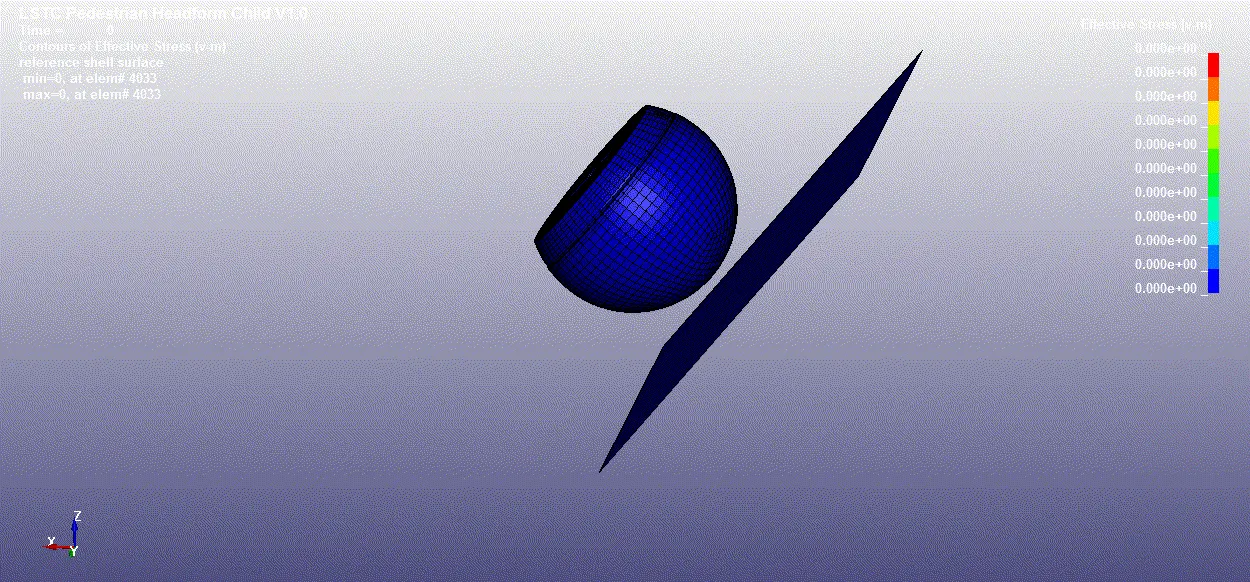
Rotated head with Rigid wall
Material:
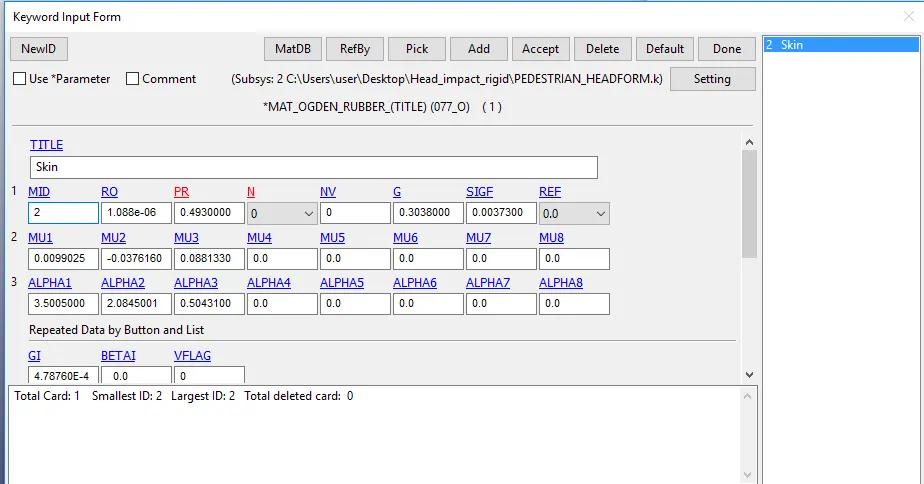
In provided model , new material card with MAT_ODGEN is used.
Initial velocity:
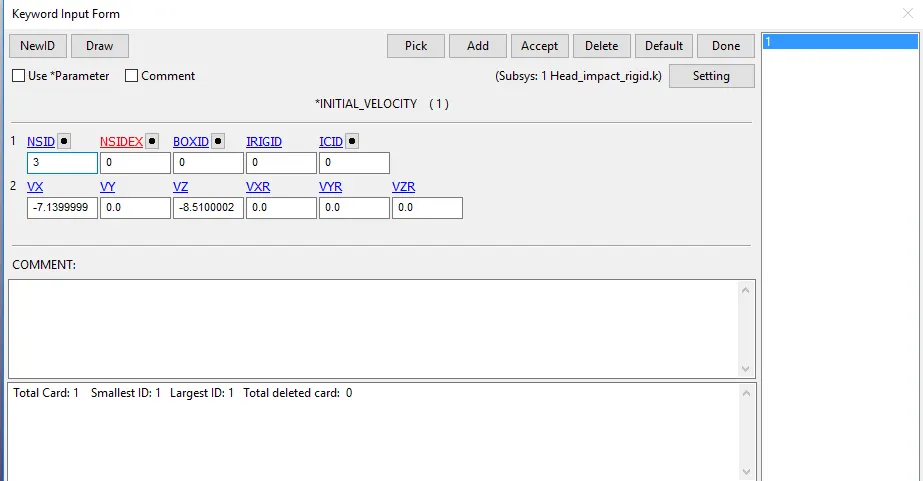
An initial velocity of 11.11mm/ms is with which the Head impacts the rigidwall but in here the it will be a projectile(resultant) motion. Si component motion in x and y direction has to be calculated.
Vx = Vr*Cos50 Vx = 11.11*Cos50 = 7.14mm/ms and Vy = Vr*Sin50 = 11.11*Sin50 =8.51mm/ms
Contact:
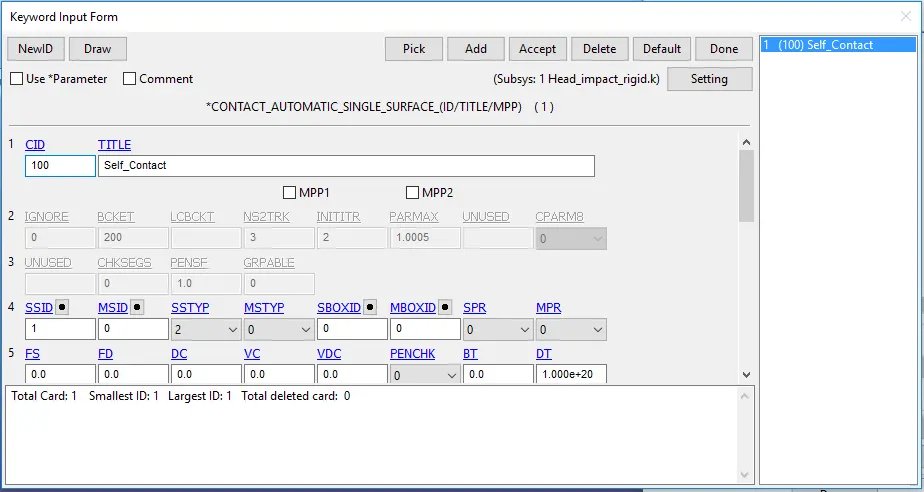
Contact automatic single surface is created for head.
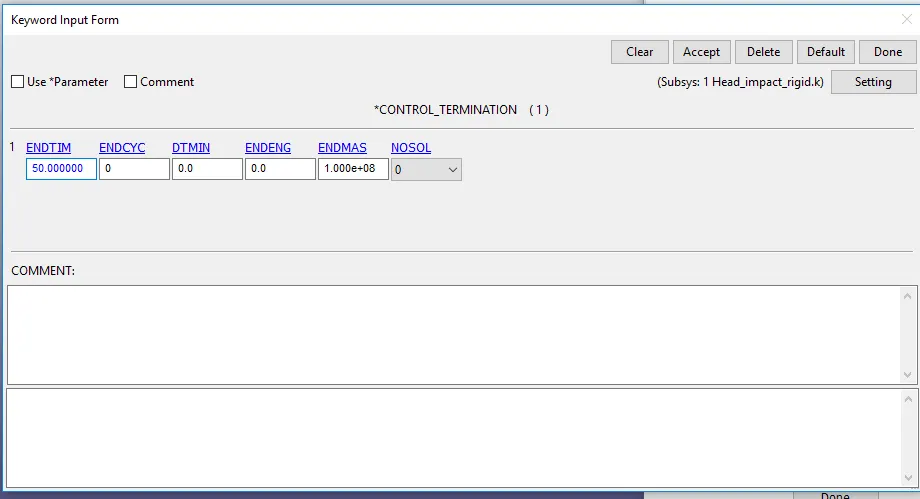
Control Termination:
End time of 50 ms is given for simulation
Animation of Simulation:
GLSTAT:
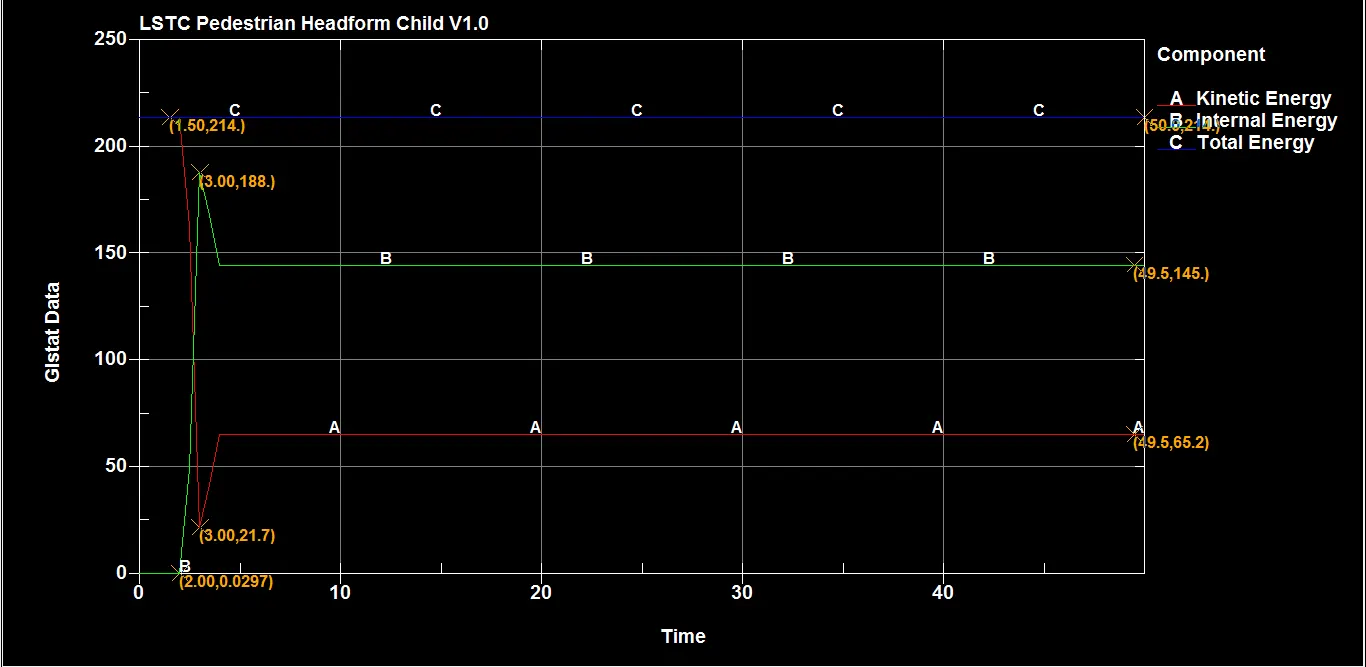
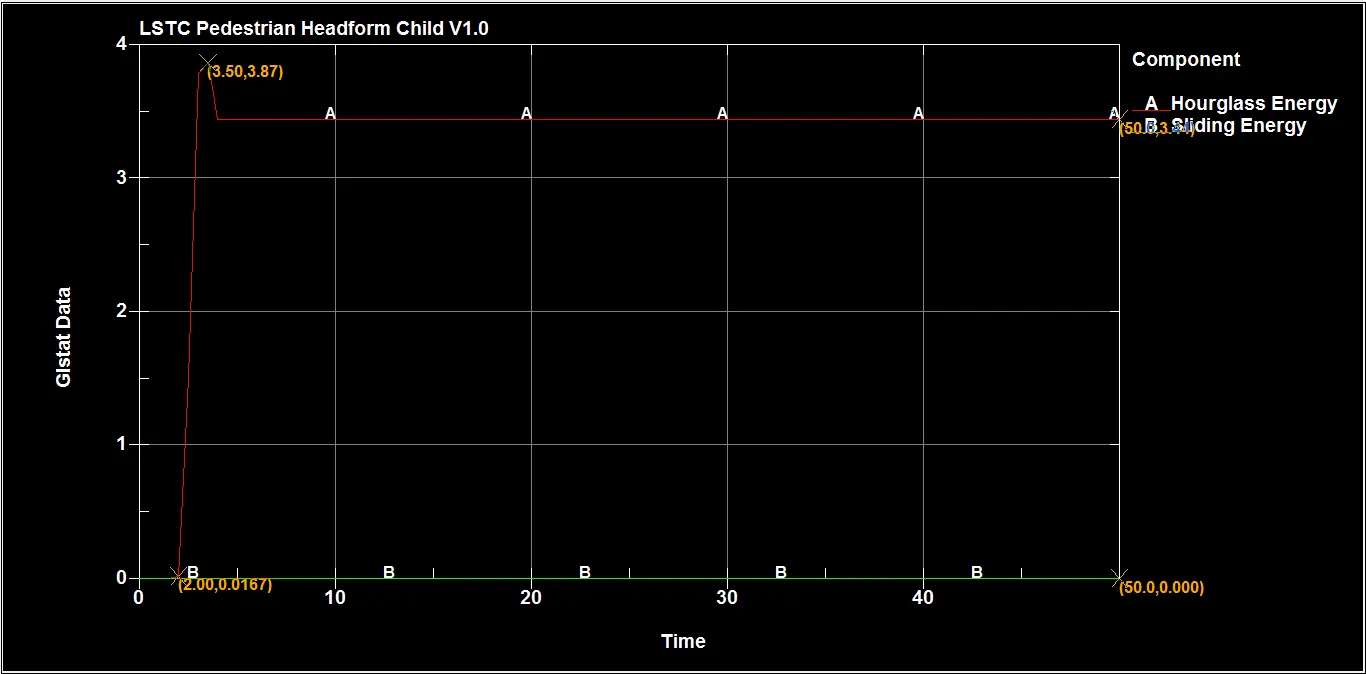
Kinetic Energy , Internal Energy , Total Energy , Hourglass Energy , Sliding Energy obtained at end of simulation are 65.2 J , 145 J , 214 J , 3.44 J , 0 J respectively.
HIC value:
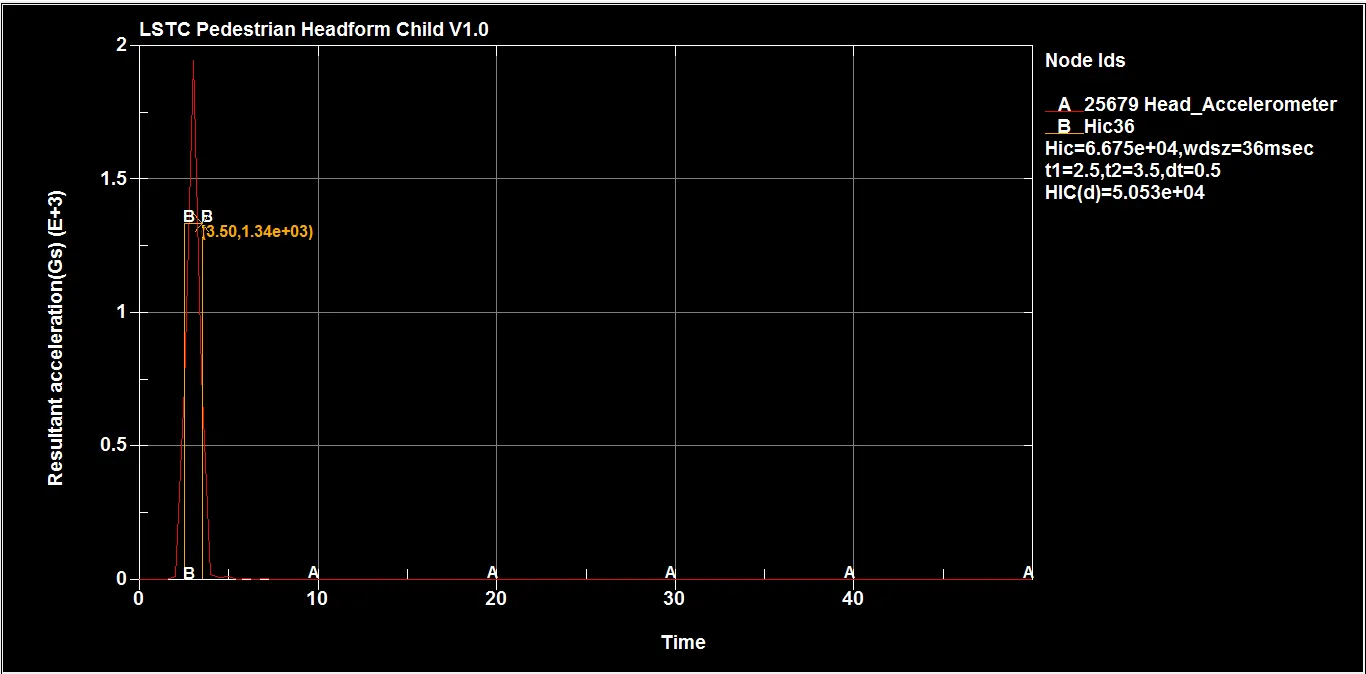
The HIC value is 5.053e+04 which is almost 10 times more than the HIC value (650) as per the pedestrian protection test procedure protocols by EURONCAP. This value obtained will define the fatal injuries odf the pedestrian.
Effective stress:
For evaluating effective von-mises stress a Solid element in child headfoam with ID no. 3362 is selected.
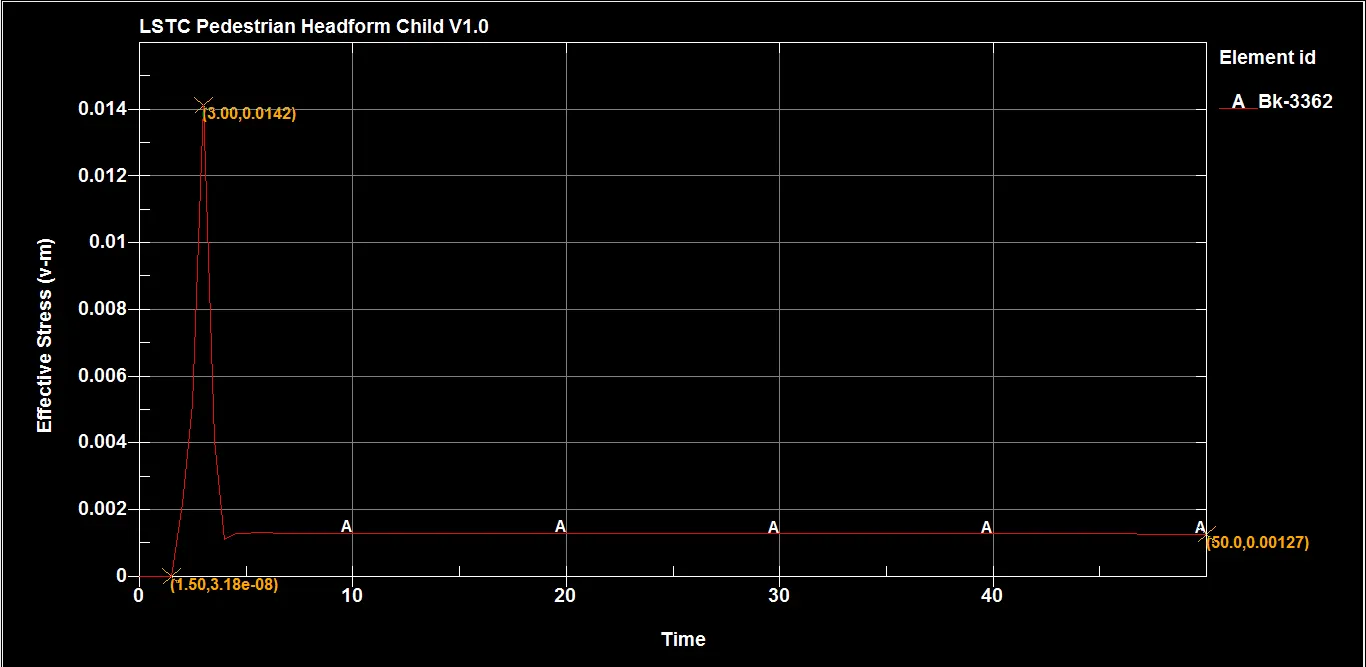
Maximum effective von-mises stress is obtained at 3 ms with value of 0.0142 GPa and at end of 50 ms is 0.00127 GPa.
Deformation:
In order to get deformation of an node , Resultant displacement is evaluated for a particular node ID on Child headfoam.
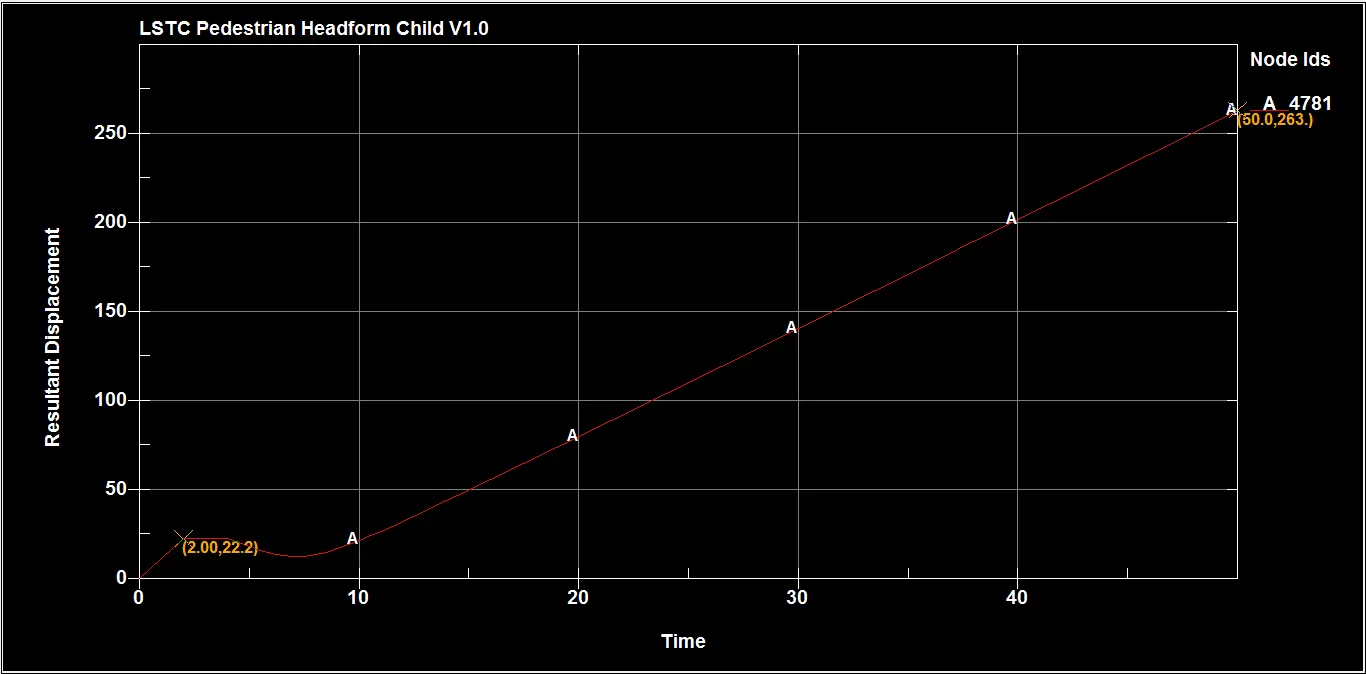
At end of 50 ms , Resultant displacement obtained by node 4781 is 263 mm.
CASE - III : Child headfoam impacting against Hood of a car:
In this case we will rotate our child headfoam model along Y with rotation degree as 50 degree which is of following EURONCAP.
In order to rotate our headform we need to define transformation which is done by DEFINE_TRANSFORMATION with creation of TRANSID and then with use of this TRANSID we will include our transformation by INCLUDE>TRANSFORM>Browse(.k file which is to be rotated)> Provide TRANSID > Accept> Done.
After completing transform save the file as new .k file with new name. Now we will open our Meshed.hood.k file and use INCLUDE keyword card to browse our new rotated head file. After this , we will again save as with new file name and save it. Make sure when using save as right file is selected for save uncheck all and select the desired file. Now close LS prepost and open it again new saved file keyword to check if everything is done poperly or not.
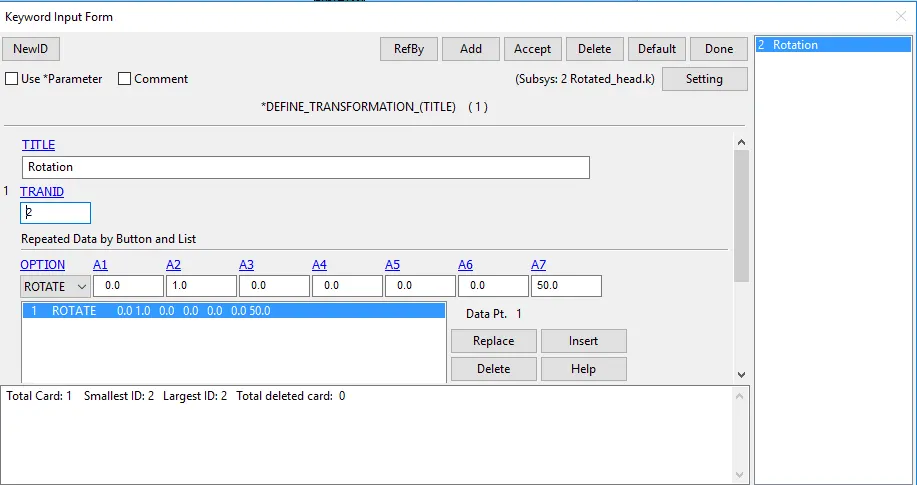
Define transformation card
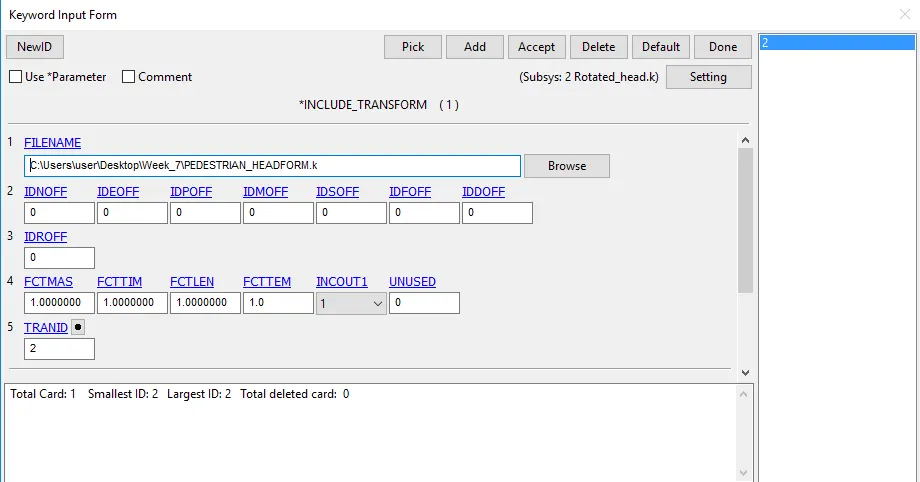
Include transform card
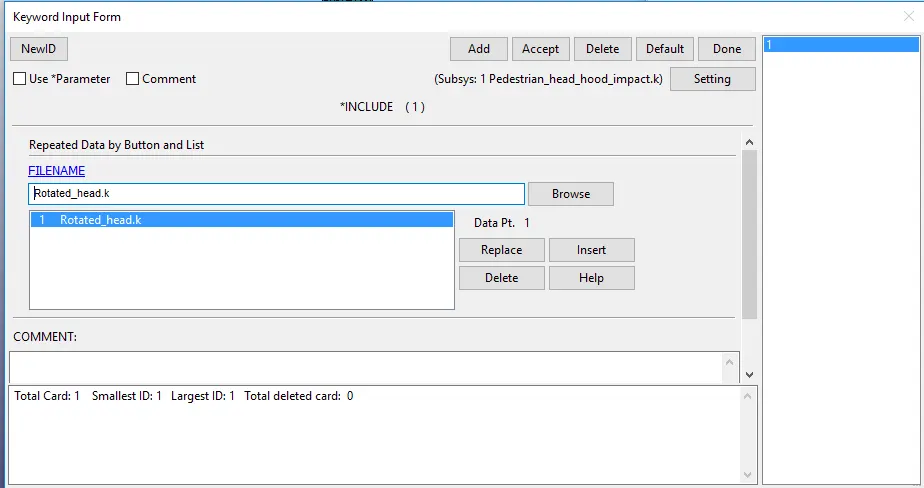
Include card
Section define for Hood:
Section SHELL is defined for hood with ELFORM=2 and Thickness as 2.1 mm . Always make sure Subsystem selected at the top of card is your current file otherwise it will create problem in the termination.
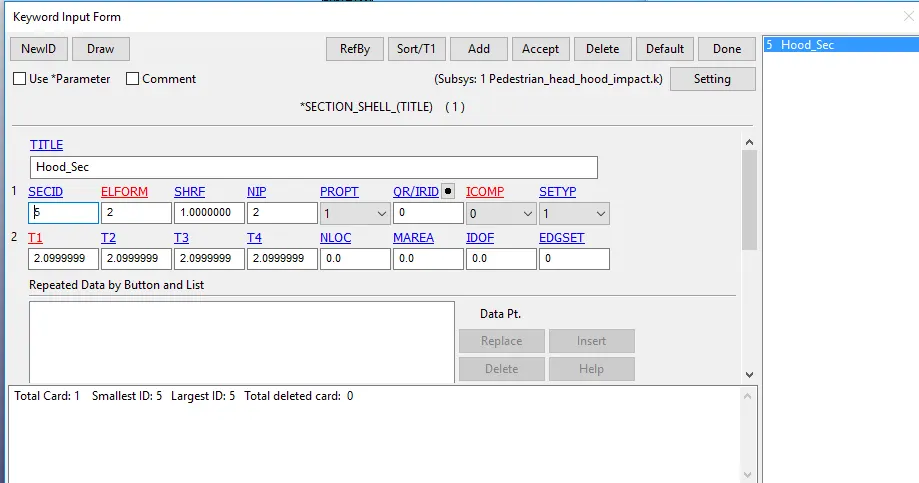
Section card for Hood
Material define for Hood:
MAT_24_Linear plasticity material with properties of Aluminium is defined for Hood.
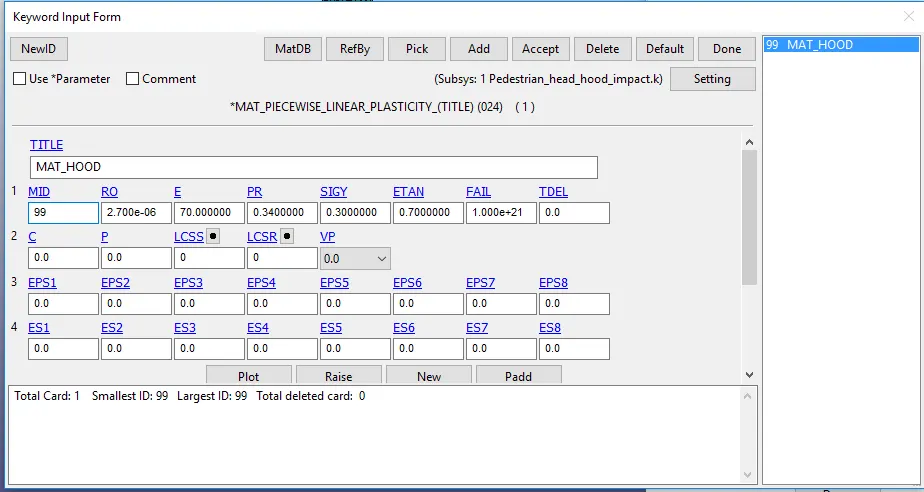
Material card for Hood
Part:
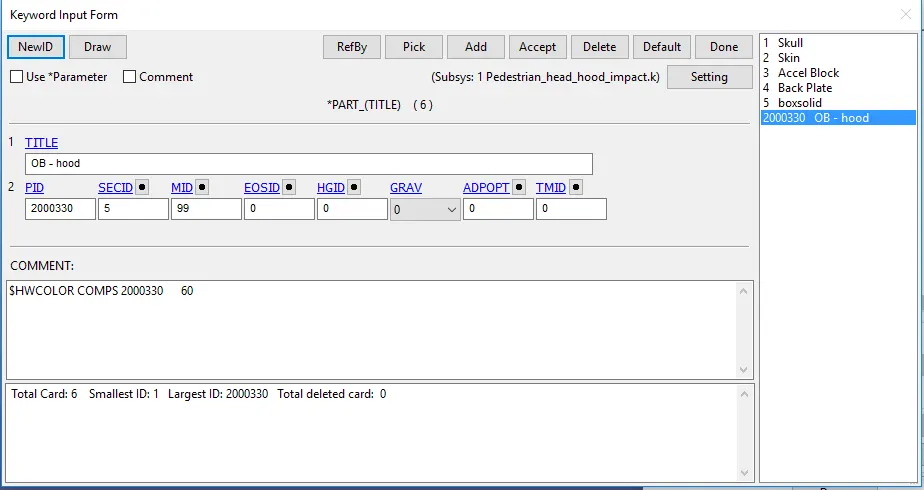
Both material and section is assigned in part of hood.
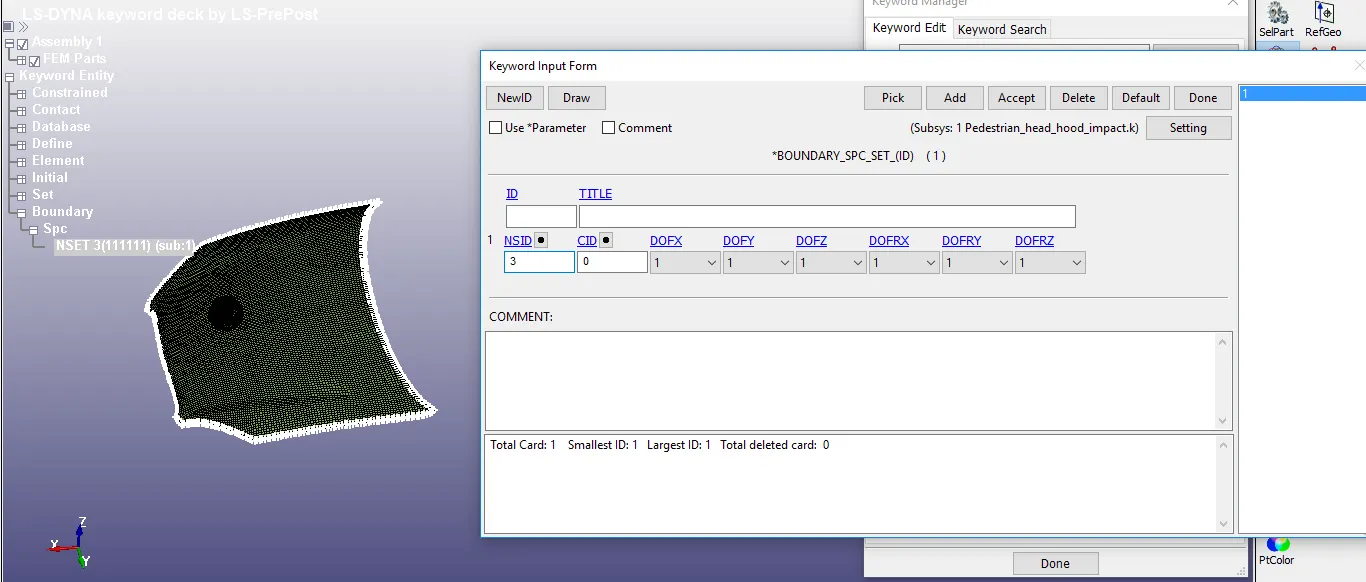
Boundary SPC at edges of Hood:
All four edges are applied Boundary SPC and constrained in all DOFs. Always make sure Subsystem selected at the top of card is your current file otherwise it will create problem in the termination.
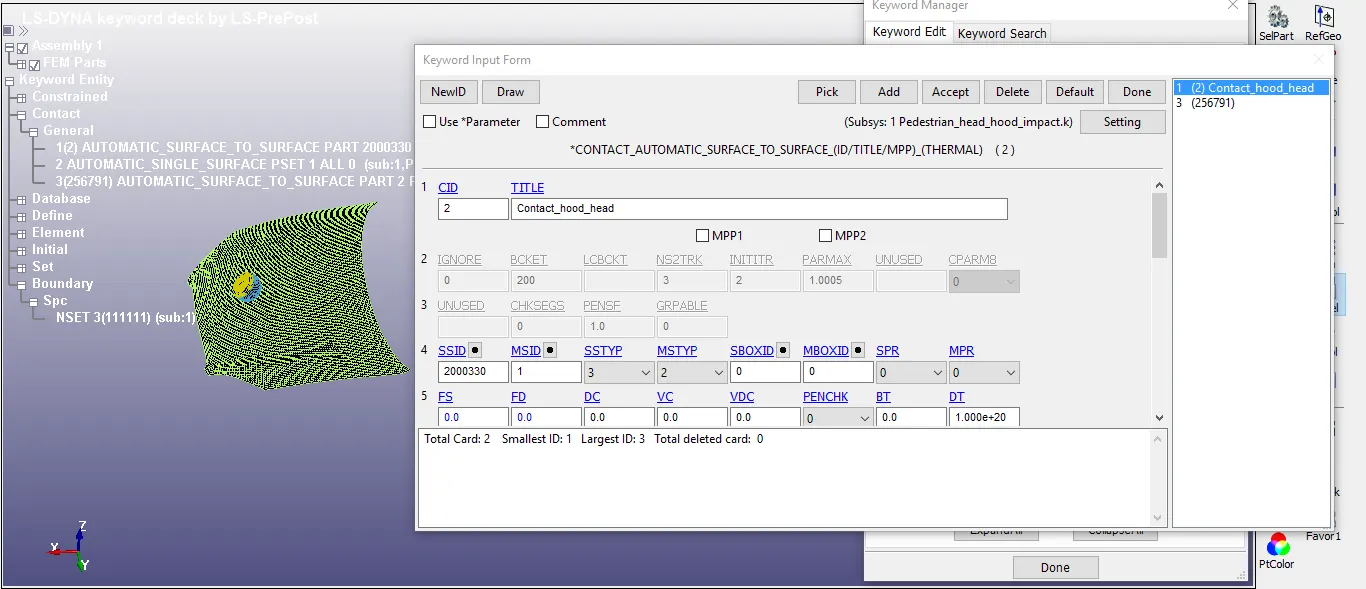
Contact:
New contact of Automatic surface to surface is created between headfoam and hood with Headfoam as Master and Hood as slave. Always make sure Subsystem selected at the top of card is your current file otherwise it will create problem in the termination.
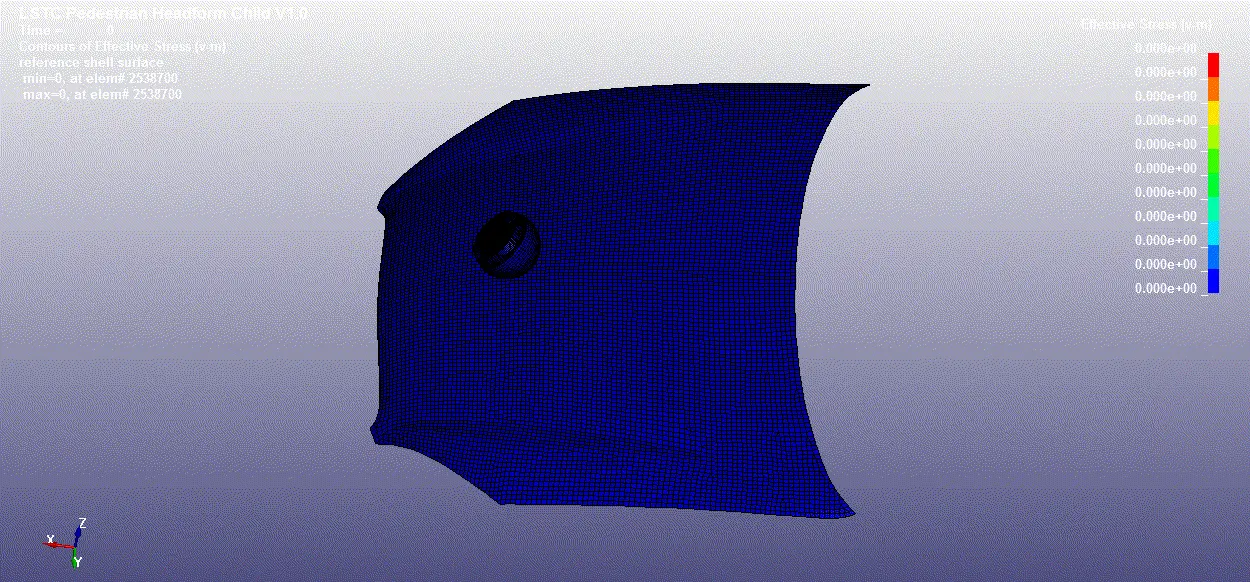
Animation of Simulation:
GLSTAT:
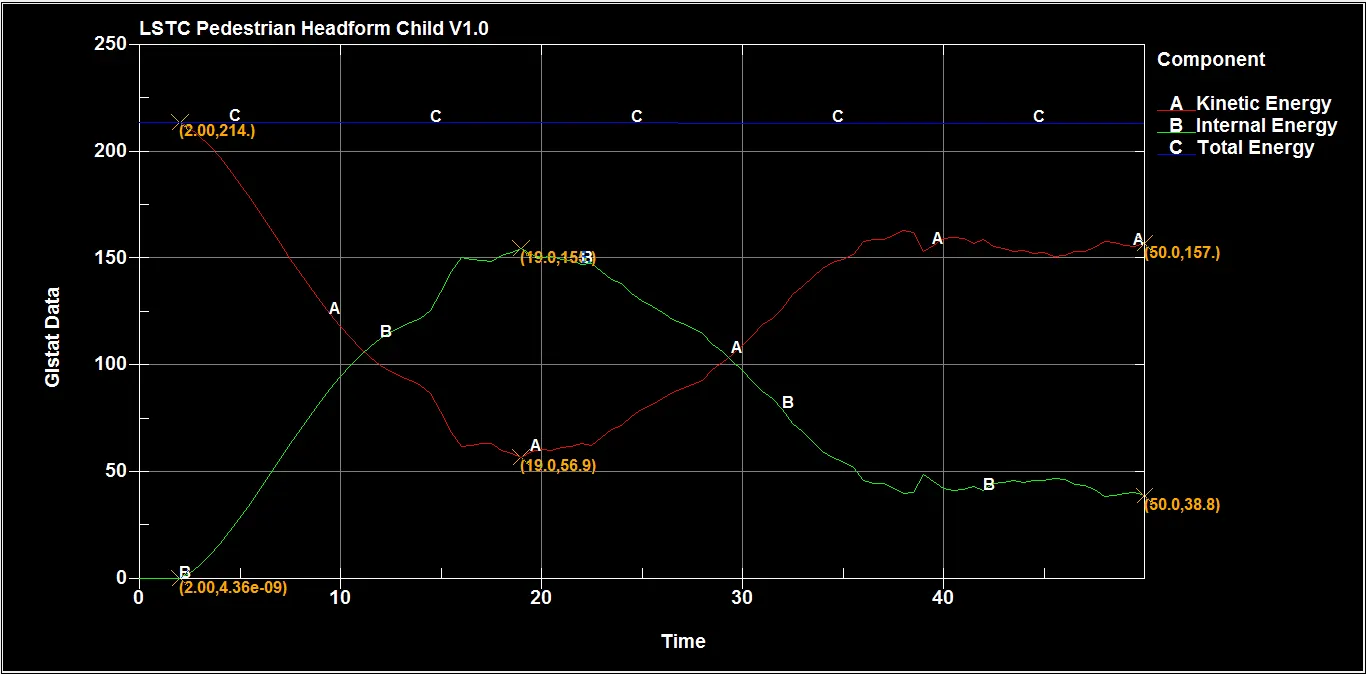
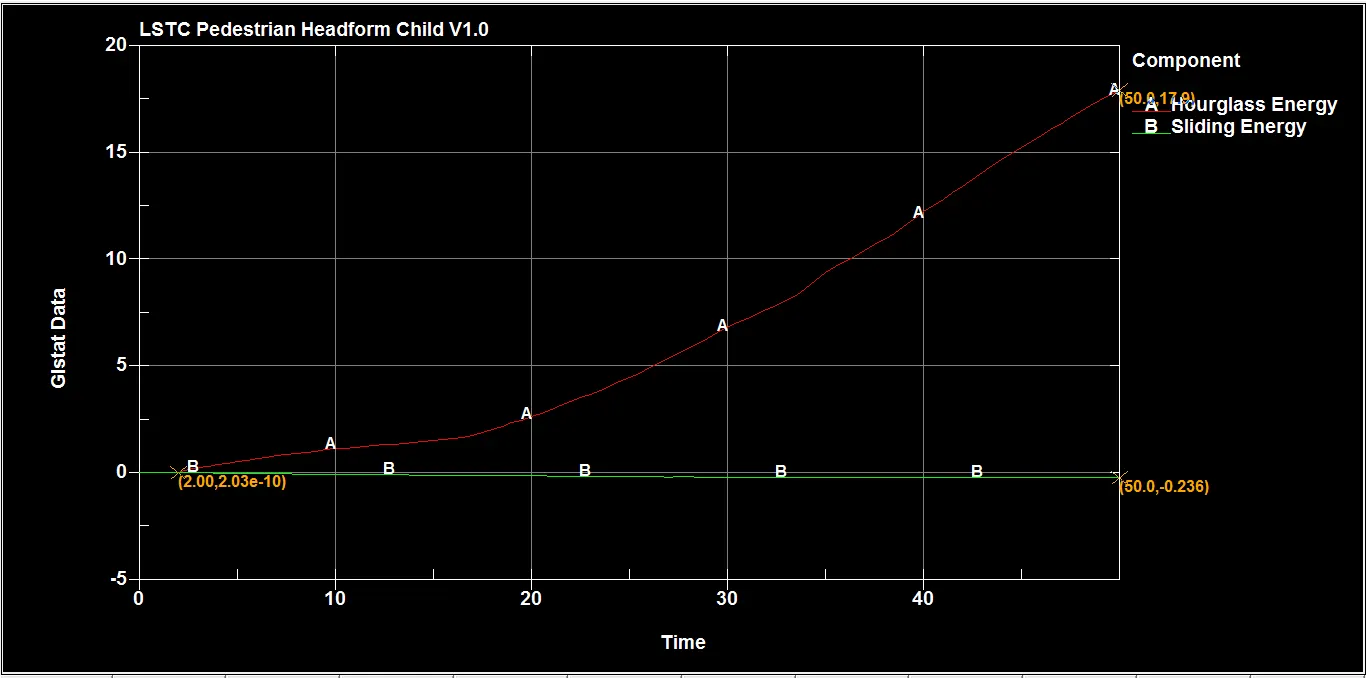
Kinetic Energy , Internal Energy , Total Energy , Hourglass Energy , Sliding Energy obtained at end of simulation 50 ms are 157 J , 38.8 J , 214 J , 17.9 J , -0.236 J respectively.
HIC value:
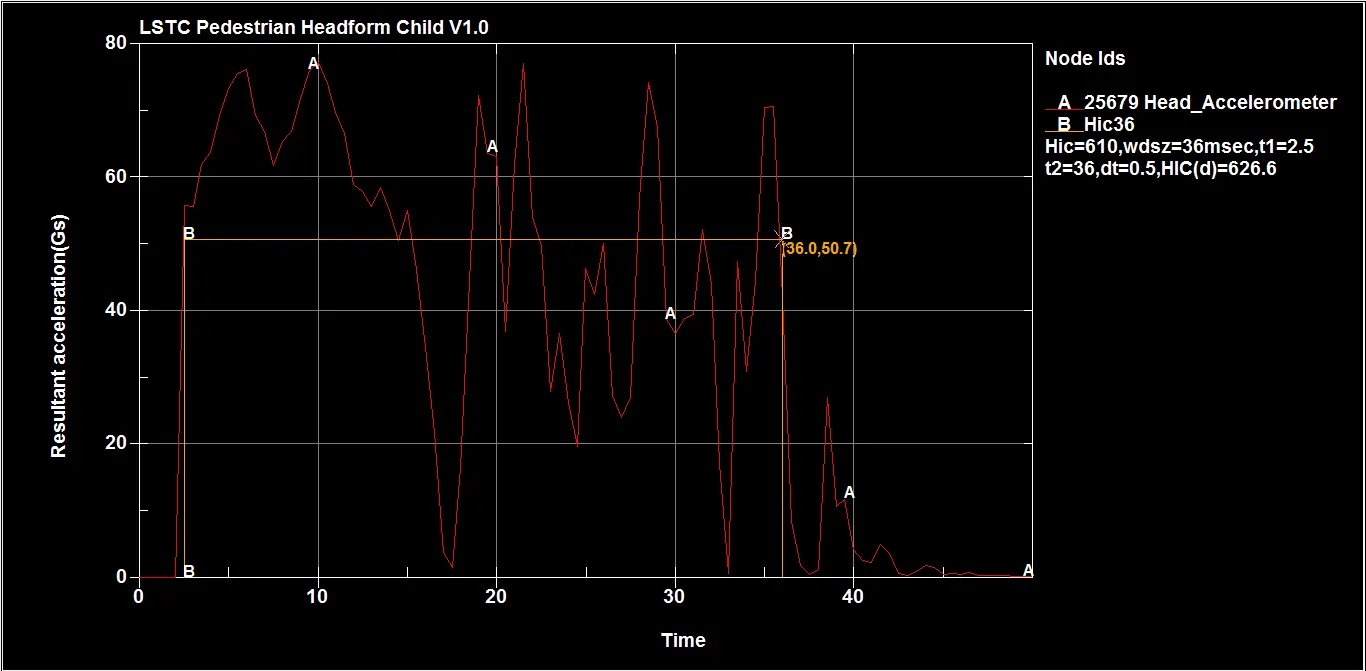
An average acceleration of 50.7 has been noticed between time duration of 2.5 to 36 ms.
The HIC = 610 and HIC(d) = 626.6 is less than the Protocol HIC value of 650 .
Stress plot:
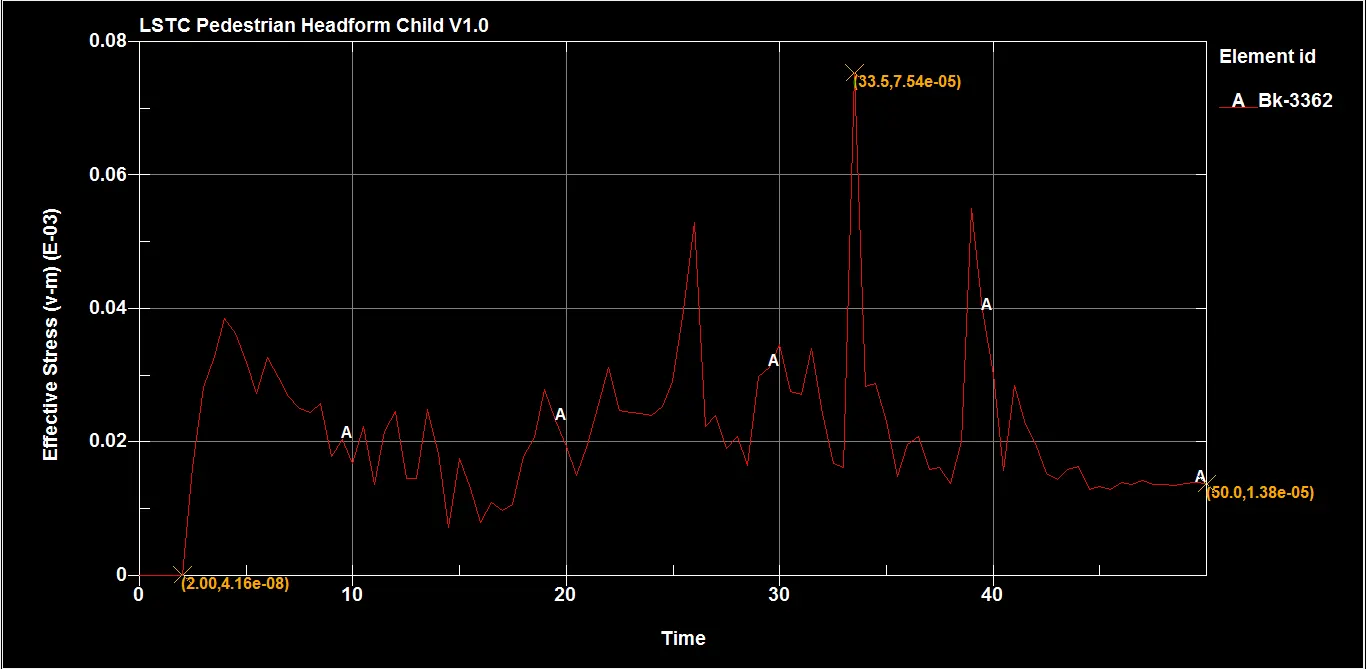
For Headfoam at Element no. 3362 ,
For Hood at Element no. 2538950,
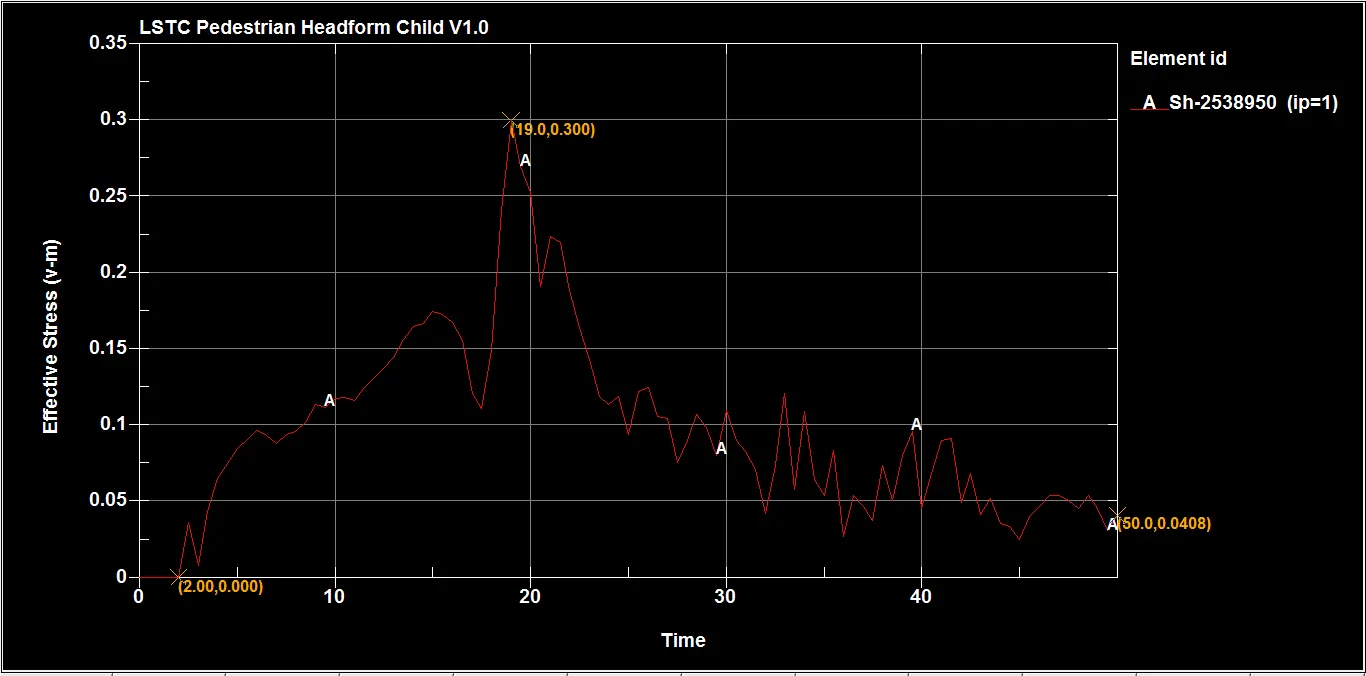
Maximum effective von-mises stress obtained for Headfoam and Hood are 7.54e-05 GPa and 300 GPa respectively.
Deformation:
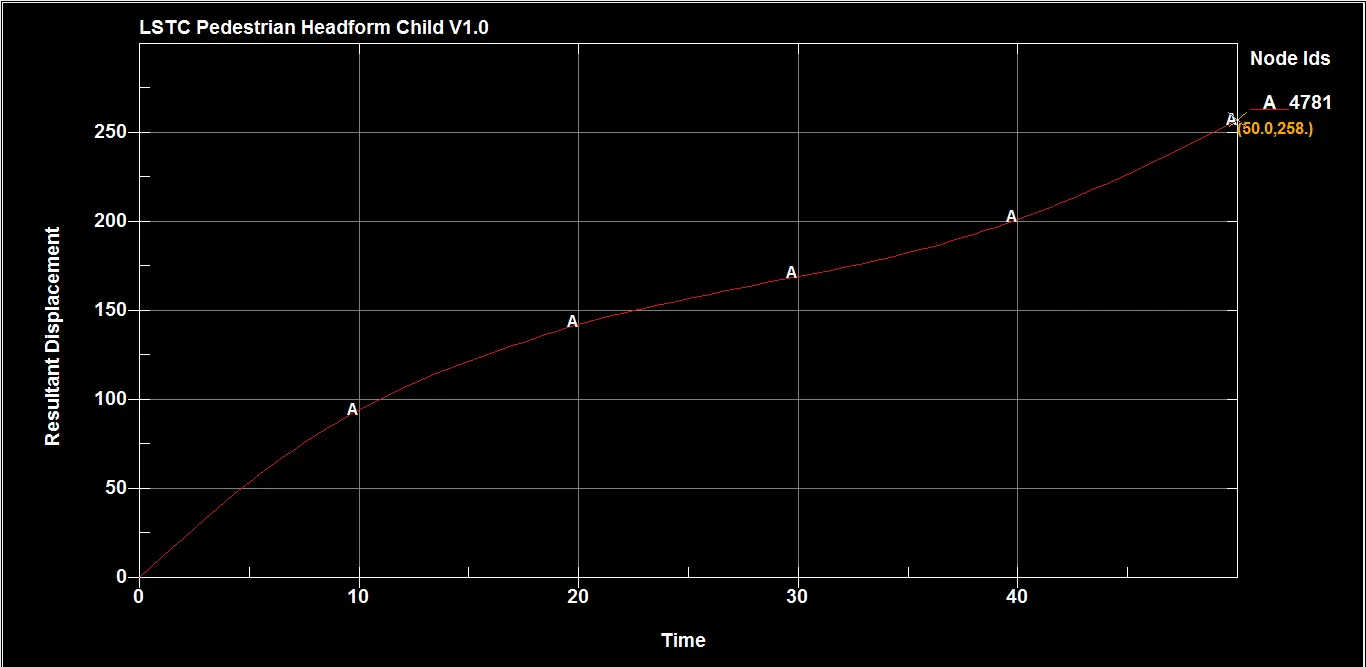
For Headfoam at node 4781,
For Hood at node 2536003,
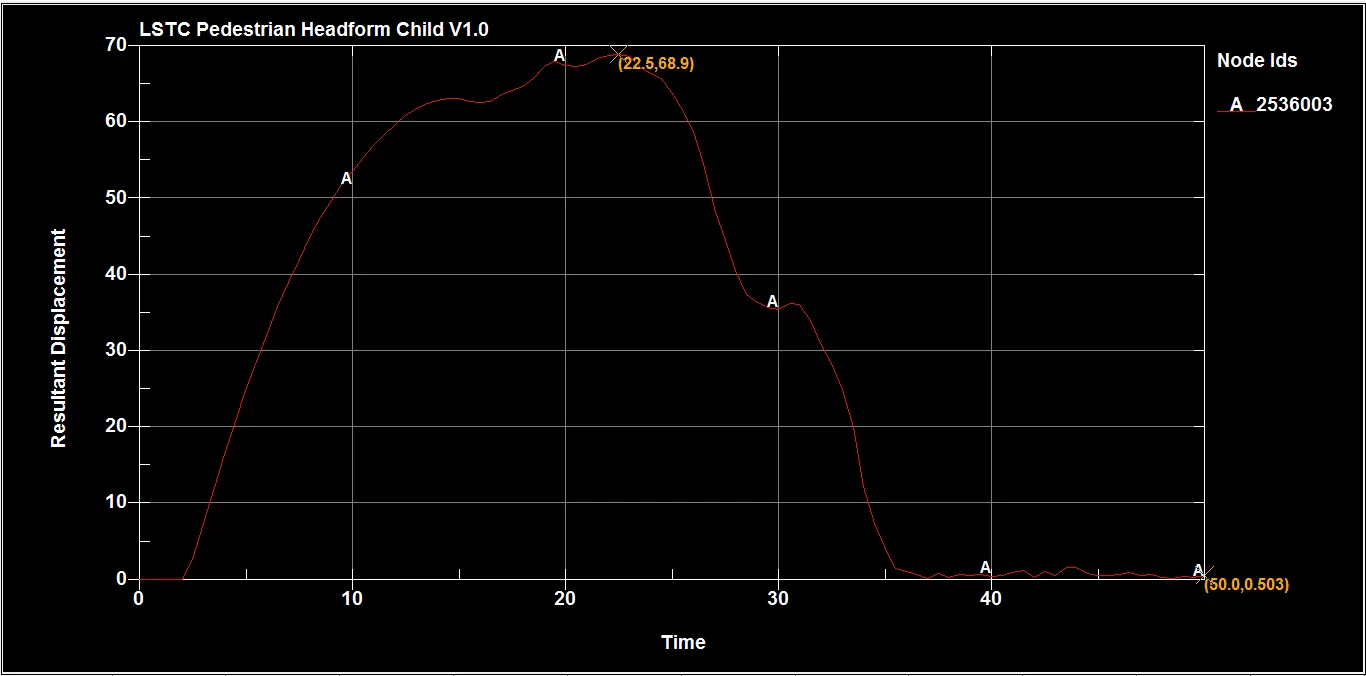
Maximum resultant displacement obtained for Headfoam and Hood are 258 mm and 68.9 mm respectively.
Manual calculation of HIC value:
The average acceleration of the impact during time internval t1 to t2 is,
`a = [1/(t2-t1)*int_(t1)^(t2) a(t)dt]`
`a = [1/(20-3)*int_(3)^(20) a(t)dt]` = 50.7
From plot the value of average acceleration is 50.7 mm/ms2
If that is substituted in Head Injury Criteria equation HIC , with t1 = 2.5 ms and t2 = 36 ms
`HIC = max(t1,t2) { (t2-t1)*[1/(t2-t1)*int_(t1)^(t2) a(t)dt]^n}`
HIC = max(t1,t2){(36-2.5)*50.7^2.5}= 61314713
Note that the HIC number is not dimensionless. Rather, it is calculated in units of seconds ( g^2.5 where g itself is 9.8 m/s2).
So HIC = 61314713/1000 = 613.147
HID(d) = 0.75446( Free motion Headfoam HIC ) + 166.4
= 0.75446*613.147 + 166.4
= 628.99
It is suggested that the HIC is to calculated manually, with the help of LS-PrePost, the only value we know apart from HIC is average acceleration, which has relation with the HIC formula. So,it has been taken and then HIC value is calculated. There is a variation in the plot to the hand calculation, but there is no big difference. So, this is acceptable.
Conclusion:
1. The HIC value is very large for second case and less than 650 in the third case.
2. A large HIC value doesn't imply that High level injuries takes place and in the same way, less HIC value doesn't signify no(less) injuries.
3. The stress that is taken up by the headform in second model is 0.0142 GPa Whereas, in the third case it is 0.000075 Gpa which is very less when compared to Second case
4. A rigidwall against which the headform impacts in the second case which didn't take load onto it. The Aluminium Hood took a stress of 0.30 GPa that is why a less amount of stress can be seen on the headform.
5. The hood absorbed maximum amount of stress undergoing a High deformation of around 68.9 mm, which conveys that the material used should have been of higher mechanical properties than Aluminium. Materials like structural steel, Aluminium Alloys and Magnesium Alloys are also to be used if a proper conclusion is needed.
6. This project has been performed only on the Headform and Hood. But in the real life scenario this won't the case. The engine block and all other parts will be present right beneath the hood. The actual HIC value will be obtained only then.
7. This project is to get the idea of the Headform, its parts (skull,skin,back plate), at what velocity and angle it hits the bonnet, defining and including multiple files using *INCLUDE,INCLUDE_TRANSFORMATION,*DEFINING_TRANSFORMATION are the major take away from this project.