Week-7 Head Impact
PEDESTRIAN HEAD IMPACT TEST
OBJECTIVES:
To simulate the pedestrian head impact test in 3 levels of model based on complexity and compare the stress-strain plot, acceleration and HIC.
INTRODUCTION :
Pedestrian protection CAE is a part of vehicle safety engineering from a crash perspective. In pedestrian protection, we look for imparting minimum injury to head, upper leg (thigh), and lower leg (including knee) in case of an accident with a human subject. These tests are usually done at a lower velocity from 20-40 kmph as accidents tend to result in more severe circumstances above these velocities and braking in case of an accident often results in collision at low velocities.
The Head Injury Criterion (HIC) is a measure of the likelihood of head injury arising from an impact. The HIC can be used to assess safety related to vehicles, personal protective gear, and sport equipment. Normally the variable is derived from the measurements of an accelerometer mounted at the center of mass of a crash test dummy’s head, when the dummy is exposed to crash forces. It is defined as:
HIC=maxₜ₁,ₜ₂{[1/(t₂-t₁)∫ₜ₁ᵗ₂a(t)dt]²·⁵(t₂-t₁)} where t₁ and t₂ are the initial and final times (in seconds) chosen to maximize HIC, and acceleration a is measured in gs (standard gravity acceleration). The result is called HIC15 if ∆tmax = 15 ms, and HIC36 if ∆tmax = 36 ms. Since the normalized head acceleration is unitless, it is clear that HIC has the units of seconds.
PROCEDURE :
CASE 1 :
1. For the simple head impact simulation, a shell meshed sphere is made to hit against a rigid wall. Open the simple_head.k file in LS-Dyna Prepost.
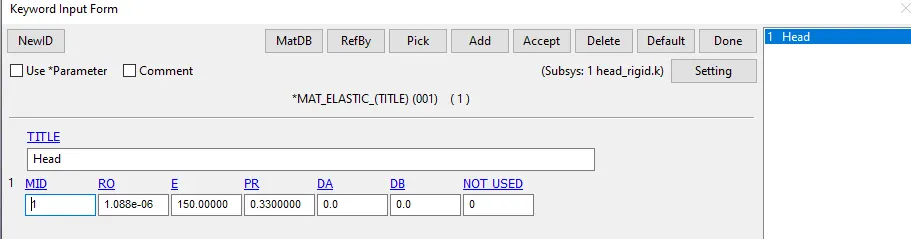
2. Create Section > shell with thickness 3mm and Material > Elastic(001). assign in PART.
3. Create a Rigidwall using create entity perpendicular to z axis.
4. Create initial velocity of 40kmph (11.11 mm/ms) in direction -z on all nodes of the head FE model.
5. Create Automatic Single surface contact with slave nodes as Head part.
6. Create Control > Energy , Hourglass and Termination time of 30ms.
7. Create Database > ASCII with ELEOUT, MATSUM, GLSTAT, NODOUT, SLEOUT, Binary d3plot, Extend binary.
8. Save and run simulation in LS-Dyna manager.

From the simulation, large amount of stress is induced in the Head model due to impact on the rigid wall, max Vonmisses stress 4.007e-02 GPa. Since this model is a simplified headimpact procedure, it does not give accurate results.
CASE 2 :
1. The Pedestrian Child head model is made to hit the rigid wall in case 2. Open the Pedestrian_headform.k file in LS-prepost. The FE model consists of 4 parts : SKIN, an Ogden(77_O) material and SKULL, ACCELERATION BLOCK, BACKPLATE are rigid(20) materials.
2. The remaining steps are followed as per case1 and simulation is obtained.
From the simulation, large amount of stress is induced in the Head model due to impact on the rigid wall, max Vonmisses stress 9.486e-3 GPa. The original head model gives accurate headimpact results than the simple head sphere FE model because of the recommended material properties and hexa elements.
CASE 3 :
1. The Pedestrian child head model is made to hit a car hood. The Meshed car hood is aluminium of thickness 2mm and ELFORM 16(fully integrated) which is to be replaced at the same place of rigid wall.
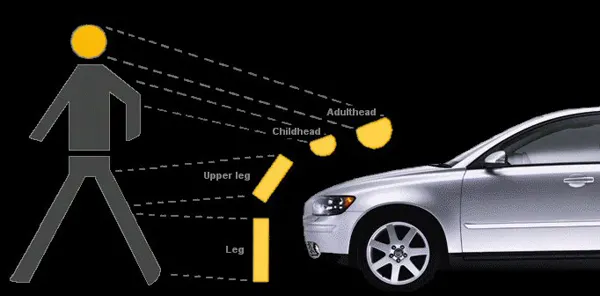
2. The pederstrian head is included in the model and trainsformed to desired angle(45deg) using include_transform, define transformation keywords.


3. Create SPC Boundary condition and fix all DOFs at the edge nodes of the meshed car hood so the hood remains constrained in all directions.
4. Create initial velocity of 40kmph (11.11 mm/ms) in direction -z on all nodes of the Pedestrian child head FE model.
5. Create Automatic Single surface contact with slave nodes as the meshed hood whild the skin and skull part are assigned as Master.
6. Create Control > Energy , Hourglass and Termination time of 30ms.
7. Create Database > ASCII with ELEOUT, MATSUM, GLSTAT, NODOUT, SLEOUT, Binary d3plot, Extend binary.
8. Save and run simulation in LS-Dyna manager.
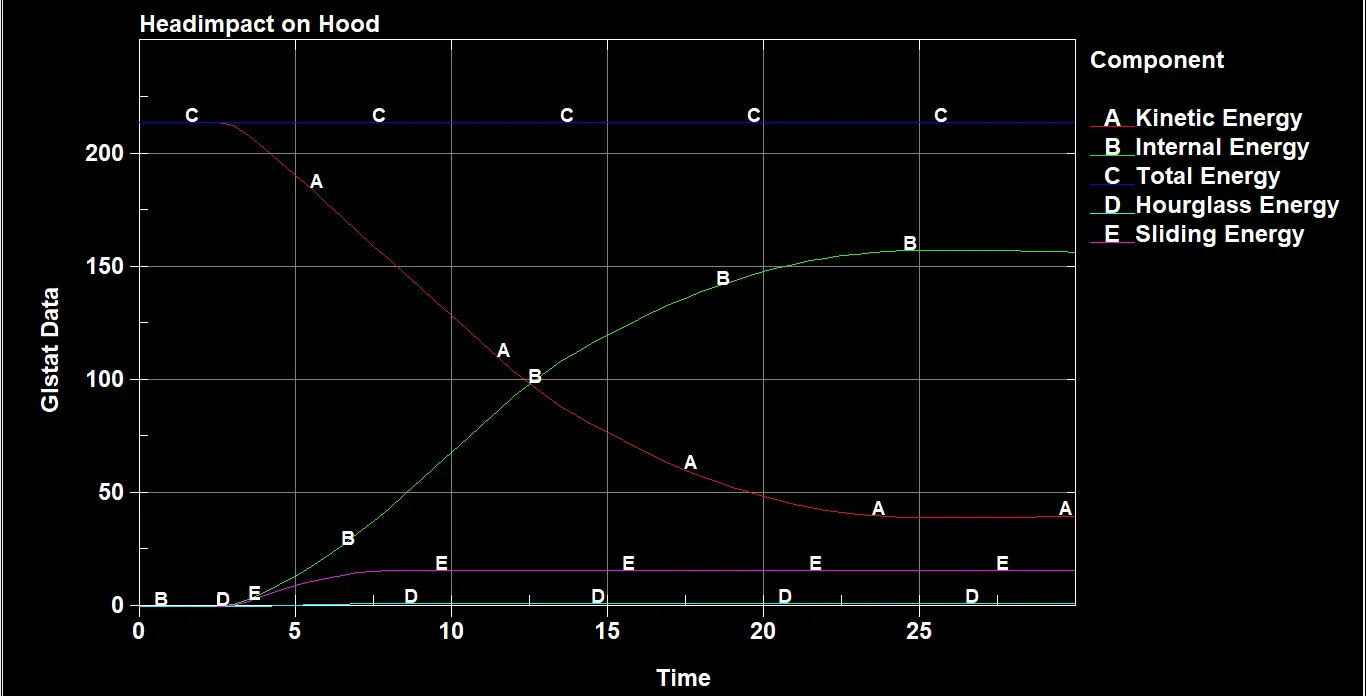
From the simulation, large amount of stress is induced in the Head model due to impact on the Car hood, max Vonmisses stress 1.429e-2 GPa. The Energy curve for this simulation shows that the Total Energy is at 214 J and the kinetic energy reduces to 40 J while the internal Energy increases to 160 J ath the end of simulation.
The Strain acting on direction z is compared for 3 cases :
CASE 1:
CASE 2 :
CASE 3 :
| PARAMETERS | CASE 1 | CASE 2 | CASE 3 |
| VONMISSES STRESS | 4.007E-02 GPa | 9.486E-03 GPa | 1.429e-02 GPa |
| STRAIN ALONG X DIRECTON | 1.420E-04 | 1.825E-01 | 4.046E-02 |
| STRAIN ALONG Y DIRECTON | 1.511E-04 | 1.805e-01 | 1.073E-01 |
| STRAIN ALONG Z DIRECTON | 1.334E-04 | 9.550E-02 | 8.328E-03 |
| STRESS ALONG X DIRECTON | 3.963E-02 GPa | 4.481E-03 GPa | 1.628E-01 GPa |
| STRESS ALONG Y DIRECTON | 3.999E-02 GPa | 2.810E-03 GPa | 1.571E-01 GPa |
| STRESS ALONG Z DIRECTON | 2.314E-02 GPa | 4.828E-03 GPa | 3.510E-02 GPa |
It is evident from the simulation that maximum strain in the case 3 is observed on the hood of the car which deforms due to the head impact while the deformation on the head is minimal. The stress and strain in the case 2 is very high because of the impact onto a rigid wall when compared to the hood in case 3. So the Head in case 3 is less prone to severe injury.
HEAD INJURY CRITERIA(HIC) COMPARISON :
CASE 1 : Simple Head 2D Shell sphere onto Rigid wall.
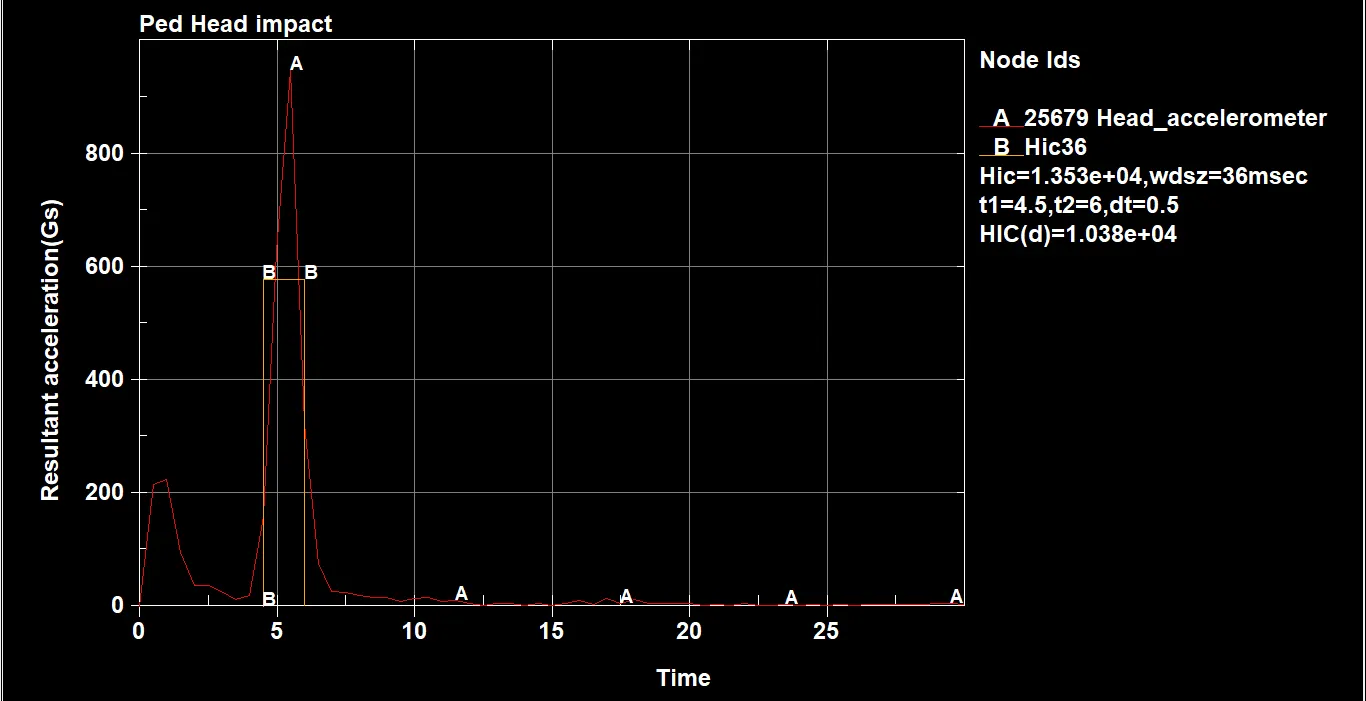
CASE 2 : Pedestrian Child head impact onto rigid wall.
CASE 3 : Pedestrian Child head impact onto car hood.
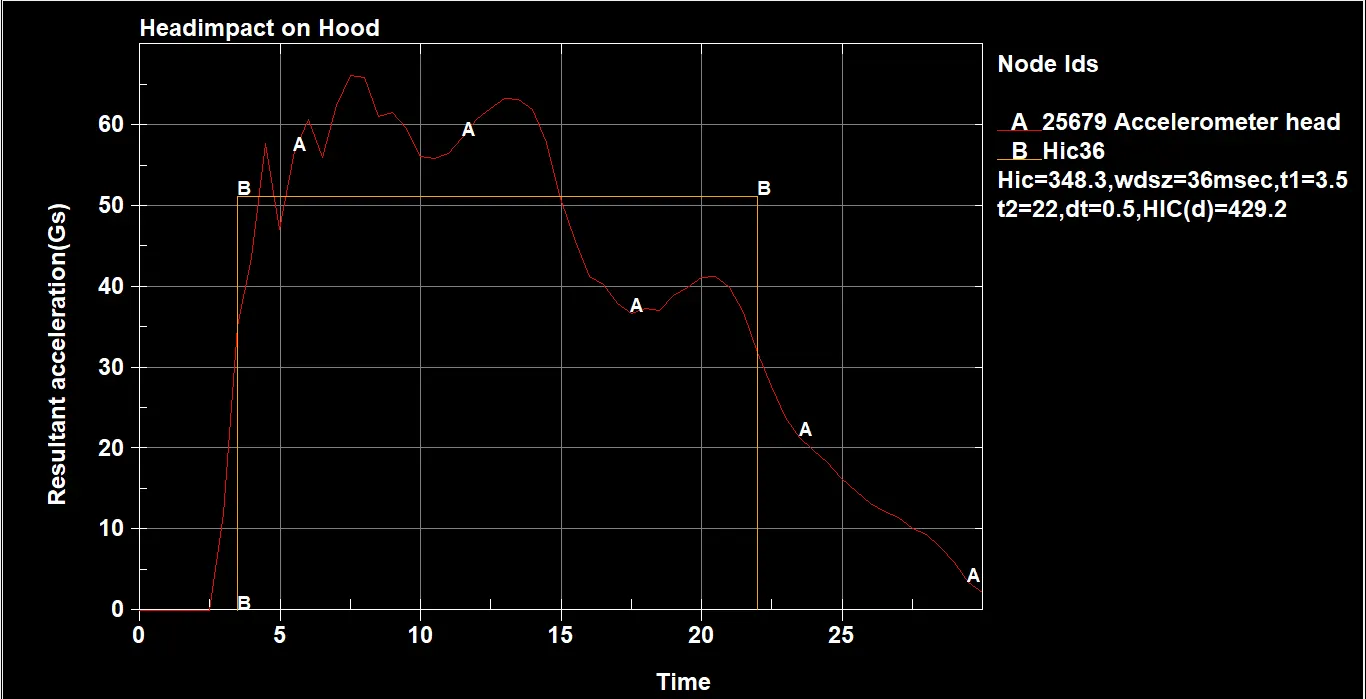
HIC value for example is calculated as :

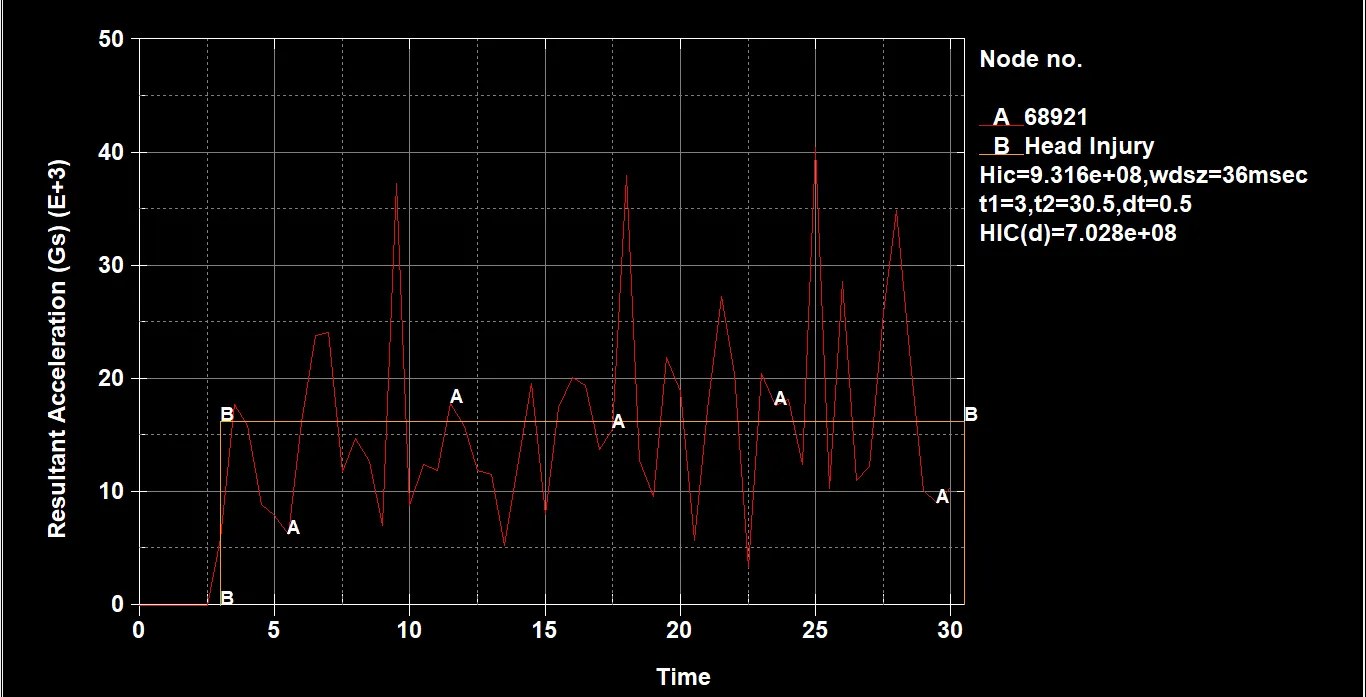
where, [1/(t₂-t₁)∫ₜ₁ᵗ₂a(t)dt]²·⁵ = [51.3]^2.5 ( value obtained by the Hic36 flat line on the graph in case 3 - avg standard gravity=51.3 Gs)
now, HIC = 18849.22 x (22-3.5) = 348310.5936
As per unit standard of kg mm ms, we get HIC = 348.3.
HIC(d) is the performance criteria. The HIC(d) value is the weighted standardized maximum integral value of the head acceleration and is calculated from the HIC36 value.

For example, case 3 HIC(d) = 0.75446 x 348.3 + 166.4 = 429.2
| MODEL | CASE 1 | CASE 2 | CASE 3 |
| ACCELERATION (Gs) | 40E+03 Gs | 940 Gs | 1.2 Gs |
| HIC | 9.316E+8 | 1.353E+4 | 348.3 |
| HIC(d) | 7.028E+08 | 1.038E+4 | 429.2 |
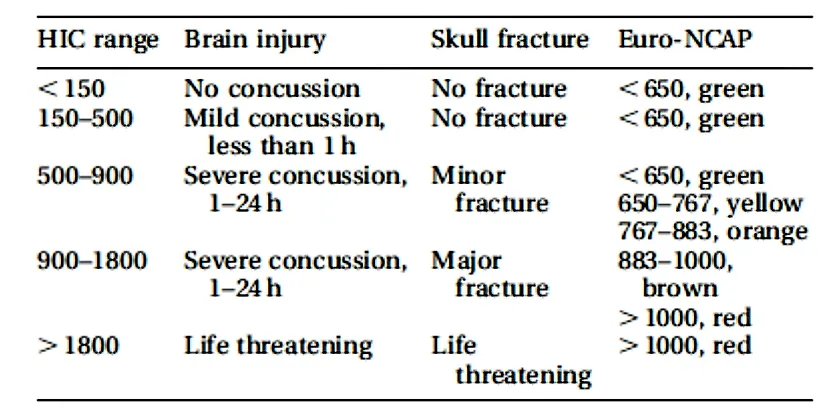
The HIC value in Case 1 is too high, whereas when the Pedestrian child head HIC value is 13530 when it hits the rigid wall as in Case 2 which leads to severe injury based on the Severity index.
The HIC value in case 3 is 348.3, so when the head hits car bonnet, more energy is absorbed by the car hood because of the less stiffer Aluminium material used. We can conclude that there will be no Skull fracture but mild concussion less than 1 hour.
LINK :
CASE 1 : https://drive.google.com/drive/folders/1iYerPhGafadUbSIo0kCjZ3Fh5lp4egUG?usp=sharing
CASE 2 : https://drive.google.com/drive/folders/1gGZzO7odnO0O6z-JAE0NKZ7RnQJsJLmi?usp=sharing
CASE 3 : https://drive.google.com/drive/folders/1a-rw-g3ev3AKB7pasqWoCg-YHTAIDMcH?usp=sharing
CONCLUSION :
1. The Simulation is done for head at an angle of 45degree in 3 cases for 30ms.
2. The stress ,strain, acceleration are plotted for 3 cases and are compared.
3. The HIC value is obtained and compared between impact on rigid wall vs Aluminium car hood.