Week-7 Challenge: DC Motor Control
1. Run MATLAB demo ‘Speed control of a DC motor using BJT H-bridge’. Modify the model such that armature current doesn’t shoot up when motor changes direction from forward to reverse.
MODEL:
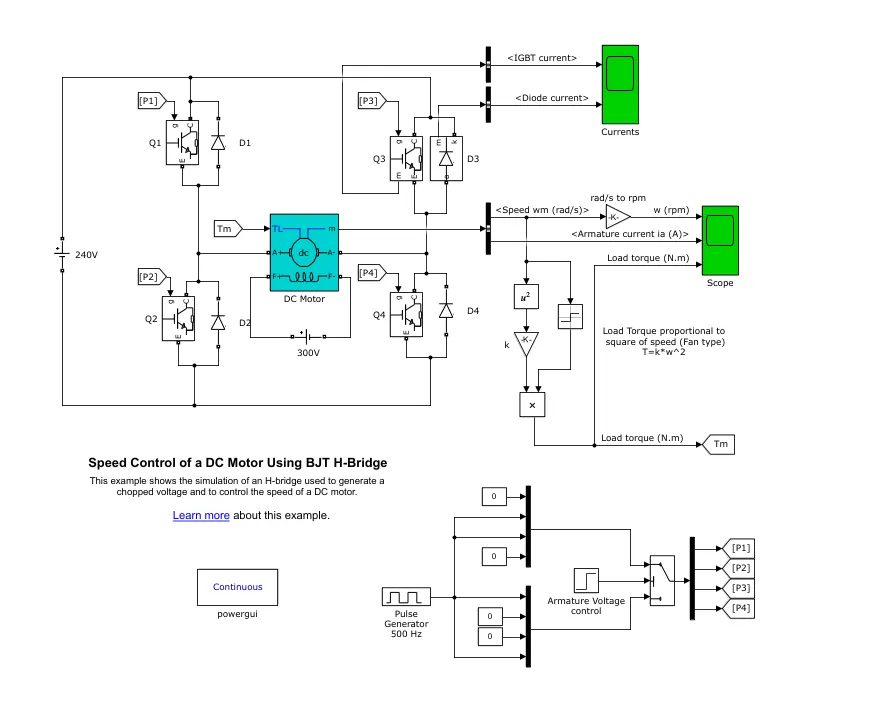
The Bipolar Junction Transistor (BJT) when used for power switching applications, operates as an IGBT. When it is conducting (BJT operating in the saturated region), a forward voltage Vf is developed between collector and emitter (in the range of 1 V). Therefore, the IGBT block can be used to model the BJT device.
The IGBT block does not simulate the gate current controlling the BJT or IGBT. The switch is controlled by a Simulink® signal (1/0). The DC motor uses the preset model (5 HP 24V 1750 rpm). It simulates a fan type load (where Load torque is proportional to square of speed). The armature mean voltage can be varied from 0 to 240 V when the duty cycle (specified in the Pulse Generator block) is varied from 0 to 100%.
The H-bridge consists of four BJT/Diode pairs (BJT simulated by IGBT models). Two transistors are switched simultaneously: Q1 and Q4 or Q2 and Q3. When Q1 and Q4 are fired, a positive voltage is applied to the motor and diodes D2-D3 operate as free-wheeling diodes when Q1 and Q4 are switched off. When Q2 and Q3 are fired, a negative voltage is applied to the motor and diodes D1-D4 operate as free-wheeling diodes when Q2 and Q3 are switched off.
Simulation Process:
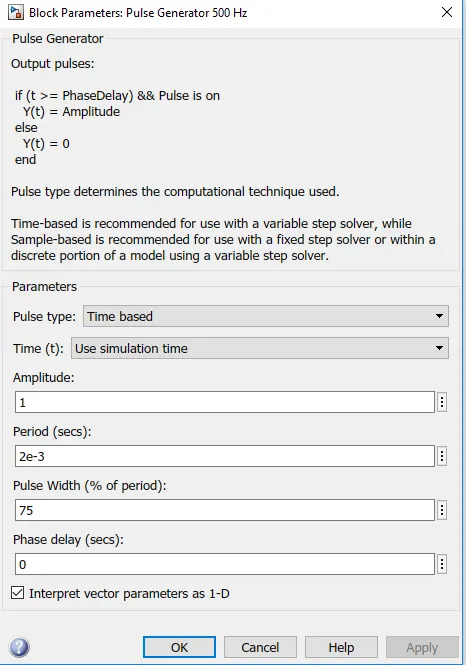
The motor starts in the positive direction with a duty cycle of 75% (mean DC voltage of 180V). At t= 0.5 sec., the armature voltage is suddenly reversed and the motor runs in the negative direction.
'Scope' shows motor speed, armature current and load torque and 'Currents' shows currents flowing in BJT Q3 and diode D3.
Without Changing The Pulse width;
SCOPE:
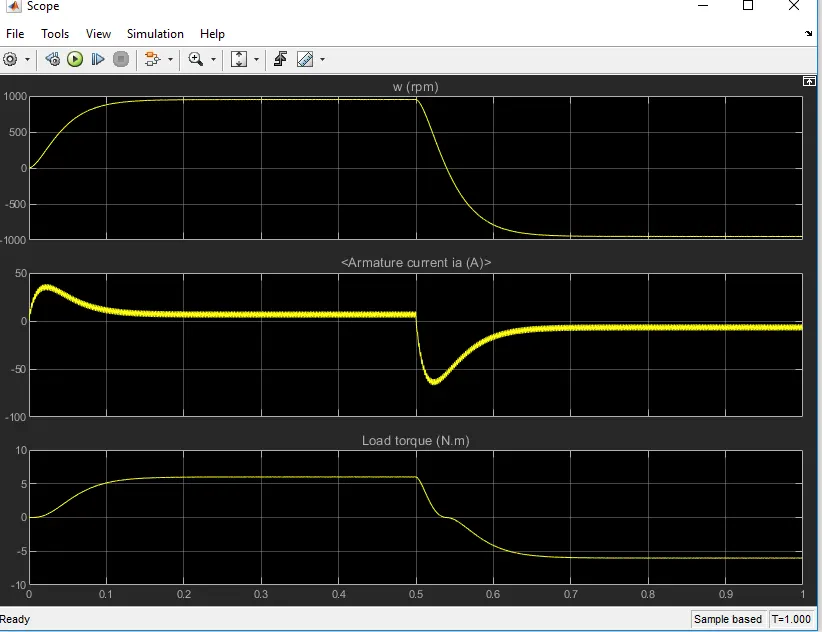
The armature current flow drops to negative, when the pulse width is at a default value of 75,when the motor changes from forward to reverse direction or vice versa.
NOW;
Modifying the pluse width;
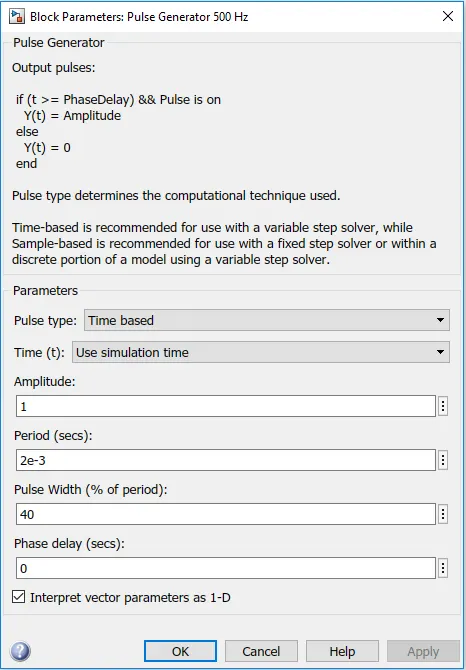
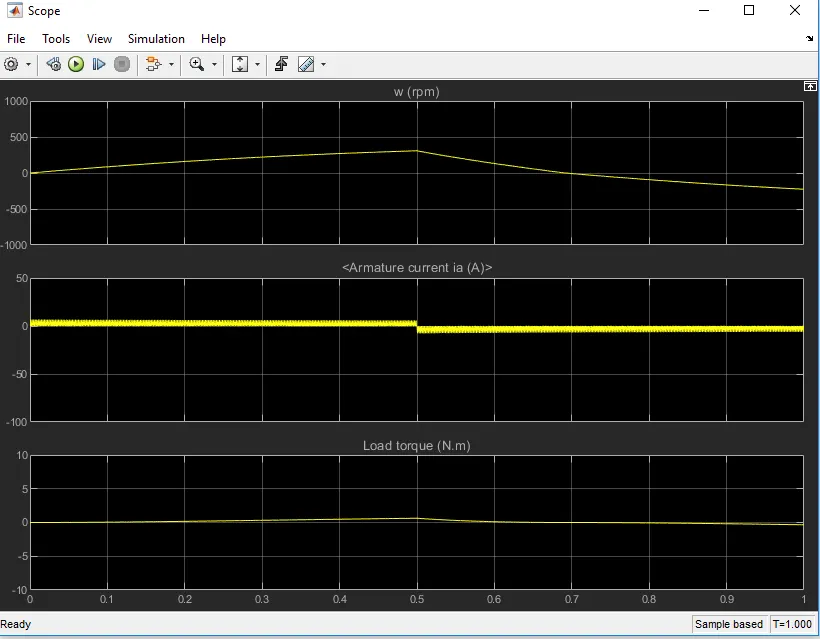
Here; we have reduced the pulse width to 40 in the pulse generator block.
Resulting Scope:
NOTE:
Pulse width modulation (PWM) is used to generate pulses with variable duty cycle rate. The rapid rising and falling edges of PWM signal minimises the switching transition time and the associated switching losses.
Pulse width modulation changes the armature voltage flow,which in turn changes the armature current flow direction.
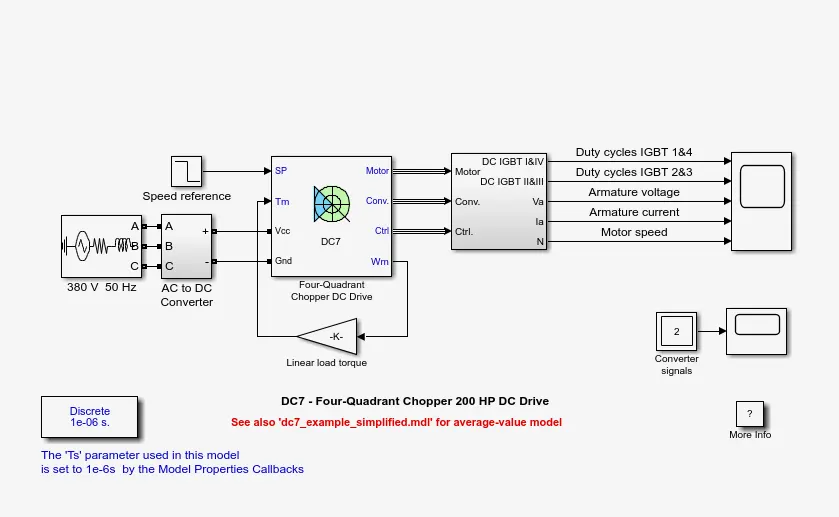
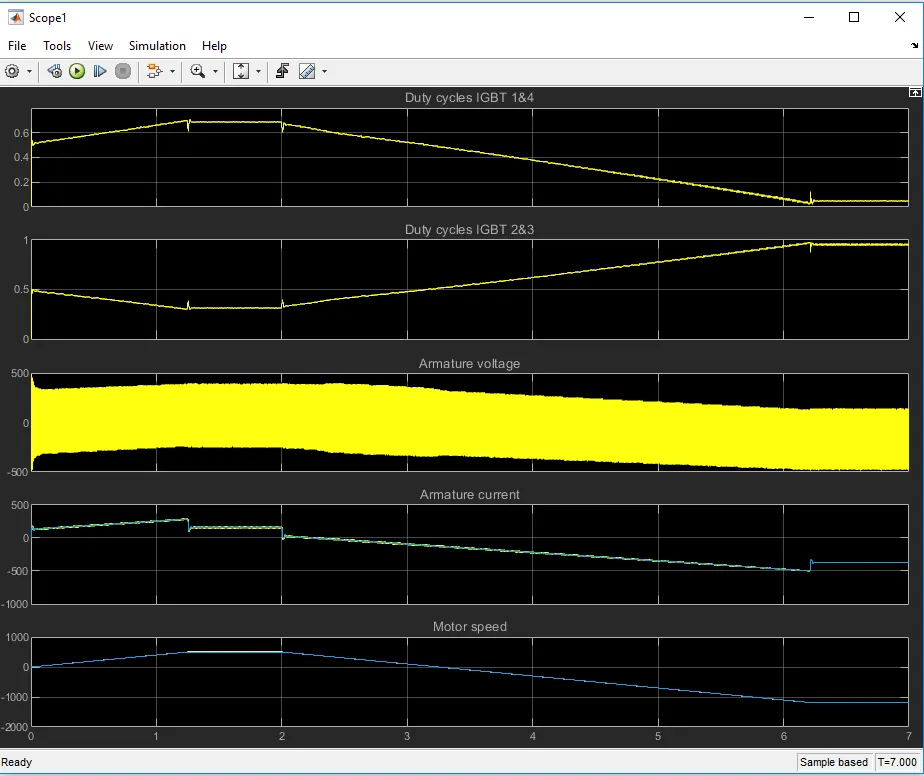
2. Refer to help section of ‘The Four-Quadrant Chopper DC Drive (DC7) block’. Compare it with H-bridge model.
The Four-Quadrant Chopper DC Drive (DC7) block:
Scope:
Speed control of a DC motor using BJT H-bridge:
Scope:
COMPARISSION:
- The DC7 block consists of a motor,converter and a controller whereas,the h-bridge block consists of just a motor control.
- The DC7 block exists in all the four quadtants, while the H-bridge block exists in only two quadrants.
- In the DC7 block you can observe the motor armature voltage and current, the four IGBT pulses and the motor speed on the scope. The current and speed references are also shown whereas, the H-bridge block is used to generate chopped voltage and control the motor speed and the scope shows motor speed, armature current and load torque.
3. Make a suitable EV model using DC7 block and make result report.
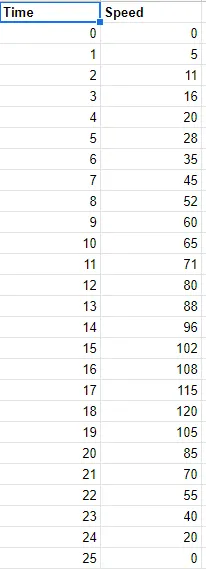
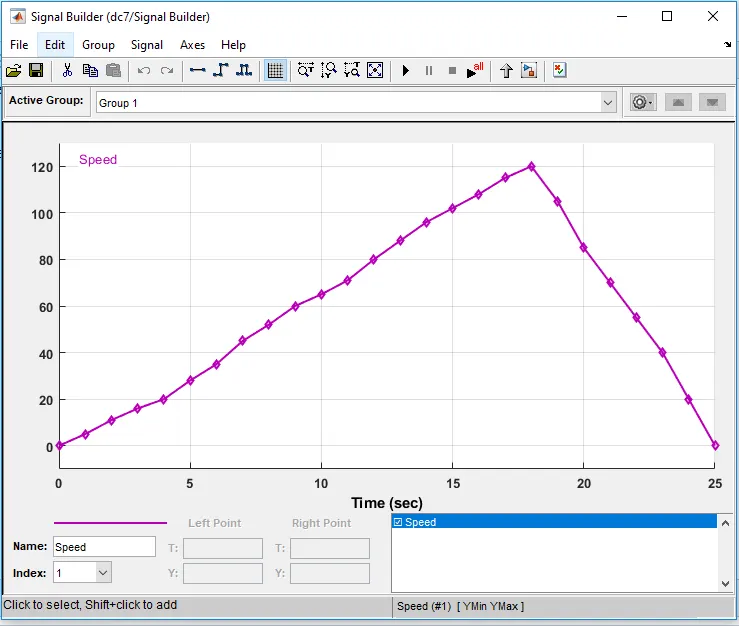
INPUT:
INPUT DRIVE CYCLE PLOT:
MODEL:
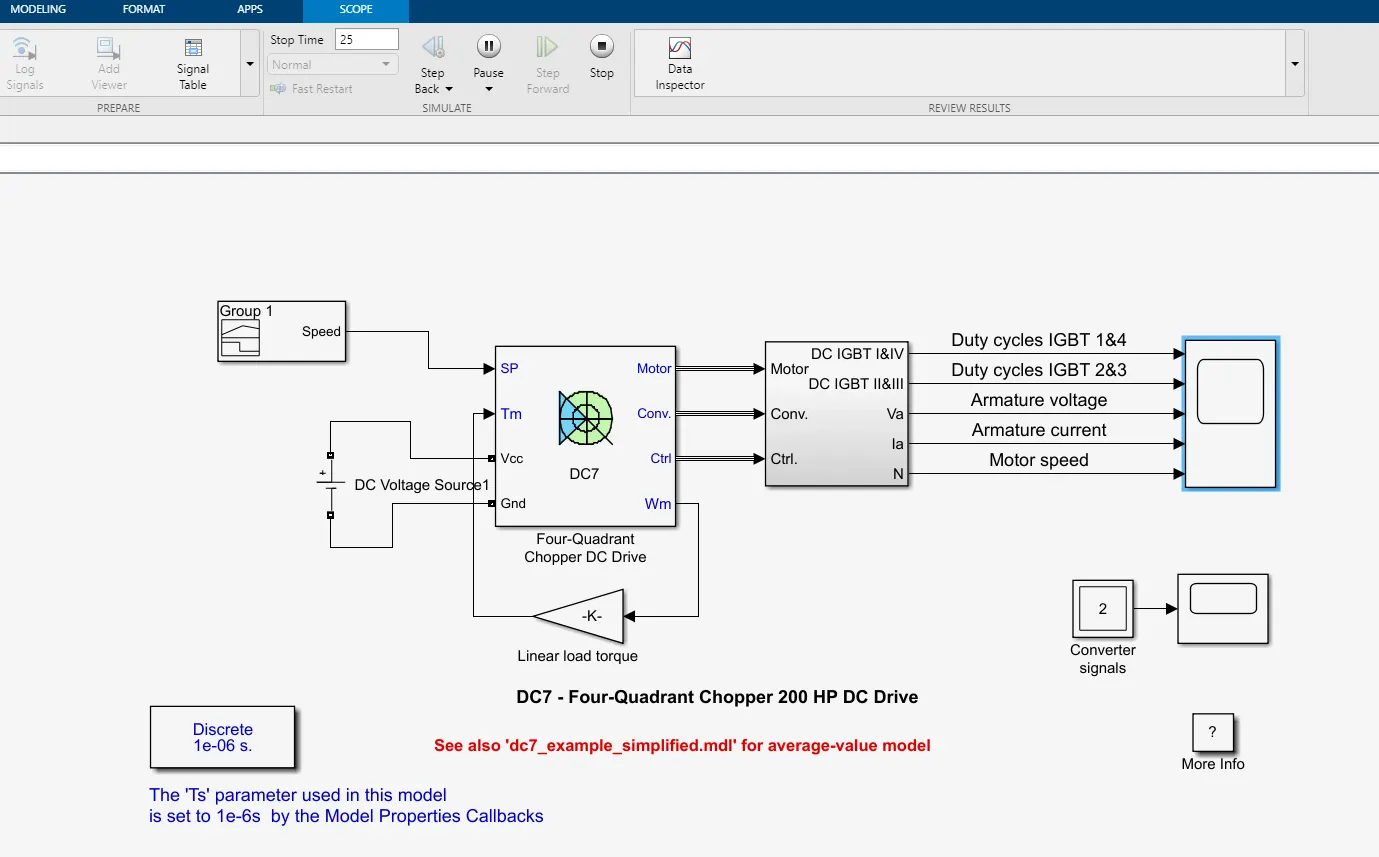
MODEL EXPLANATION:
- First of all, we give the inputs to the model to run according to our given drive cycle.
- A DC voltage source is added to the model and is connected to the Vcc and ground, and its amplitude is set at 200.
- The linear load torque eqation is;
`T_(TR) = 24.7 + 0.0051 * omega^2`
- Then the model is run, and we get the corresponding outputs ( DC IGBT 1,4; DC IGBT 2,3; ARMATURE VOLTAGE; ARMATURE CURRENT; MOTOR SPEED ) in the Scope for our given drive cycle.
SCOPE:
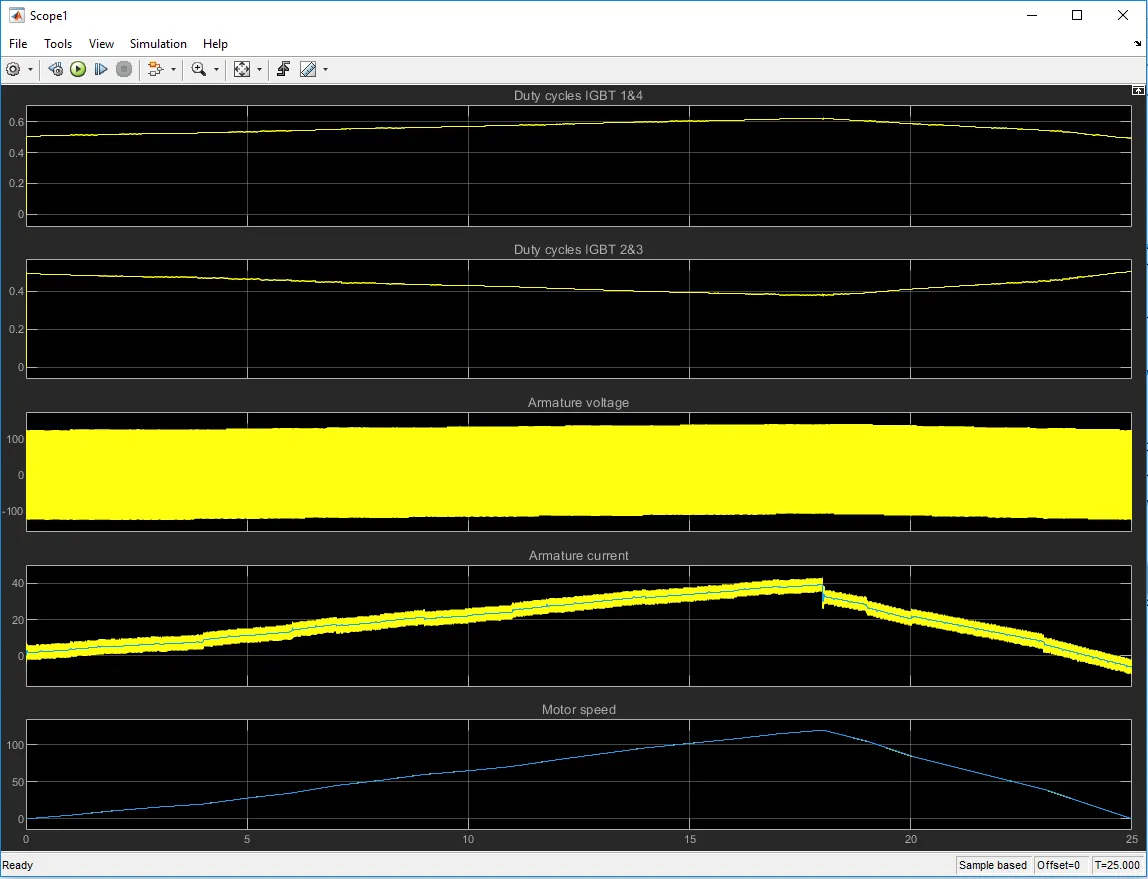
Thus we have created a EV MODEL drive cycle using the DC7 block.