Week 7 Challenge
- AIM:- To determine the numbers of piles required for deep foundation in bridges.
- INTRODUCTION:- Piles basically comes under deep foundation.As it can be used as single or in group action to transfer the load vertical by end bearings and skin frictions or horizontally.
- EXPLAINATIONS:-
- If the group of pile is subjected to vertical force than the calculation of load on single pile can be be done by knowing the total load coming on group of piles and divide it by the number of piles. However, if the group of piles is subjected to lateralload or eccentric vertical load which ultimately can cause moment on the group of pile and that should be taken i to account during calculations.
- The total numbers of piles in the pile group depends upon the loads that is needed to be transferred to the foundation from the substructure. If the magnitude of the loads are more, that the number of piles required will be more. Various geotechnical, hydrological and topographical factors should also be taken in to consicerationswhile deciding the number of piles in group. It is not the least but also depends upon the bearing capacity of the pile group.
- Number of piles = Maximum bearing capacity of soil/Pile capacity.
- AIM:- To understand the concept for fixing the diameter of well foundation
- EXPLAINATION:-
- Base pressure is the governing criteria for fixing the diameter of well foundation. It is also dependent on the size of super structure, spa, type of well foundation. The minimum size of dredge hole should be taken as 2.5m. Maximum size of single circular well shall be 12m for concrete steiniing & the external diameter of the brick masonry well shall not exceed 6m.
- As per the guidelines of IRC78, the thickness of the steining should be such that it should be able to sink in the well with out any additional concrete blocks and also while sinking it should not get damaged. The steining should also be able to resist differential earth pressure developed during sand blow or other condition, like sudden drop. Stresses sound be with in permissible limitsunder all conditions for loads that may be transferred to the wells. Use of cellular steining with 2 or more shells or use of composite materials in the well steining shall not be permitted for wells up to 12 m in diameters.
- Area required for well foundation= p/q
- p---Load transfers to the foundation base
- q--- Safe beraing capacity of soil.
- From the area diameter can be determined . The minimum thickness of the well steining shall not be less tha 500m and satisfy the following relationship: h=Kdsqrt(l)
- h--- minimum thickness of stiening in m
- d--- external diameter of circular well of bumb bell shaped well
- l--- Depth of well in meter below top of well cap or LWL which ever is greater.
- K--- A constant value of K shall be as follow
- Well in cement concrete K=0.03
- Well in brick masomnary K= 0.05
- Twin D well K= 0.039
- Brick masonry well for depth greater tha 20m shall not be permitted.
- AIM:- To know about the free standing length of the pile and to calculatethe length of the same.
- EXPLAINATION:-
- The length of the pile in scouring or liquifaction zone is consider as free standing length of the pile. The piles are not considered to take any loads in such zones. In order to calculate the free standing length, the scour depth below the natural ground level need to determined . In case of liquefiable soil, the depth of the same is found out experimentally using site samples.
- Mean depth of scour Dsm= 1.34((Db^2/Ksf)1/3) as per IRC 78
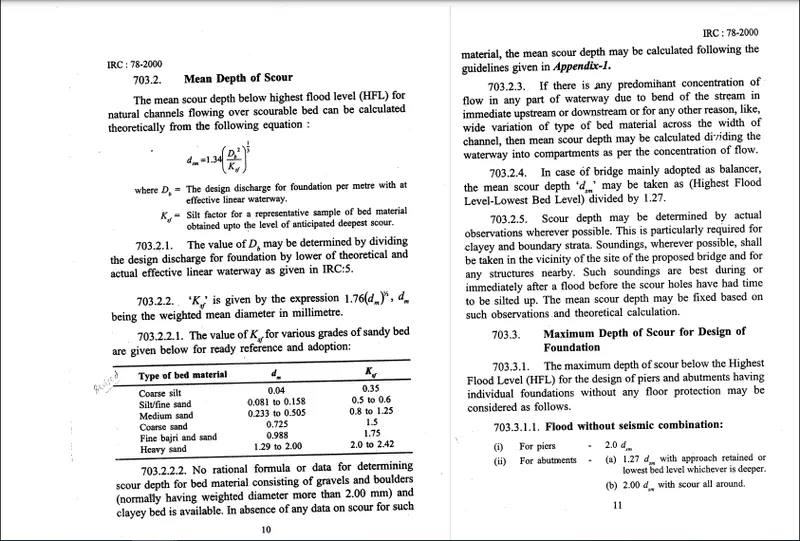
Maximum scour depth for pier and abutment with scour all round is Dm= 2 Dsm, and maximum scour depth for abutment with approach retained is Dm= 1.27 Dsm
- AIM:- Impact of free standing and full length of the pile.
- EXPLAINATION:-
- If the free standing length is more , the scouir depth is more hence erosion of the soil is more. Also the capacity of the pile in its length cannot be include in design calculation.
- Also because of erosion piles are exposed to the external environment and hence protection of the piles has to e done. This also impacts the overall economy of the construction.
- GIVEN DATA:-
- Vertical capacity:- 250 T
- Horizontal capacity:- 35 T
- Height of abutment:- 5m
- If the load from the abutment is 2250 T
- Number of piles will be = 2250/250 = 9 nos.
- AIM:- To list down the failures that occurs in beep foundation and their remedies.
- EXPLAINATION:
- Deep foundations are preferred in a particular site depending on the various factor such as the soil type, scouring, liquifaction, span type and oading. The failures that happen in the deep foundation are mainly because of the surrounding soil.
- Failures in deep foundations:-
- Uequal settlement of subsoil.
- Horizontal movement of theadjoining structure.
- Tilt and tolerance failure cause due to boulder in the soil. This results in the uneven sinking of well.
- Lateral escape of soil below the foundation.
- Lateral pressure tending to overturn the structure.
- RCC failure.
- Remedies:-
- Symmetrical placing of the piles.
- Proper recording of the tilt & shift by checking the site prameters.
- Increasing the number of te pile according to the loads.
- Checking the horizontal capacity of piles.
- Pemoving the liqefiable soil and fill it with some other high density soil.
- AIM:- To present the construction parameters to be considered before planning a deep foundation.
- EXPLAINATION:-
- Various parameters should have to be taken in to consideration before planning for deep foundation such as pile foundation & well foundations which includes:-
- Site clearance and boring should be carried out as oer indian standards.
- Casting the piles by pouring wet concrete.
- Prottective work such as cofferdam & sheetpiling should be done around the foundation.
- Bottom plug, sinking & top plugging in case of well foundation.
- Lowering the steel cage after clearing.
- Various parameters should have to be taken in to consideration before planning for deep foundation such as pile foundation & well foundations which includes:-