Week 6 Session 13
There are four types of electric vehicles available:
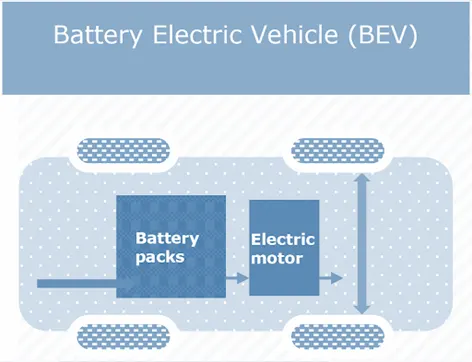
- Battery Electric Vehicle (BEV): Fully powered by electricity. These are more efficient compared to hybrid and plug-in hybrids.
- Hybrid Electric Vehicle:
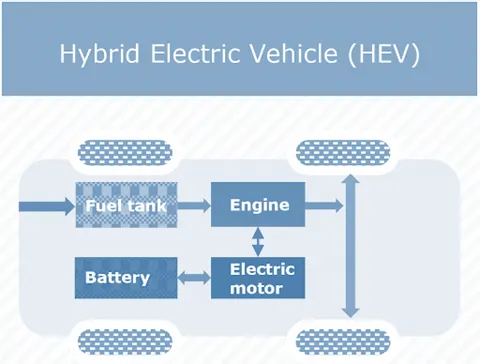
- Hybrid Electric Vehicle (HEV): The vehicle uses both the internal combustion (usually petrol) engine and the battery-powered motor powertrain. The petrol engine is used both to drive and charge when the battery is empty. These vehicles are not as efficient as fully electric or plug-in hybrid vehicles.
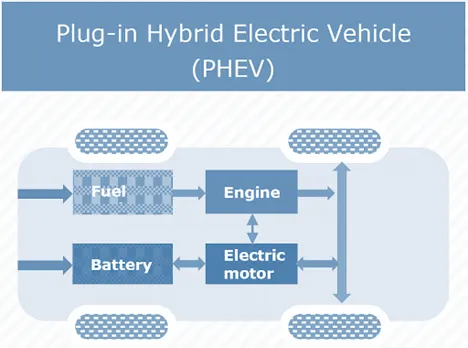
- Plug-in Hybrid Electric Vehicle (PHEV): Uses both an internal combustion engine and a battery charged from an external socket (they have a plug). This means the vehicle’s battery can be charged with electricity rather than the engine. PHEVs are more efficient than HEVs but less efficient than BEVs.
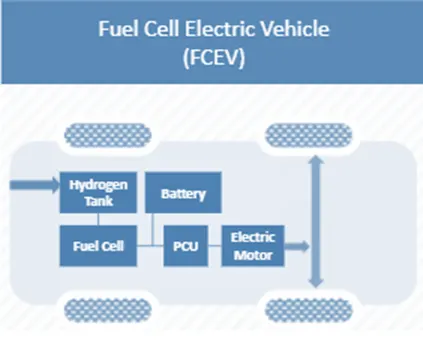
- Fuel Cell Electric Vehicle (FCEV): Electric energy is produced from chemical energy. For example, a hydrogen FCEV.
System Architecture of 4 types of electric cars is as follows:
Battery Electric Vehicles (BEVs)
BEVs are also known as All-Electric Vehicles (AEV). Electric Vehicles using BEV technology run entirely on a battery-powered electric drivetrain. The electricity used to drive the vehicle is stored in a large battery pack which can be charged by plugging it into the electricity grid. The charged battery pack then provides power to one or more electric motors to run the electric car. To find out more about BEVs, click below.
Main Components of BEV:
Electric motor, Inverter, Battery, Control Module, Drive train
Working Principles of BEV:
The power for the electric motor is converted from the DC Battery to AC. As the accelerator is pressed, a signal is sent to the controller. The controller adjusts the speed of the vehicle by changing the frequency of the AC power from the inverter to the motor. The motor then connects and leads to the turning of wheels through a cog. If the brakes are pressed, or the electric car is decelerating, the motor becomes an alternator and produces power, which is sent back to the battery
Examples of BEV:
MG ZS, TATA Nexon, TATA Tigor, Mahindra E20 plus, Hyundai Kona, Mahindra Verito
Hybrid Electric Vehicle (HEV):
HEVs are also known as series hybrid or parallel hybrid. HEVs have both engine and electric motor. The engine gets energy from fuel, and the motor gets electricity from batteries. The transmission is rotated simultaneously by both engine and electric motor. This then drives the wheels. To find out more about HEVs, click below.
Main Components of HEV:
Engine, Electric motor, Battery pack with controller & inverter, Fuel tank, Control module
Working Principles of HEV:
The fuel tank supplies energy to the engine like a regular car. The batteries run on an electric motor. Both the engine and electric motor can turn the transmission at the same time.
Examples of HEV:
Engine, Electric motor, Battery pack with controller & inverter, Fuel tank, Control module
Plug-in Hybrid Electric Vehicle (PHEV):
The PHEVs are also known as series hybrids. They have both engine and a motor. You can choose among the fuels, conventional fuel (such as petrol) or alternative fuel (such as bio-diesel). It can also be powered by a rechargeable battery pack. The battery can be charged externally. To find out more about PHEVs, click below.
PHEVs can run in at least 2 modes:
- All-electric Mode, in which the motor and battery provide all the car’s energy
- Hybrid Mode, in which both electricity and petrol/diesel are employed
Main Components of PHEV:
Electric motor, Engine, Inverter, Battery, Fuel tank, Control module, Battery Charger (if onboard model)
Working Principles of PHEV:
PHEVs start-up in all-electric mode and make use of electricity until their battery pack is depleted. Once the battery gets drained, the engine takes over, and the vehicle operates as a conventional, non-plug-in hybrid. PHEVs can be charged by plugging into an outside electric power source, engine, or regenerative braking. When brakes are applied, the electric motor acts as a generator, using the energy to charge the battery. The engine’s power is supplemented by the electric motor; as a result, smaller engines can be used, increasing the car’s fuel efficiency without compromising performance.
Examples of PHEV:
Porsche Cayenne S E-Hybrid, BMW 330e, Porsche Panamera S E-hybrid, Chevy Volt, Chrysler Pacifica, Ford C-Max Energi, Mercedes C350e, Mercedes S550e, Mercedes GLE550e, Mini Cooper SE Countryman, Ford Fusion Energi, Audi A3 E-Tron, BMW i8, BMW X5 xdrive40e, Fiat 500e, Hyundai Sonata, Kia Optima, Volvo XC90 T8.
Fuel Cell Electric Vehicle(FCEV):
FCEVs are also known as Zero-Emission Vehicles. They employ ‘fuel cell technology’ to generate the electricity required to run the vehicle. The chemical energy of the fuel is converted directly into electric energy. To find out more about FCEVs, click below.
Main Components of FCEV:
Electric motor, Fuel-cell stack, Hydrogen storage tank, battery with converter and controller
Working Principles of FCEV:
The FCEV generates the electricity required to run this vehicle on the vehicle itself.
Examples of FCEV:
Toyota Mirai, Riversimple Rasa, Hyundai Tucson FCEV, Honda Clarity Fuel Cell, Hyundai Nexo.
charging system requirements
EV chargers currently come in three different models: Level 1, Level 2, and Level 3. Level 3 is also commonly known as Direct Current Fast Charging (DCFC). In Levels 1 & 2. the EV is connected to AC power, 120V or 240V, and a battery charger in the EV converts the AC power to the DC needed to charge the battery and controls the charging process. In DCFC the DCFC converts the AC power to DC and the DC power is sent directly to the EV battery bypassing the onboard battery charger. This allows the DCFC to charge the EV battery directly. Level 1 & 2 charging is generally limited by the AC power available and the size of the onboard battery charger installed in the EV. DCFC is limited by the rating of the DCFC equipment and the amount of power available from the utility or other primary power sources. The charge rate, range of the EV, and the amount of time that the EV is available to recharge, known as the dwell time, work together to determine the best type of EV charging system needed for the application.
Level 1
This charge level is the simplest level of EV charging and consists of plugging the EV into a standard 120V AC receptacle using a unique electrical cord with the appropriate plugs in each end. The built-in battery charger in the EV then charges the battery. This type of charging is generally limited by the amount of power that can be supplied by the receptacle usually, 12-16A or less (1.44-1.92kW) which based on an EV with a 3 MPkWh rating will add up to 5.8 miles for each hour of charging. If we charge for 10 hours overnight, it would only add up to 58 miles to the battery. Level 1 charging is useful for only limited range EVs when daily miles driven are low, or when several days of dwell time are available between EV usage.
Level 1 chargers are inexpensive, readily available, and can be carried with the EV.
Level 2
Level 2 chargers allow the EV to be connected to a 240V receptacle, like that used for an electric range or clothes dryer. Level 2 chargers are currently available up to around 20kW and continuing our example would add 60 miles for each hour of charging at 20kW. Many Level 2 chargers are in the 7kW to 10kW range. Enough to fully recharge most EVs overnight. A long-range car or a delivery van might have a battery capacity of 100kWh and could be recharged over a little more than 10 hours by a Level 2 10kW charger taking system losses into account.
Level 2 chargers are readily available and moderately priced. Higher capacity Level 2 chargers are fixed in place, but lower capacity portable ones are available. Finding a 240V receptacle to plug into can be much more challenging than a Level 1 120V receptacle though.
Level 3 or DCFC
DCFC charging uses DC to charge the EV battery without needing to go through the onboard AC battery charger. This charging level allows for a much higher capacity battery charging system. DCFC chargers, due to the cost and need for 480V electrical service, are usually limited to commercial use, either in commercial fast charging stations or in fleet operations. A 100kW DCFC can recharge an EV with a 100kWh battery in about an hour. At his rate, a 3MPkWh EV will gain 300 miles for each hour of charging.
DCFC chargers are significantly more expensive than Level 1 or 2 chargers and require 480V 3 phase power. This limits them mostly to commercial EV charger installations.