CHT Analysis on a Graphics card
Aim: To perform state-state heat transfer analysis on a graphics card (GPU)
Introduction:
Conjugate Heat Transfer Analysis
Computational Fluid Dynamics (CFD) and more specifically conjugate heat transfer (CHT) analysis can accurately predict heat transfer by simultaneously solving all the relevant solid and flow field heat transfer processes, for example, conduction through solids, free and forced convection in the gases/fluids and thermal radiation.
The CHT approach has an advantage over FE thermal analyses in that wall heat transfer coefficients and their local variations on surfaces are directly calculated within the model rather than based on simplified empirical calculations. The CHT approach, therefore, has benefits for those applications where heat transfer is either non-uniform or difficult to calculate empirically.
The heat transfer projects have covered a wide range of aerodynamic and hydrodynamic industrial applications but projects typically had objectives such as:
- Temperature distribution analysis.
- Heat flux rate analysis – calculation of wall heat flux rates or heat transfer coefficients.
- Visualization of heat transfer features for improved understanding of system flow phenomena.
- Identification of localized ‘hot spots’ or heat sinks in checking against specified requirements.
- Evaluating variation in temperature peaks for different operating conditions/ failure modes.
- Assessing insulation or heat shield effectiveness and optimizing material selections.
- Coupling CHT with FE analysis to evaluate thermally induced stresses, expansion, or fatigue.
- Temperature field analysis
- CFD thermal analysis
- Heat transfer coefficient analysis
- Heat transfer rate analysis
CHT Analysis on a Graphics card
Model
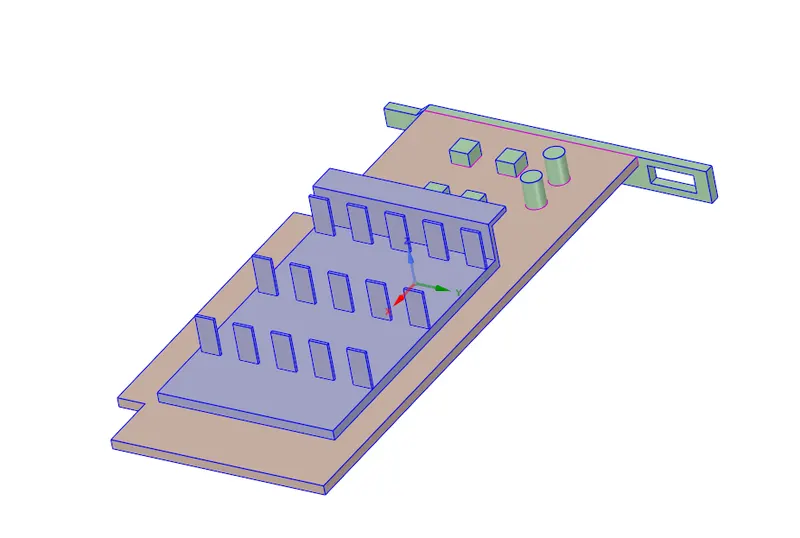
Materials
Fins - Aluminum
Density - 2719 Kg/m^3
Heat capacity - 871 J/Kg-K
Thermal Conductivity - 202.4 W/m-K
Processor - Silicon
Density - 2000 Kg/m^3
Heat capacity - 710 J/Kg-K
Thermal Conductivity - 150 W/m-K
PCB - FR4 ( Glass-reinforced epoxy laminated material)
Density - 1850 Kg/m^3
Heat capacity - 950 J/Kg-K
Thermal Conductivity - 0.29 W/m-K
Pannel - Steel
Density - 8030 Kg/m^3
Heat capacity - 502.48 J/Kg-K
Thermal Conductivity - 16.27 W/m-K
Solver set-up
Turbulence Model - pressure based/Steady-state/K epsilon realizable
Inlet velocity - 2.5m/s
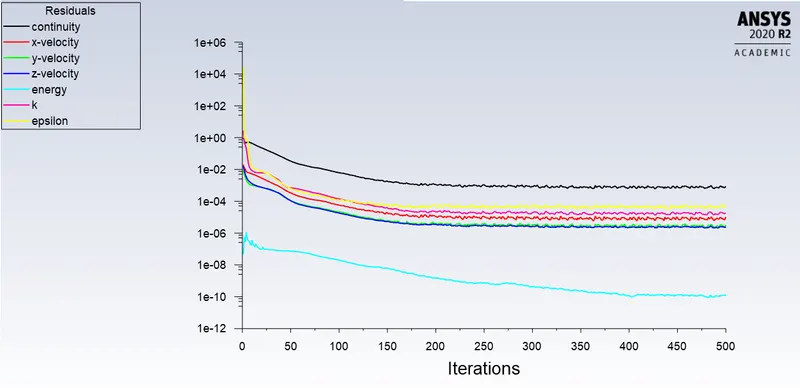
No of iterations - 500
The heat generated by GPU
Normally a 2GB graphics card uses 75W energy and 99.9% of it is converted into heat.
our GPU is 8x8x1mm
Therefore Heat generated = 75/(0.08*0.08*0.1)=1171875 W/m^3
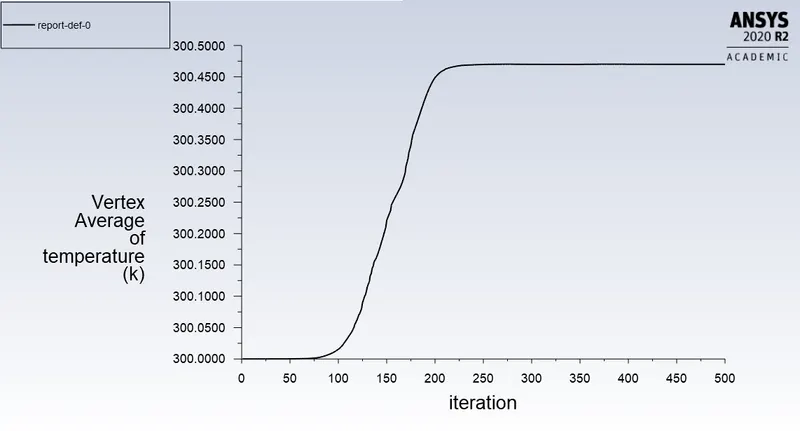
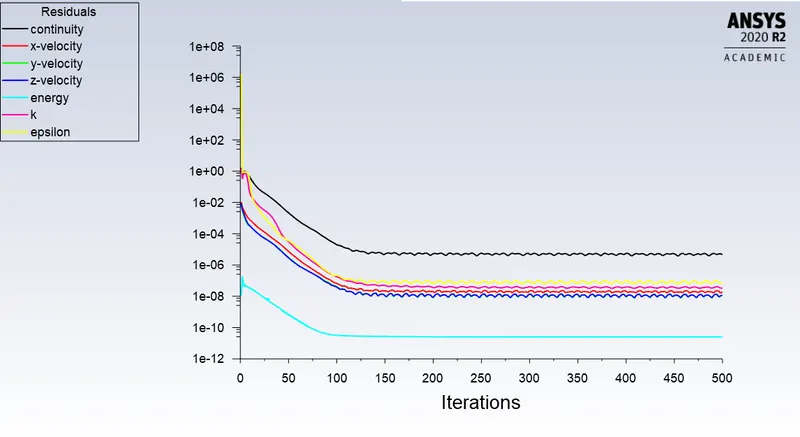
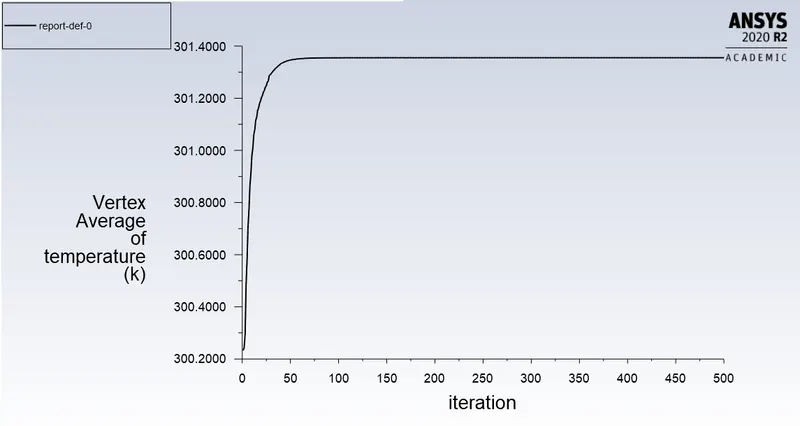
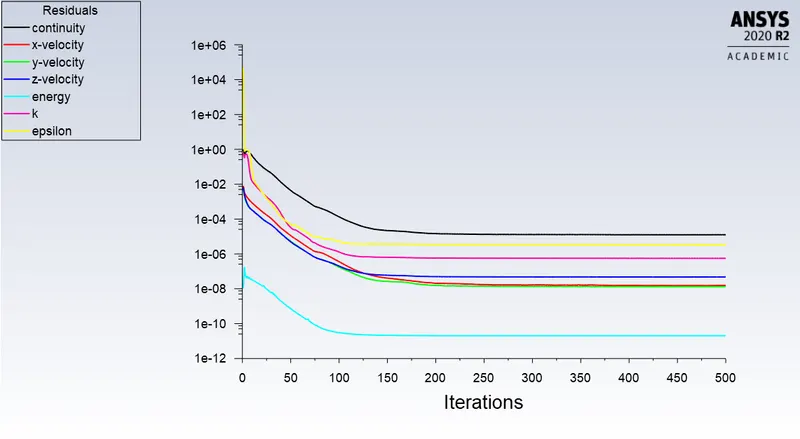
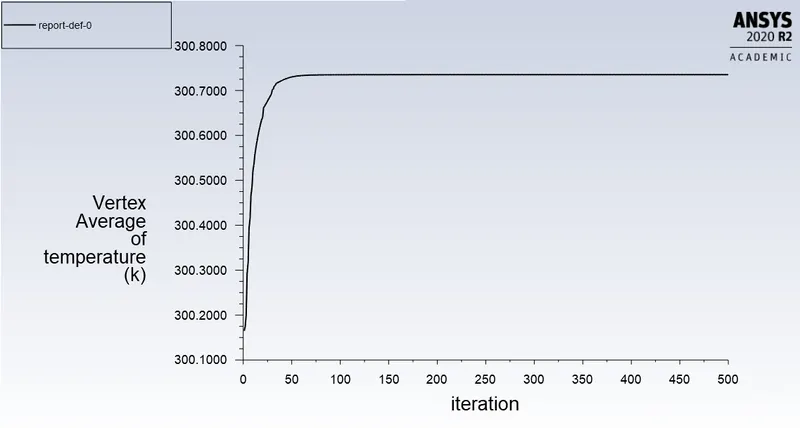
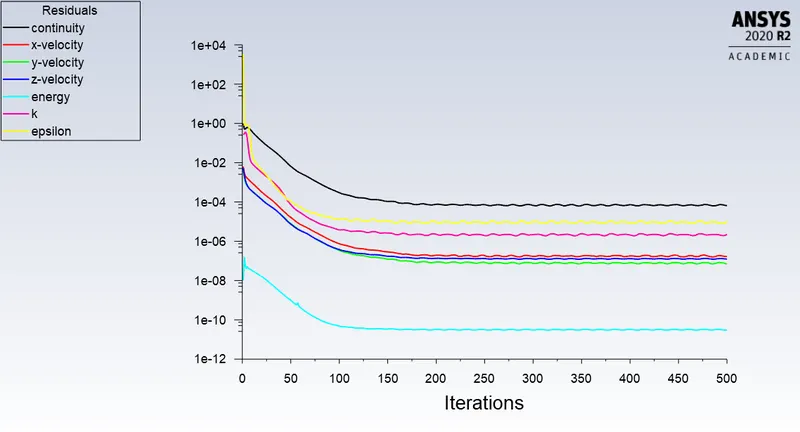
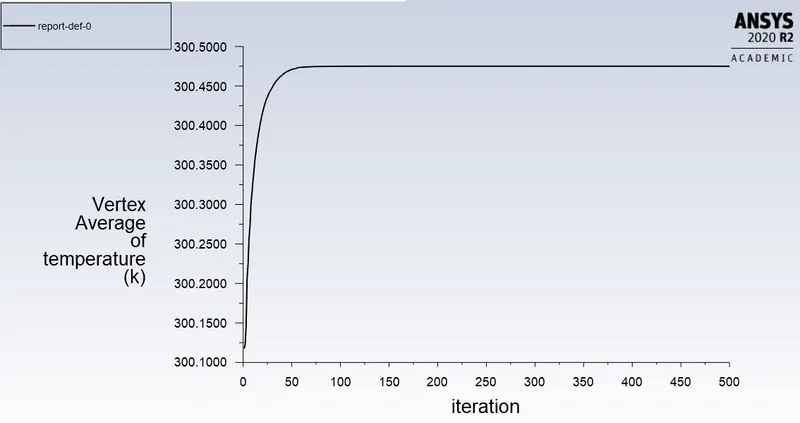
To identify the simulation is converged or not, I have used residual and vertex average temperature plots.
Case 1
Global mesh size 2.5mm
No of elements - 214916
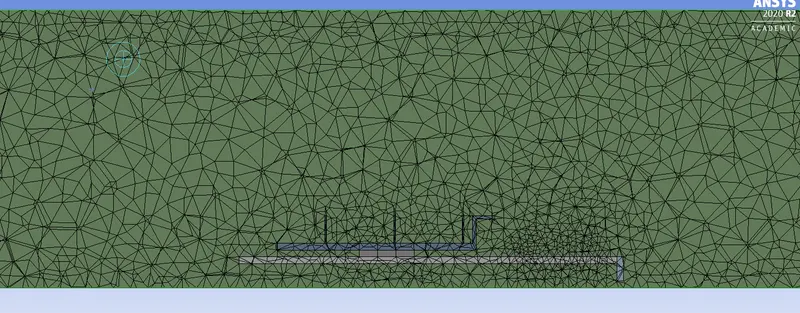
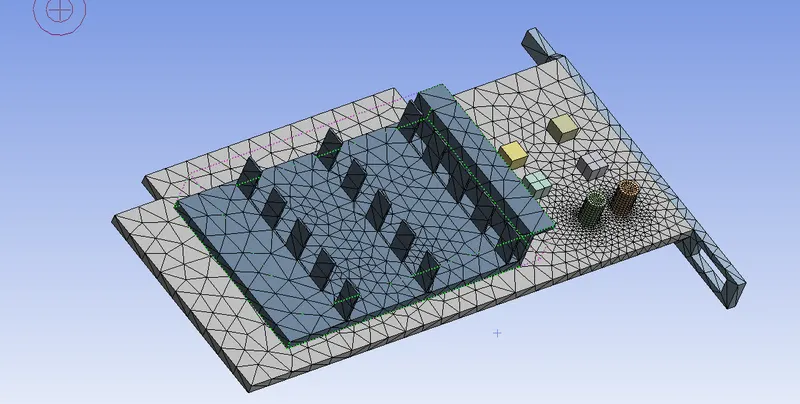
Residuals
Vertex average of the temperature
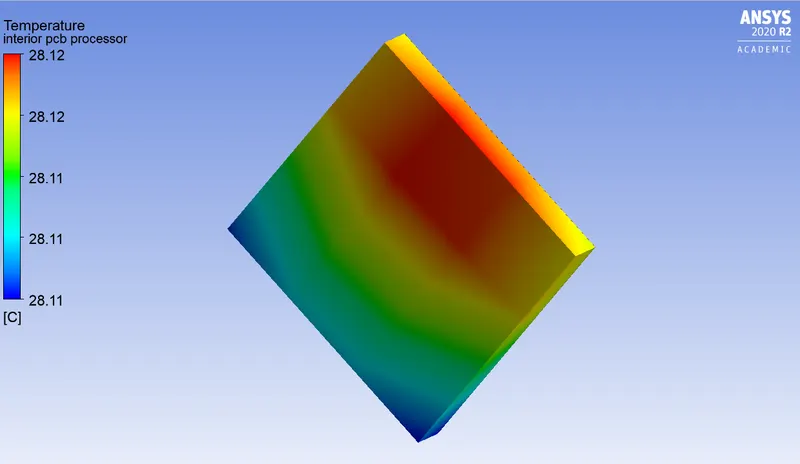
Temperature contour
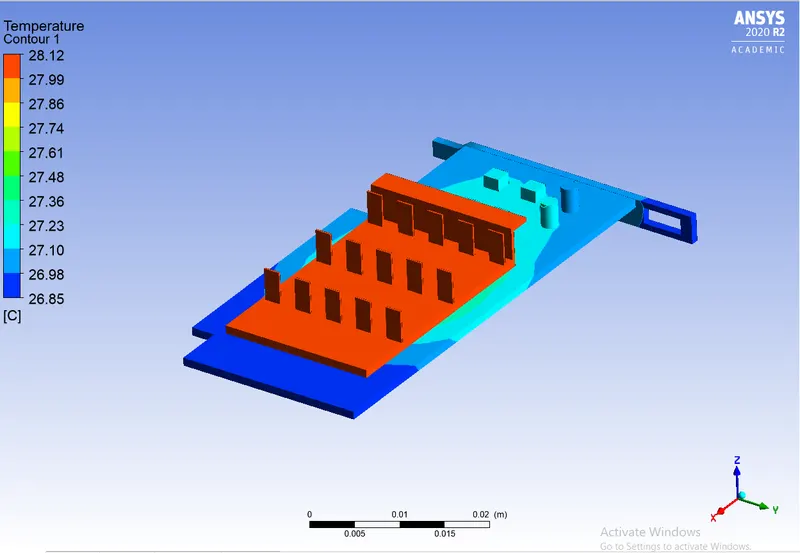
Figure showing potential hotspot
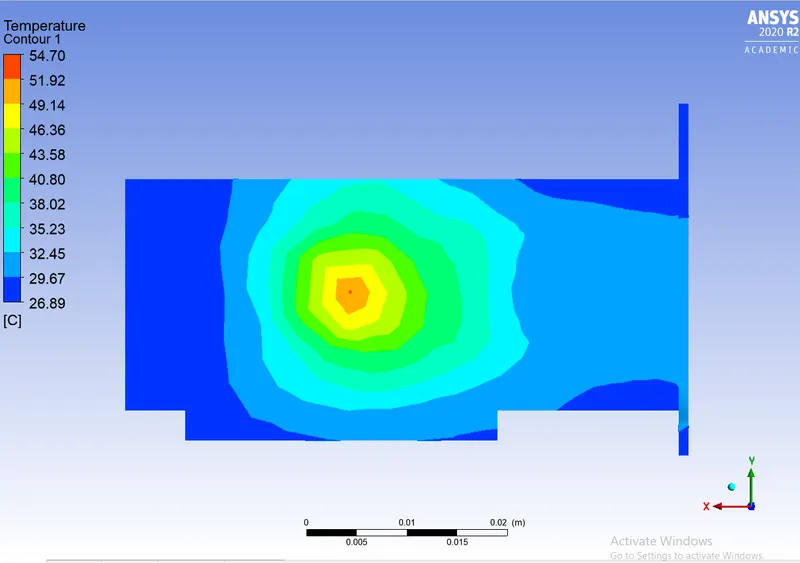
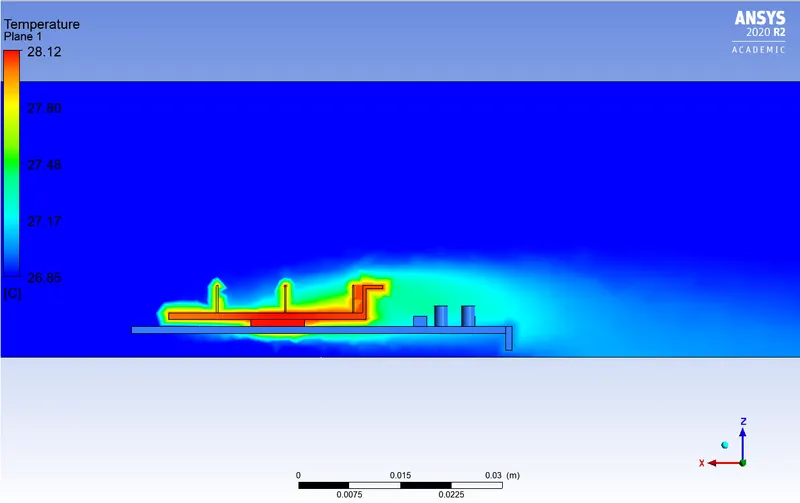
Processor Temperature
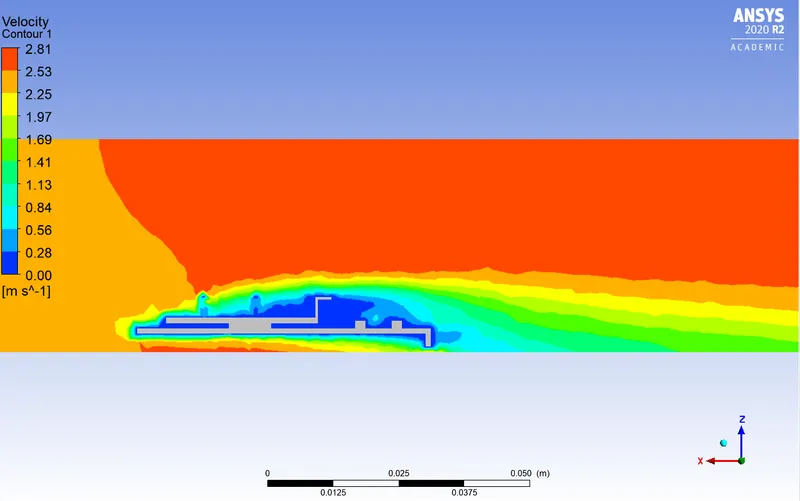
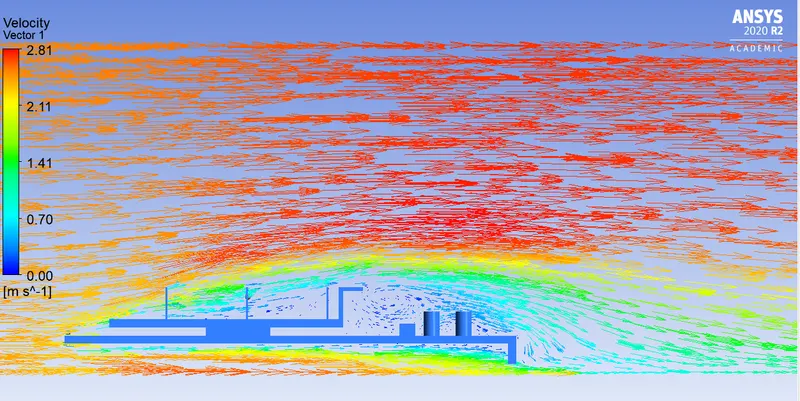
Velocity plot
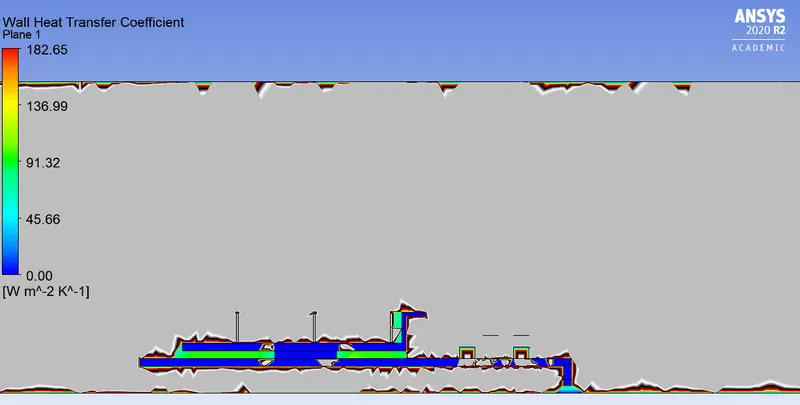
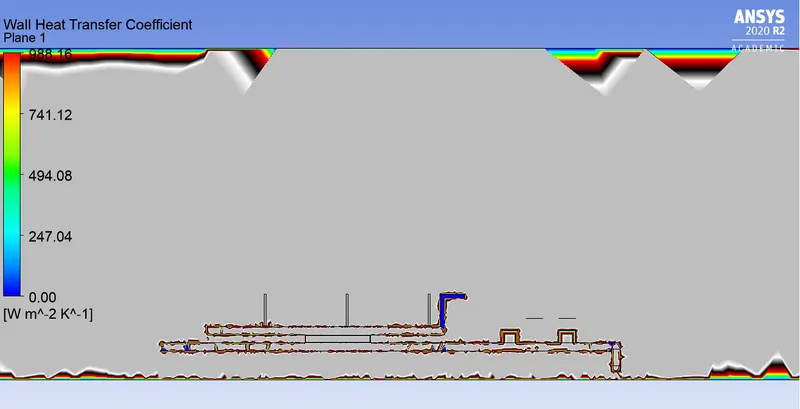
Wall Heat Transfer Coefficient
| Velocity m/s | Mesh size | No of elements | PCB hotspot temp | Fins hotspot temp | GPU hotspot temp |
| 2.5 | 2.5mm | 214916 | 27.94 Celcius | 28.1 Celcius | 28.12 Celcius |
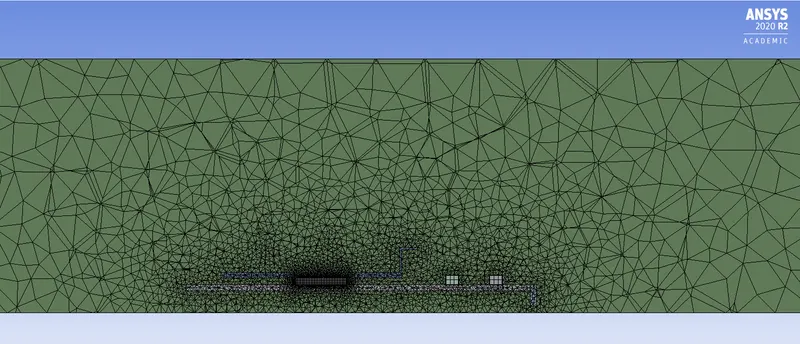
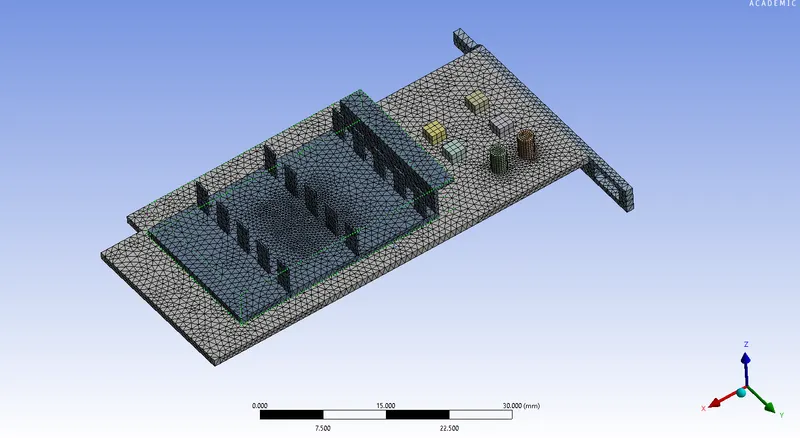
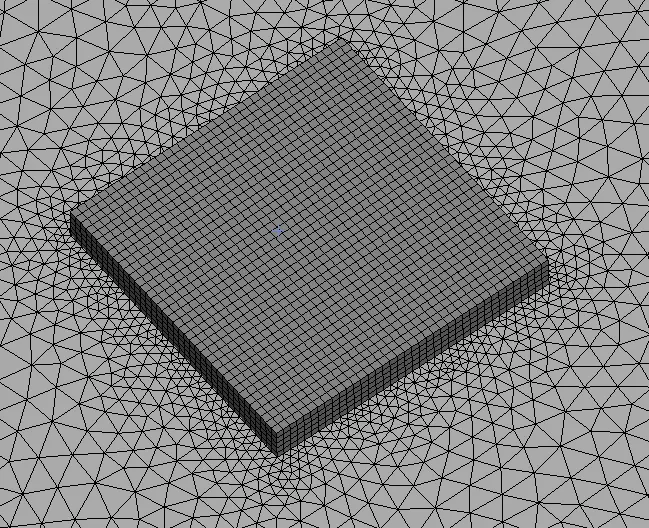
Mesh refinement
Global mesh size 10 mm
GPU (Processor) mesh size 0.2 mm
Fins, PCB, and Pannel mesh size 0.8 mm
No of elements 436712
Case 2
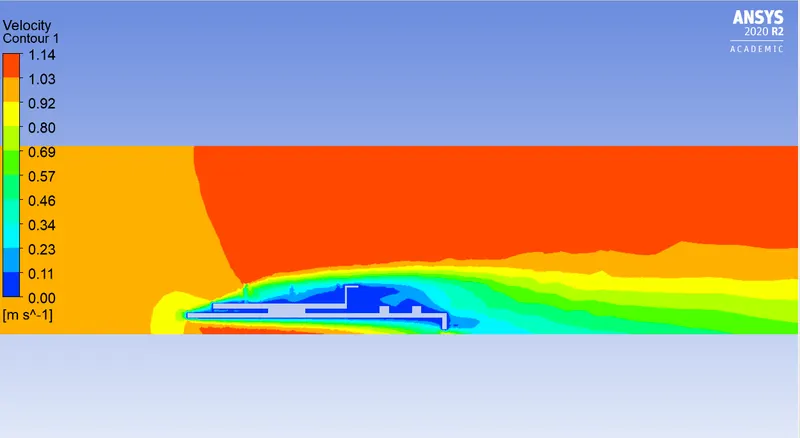
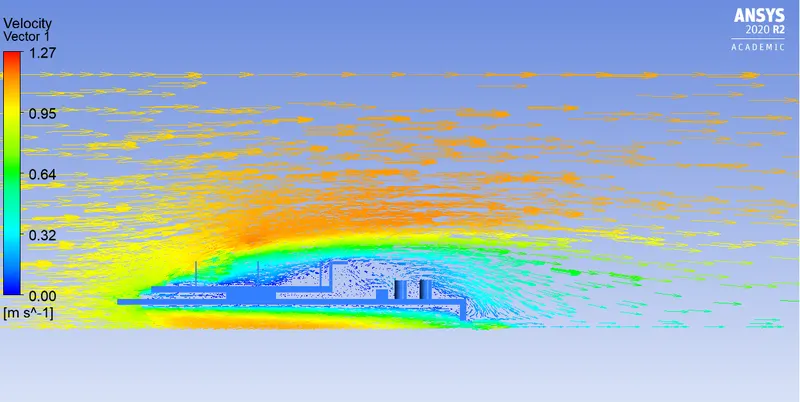
Inlet velocity 1m/s
Residuals
Vertex average of the Temperature
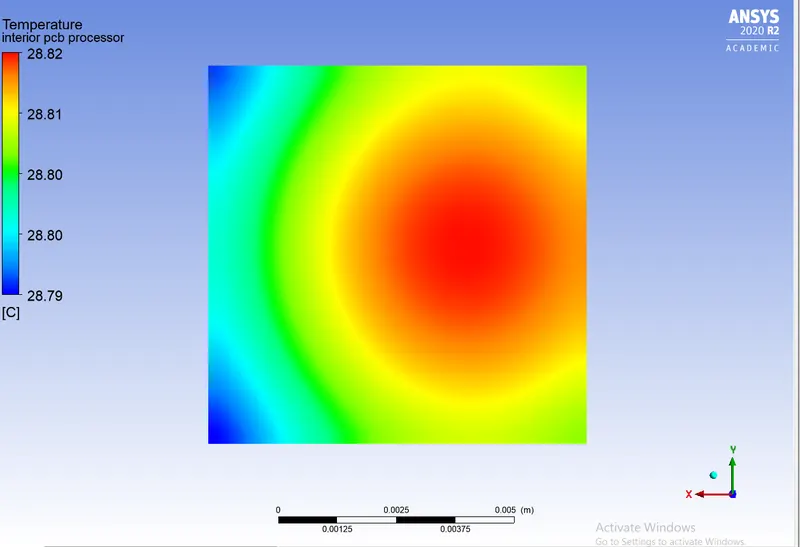
Temperature contour
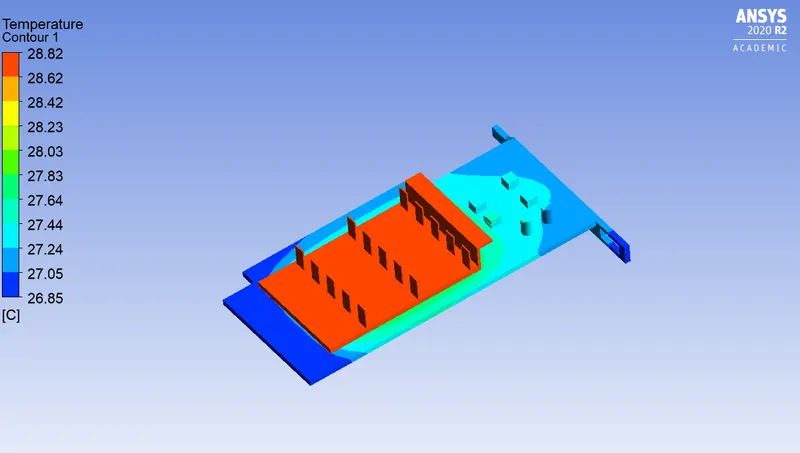
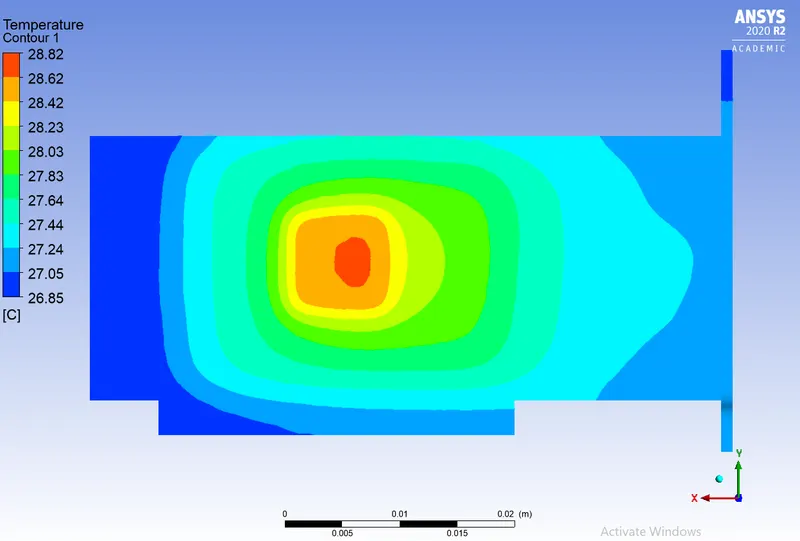
Figure showing potential hotspot
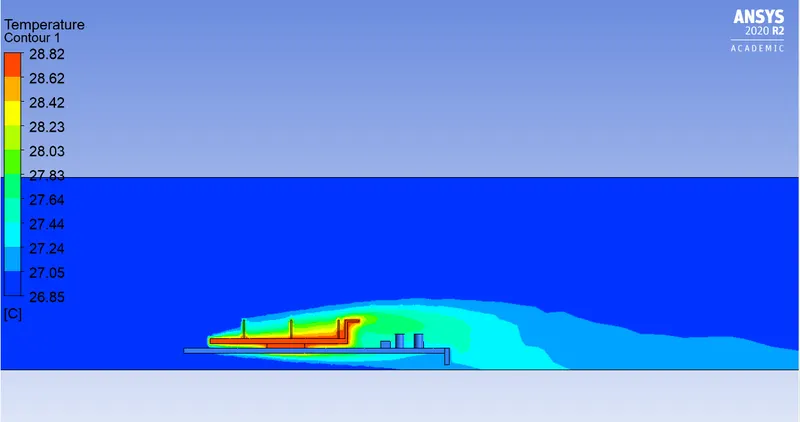
Processor temperature
Velocity plot
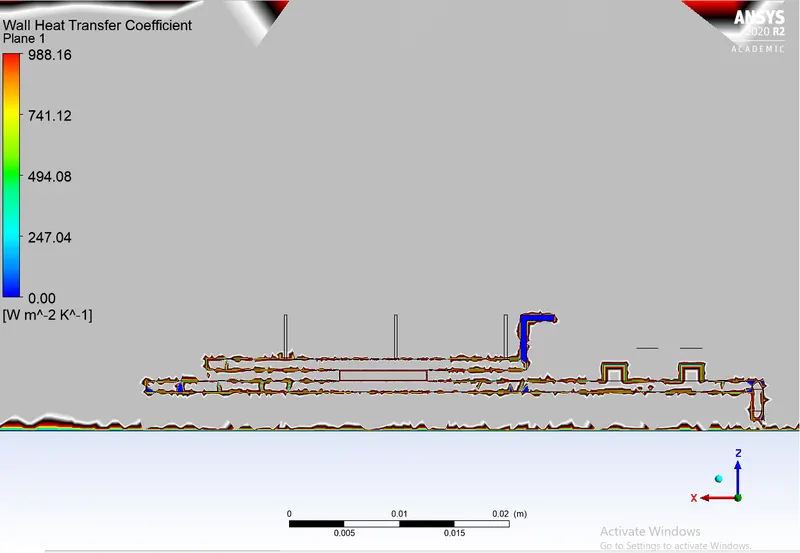
Wall Heat Transfer Coefficient
Case 3
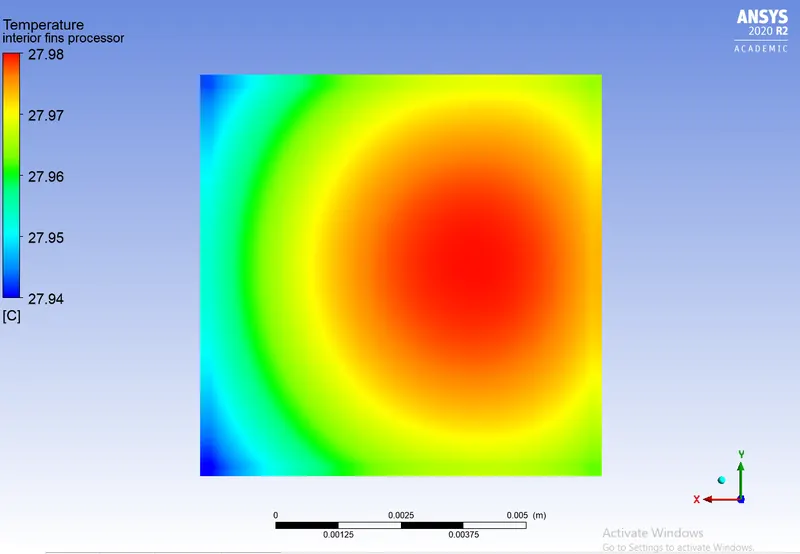
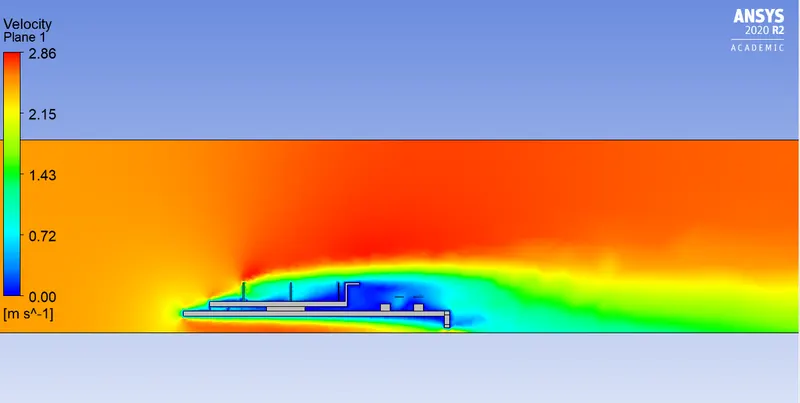
Inlet velocity 2.5m/s
Residuals
Vertex average of the temperature
Temperature contour
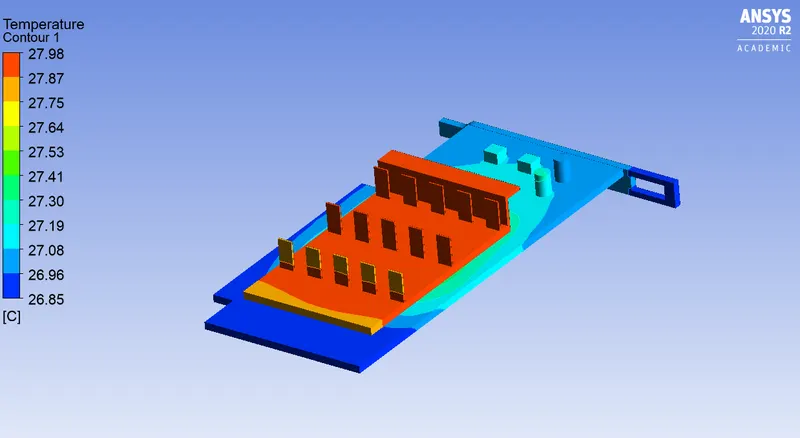
Figure showing potential hotspot
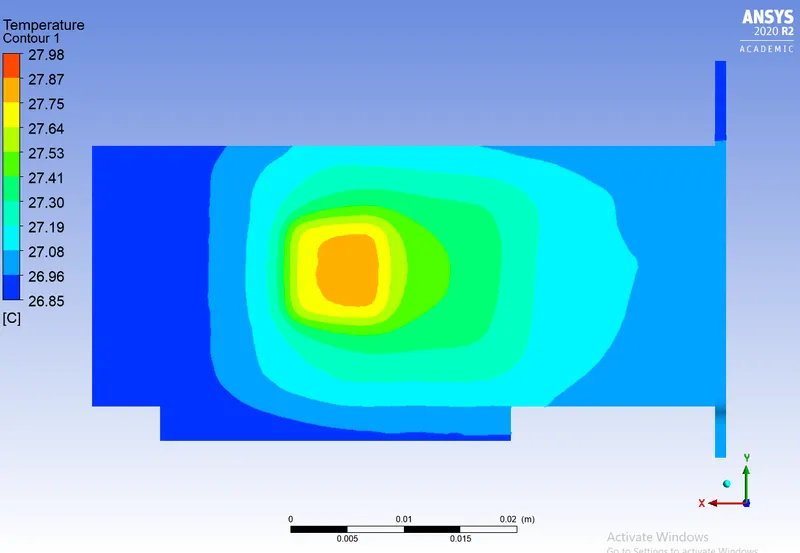
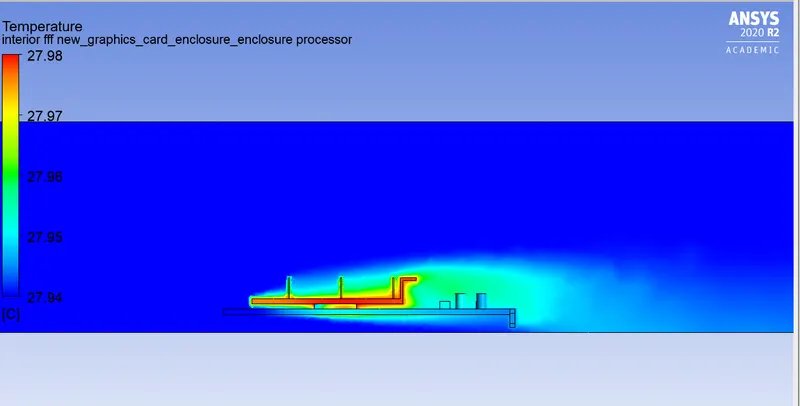
Processor temperature
Velocity plot
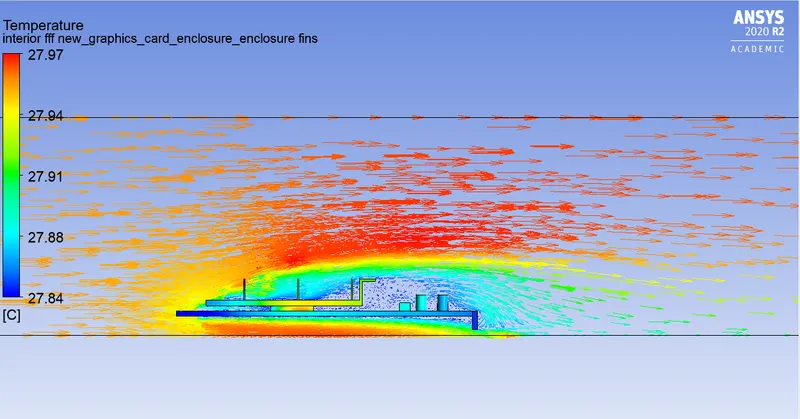
Wall Heat Transfer Coefficient
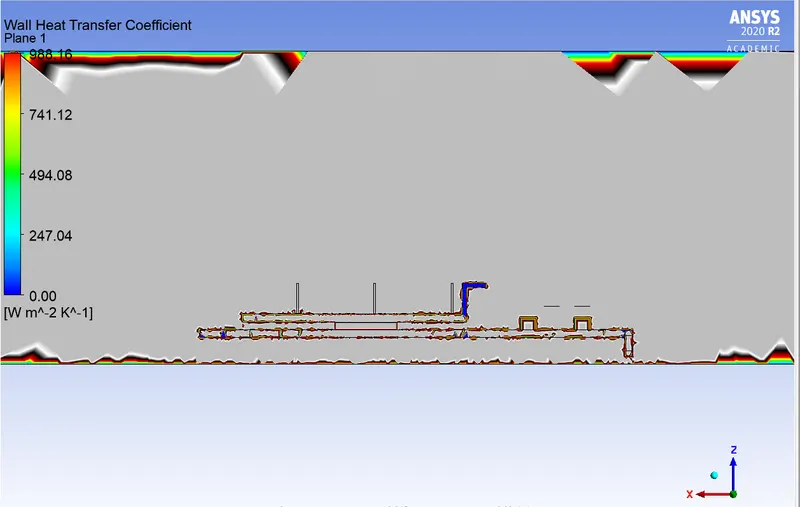
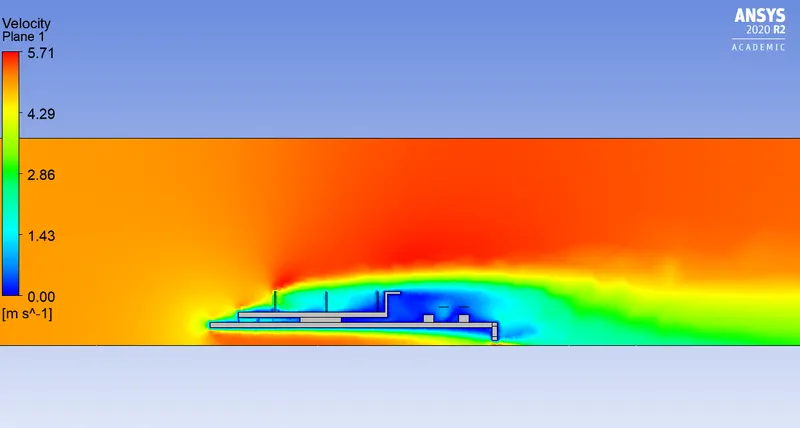
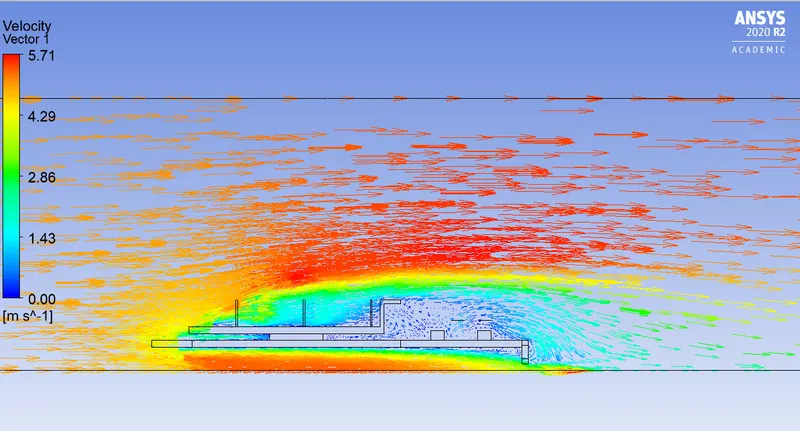
Case 4
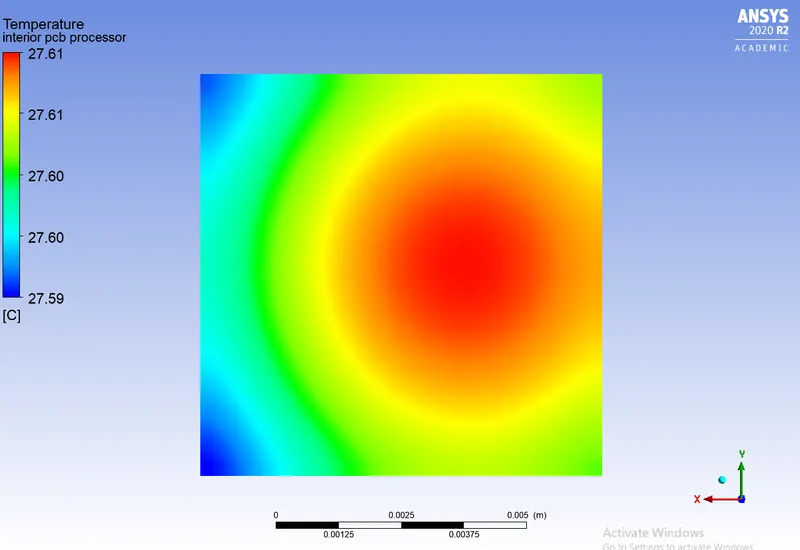
Inlet velocity 5m/s
Residuals
Vertex average of the temperature
Temperature contour
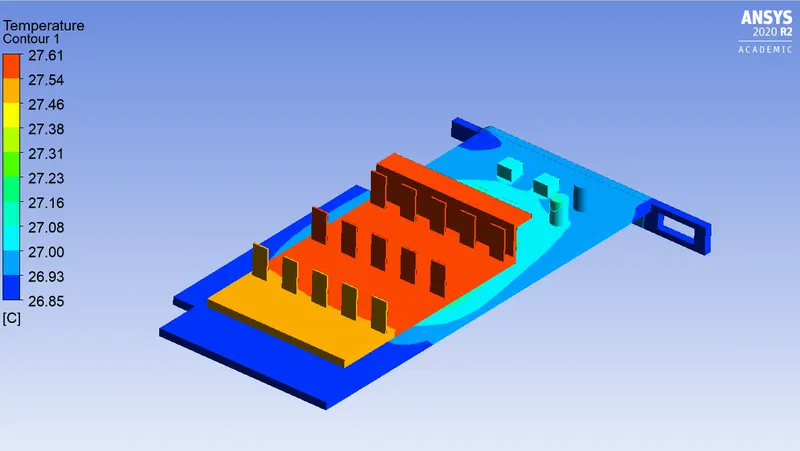
Figure showing potential hotspot
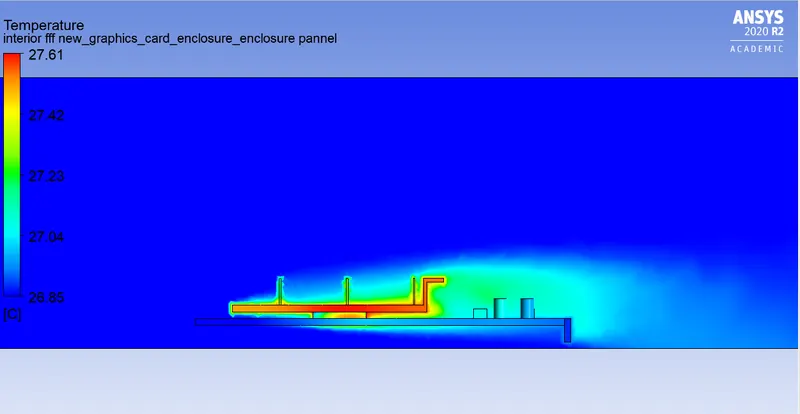
Processor temperature
Velocity plot
Wall Heat Transfer Coefficient
Results:
| Velocities in m/s | 1 | 2.5 | 5 | 2.5 (baseline) |
| GPU (Processor) hotspot temp in Celcius | 28.81 | 27.97 | 27.61 | 28.11 |
| Fins hotspot temp in Celcius | 28.81 | 27.92 | 27.55 | 28.11 |
| PCB hotspot temp in Celcius | 28.63 | 27.79 | 27.44 | 27.94 |
| Vertex average of the Temperature in Celcius | 28.20 | 27.58 | 27.32 | 27.43 |
| Wall HTC in W/M^2K | 988.16 | 988.16 | 988.16 | 182.60 |
| No of iteration to achieve convergence | 125 | 150 | 150 | 250 |