Week-6 Challenge: EV Drivetrain
Q1. Which types of power converter circuits are employed in electric and hybrid electric vehicle?
Power Electronic Converters: -
In Electric and Hybrid Electric Vehicles (EV/HEV), the power electronic converters are considered as the key elements that interface their power sources to the drivetrain of the EVs. In order to design highly efficient converters for the EV’s power system, advanced DC/DC and DC/AC converters are required to adapt the output voltage and current levels with high power quality.
The 3 types of converters which are widely used in an Electric Vehicle are:
AC – DC Converter (On Board Charger): -
AC to DC converters are most commonly used in Plug-in Hybrid Electric Vehicles (PHEV) & Plug-in Electric Vehicles (PEV). These vehicles get their propulsion power from an external electricity source (charging stations) which is alternating current. The battery needs to be charged using a direct current source. For this purpose, AC to DC converter is employed in a PHEV & PEV.
DC – DC Converter: -
DC-DC converters can be used to interface the elements in the electric power train by boosting or chopping the voltage levels. By introducing DC/DC converters one can choose the voltage variation of the devices and the power of each device can be controlled. The power of the DC/DC converter depends on the characteristics of the vehicle such as top speed, acceleration time from 0 to 100 Km/h, weight, maximum torque, and power profile (peak power, continuous power).
DC – AC Converter (Inverter): -
The DC/AC converter is required to convert the dc power to a suitable ac power for the electrical machine. The power output from battery pack (DC current) is converted using inverter to be used in electric motor (AC current).
References: - https://www.intechopen.com/books/electric-vehicles-modelling-and-simulations/dc-dc-converters-for-electric-vehicles#B14
Study#2:
Q2. An Electric Vehicle's powertrain with 72V battery pack in shown in the diagram below. The duty ratio for acceleration operation is 'd1' and for the braking operation the duty ratio is 'd2'.
The other parameters of the electric vehicle is given below,
Motor and Controller Parameters:
Rated Armature voltage= 72 V
Rated armature current= 400 A
Ra= 0.5Ω, KΦ= 0.7 Volt second
Chopper Switching frequency= 400 Hz
The vehicle speed-torque characteristics are given by the below equation
What is EV steady state speed if duty cycle is 70%?
Given: -
The following input parameters are given: -
Battery pack voltage (V) = 72V
Rated armature current = 400 A
Armature Resistance (Ra) = 0.5Ω
Motor constant (KΦ) = 0.7
Chopper Switching frequency= 400 Hz
Duty Cycle = 70%
Solution: -
Vehicle Output Voltage (Vv) is given by: -
Vv = Battery Voltage (V) * Duty Cycle
Vv = 72 * 0.70
Thus, Vehicle voltage = 50.4V
Now, Equation for Vehicle torque is given by: -
Where;
Substituting all these values in equation, we get:
Solving these two equations,
We get a quadratic equation:
Since quadratic equation, we get two values of ;
We take the positive value;
Steady state speed of vehicle = = 38.85 rad/s
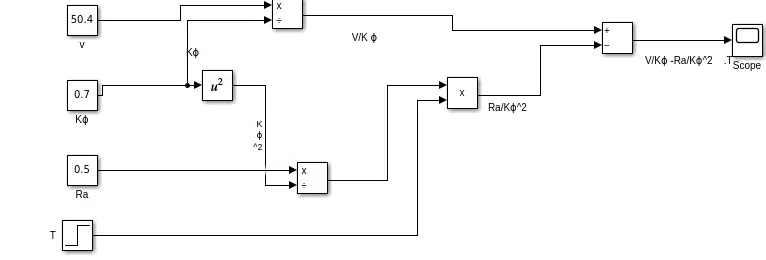
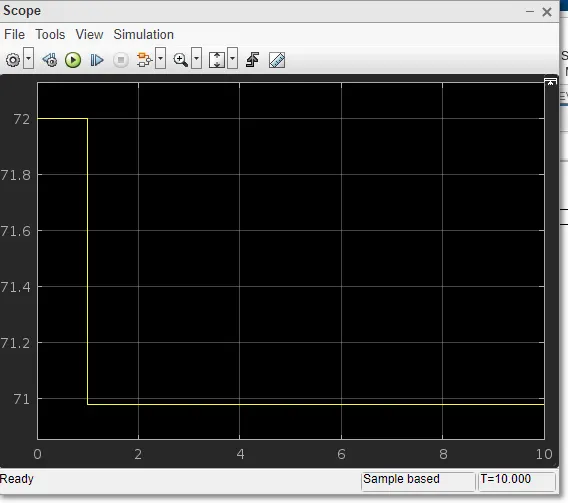
3. Develop a mathematical model of a DC Motor for the below equation using Simulink.
ans:
simulink model:
4. Refer to the blog on below topic:
Induction Versus DC brushless motors by Wally Rippel, Tesla
Explain in brief about author’s perspective.
ans:
The author, Wally Rippel, provides a perspective on the differences and potential future of two types of electric vehicle (EV) motors: induction motors and DC brushless motors. His perspective can be summarized as follows:
1. **Variety in EV Motors**: Rippel acknowledges that, much like traditional internal combustion engines, there isn't a one-size-fits-all solution for electric vehicle motors. Different types of motors are suited to different applications, depending on factors such as price and performance.
2. **Evolution of Technology**: He highlights the evolution of technology in the electric vehicle industry, where older technologies like lead-acid batteries and DC brush motors have been replaced by lithium-ion batteries, DC brushless motors, and induction motors, accompanied by modulating inverters.
3. **DC Brushless Motors**: Rippel explains that DC brushless motors rely on permanent magnets in the rotor to generate a magnetic field. These motors require an inverter to control the stator currents, which allows for efficient energy conversion. However, they lack starting torque when directly connected to fixed-frequency utility power.
4. **Induction Motors**: In contrast, he describes induction motors as having rotors without magnets. They can start under load when connected to utility power without the need for an inverter. This compatibility with conventional utility power is seen as a significant advantage.
5. **Advantages of Induction Motors**: The author emphasizes that induction motors' compatibility with utility power makes them suitable for various applications. They can also be powered from batteries or DC sources with an inverter, enabling variable speed control.
6. **Control Complexity**: Rippel notes that while induction motors have their advantages, they are more challenging to control due to complex control laws. Achieving stability over a wide torque-speed range and varying temperatures can be difficult.
7. **Efficiency and Cost Considerations**: He points out that DC brushless drives tend to generate less rotor heat and can operate at unity power factor, resulting in slightly higher peak point energy efficiency compared to induction drives. However, induction motors may have a cost advantage due to the lower cost of materials.
8. **Future Outlook**: The author predicts that DC brushless drives will continue to dominate in hybrid and plug-in hybrid markets. In contrast, induction drives may maintain their dominance in high-performance pure electric vehicles. He suggests that both technologies could coexist as the electric vehicle market grows, catering to different segments and performance requirements.
9. **Common Hardware**: Rippel highlights that many components are common between both drive types, suggesting that they might coexist and complement each other as the electric vehicle market evolves.
In summary, the author's perspective is that the choice between induction and DC brushless motors for electric vehicles depends on specific use cases and requirements. While he acknowledges the strengths and limitations of each technology, he envisions a future where both technologies continue to have their place within the electric vehicle industry, serving different niches and adapting to the evolving market.