Week-6 Challenge: EV Drivetrain
ANS.1-Power Converter circuit is a circuit which converts the one form of electric energy into other form of electric energy. It consists of power electronic switches, transformers, electric choke,resistors, capacitors, diodes.It can be classified into 4 categories:
- AC to DC: It is also called "Rectifier". It converts AC into Unipolar DC current.It is used to Charge the battery of the vehicle, when the source is AC.
- DC to AC:It is also called "Inverter". It converts DC into AC of desired Voltage and frequency. It can be use in the case the source is DC and to convert the DC supply of the battery to provide to the AC motors In some vehicle.
- DC to DC:It is also called "Chopper".It converts high voltage DC to low Voltage DC or vice-versa. It uses to supply the voltage to the auxalry battery inside the vehicle, which has been used for head light or infotainment system.
- AC to AC:It is also called "Cycloconverter".It converts the AC of the desired frequency and desired voltage magnitude from the AC supply. It uses in Transmission System but Do not have any applications in case of electric vehicles.
ANS-2 Battery pack voltage=72V
Duty ratio for acceleration is "d1"
Duty Ratio For Braking is "d2"
Motor and Controller Parameters:
- Rated Armature voltage(Va)= 72 V
- Rated armature current(Ia)= 400 A
- Ra= 0.5ohm, Kphi= 0.7 Volt second
- Chopper Switching frequency(f)= 400 Hz
The vehicle speed-torque characteristics are given by the below equation:
Tv=24.7 + (0.0051)omega^2 --------(1)
The EV steady state speed if duty cycle is 70%.
Actual Voltage(V) =72*0.7 => 50.4V
Now the angular velocity(omega) of DC motor is given by:
`omega = V/(Kphi)-(T*R)/(Kphi)^2`
so, T= (V*Kphi)/R - (omega*(Kphi)^2)/R
Now put all the values in the Above equation
Tm= (50.4*0.7)/0.5 - (omega*(0.7)^2)/o.5
Tm=70.56 -0.98*omega -------(2)
At steady state,
Tv=Tm
Then Equating both the equations:
=>24.7 + (0.0051)omega^2 = 70.56 - 0.98*omega
=>(0.00051)omega^2 + (0.98)omega - 45.86 =0
Divide both side by (0.00051).
we get, omega^2 + (192.16)omega - 8992.16=0
On solving we get,
omega= 38.91 rad/sec
so the steady state speed if duty cycle is 70% is 38.91rad/sec.
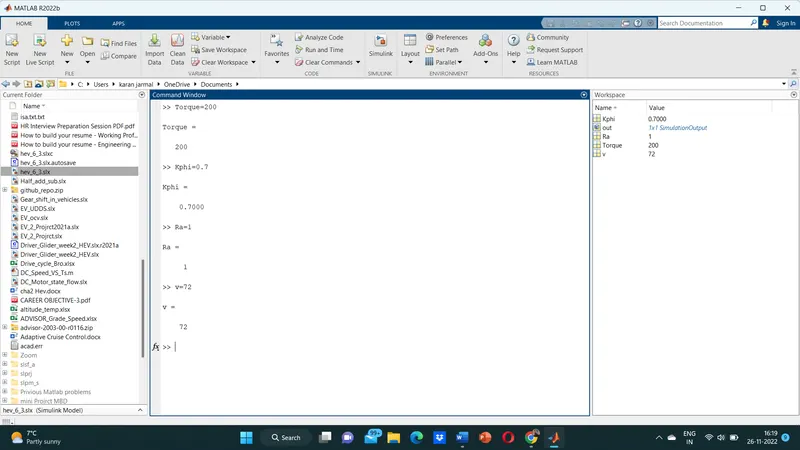
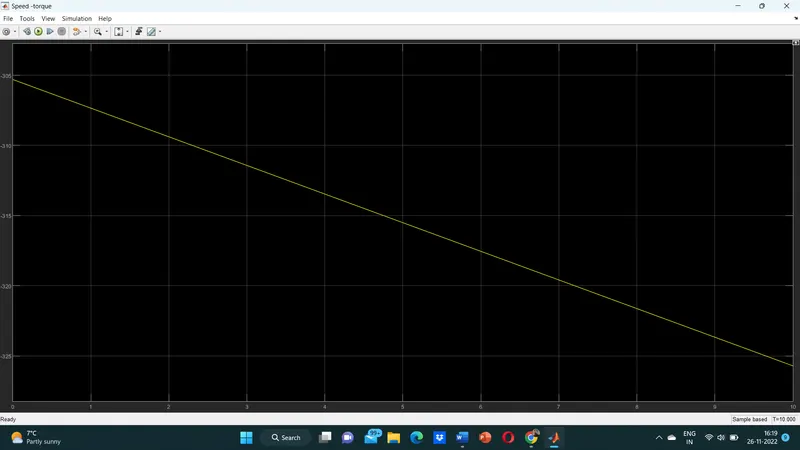
ANS.3- Mathematical model of a DC Motor for the below equation using Simulink.
`omega = V/(Kphi)-(T*R)/(Kphi)^2`
ANS-4. Explaination about author’s perspective.
Induction motor Vs BLDC motor by Wally ripple.
A BLDC electric motor is a synchronous DC motors, it is powered by direct current(DC) electricity via an inverter or switching power supply which produces electricity in the form of alternating current(AC) to drive each phase of the motor via a closed-loop controller. The controller provides pulses of current to the motor windings that control the speed and torque of the motor. This control system replaces the commutator(brushes) used in many conventional electric motors.
The construction of a brushless motor system is typically similar to a 'PMSM', but can also be a switched reluctance motor, or an induction(asynchronous) motor.
They may also use neodymium magnets and can be a
- Outrunners (the stator is surrounded by the rotor)
- In runners (the rotor is surrounded by the stator)
- or axial (the rotor and stator are flat and parallel)
The advantages of a brushless motor over brushed motors are as follows:
High power-to-weight ratio, high speed, electronic control, and low maintenance. Brushless motors uses in computer peripherals (disk drives, printers), hand-held power tools, and vehicles ranging from model aircraft to automobiles. In modern washing machines, brushless DC motors have allowed replacement of rubber belts and gearboxes with a much simpler way.
Induction motor
An induction motor is a asynchronous motor is an AC electric motor in which the electric current in the rotor needed to produce torque is obtained by electromagnetic induction from the magnetic field of the stator winding. An induction motor can therefore be made without electrical connections to the rotor.
An induction motor's rotor can be either wound type or squirrel-cage type.
Three-phase squirrel-cage induction motors are widely used as industrial drives because they are self-starting, reliable, and economical.
Single-phase induction motors are used extensively for smaller loads, such as household appliances like fans.
Although traditionally used in fixed-speed service, induction motors can also be used with variable-frequency drives (VFD).
VFDs offer especially important energy savings opportunities for existing and prospective induction motors in variable-torque centrifugal fan, pump, and compressor load applications.
Squirrel cage induction motors are very widely used in both fixed-speed and variable-frequency drive applications.
So, we can say that, DC brushless drives will likely continue to dominate in the hybrid and coming plug-in hybrid markets, and that induction drives will likely maintain dominance for the high-performance pure electric side.