Week-6 Challenge: EV Drivetrain
Aim:
- Which type of power converter circuits are employed in an electric and hybrid electric vehicles??
- An electric vehicle with a 72 volt battery pack is shown in the diagram below. The duty ratio for operation is d1’ and for braking operation the duty ratio is 2’. The other parameters of the electric vehicle are given as follows: Motor and controller parameters:
Rated armature voltage=72 v
Rated armature current = 400 a
Ra=0.5 ohms, k∅=0.7 V-s
Chopper Switching frequency =400Hz
Vehicle characteristics are given below
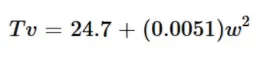
TTR=24.7+0.0051w^2
What is EV steady-state speed if the duty cycle is 70%
- Refer to the blog on the below topic:
Induction versus DC brushless motor by Wally Rippel, Tesla
Explain in brief about the authors perspective
Solution 1:
Power converter circuits used in EV’s and Hybrid vehicles consists of the following types
AC-DC Converter
PHEV’s and EV’s are equipped with an AC-DC converter supplying power from a commercial power system to an onboard high-voltage battery. The AC-DC converter is essential to work more proficiently to cut the charging time and also to be reduced so as to be fitted in a limited space. The drawbacks are high power loss accompanied with high frequency switching along with large and heavy coil parts. This type of converter has a (PFC) power factor correction which converts AC voltage to DC voltage , an H-bridge which converts DC voltage to high frequency AC voltage, a high frequency transformer regulating transformation and insulation and a circuit which rectifies and smooths high frequency AC voltage.
DC-AC Converters
DC- AC consists of 6 bidirectional (IGBT) semiconductors. The only source of electricity is the battery which is the DC source. The DC output of the battery is controlled according to the requirement and then converted into AC using a DC-AC inverter. The function of an inverter is to change a DC input voltage to asymmetric AC output voltage of desired magnitude and frequency. The output voltage waveform of ideal inverter should be sinusoidal.
DC-DC converter
AC motors are used in HEV’s and EV’s for traction and they are fed by inverter and this inverter is fed by a DC-DC converter. DC-DC converters used in an HEV or EV are
Unidirectional Converter
They provide onboard loads such as sensors, control, entertainment, utility and safety type of equipment.
Bidirectional Converter
They are used in place where battery charging and regenerative braking is required. The power flow in a bi-directional converter is usually from a low voltage end such as a battery or a supercapacitor to a high voltage side and is preferred to as boost operation.
The DC-DC converter and the boost DC-DC converter with resonant circuit is suitable for low power BEV’s and PHEV’s because of their soft switching,noise free operation , low switching loss and high efficiency. For bidirectional electric source like SCs and batteries ,bidirectional DC-DC converters are essential to absorb the regenerative braking energy maximizing the overall efficiency of the system. DC-DC converters used in BEV and PHEV drivetrains use silicon based semiconductors limiting their efficiency to 92-93% allowing switching frequency to 30 KHz and attain only 3-12W/in3 power density.
Different DC-DC converter used in BEV and PHEV ar as follows
- Boost DC-DC converter (BC)
- Interleaved 4-Phase Boost DC-DC converter (IBC)
- Boost DC-DC converter with Resonant circuit (BCRC)
- Full bridge Boost DC-DC converter (FBC)
- Isolated ZVS DC-DC converter (ZVSC)
AC-AC Converter
A solid-state AC-AC converter converts an AC waveform to another AC waveform, where the output voltage and frequency can be set randomly. This changes is mainly essential in case of speed controlling of machine , for low frequency and variable voltage magnitude application as well. We know that there are different types of loads that work with different type of power supplied like single-phase, three-phase supply and the supplies can be differentiated based on the voltage and frequency range also.
AC-AC converter can be classified into different types.
Cyclic converter
Ac to AC converter with DC link
Matrix Converters
Hybrid Matrix Converters
Solution 2: -
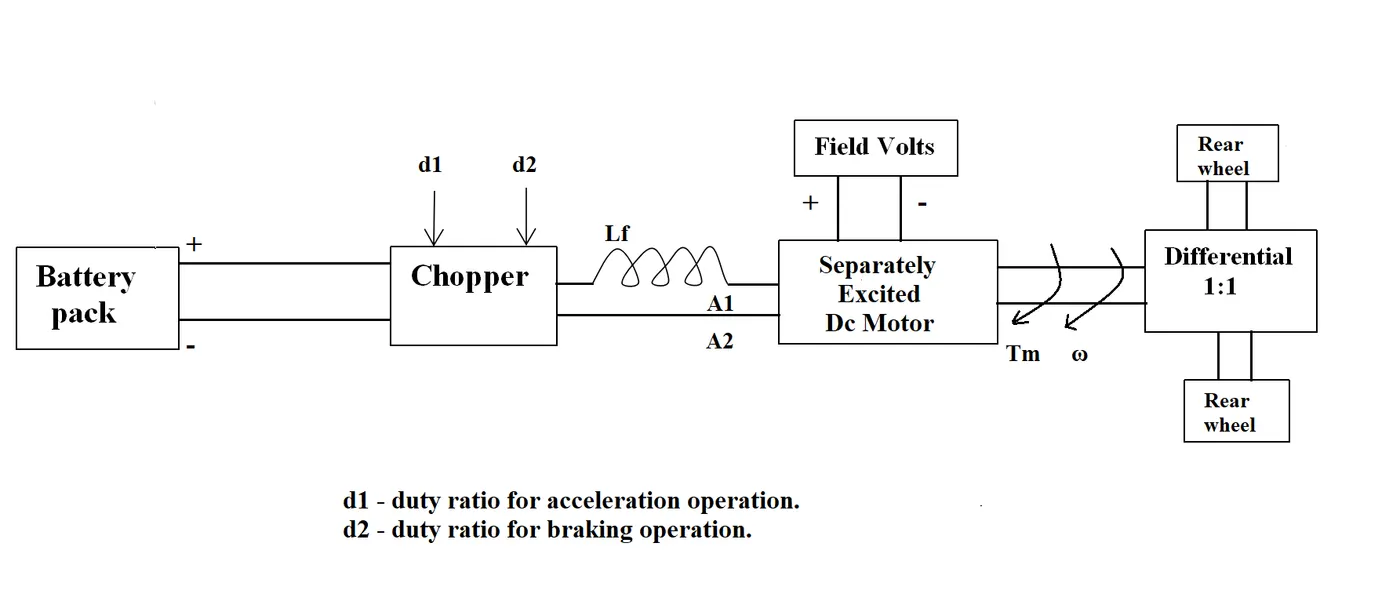
Motor and controller parameters:
Rated armature voltage=72 v
Rated armature current = 400 A
Ra=0.5 ohms, k∅=0.7 V-s
Chopper Switching frequency =400Hz
Vehicle characteristics are given below
TTR=24.7+0.0051w^2
Given,
The battery pack in EV drivetrain=72V
Armature current =400A
Armature resistance = 0.5 ohms
Motor Constant = 0.7 V-s
Switching frequency = 400 Hz
For 70% Duty Cycle
=72*70/100
=5040/100
=50.4 Volts
The DC machine torque speed is calculated using the formula given below
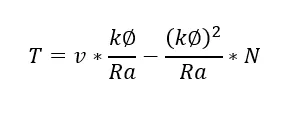
T=70.56-0.98*N
T=70.56-0.98*w
Now ,
24.7+0.0015w^2= 70.56-0.98*w
0.0051w^2+0.98w-45.89=0
By solving the quadratic equation we get,
X=-231.07 or 38.91
Thus the angular speed w= 38.91 or -231.07
At 70% duty cycle the angular speed is 38.91rad/s or -231.07rad/s
Solution 3:-
In the blog ‘Induction Versus DC brushless motor by Wally Rippel, Tesla’ author has highlighted topics related to EV technology, especially related to DC brushless and motor.
According to the author, DC(direct current) is replaced by DC brushless motor or Induction motor. Also, lead-acid batteries are replaced by lithium-ion batteries. The author also says that the future of these components depends on their usage and their demands.
The technology behind brushless DC motor
Brushless DC motors consist of 2 permanent magnets generating DC magnetic fields. For higher torque generation in rotor and stator, a current flows in the winding and this happens due to the magnetic field near the stator. According to the author, the current flow to the stator and rotor should be proper if not then the current will not be generated and the torque will decrease. To maintain the electrical to mechanical conversion there should be a smooth flow of current else the brushless motor is not useful. A brushless motor does not create any starting torque.
Advantages of DC brushless motor
- Low heat generation
- Better cooling capacity
- Higher peak efficiency
- Can operate at unity power factor
In DC brushless drive strength of magnetic field is generated by a permanent magnet. At low speeds when maximum torque is required there should be a magnetic field strength is required which is in maximum value to control the inverter and motor currents. The disadvantage includes magnetic loss reducing the maximum efficiency.
Induction motor
It is basically a 3 phase motor developed by Nikola Tesla in 1889. The induction motor uses laminated steel instead of magnets. Current flowing in the stator winding produce rotating magnetic field that enters the rotor. Current flowing in the stator winding produce a rotating magnetic field that enters the rotor. In an induction motor current interacts with the magnetic field to produce a force required for rotor torque. Induction motor is compatible with any power source. Induction motors cannot operate on DC voltage.
The induction motors do not have any magnet and the field is adjustable. Induction motor is used to reduce magnetic loss increasing overall efficiency.
Advantages of induction motor
- Lower magnetic loss and conduction loss
- High efficiency compared to brushless DC motor
- Smoother operations
Now the question is which one is the better and the most preferred. In 1990 GM EV-1 and Tesla roadster used induction motor and the rest HEVs used brushless DC motor. Both the motors uses 3-phase system.
According to the sensor the DC motor requires absolute position sensors whereas induction motor only needs speed sensors.
Another factor is the permanent magnet are costly and the rotor needs to be carefully maintained and they are difficult to handle,thus the cost of induction motor is less.
Conclusion
According to the author, induction motors are the only best motor for high performance electric vehicle whereas Dc brushless motors are useful for hybrids vehicles.
The author also says that the demand of the motors will increase with increase of hybrid and pure electric vehicles.