Week-6 Challenge: EV Drivetrain
Answer
1.Aim
An EV is a shortened acronym for an electric vehicle. EVs are vehicles that are either partially or fully powered on electric power.
Electric vehicles have low running costs as they have less moving parts for maintaining and also very environmentally friendly as they use little or no fossil fuels (petrol or diesel). While some EVs used lead acid or nickel metal hydride batteries, the standard for modern battery electric vehicles is now considered to be lithium ion batteries as they have a greater longevity and are excellent at retaining energy, with a self discharge rate of just 5% per month. Despite this improved efficiency, there are still challenges with these batteries as they can experience thermal runaway, which have, for example, caused fires or explosions in the Tesla model S, although efforts have been made to improve the safety of these batteries.
The power electronics gain immense importance and the reasons are the following. Firstly, the modern architecture which included the integrated switching and fusing functions into a single component with increased reliability.
The power convertors can be used for different control methods Secondly, the conversion of power is realized by using adjustable speed drives. Lastly, the conversion of voltage as per the demand of the application can be efficiently realized by using power electronics. The different components used in the power electronics of an electric vehicle are rectifiers, inverters dc-dc converters etc.
The 3 type of converter which is widely use in an electric vehicle
- AC TO DC CONVERTER
- DC TO DC CONVERTER
- DC TO AC CONVERTERAC to Dc converter
AC to DC Converters are one of the most important elements in power electronics. This is because there are a lot of real-life applications that are based on these conversions. The electrical circuits that transform alternating current (AC) input into direct current (DC) output are known as AC-DC converters. They are used in power electronic applications where the power input a 50 Hz or 60 Hz sine-wave AC voltage that requires power conversion for a DC output.
The rectifier converts the AC supply into the DC supply at the load end connection. There are different types of rectifiers, such as half-wave, full-wave, and bridge rectifiers.
AC to DC converter circuit
Full Bridge rectifier which consists of four diodes are connected in the form of a bridge. The diode conducts only in one direction, i.e during forward bias. It remains in an off state in another direction, i.e. during reverse bias.
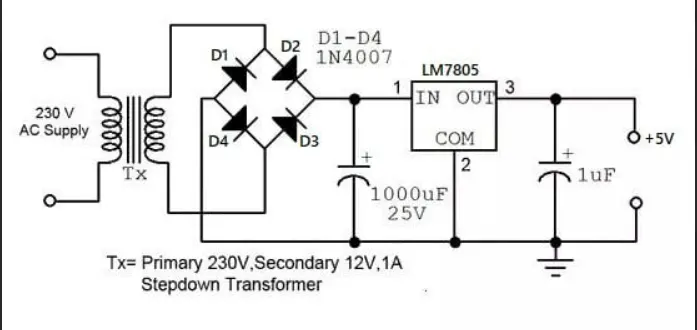
In the above circuit, during the positive half cycle, the diodes D2 & D4 conducts. And during the negative half cycle of the power supply, diodes D1 & D3 conducts. Thus, in this way input AC power is rectified into output DC power. But the problem is DC output power consists of pulses and is not pure DC.
DC to DC converter
A DC-to-DC converter is an electronic circuit or electromechanical device that converts a source of direct current (DC) from one voltage level to another. It is a type of electric power converter. Power levels range from very low (small batteries) to very high (high-voltage power transmission).
During regenerative braking, power flows back to the low voltage bus to recharge the battery (buck mode). As a backup power system.the bidirectional DC-DC converter facilitates the safe operation of the vehicle when ICES or electric drives fail to drive the motor. Due to the aforementioned reasons, high power bidirectional DC-DC converters have gained a lot of importance in the recent past
The converter topologies are classified as
- Buck Converters
- Boost Converters
- Buck-boost Converters
1.The Buck Converter
The Buck Converter is used in SMPS circuits where the DC output voltage needs to be lower than the DC input voltage. The DC input can be derived from rectified AC or from any DC supply. It is useful where electrical isolation is not needed between the switching circuit and the output, but where the input is from a rectified AC source, isolation between the AC source and the rectifier could be provided by the mains isolating transformer.
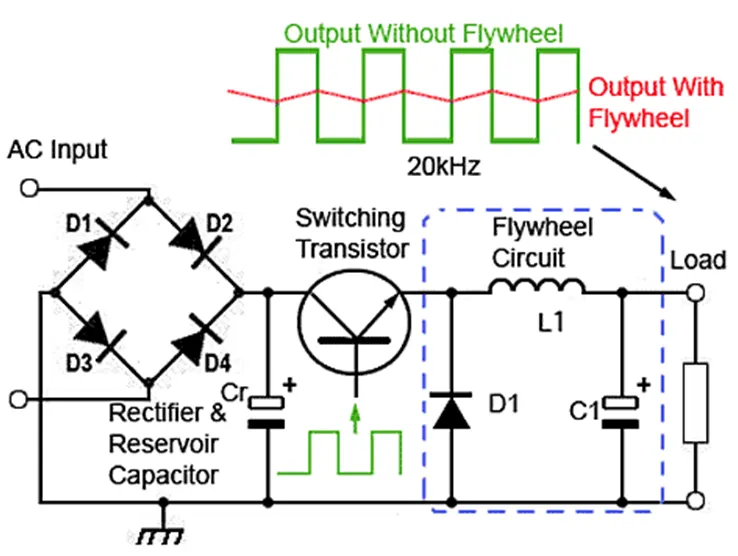
Fig. The Buck Converter
2.Boost Converter
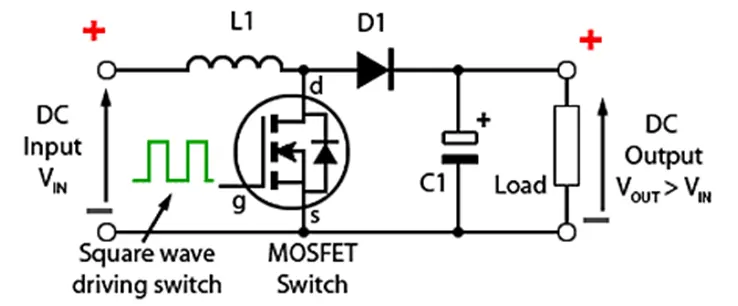
Switched-mode supplies can be used for many purposes including DC to DC converters. Often, although a DC supply, such as a battery may be available, its available voltage is not suitable for the system being supplied. For example, the motors used in driving electric automobiles require much higher voltages, in the region of 500V, than could be supplied by a battery alone. Even if banks of batteries were used, the extra weight and space taken up would be too great to be practical. The answer to this problem is to use fewer batteries and to boost the available DC voltage to the required level by using a boost converter.
3.Buck-Boost Converter
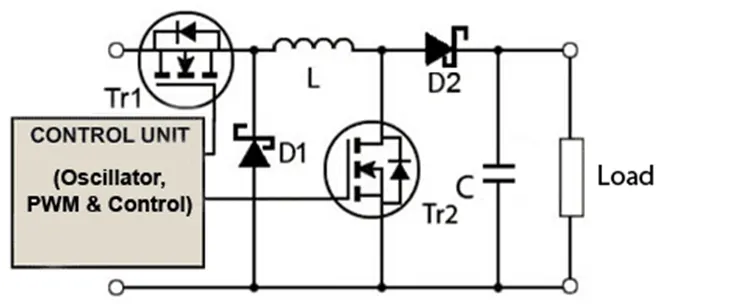
A Buck-Boost converter is a type of switched-mode power supply that combines the principles of the Buck Converter and the Boost converter in a single circuit. Like other SMPS designs, it provides a regulated DC output voltage from either an AC or a DC input.
DC TO AC CONVERTER
An inverter is a device that converts DC power from the battery to AC power used in an electric vehicle motor. The inverter can change the speed at which the motor rotates by adjusting the frequency of the alternating current.
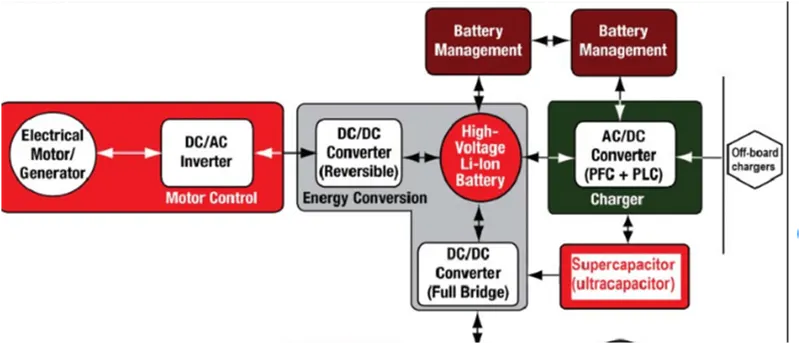
The use of Inverters can increase or decrease the power or torque of the Engine the motor by adjusting the amplitude of the signal. It plays a significant role in capturing energy from regenerative braking and feeding it back to the battery. The output voltage waveform of ideal inverters should be sinusoidal, However, the waveform of practical inverters are non-sinusoidal and contain certain harmonics
1) AC T0 DC CONVERTER RECTIFIER-USED IN EV CHARGER
2) DC TO DE CONVERTER (CHOPPER-ED TO SUPPLY DC POMEN 10 AUSARY LEAD AND CAR HEADLIGHTS
3) DC T0 AC CONVERTER INVERTERS-SED TO SUPPLY POWER TO MASTER
2.Aim
Solution:-
vehicle output voltage (Vv) is given by:_
Vv=Battery voltage (V)*Duty cycle
Vv=72*0.70
Thus vehicle voltage =50.04
Now Equation for vehicle torque is given by
T= Vehicle Torque (N-m)
V= Vehicle voltage (Volts)
ω =steady-state speed of the vehicle (rps)
K=Motor constant
Ra=Armature Resistance
Substituting all these values in the equation, we get:
Solving these two equations.
We get a quadratic equation
since the quadratic equation, we get two values
we have taken positive value
steady-state speed of the vehicle (rps)=38.85 rps
3.Aim
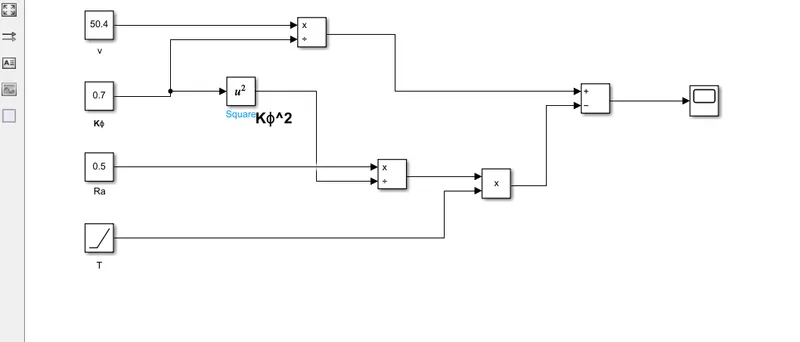
Develop a mathematical model of a DC Motor for the below equation using Simulink.
ω= V/Kϕ -Ra/Kϕ^2.T
let us draw a model for the above equation as shown below.
let
V=50.4 volts
Kϕ=0.7
Ra=0.5 ohms
let us consider torque as a linearly increasing signalled that is equal to the ram block of the following Simulink model
thus we find that, for the fixed voltage,
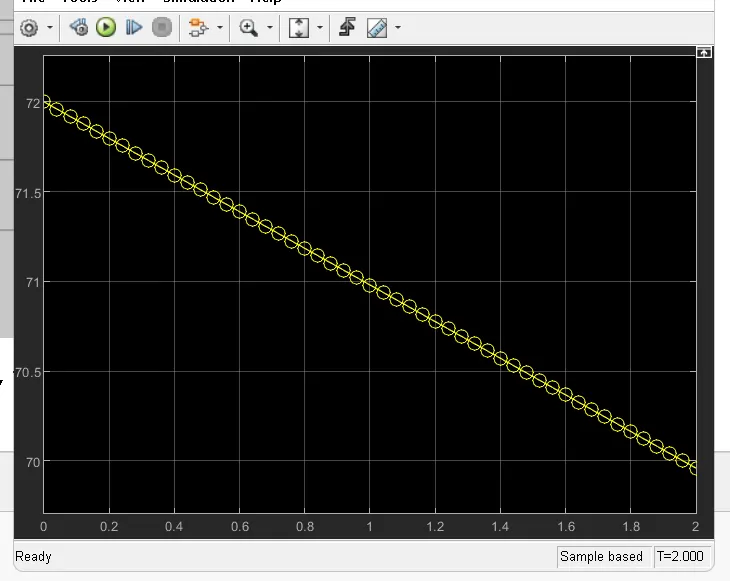
the speed of the motor is inversely proportional to load this means that increase in load torque will result in a decrease in speed.
4. Aim
. Refer to the blog on the below topic Induction Versus DC brushless motors by Wally Rippel, Tesla Explain in brief about author's perspective. The following points can be concluded from the above topic:
In the first place, the creator portrays the predominance of Internal Combustion Engines (ICE) in the realm of the auto business and furthermore examine various sorts of motors. He clarifies that all motors were comparative and it was dependent upon the client to choose as indicated by their necessity. He additionally talks about enlistment engines and brushless DC engines and presents his view that these two innovations will be broadly utilized in the coming years.
- Then he clarifies the working of both a 3-stage enlistment engine and a brushless DC engine. . Presently the creator has done a correlation between these two innovations and expressed a few benefits and burdens of each.
- Induction engine enjoys a few benefits like it has no magnets The engine can turn over under load. No inverter is required. A few disservices of Induction engines are: They can't work from DC: AC is an absolute necessity. Shaft speed is proportionate to line recurrence. Consequently, when utilized with utility force, they are steady speed machines. When worked from utility force, they have restricted beginning force and fairly restricted running pinnacle force abilities, when contrasted with DC type machines
- Brushless DC engine enjoys a few benefits like considerably less rotor heat is produced with the DC brushless drive. The pinnacle point energy productivity for a DC brushless drive will normally be a couple of rate focuses higher than for an acceptance drive. A few drawbacks of a Brushless DC engine are: as machine size develops. the attractive misfortunes increment proportionately and part load proficiency drops. Perpetual magnets are costly and hard to deal with because of extremely enormous powers that become an integral factor when anything ferromagnetic draws near to them.
- Finally, the creator couldn't pick which drive is superior to the next however clarifies that DC brushless drives will probably keep on overwhelming in the crossbreed and coming module half breed markets, and that enlistment drives will probably keep up with strength for the elite unadulterated electrics