Week-6 Challenge: EV Drivetrain
Q.1 Which types of power converter circuits are employed in electric and hybrid electric vehicle?
Solution:
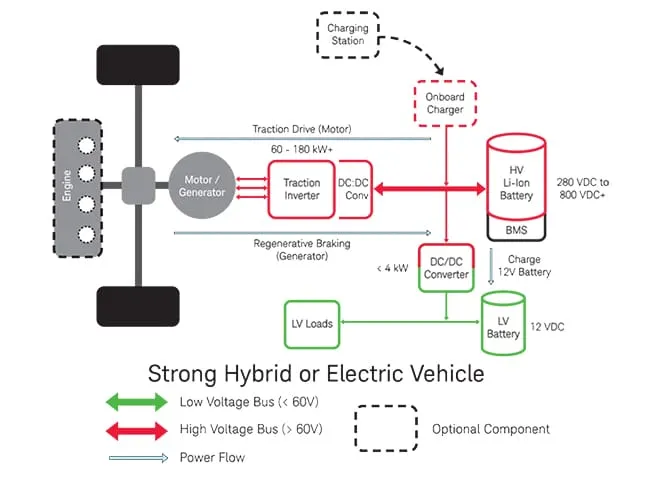
what is Electric vehicle: The electric motor gets energy from a controller, which regulates the amount of power—based on the driver's use of an accelerator pedal. The electric car (also known as electric vehicle or EV) uses energy stored in its rechargeable batteries, which are recharged by common household electricity.
What is hybrid what is Electric vehicle: Today's hybrid electric vehicles (HEVs) are powered by an internal combustion engine in combination with one or more electric motors that use energy stored in batteries. HEVs combine the benefits of high fuel economy and low tailpipe emissions with the power and range of conventional vehicles.
Converter used in ev & hev:
Inverter: A inverter converts the DC voltage to an AC voltage
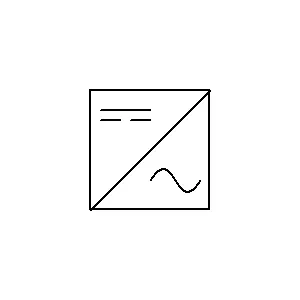
Rectifire: A rectifier is a device that converts an oscillating two-directional alternating current (AC) into a single-directional direct current (DC). ... The simplest rectifiers, called half-wave rectifiers, work by eliminating one side of the AC, thereby only allowing one direction of current to pass through
Chopper: A chopper is a device that converts fixed DC input to a variable DC output voltage directly. Essentially, a chopper is an electronic switch that is used to interrupt one signal under the control of another
TYPE OF CHOPPER: Two types of chopper
1. Step up chopper
2.Step down chopper
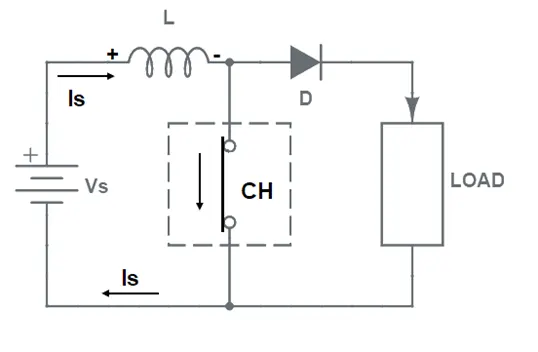
STEP UP CHOPPER: Step-up chopper is a static device whose average output DC voltage is greater than its input DC voltage. It is different from the step-down chopper. In step-down chopper, the average value of output voltage stepped down i.e. it is less than its input voltage.
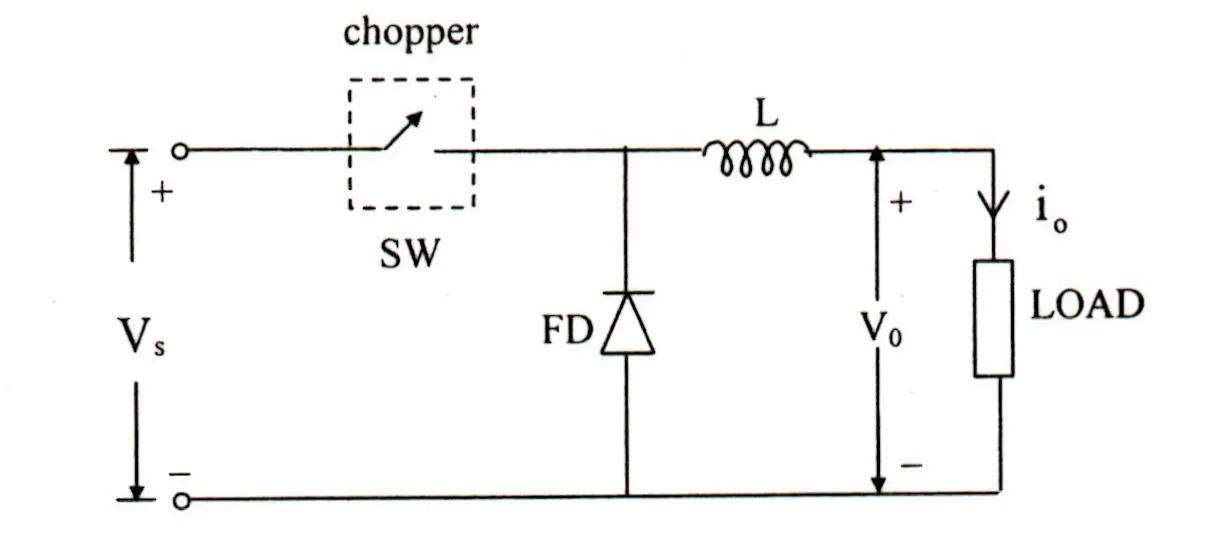
STEP DOWN CHOPPER: A Step-down chopper is a static device that step downs its DC input voltage. The value of average output DC voltage of this chopper is less than that of its fixed DC input source voltage
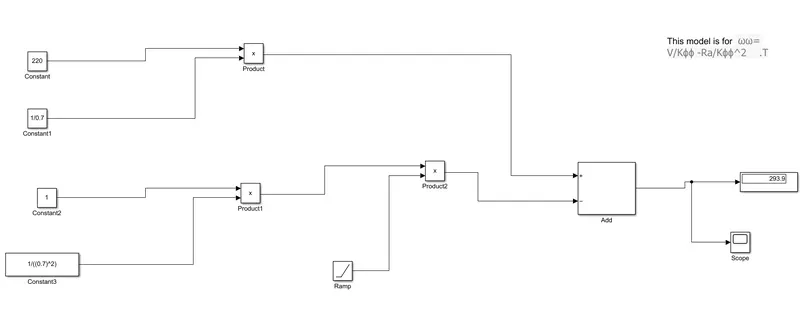
ωω= V/Kϕϕ -Ra/Kϕϕ^2 .T
solution:
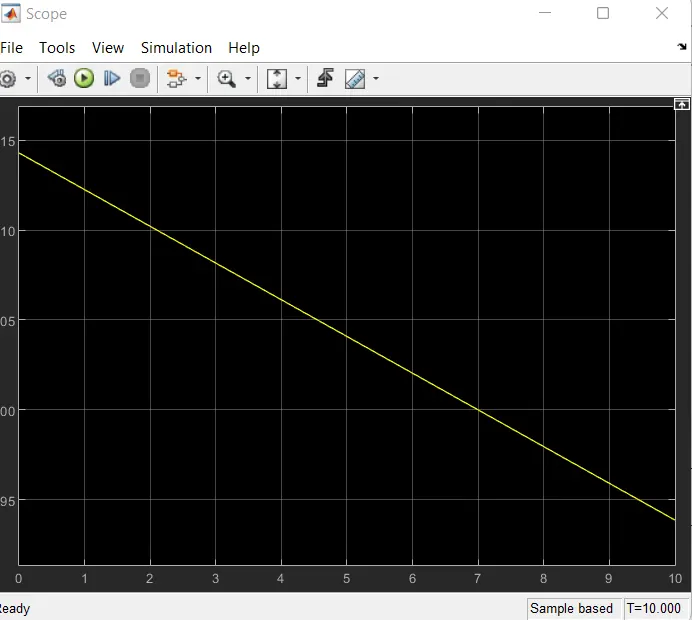
WAVEFORM:
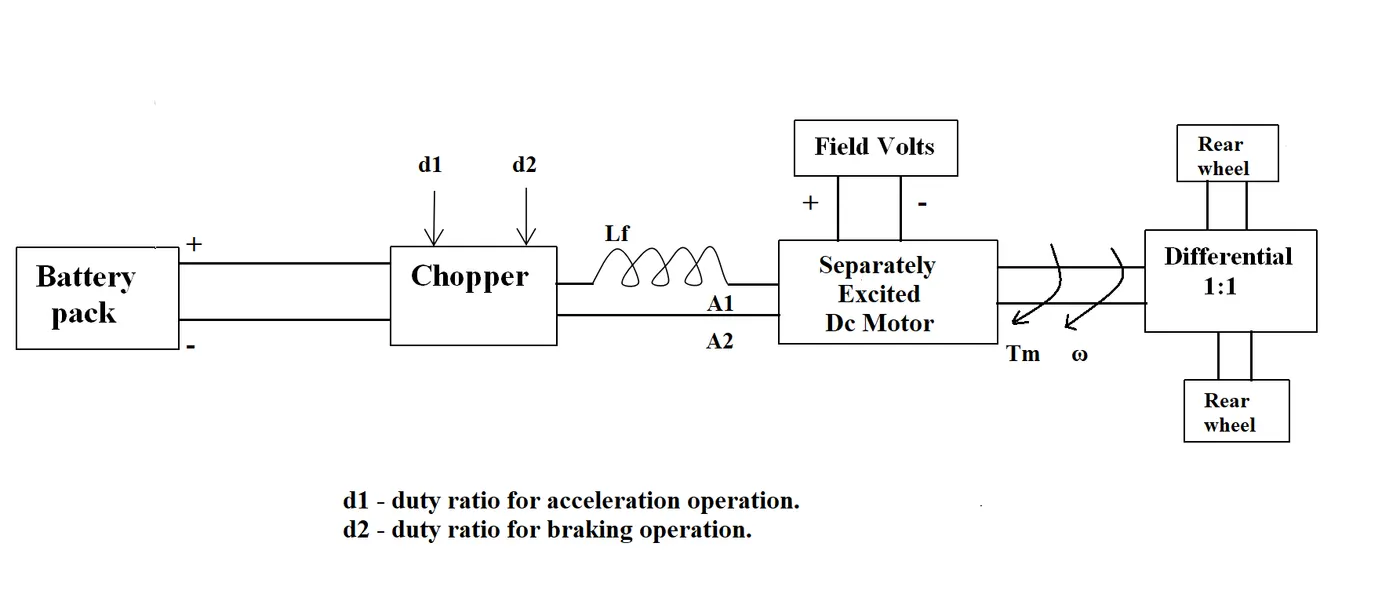
Q.3 An Electric Vehicle's powertrain with 72V battery pack in shown in the diagram below. The duty ratio for acceleration operation is 'd1' and for the braking operation the duty ratio is 'd2'.
The other parameters of the electric vehicle is given below,
Motor and Controller Parameters:
Rated Armature voltage= 72 V
Rated armature current= 400 A
Ra= 0.5Ω, KΦ= 0.7 Volt second
Chopper Switching frequency= 400 Hz
The vehicle speed-torque characteristics are given by the below equation

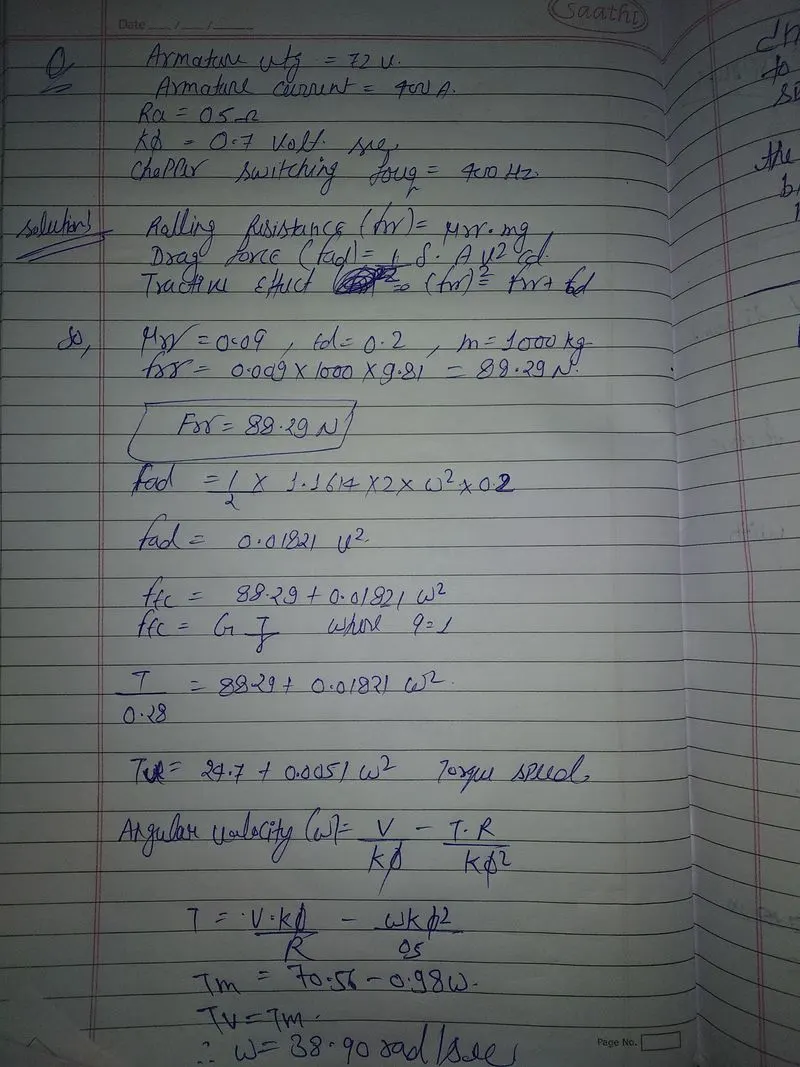
What is EV steady state speed if duty cycle is 70%?
SOLUTION:
Q.4
Refer to the blog on below topic:
Induction Versus DC brushless motors by Wally Rippel, Tesla
Explain in brief about author’s perspective.
SOLUTIUON:
With the DC Brushless Motor, the rotor inside incorporates two or more permanent magnets that generate a DC magnetic field. This magnetic field enters the stator core and interacts with the voltage/current within the windings to produce a twisting force between the two (torque). As the rotor spins, the current within the stator has to have its magnitude and current constantly monitored and varied to optimize both torque and efficiency. This control unit is called an Inverter or switching power supply and it is the drive brain of the motor.
The Induction Motor is very different and at the same time very similar. Nikola Tesla invented the Induction Motor in the 1880s.
His invention, when connected to three phase AC power, will allow the motor to spin at a constant speed. The primary difference is the absence of magnets within the motor. Both have Rotors, both have Stator Cores and both have Distributed Windings. The magnets within the rotor of the DC brushless motor are replaced with stacked laminations of steel and the induction motor utilizes a squirrel cage type rotor.
Currents within the Stator windings produce a rotating magnetic field and the Rotor reacts accordingly by applying a rotational force. Of course there is a lot of engineering that goes into monitoring and application of Current, Voltage Peak to Peak, and Frequency in these motors to maintain the optimal torque and power at any given speed. This brain is also called an Inverter.
They actually seem more alike than different, and they are, but the differences are there and they mean a lot depending on what you want the motor to do. In the DC Brushless Drive the magnetic field produced by the permanent magnets is constant. This puts the motor at a disadvantage where peak performance at all times is required. In the Induction Motor, this magnetic field is adjustable by changing voltage, frequency and current to maintain optimal torque and performance at all speeds. That being said, the programming in the Inverter brain of the Induction Motor is exponentially more complicated.
Rare Earth Metals is another difference. The Rare Earth Metals are, in all actuality, not that rare. Some of these metals like Scandium, Lanthanum, and others are just as abundant as nickel, copper and zinc. But because they are usually accompanied with thorium and uranium the extraction and refining processes is expensive, lengthy, and toxic. The last of these mining facilities in the United States was closed almost 20 years ago. Since then China has taken control of the production of rare earth metals, now producing 97% of the world’s supply. The DC Brushless motor absolutely depends on these and the Induction Motor uses absolutely none. Opting for copper and steel, the induction motor is controlled by a computer. Tesla Motors was the first to innovate with the introduction of the AC Induction Motor in automobiles and others have followed suit. Recently both BMW and Toyota have started experimentation and utilization of the Induction Motor so they could remove something from their cars that has a market that is both volatile and single sourced (probably not good for cost and availability.