Week-6 Challenge: EV Drivetrain
1. Which types of power converter circuits are employed in electric and hybrid electric vehicle?
Q1.ans} Power converter circuits are important circuits in the drivetrain of an EV/HEV as they are the direct interface between the power sources and the EV drivetrain.Therefore it is a priority to design highly efficient and adaptable converter circuits of DC-DC,AC-DC and the DC-AC types.Thes converters are required to show varying output current and voltage levels with minimal loss.
As mentioned there are namely 3 types of Power converter circuits.Firstly being:
AC-DC Converter
- This circuit is also called the ON-BOARD charger circuit.It converts AC power supply to DC supply.
- It is commonly seen in Plug-in Hybrid Electric Vehicles(PHEV) and Plug in EV(PEV).This version of cars get their batteries charged from a electrical grid outside(Charging stations).This power is tored in the battery and is later used for propulsion.
- In the case where the vehicle is charged using an external power network supplying AC supply,the power is passed through the converter circuit and then mad to reach the battery as DC supply since the battery itself is aDC power source.
DC-AC Converter
- This circuit has another name as the Inverter Circuit.It converts DC supply to AC supply.
- It is seen in EV using AC induction type motors for propulsion purpose.The DC power from battery is passed through this inverter circuit and is sent to the motor as AC supply in 3 different phases(in case of 3 phase I.M ,3 Phase power supply).
DC-DC Converter
- A DC-DCC converter can be used in an EV/PHEV to vary the output voltage before reaching a variety of components with different power requirement.
- The power of this converter can change/affect the vehicular top speed ,acceleration level, torque output etc
2. An Electric Vehicle's powertrain with 72V battery pack in shown in the diagram below. The duty ratio for acceleration operation is 'd1' and for the braking operation the duty ratio is 'd2'.
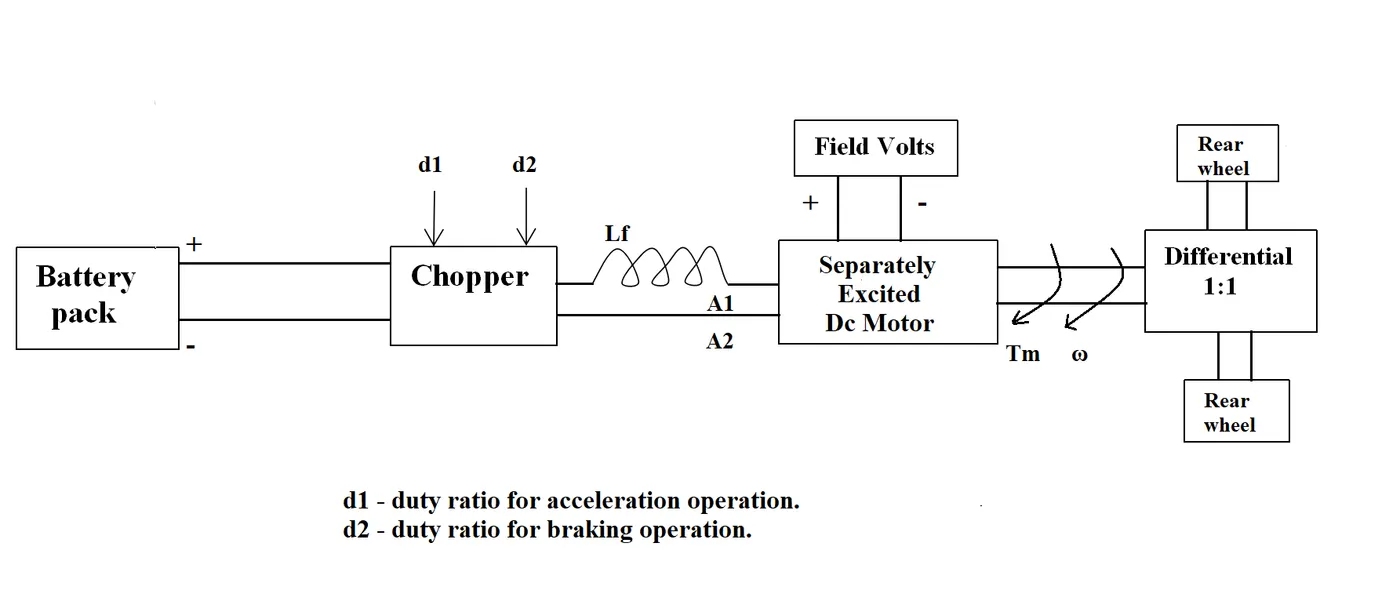
The other parameters of the electric vehicle is given below,
Motor and Controller Parameters:
Rated Armature voltage= 72 V
Rated armature current= 400 A
Ra= 0.5Ω, KΦ= 0.7 Volt second
Chopper Switching frequency= 400 Hz
The vehicle speed-torque characteristics are given by the below equation

What is EV steady state speed if duty cycle is 70%?
Q2.ans}Given data:
Battery Voltage (Vb)= 72V
Ia=400A , Ra= 0.5 ohms , Va=72V
motor constant(K-fi)= 0.7V-s
f = 400hz
Duty cycle = 70%
Ans) Formula to be used is:
Tv = (Vv-ω.k-fi).K-fi ,where, ω is the steady state speed of the vehicle
Ra
Vehicle output voltage(Vv)
Vv = Vb*duty cycle = 72*0.7= 50.4V
Substituting in formula,we will remain with two unknowns
Tv = (50.4-ω.0.7).0.7
0.5
Tv=70.96-0.98ω------------------1
Given: Tv=24.7-0.005ω^2---------------2
Since LHS is Torque of Vehicle,We equate it to get a quadratic eqn,
70.96-0.98ω=24.7-0.005ω^2
= 0.0051ω^2+0.98ω-46.94=0
Solving the Quadratic equation we get 2 values fow 'ω'
ω1=38.7rad/s--------------Answer
ω2=-230.98 rad/s.
Q4.ans}In the blog the author gives his overall perspective about the HEV and EV drives in existence today and how they came to be.Intially he opens with the wide variety of engines available in IC variant and pn how there has not been a definitive best type till date.He also concludes that the engine type used mainly depends on the price and performance needed ny the customer.
Coming to the EV and HEV the author gives and introduction and a small hsitory about the orgin and moves on to tak about the different machines available to generate propulsion.The brushless Dc machine and the AC induction machine
Up next the author goes in brief detail about the DC brushless machine construction of stator and rotor the flow of current mag field generation etca nd explains how propulsion is achieved and then comes to talk about the invention of induction(3 phase) by Nikola Tesla and its working and construction. He also talks about how each type has its own advantages and disadvantages and how hard iit is to choose between the two of them.He concludes the blog by saying how similar the two drives are fundamentally and how they will work side by side in the golden era of HEV and EV.