ELECTRIC VEHICLE DRIVETRAIN
POWERTRAIN IN ELECTRIC AND HYBRID ELECTRIC VEHICLES:
An Electric Vehicle is a vehicle that uses a combination of different energy sources, Fuel Cells (FCs), Batteries and Supercapacitors (SCs) to power an electric drive system In EV the main energy source is assisted by one or more energy storage devices. However, in this way the power drawn from each device cannot be controlled, but is passively determined by the impedance of the devices. The impedance depends on many parameters, e.g. temperature, state-of-charge, health, and point of operation.
DC-DC POWER CONVERTER:
By introducing DC/DC converters one can chose the voltage variation of the devices and the power of each device can be controlled . It can be noticed that the use of high power DC/DC converters is necessary for EV power supply system. The power of the DC/DC converter depends on the characteristics of the vehicle such as top speed, acceleration time from 0 to 100 Km/h, weight, maximum torque, and power output Generally, for passenger cars, the power of the converter is more than 20 KW and it can go up to 100 KW. The different configurations of EV power supply show that at least one DC/DC converter is necessary to interface the FC, the Battery or the Supercapacitors module to the DC-link.
WORKING OF THE DC-DC POWER CONVERTER:
A DC to DC converter is a category of power converters and it is an electric circuit which converts a source of direct current (DC) from one voltage level to another, by storing the input energy temporarily and then releasing that energy to the output at a different voltage. The storage may be in either magnetic field storage components (inductors, transformers) or electric field storage components (capacitors).
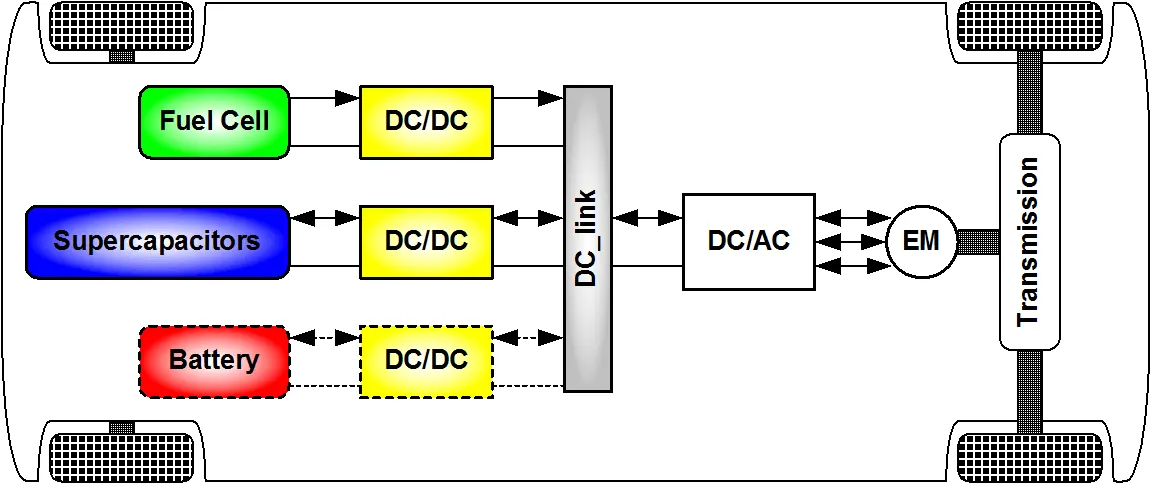
DC/DC converters can be designed to transfer power in only one direction, from the input to the output. A bi-directional converter can move power in either direction, which is useful in applications requiring regenerative braking.
The amount of power flow between the input and the output can be controlled by adjusting the duty cycle (ratio of on/off time of the switch). Usually, this is done to control the output voltage, the input current, the output current, or to maintain a constant power.
TO FIND THE STEADY STATE POINT OF THE ELECTRIC VEHICLE:
The input values are already given in the question.
- Armature voltage Va = 72V,
- Armature current Ia = 400A
- Armature Resistance Ra= 0.5ohm
- Motor constant k_phi = 0.7V-s
- Chopper frequency = 400HZ
THE VEHICLE CHARACTERISTICS ARE GIVEN BY THE EQUATION
TTR=24.7+0.0051w^2----------------------------------- 1
THE STEADY STATE POINT OF THE DC MOTOR CHARACTERISTICS GIVEN BY;
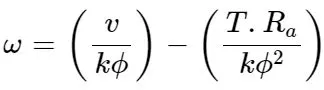
By rearranging in the form OF torque is;
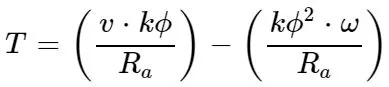
By substituiting the input values in the bove equation, we get
T=(v*0.7/0.5)-(omega*0.72/0.5)
Here we don't know the valve of the voltage, to calculate the output voltage the duty cycle is taken into the account.
The duty ratio = 70%, for the accelaration, so
v=V*duty ratio
=72*0.7
v=50.4V
substitiuting the output voltage, we get
T=(50.4*0.7)-(omega*0.72/0.5)
T=70.56-0.98*omega--------------------------------- 2
By equating the 1 & 2, we get
TTR=T
24.7+0.0051omega2 = 70.56-0.98*omega
0.0051*omega2+0.98*omega+24.7-70.56 =0
0.0051*omega2+0.98*omega-45.86 = 0
By equating the quadratic equation, we get two answers
omega=-231.06&38.90 rad/sec
The value of omega is always positive, so the answer is
omega=38.90 rad/sec.
BRUSHLESS DC MOTOR:
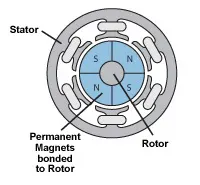
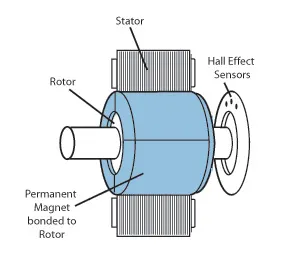
With brushless machines, the rotor includes two or more permanent magnets and generates DC magnetiv fields. This magnetic fields enters the stator and interacts with the rotor to produce torque. the polarity and magnitude is frequently changed and makes the torque constant for the period of time. Without the help of the inverter the DC brusless drive doesn't produces the currents. DC brushless drives require an absolute position sensor
ADVANTAGES:
The heat generated in the rotor is much more less and the cooling of the system is easier.
This makes the higher peak point efficiency and operates at unity power factor which means the peak efficiency of the system is higher.
The strength of the magnetic field produced by the permanent magnet is adjustable W.R.T. the torque requirements. This means at low speeds with high torque requires the magnetic field strength is higher and at low torque the losses like eddie and hysterisis are reduced when the field strtength are reduced.
LIMITATIONS:
It is powerless without the use of inverter.
The permanent magnets are highly expensive. The permanent magnet rotor produces large amount of forces which makes the system difficult to handle .
It doesn't able to produce torque when directly connected to the utility power systems.
When the size of the motor drive increases the magnetic losses increases and this leads to the part load efficieny losses.
INDUCTION MOTORS:
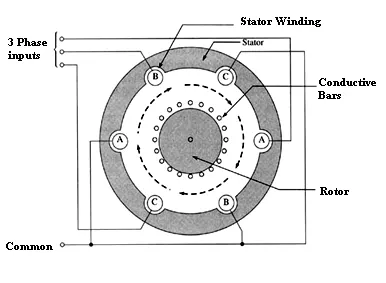
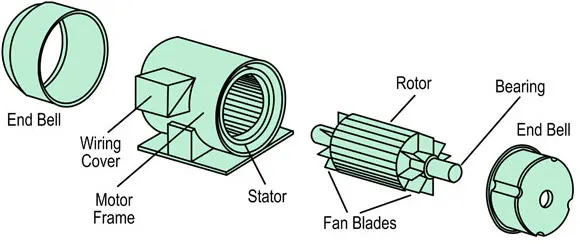
The induction rotor has no magnets which in alternate having a steel laminations with buried peripheral conductors. Currents flowing in the stator windings produce a rotating magnetic field that enters the rotor. currents are produced within the rotor conductors that are approximately proportionate to the voltage, hence the speed difference. Finally, these currents interact with the original magnetic field to produce forces – a component of which is the desired rotor torque.
ADVANTAGES:
In the induction drive, the motor has the ability to start under load. No inverter is needed. The fact that induction motors are directly compatible with conventional utility power.
Induction motors have no magnets and magnetic field strength are adjustable ,since magnetic field strength is proportionate to voltage to frequency. This means when the voltage is reduced the field strength is also gets reduced this makes less magnetic and conduction losses and efficiency is maximized.
Since it don't have any permanent magnets it is cost effective.
With induction, as machine size grows, losses do not necessarily grow. Thus, induction drives may be the favored approach where high-performance is desired; peak efficiency will be a little less than with DC brushless, but average efficiency may actually be better.
LIMITATIONS:
It doesn't operates on the DC, AC is must. By adding an inverter to the system it can able to power the DC motor drive.
Induction machines are more difficult to control. The control laws are more complex and difficult to understand. Achieving stability over the entire torque-speed range and over temperature is more difficult.
CONCLUSION:
My conclusion is that DC brushless drives are used in the hybrid and plug-in hybrid vehicles and that induction drives are used for the high-performance pure electrics. At last both the drives having similar components inside the system and produces high level of efficieny.