Week-6 Challenge: EV Drivetrain
1. Which types of power converter circuits are employed in an electric and hybrid electric vehicle?
EVs & HEV use either an AC or a DC motor, the difference between the two usually showing in how many volts at which the motor can run. A DC motor will likely run between 96 and 192 V, while an AC motor is probably a three-phase motor that runs at 240 V. According to How Stuff Works, DC installations lean more on the inexpensive side, so they may be the better option for someone still unsure about EVs but willing to try them. Usually covering the 20,000- to 30,000-W range, DC motors also allow you to overdrive them, meaning that a 20,000-W motor would briefly accept a higher wattage and “deliver five times its rated horsepower.” The driver’s only concern would be the building up of heat that too much overdriving can cause. If a driver doesn’t push an AC motor too far, they shouldn’t have too much to worry about in terms of longevity.
Advantages of a DC motor for anyone skeptical of EVs also include more widespread availability and easy installation. One of the standout DC devices, the DC Series wound electric car motor, has a strong reputation partially because it also works as a motor in electric drills. When it comes to cars, the wound electric motor offers all of its torque from a standstill. Another reliable source, the EV Photo Album, cites the Advanced DC Serious wound motor as the most popular of its kind.
As for AC motors, they’re usually more adaptable if a driver has a certain size, shape, or power rating in mind, as they work with nearly any industrial three-phase motor. Because of the AC motor’s regen feature, an EV’s AC motor can serve as a generator and bring power back to its batteries. While a three-phase motor relies on a DC power source, an inverter is present instead of a DC system’s controller. An AC motor will handle rougher terrain more smoothly and allows more acceleration. While this type is pricier, the benefits appeal to a wider audience and could potentially help your EV last longer in general.
While deciding which EV motor to use is largely a situational decision, both AC and DC motors help lead to a healthier planet.
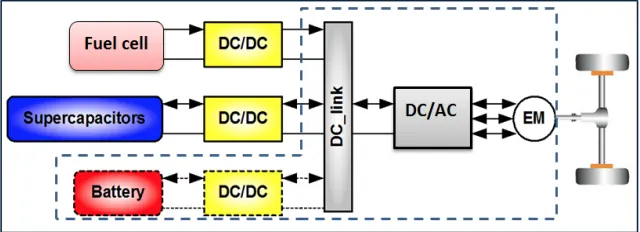
The structure of the EV’s drive system is depicted in figure below. It consists of a HPS, DC/DC boost converter, DC/AC converter and an induction machine. In this configur interfaced to the dc-bus through a unid converter, whereas the energy storage system SCs and battery is connected to the dc-bus vi boost converter. The electrical motor is inte common EV dc-link through DC/AC convert dc power to a suitable ac power. The propos the dashed lines will be discussed in details sections.
Block diagram for the proposed system as a part of EV Prototype:-
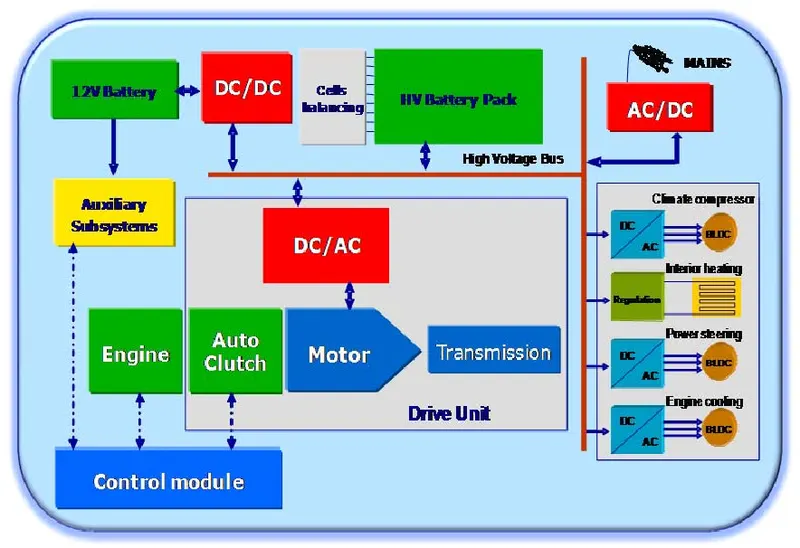
Hybrid power train block diagram:-
2. An Electric Vehicle's powertrain with 72V battery pack in shown in the diagram below. The duty ratio for acceleration operation is 'd1' and for the braking operation the duty ratio is 'd2'.
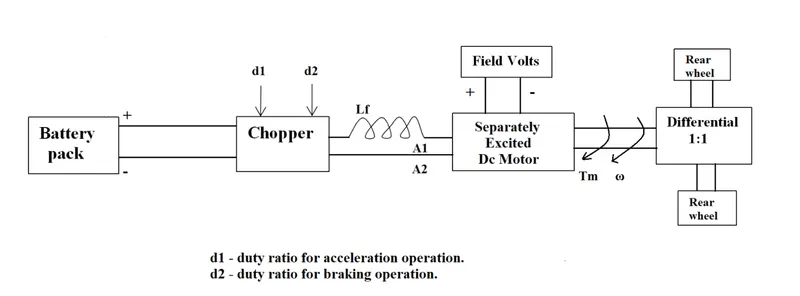
The other parameters of the electric vehicle is given below,
Motor and Controller Parameters:
Rated Armature voltage= 72 V
Rated armature current= 400 A
Ra= 0.5Ω, KΦ= 0.7 Volt second
Chopper Switching frequency= 400 Hz
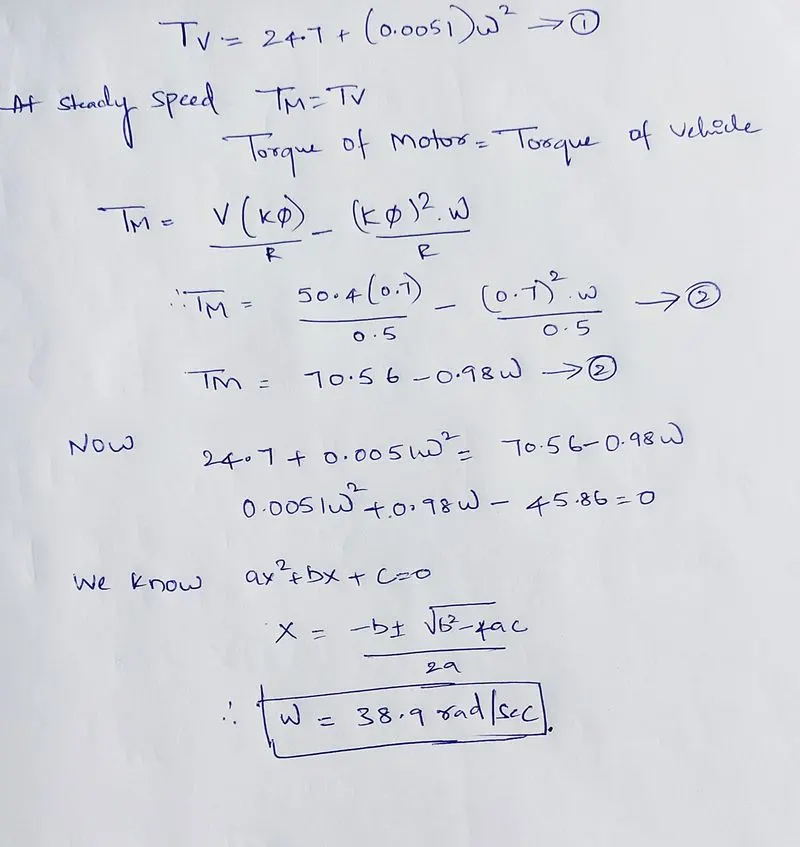
The vehicle speed-torque characteristics are given by the below equation

What is EV steady state speed if duty cycle is 70%?
Duty cycle - 70% of 72, V = 50.4
3. Refer to the blog on below topic & Explain in brief about author’s perspective.
Induction Versus DC brushless motors by Wally Rippel, Tesla
Usually Telsa only use customised AC Induction Motor, than the DC Motor becasue of 2 factors
- Electrical & Mechanical Highlights.
- Top Speed attributes with regenerative breaking
Wally Rippel Talked much about the key differnces between DC Brushless Motor vs Indcution Motor
Efficiency:-
- DC burshless are more efficient upto 85-90% mainly used in HEV & PHEV
- Where as AC Induction is less efficient upto 75-80% mainly used in EV
Acceleraion & Torque:-
- DC Motor the torque straley deminishes as speed increments
- AC induction are consistant upto certain speeds, regenerative can be used.
Key Differences:-
AC induction uses 3-phase supply where DC same as the name.
DC has much energy loss than the AC induction
AC induction are cost effective than the DC.
Authors Conclusion:-
DC brushless drives will likely continue to dominate in the hybrid and coming plug-in hybrid markets, and that induction drives will likely maintain dominance for the high-performance pure electrics. The question is what will happen as hybrids become more electrically intensive and as their performance levels increase? The fact that so much of the hardware is common for both drives could mean that we will see induction and DC brushless live and work side by side during the coming golden era of hybrid and electric vehicles.