Week-6 Challenge: EV Drivetrain
1. Which types of power converter circuits are employed in electric and hybrid electric vehicle?
A. In an electric vehicle, the electrical energy has to be converted into mechanical energy to be used by as the motor output. Additionally, the charging of the electrical energy takes places via charging stations, where electrical energy in the form of alternating supply is converted to direct supply. This conversion of energy happens via Power Cinverters
The following types of Power Converter Circuits are used in EVs and HEVs:
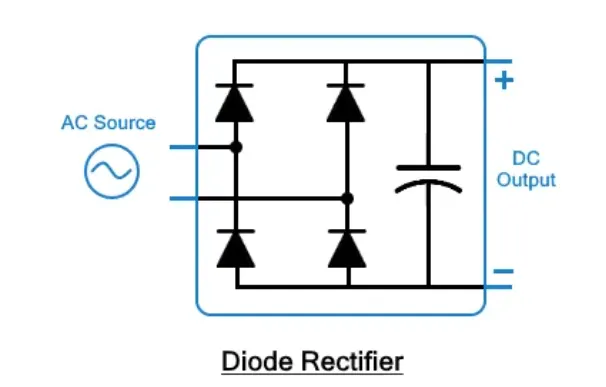
1. Diode rectifier:
This is a simple circuit where the AC signal is converted to DC. The max voltage depends entirely on the input AC supply, and cannot be controlled.
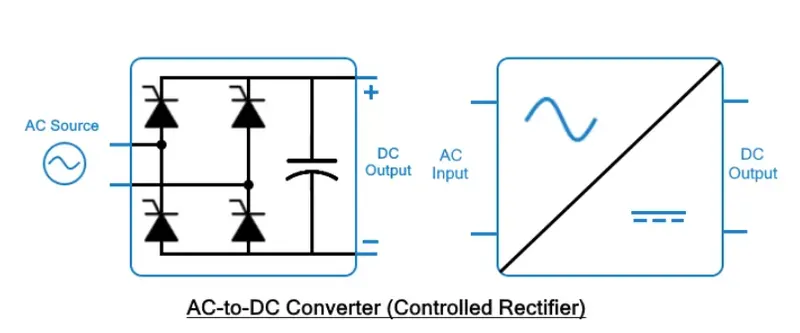
2. AC-DC Converter (Controlled Rectifier):
This is a more complex version of Diode rectifier where instead of diodes, thyristors are used. By controlling the duty cycle of the transistors, the output voltage can be controlled.
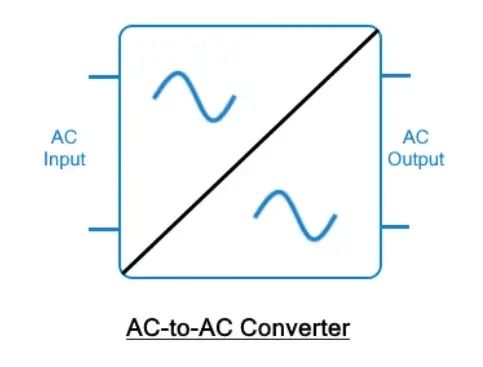
3. AC-AC converter:
It converts an AC suppply into another AC supply with different frequency or amplitude.
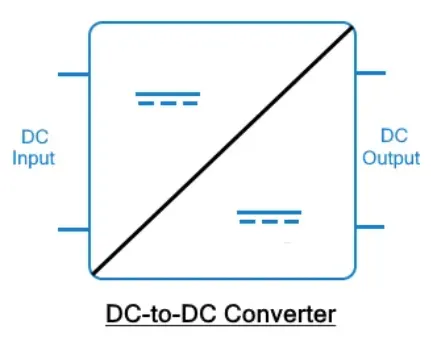
4. DC-DC Converter:
It converts the applied DC inout into another DC output with different voltage. It is also called chopper, transistor chopper or switching regulator.
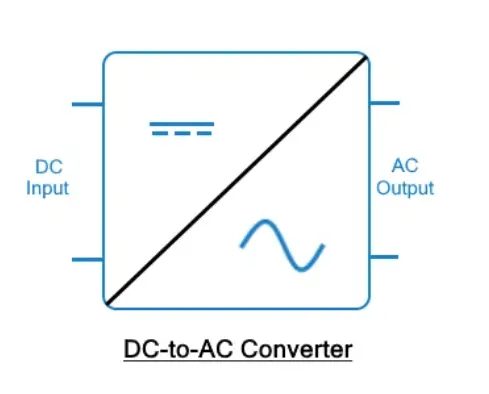
5. DC-AC Converters:
It converts the input DC supply into an AC output. It is also called an inverter. It uses pairs of thyristors which are turned on or off alternatively. This creates the alternating voltages, which can be filtered to create an AC supply.
2. To calculate the EV steady state speed
A.
The steady state of a motor is the state where the motor speed is equal to the vehicle speed.
The torque characteristics of the vehicle is
`T_v` = 24.7 + 0.0051`omega^2` - (1)
First we need to calculate the output voltage from the chopper.
For this we use the following formula:
V=Vs * duty cycle
V = 72 * 0.7 = 50.4V
This is the supply to the DC motor.
Now we use this to calculate the motor torque as a function of speed.
`T_m` = `(V*kphi)/R` - `(omega/R)*(kphi)^2`
substituting the values, we get
`T_m` = 50.4 * 0.7/0.5 - `omega`*(`0.7^2`)/0.5 = 70.56 - 0.98*`omega` - (2)
equating equations 1 and 2 we get,
70.56 - 0.98*`omega` = 24.7 + 0.0051`omega^2`
0.0051`omega^2` + 0.98*`omega` - 45.86 = 0
by solving above equation using an online calculator, we get,
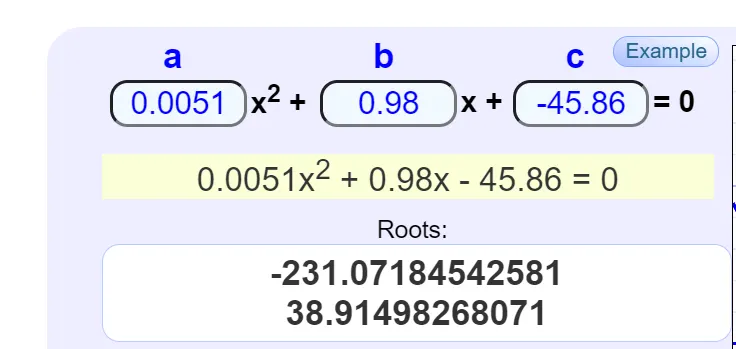
since steady state speed cannot be in the regenerative mode, the speed cannot be negative.
Hence `omega` = 38.91 rad/s or 371.56 rpm
3. Refer to the blog on below topic:
Induction Versus DC brushless motors by Wally Rippel, Tesla
Explain in brief about author’s perspective.
A. In the blog, the author italks about the advantages and disadvantages of DC brushless motor and Induction motor for use in EVs.
Both these technologies have developed side by side and are used in different applications.
Following is the summary of comparison of the two technologies:
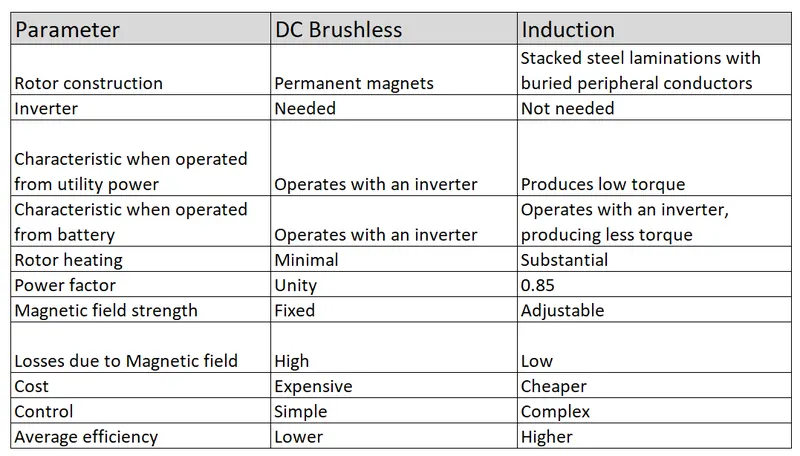
The author concludes that there is no clear winning technology, and that due to such contrasting pros and cons, both these technologies will see utilisation in the electrical motor application.
References:
1. https://allabouteng.com/types-of-power-electronics-circuits-converters/
2. https://www.mathsisfun.com/quadratic-equation-solver.html