Week-6 Challenge: EV Drivetrain
1. Which types of power converter circuits are employed in electric and hybrid electric vehicle?
The main components of an Electric Vehicle are DC-AC inverter, DC-DC converter, battery, and electric motor.
There are two major power electronic units in the general configuration - DC-DC converter. DC-AC converter
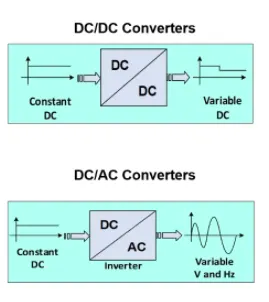
DC-DC converter
In electric vehicles which use a DC motor, running the motor can use up to three times the voltage provided by the battery. With the help of the right converter, we can bridge this gap without having to possibility to a larger, prohibitively heavy battery.
Unidirectional DC-DC converters cater to various onboard loads such as sensors, controls, entertainment, utility, and safety equipments. They are also used in DC motor drives and electric traction. Bidirectional DC-DC converters find applications in places where battery charging, regenerative braking, and backup power are required.
DC-AC inverter
Usually AC motors are used in HEVs or EVs for traction and they are fed by inverter and this inverter is fed by DC-DC converter
An inverter is a device that converts DC power from the battery to AC power used in an electric vehicle motor. The inverter can change the speed at which the motor rotates by adjusting the frequency of the alternating current.
It plays a significant role in capturing energy from regenerative braking and feeding it back to the battery.
----------------------------------------------------------------------------------------------------------------------------------------------
2. An Electric Vehicle's powertrain with 72V battery pack in shown in the diagram below. The duty ratio for acceleration operation is 'd1' and for the braking operation the duty ratio is 'd2'.
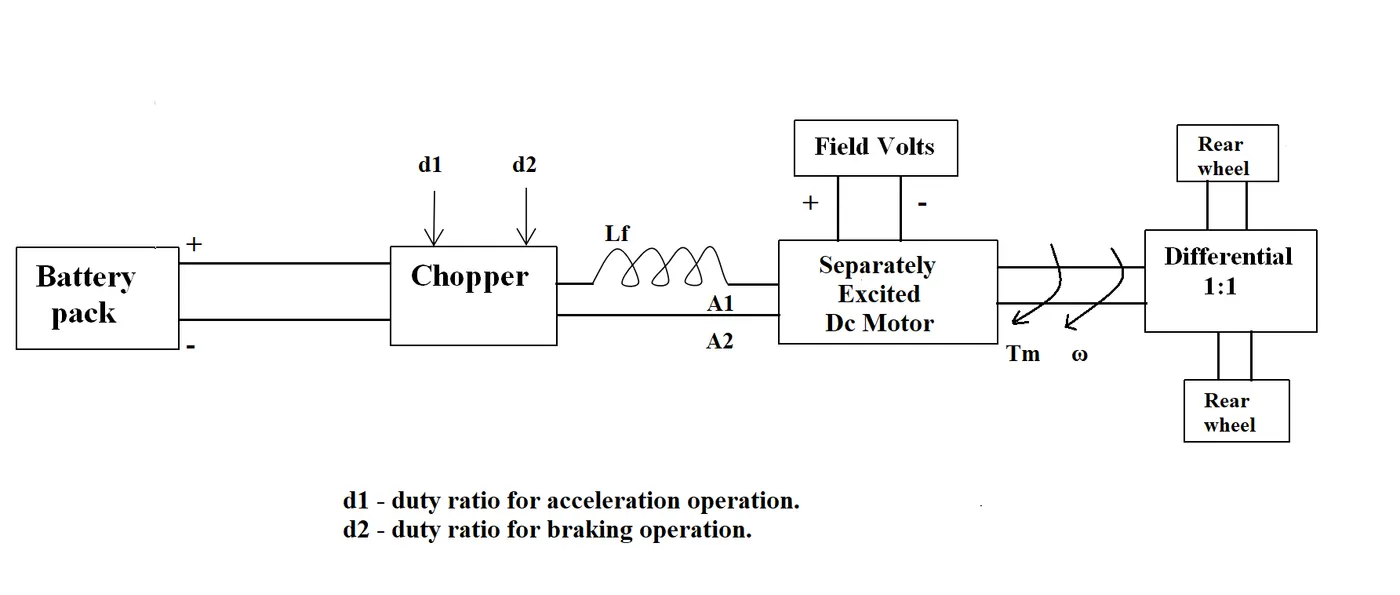
The other parameters of the electric vehicle is given below,
Motor and Controller Parameters:
Rated Armature voltage= 72 V
Rated armature current= 400 A
Ra= 0.5Ω, KΦ= 0.7 Volt second
Chopper Switching frequency= 400 Hz
The vehicle speed-torque characteristics are given by the below equation

What is EV steady state speed if duty cycle is 70%?
motor voltage=batter voltage * duty cycle
since the duty cycle is 70%, the effective voltage for the motor is 72*0.1=50.4 V
speed-torque characteristics for motor is given by
`T_m=(V.k)/R-(wK^2)/R`
so `T_m=(50.4 *0.7)/0.5-(0.7^2*w)/0.5`
`T_m=70.56-0.98w`------eqn(1)
speed-torque characteristics for vehicle is given as
`T_v=24.7+0.0051w^2`----eqn(2)
since he differential ratio is 1:1 and transmission ratio is 1:1
so speed torque equation of motor and vehicle can be compared directly
so from(1),(2)
`70.56-0.98w=24.7+0.0051w^2`
`0.0051w^2+0.98w-45.86=0`--------eqn(3)
solving(3) by quadratic method
we will get the results as
`w=38.82,-230.98`
negleting the negative value
steady state speed of motor is 38.82rad/s.
`rad/s=60 / (2*pi) rpm, so 38.83rad/s = 370.89 rp`
steady state speed of vehicle is given by `speed(m/s) = (N*pi*D)/60` where N is speed in rpm and D is diameter of vehicel tyre`
------------------------------------------------------------------------------------------------------------------------------------------------
3. Refer to the blog on below topic:
Induction Versus DC brushless motors by Wally Rippel, Tesla
Explain in brief about author’s perspective.
- Author explains that both DC bruchless motor and Induction motor has their differences and advantages in different situations similar to IC engines where different configurations such as V-twin, inline,radial are used in different appilications.
- Induction motor is suited for high-performance applications because, as size grows losses are not increased, low cost as it doesnt have permanent magnets,speed can be varied by changing frequency using inverters but hard to develop these controls so cost may be high.. But it required ac to operate so energy is lossed in converting battery dc to ac.
- Dc brushless motors acheive high peak point efficiency, heat generated is less and cooling is easy.
- Now, pure electric is dominated by induction and hydrids are dominated by brushless motors but auhtor beleives that wi th the increase in electrical systems in hybrids and increasing performance requirements, both induction and brushless motors will work side by side to get the best in all situations.