Week 6-3D Tetra Meshing Challenge
- For the given MODEL 1, Create a Teramesh for Housing component with the following quality criteria.
TetraMesh Generation Method: 2D to 3D Conversion
Elements sizes: Min- 2 Units, Target- 5 Units, Max- 7 Units
Tet collapse: 0.15
- For the given MODEL 2, Create a 3D Tetramesh with the following quality criteria.
TetraMesh Generation Method: Quick Tetra Mesh/ Volume Tetra Mesh
Target Element size: 3 Units.
Tet Collapse: 0.15
- For the given assembly MODEL 3, Create a 3D Tetramesh with the following quality criteria.
TetraMesh Generation Method: Quick Tetra Mesh/ Volume Tetra Mesh
Target Element size: 4 Units.
Tet Collapse: 0.15
Solution:
- Model 1(Housing)
Step 1:
- Import the given model and check for any geometrical errors.
- Next defeature some edges which might fail for minimum length quality criteria.
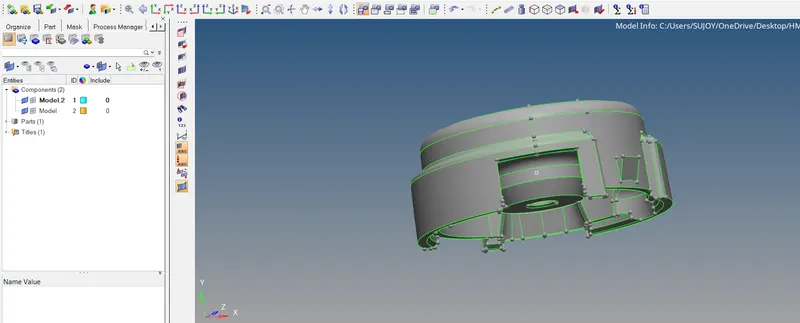
- Remove the unnecessary fillets, toggle unwanted edges.
- Now we can proceed for meshing the model with 2D tria elements.
- Go to 2D>Automesh and give proper element size and type as trias only, as we need to later convert them to tetras.
Step 3:
- Initially Mesh the surface using 2D tria elements.
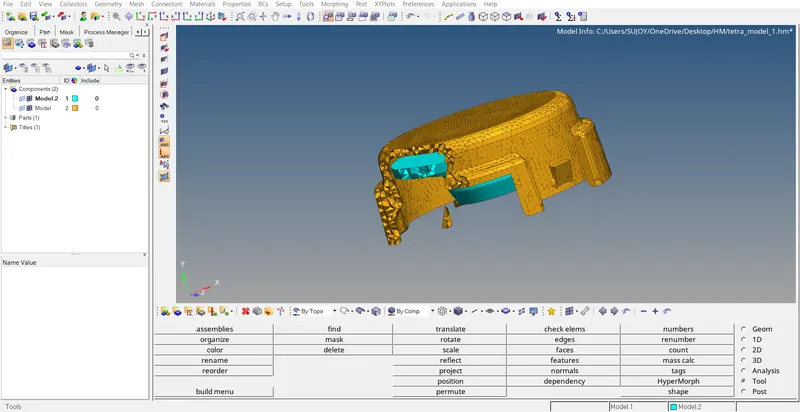
- Check for minimum and maximum element size errors from and clear the same
- Below the image shows there no min and max element size error
Step 4:
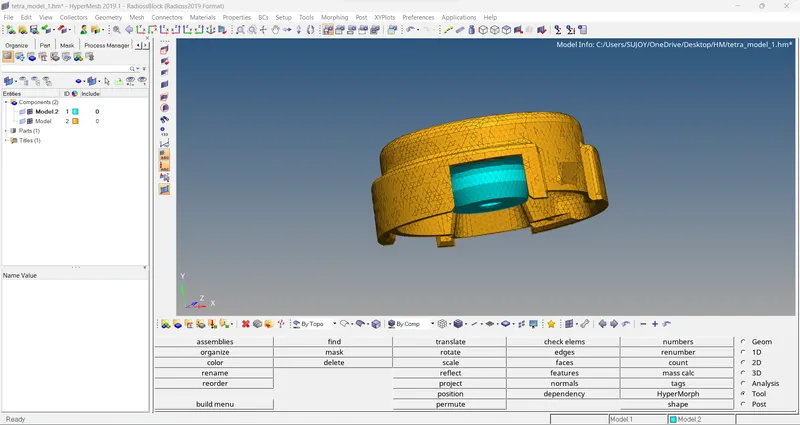
- Perform 3D tetramesh using the 2D tria elements, 3D>Tetramesh>select all the elements.
- Check tet collapse for 0.15, in tools>check elements>3d>tet collapse, fix the errors by tetra remesh or manually by moving the nodes
- Below image shows there is no tet collapse error.
Model 2:
Step 1:
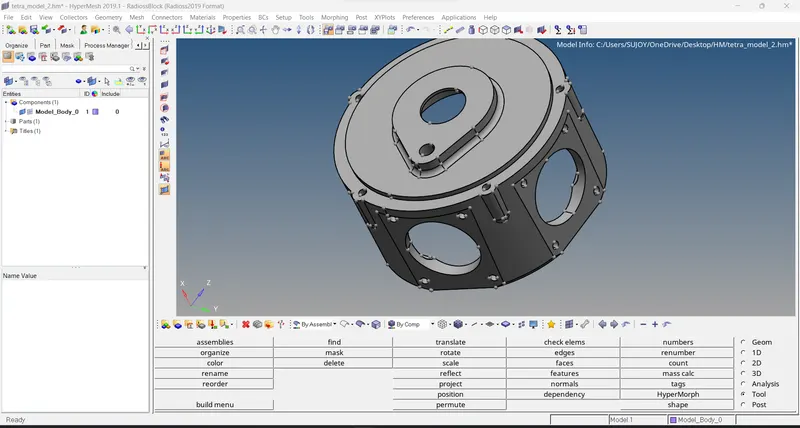
- Import the given model and check for any geometrical errors.
-
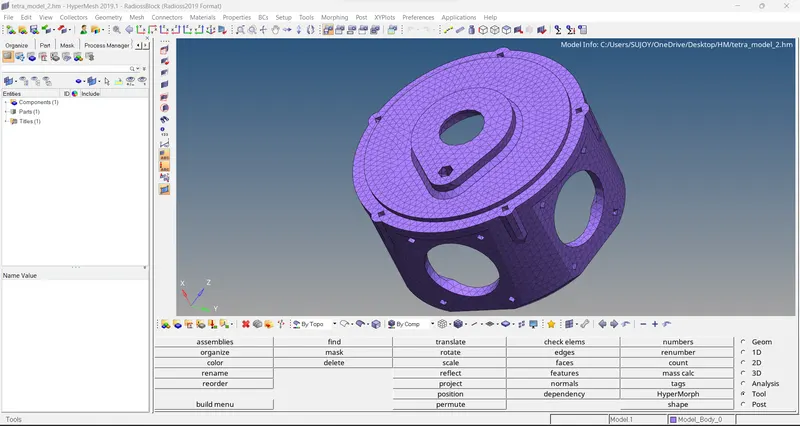
Volume Tetra Mesh
- Go to 3D>Tetramesh>Volume Tetra, select the volume we need to mesh, select the 2d element type (Trias),select the 3D Elements as Tetras , give proper element size and hit mesh.
- Here meshing the component into 2D trias separately is not required. In the volume tetra menu it asks for both the 2D as well as 3D elements specifications and applies them simultaneously. So basically it saves some time.
- In this model there is no minimum and maximum element size criteria
-
Quick Tetra Mesh
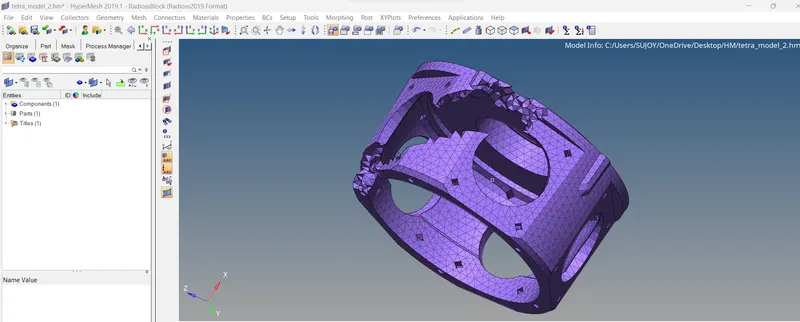
- For doing quick tetra mesh we need to first open the utility tab by going to View>Browsers>Hypermesh>Utilities Then, by going to the utilities tab, Under the optistruct menu, there is a tab called Geom/mesh, once we click that, Mesh tools menu will be visible and we can then choose the Quick tetra command from there
- The given model is meshed and fixed all the tet collapse error.
- This method is used for meshing a model having meshing criteria.
- For the meshing of models without criteria, volume mesh from the tetra mesh deck is used.
-
Model 3:
-
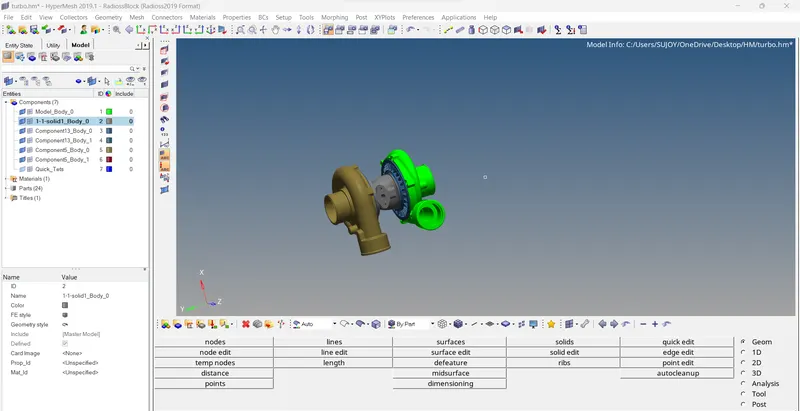
Steps carried out :
- Import the given model and check for any geometrical erros.
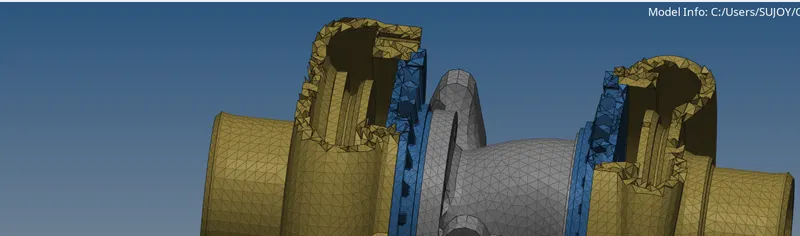
- There are 4 different components in this model, mesh each the component in different methods
- Casing 1 is meshed using the quick tetramesh method.
- Casing 2 is meshed using the quick tetramesh method.
- Central hub is meshed using the quick tetramesh method. The hub can be meshed with volume mesh also however the meshing is causing hypermesh to crash.
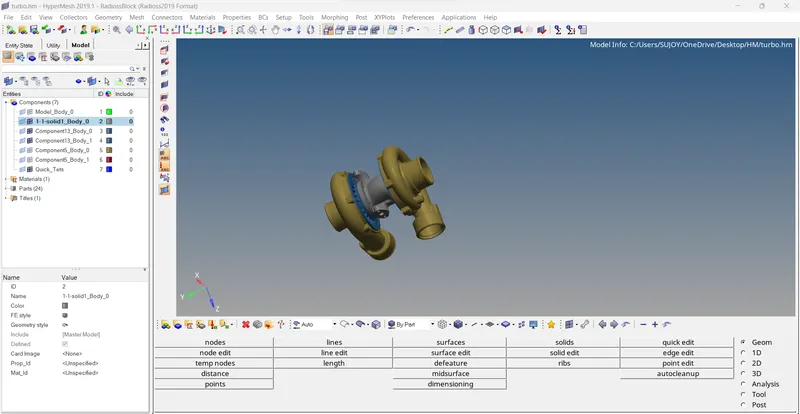
- Check for only the tet collapse error in this model and fix the same
CONCLUSION:
- The types of 3d mesh used in different scenarios were studied and the models were meshed
- The given model is meshed using 3d tetra elements