Week 5 Sphere pressing on a plate
Aim: To conduct an analysis on a sphere pressing on a plate.
Procedure:
Materials: Go to engineering data and import non-linear structural steel as it will be applied on the plate. This material can be found in General data for non-linear materials.
Geometry: Drag and drop the geometry in space claim to upload it.
Setup:
Components: Name the two components as sphere and plate. Assign the material structural steel to the material and structural steel (non-linear) to the plate.
Connections: The connection here is frictional. From the tribology table, we find that the coeff. of friction between the two surfaces is 0.74. The behavior must be program-controlled here.
Mesh: Add a default mesh here to obtain the results.
Analysis Settings:
- Number of Steps: 4
- Solver type: Direct
- Large Deflections: On
- Auto time Stepping: Program Controlled
Load Settings:
- Add fixed support at the bottom of the non-linear plate.
- Add a displacement load at the top of the sphere, this is done by using a tabular column. Apply 4mm displacement till the 3s time step and then in the 4th-second lift the sphere. While doing this keep the x and z displacement in the tabular column constant/fixed.
Solution:
Results & Discussion:
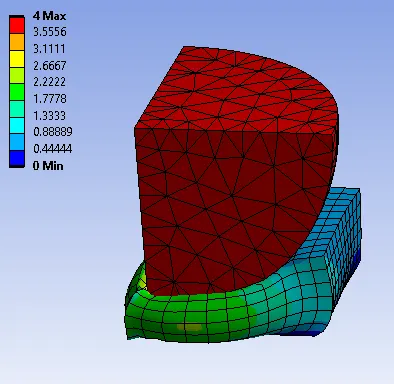
The contour for displacement is obtained to check the current application of the load conditions. The given contour is for the 3rd-second interaction where the displacement is the maximum .i.e. 4mm.
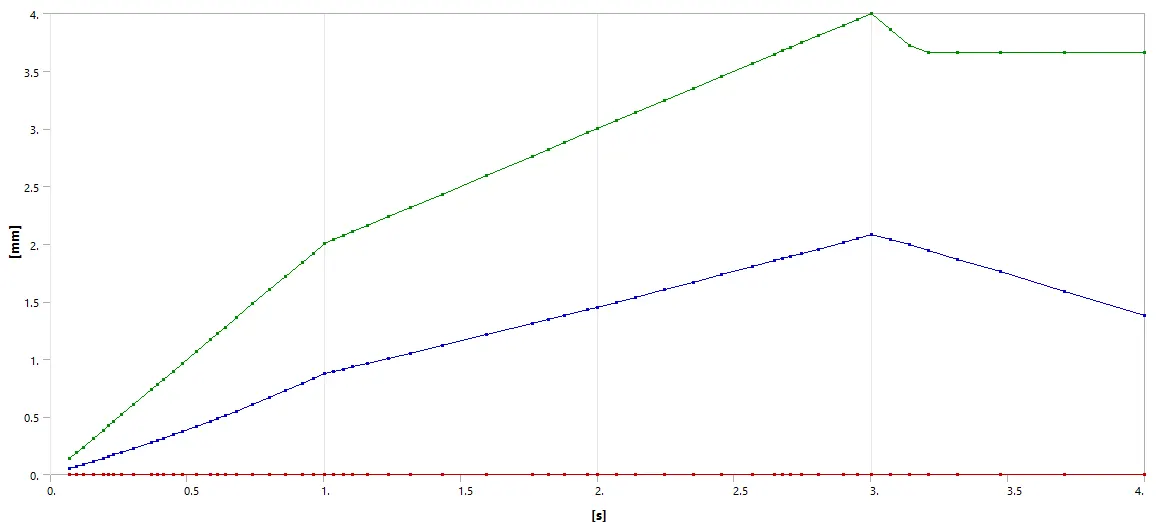
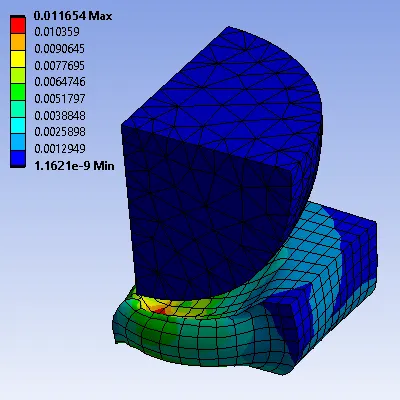
The maximum stress is obtained just a little after 3s. At that moment the strain is 0.1435. This is the point where plastic deformation starts. At the end of the 4s, the stress is 0.011654. This stress is observed a the point on the plate where the radius of the sphere is in contact.
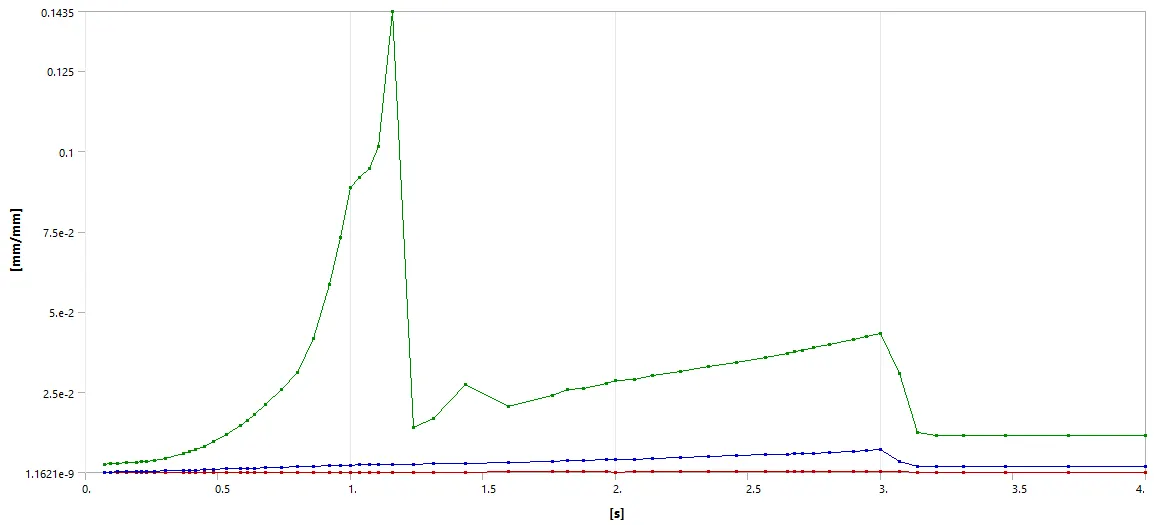
The maximum stress is also observed when the strain is maximum and is 28700 MPa at that point. At the end of the simulation, the maximum strain is 2187 MPa as there is no load on the plate.
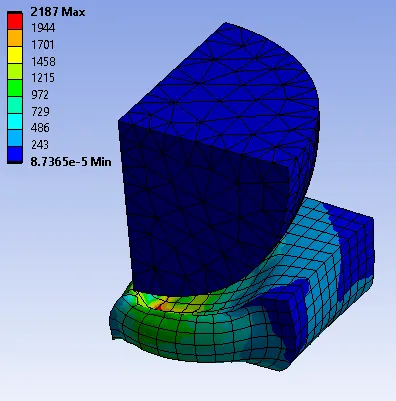
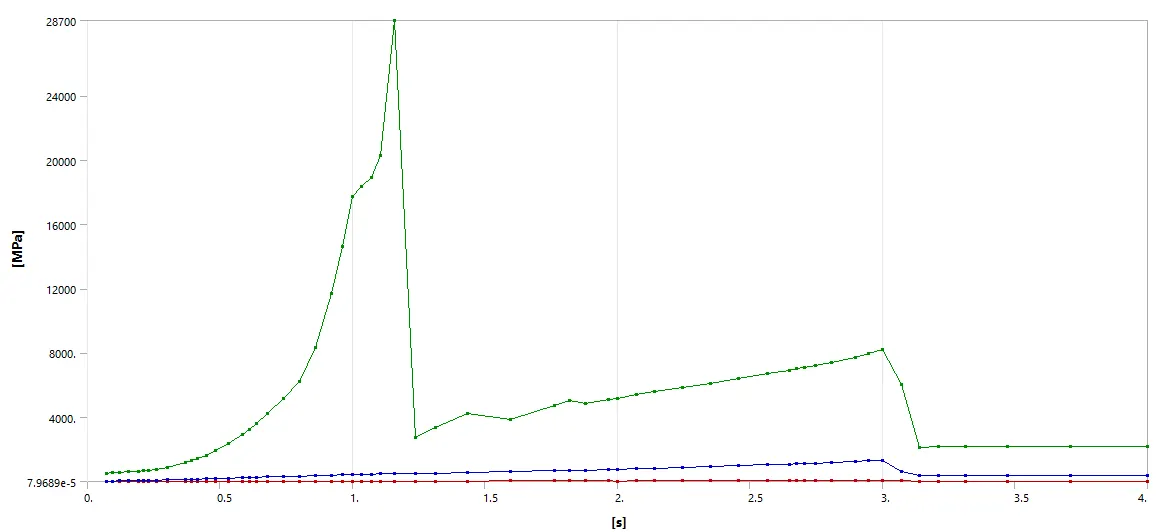
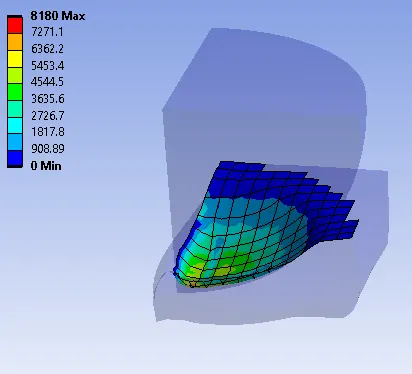
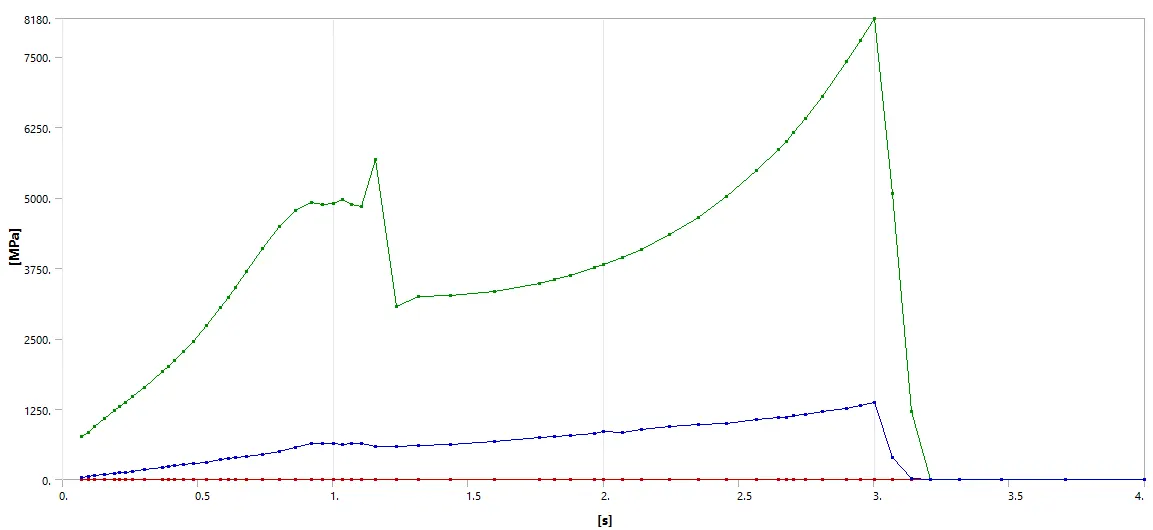
Here we observe that the pressure is maximum at the plastic region, which is at the point where the sphere is lifted from the plate. At that point is it 8180 MPa.
Conclusion: Plastic deformation was successfully observed when the sphere went 4mm into the plate.