Week 5 - Rayleigh Taylor Instability
Objective:
To simulate the Multiphase flow of rayleigh Taylor instability in Ansys fluent.
Theory:
Multiphase flows take place in nuclear geothermal power plants, food processing industries, and many others. One of the basic examples is Rayleigh Taylor Instability. The Rayleigh Taylor Instability is a hydrodynamic instability that arises when a high-density fluid is placed over a low-density fluid in a gravitational field. When the density interface is disturbed, the hydrostatic pressure is generated, so the heavier fluid moves downwards and mixes with the lighter one. The Rayleigh Taylor instability is the instability of an interface between two fluids of different densities which occurs when the lighter fluid is pushing the heavier fluid in a gravitational field.
CFD model based on Rayleigh-Taylor instability:
- Dam break analysis is based on the Rayleigh Taylor instability.
- Plateau–Rayleigh instability which helps to solve fluid breaks into smaller particles example: water from the tap, falls, rain, ink from the printer, etc.
- Richtmyer–Meshkov instability occurs when two fluids of different densities are impulsively accelerated.
- the Kelvin-Helmholtz instability is responsible for some of nature's most basic structures. Example: Cloud
Meshing:
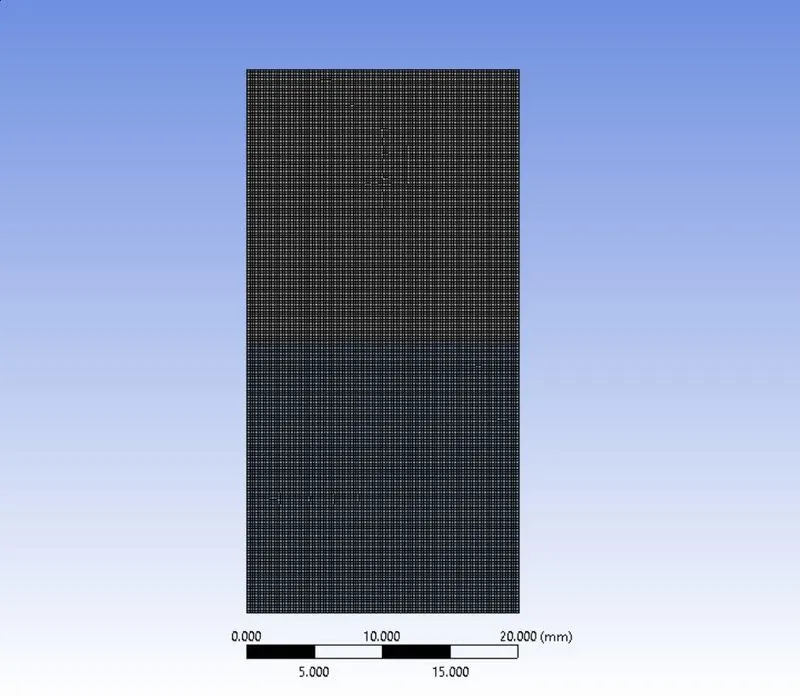
For this problem, meshing is quite simple with hexahedron mesh so the Quality of the mesh will be higher.
mesh with 20 thousand cells
Grid independant test:
Refined mesh result is much more accurate than coarse mesh.
For Transient simulation, compared to steady-state, has higher computational time. Transient solver better captures the flow and can be used to run at smaller time steps.
Smaller time steps are required to observe the instabilities and can be only possible through transient simulation. Since it is a time marching solution, we expect more accuracy from transient simulation for which Transient simulation is the ideal setup to run the calculation for Rayleigh Taylor Instability.
user-defined material(density = 400 kg/m3, viscosity = 0.001 kg/m-s) in refined mesh:
Atwood number is used to scale the difference in density in the scale of 0 to 1.
Higher the Atwood number is higher the density difference.
From running the simulation at higher and lower Atwood number we can say that at low Atwood number the time taken is more than the higher Atwood number. We can observe that the compressibility on the bubble velocity is strong at a larger Atwood Number.
Conclusion:
Hence the Multiphase flow of rayleigh Taylor instability in Ansys fluent successfully ran.