Week 5 Bending of iPhone
Aim: To conduct a bending test on an iPhone.
Procedure:
Materials: Go to engineering data and import aluminum alloy nonlinear, polyethylene, and structural steel.
Geometry: Drag and drop the geometry in space claim to upload it. alloy
Setup:
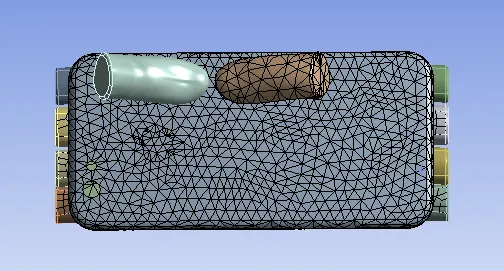
Components: Rename the components as fingers, posh fingers, display, frame, and inside. Then assign the materials as follows:
- Structural Steel: Push fingers and fingers.
- Display: Glass
- Inside: Plastic
- Frame: Aluminium Alloy
Change the finger and one of the push fingers as a rigid body.
Connections:
- Contact
- Assign a frictional contact between the finger and the display.
- Assign a bonded contact between the display and the frame.
- Another frictionless contact is added between the frame and the push fingers.
- Finally, a frictionless contact is created between the frame and the insides.
- Joints
- A body to ground fixed joint is created in every finger.
- A body to ground translational joint is created in every push finger too.
Mesh: Apply a face sizing to the fingers and the rear of the iPhone.
Analysis Settings: Set the number of time steps at 8 and let the time step control be program control.
Load Settings:
- Add fixed support to the insides of the model.
- Make sure that the phone is free to move in the Y-direction.
- Assign joint displacement to both the push fingers at 2mm increment every second.
Solution:
Results & Discussion:
Case 1:
The maximum deformation is in the point that is being pressed. And at the end of 8s, this deformation is 5.4mm in the y-direction.
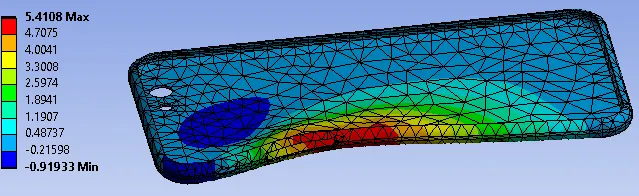
Now observing total deformation, this also observes the deformation in x and z direction thus it is greater. The magnitude of total deformation is greater at the same region where the directional deformation is great.
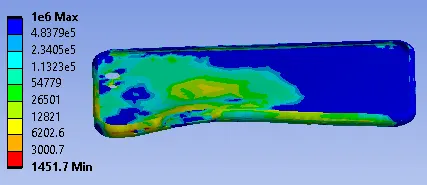
On observing the life span of the frame we see space above the volume key has the least life span.
Case 2:
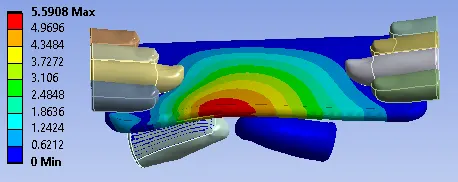
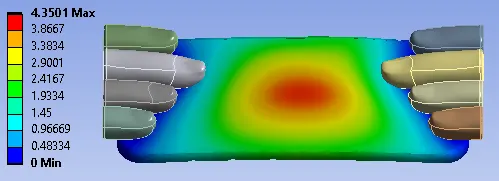
The directional deformation for this case is at a maximum of 4.35mm in the Y direction. This deformation is observed at the center of the iPhone as the force is applied in that region.
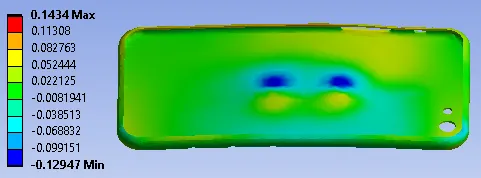
The maximum total deformation is 0.1434mm on the frame.
The fatigue life of the point of bending is zero as it fails after undergoing central deformation. This is due to the applied S N curve on the material.
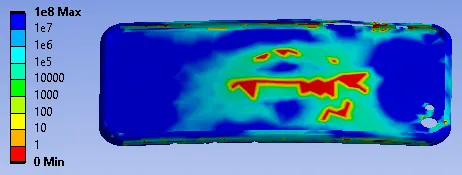
Conclusion: The simulation for both the cases was conducted successfully. It is observed that for Al Alloy nonlinear with applied SN curve has lower fatigue life. Also, the directional deformation in the center is less (case 2) when compared to deformation of the edge(case 1).