Week 5
Google drrive link:
https://drive.google.com/file/d/1OKiegB_e8veD9G6O-tLtVmYKl_wF25OT/view?usp=sharing
Aim:
Obtain a 3D tetra mesh from the rear view mirror component with the following the given criteria.
| Target/Average length | 1 mm |
| Minimum length | 0.5 mm |
| Maximum length | 2 mm |
| Tet collapse | 0.2 |
Objective:
- Clear the geometry errors of the parent model.
- Separate the components from the assembly model of rear view model.
- Create a 2D tria mesh from the surfaces of the mirror model.
- Generate 3D mesh from the existing 2D mesh for all volumes using a suitable non-structured mesh algorithm.
- Check for feature capturing and update elements if failing for quality criteria.
Procedure:
- The Rear view mirror model is loaded into the ANSA workspace.
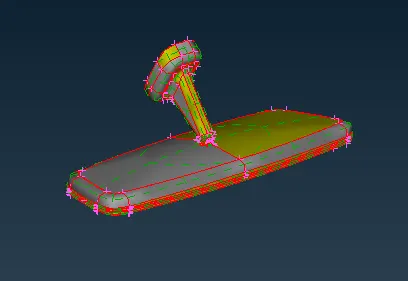
- Model is refined and model is found to be missing the connectivity between the surfaces.
- Since the model is found to be an assembly of four components, say namely: Support, Socket, Pad and mirror. All components are arranged in separate lock views.
- Topo operation is done on each component to establish the missing connectivity between the surfaces. Surfaces are oriented to have grey on outside.(Model is kept in entity mode)
- The quality criteria and mesh parameter are inserted into the software.
- Surfaces of the each component are checked for its compatibility with mesh criteria and if surfaces are found to be difficult to mesh, needed action is taken to modify the surfaces.
- The tria mesh is generated from the surfaces of the model.
- Ortho tria's are used on cuved sufaces to ensure the feature capturing, while regular trias are used on straight surfaces.
- Mesh is checked for any kinks and dips. If found, the mesh is recontructed to remove them.
- Separate volumes are created for each component by defining volumes manually. Solid property is assigned to them.
- Using a tetra Rapid algorithm, tetra mesh is generated from the existing tria mesh.
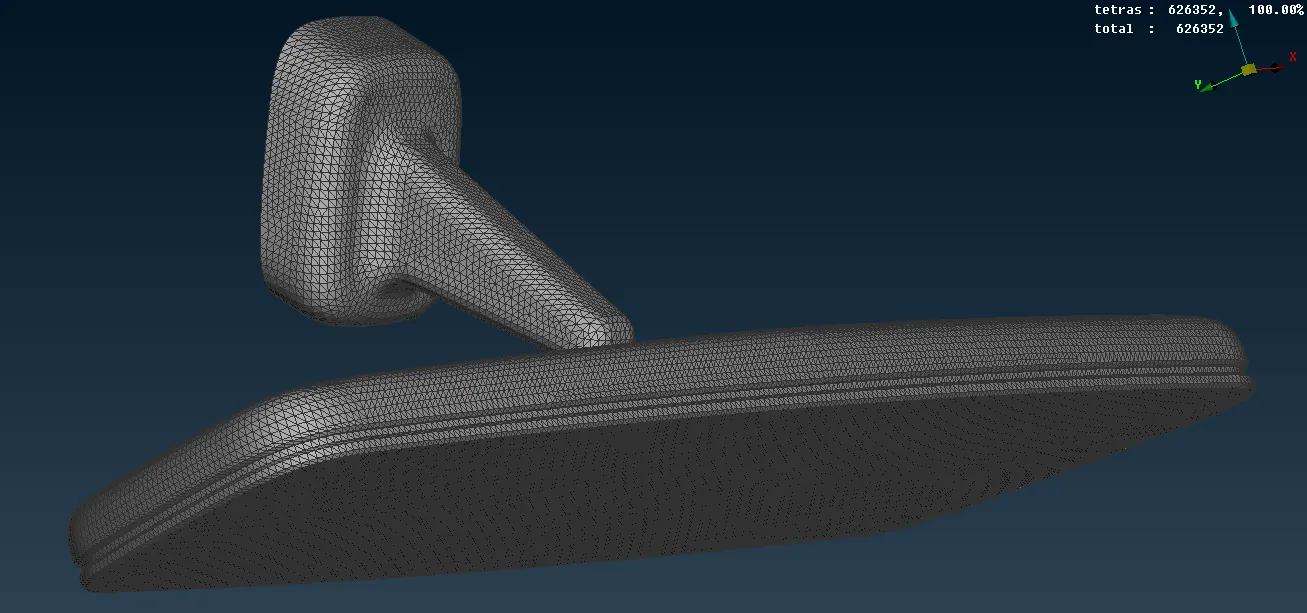
- The mesh is checked for min & max length, tet collapse failing. Since no element is found the obtained mesh is accepted.
- The tetra elements are released from the model.
Result:
The tetra mesh generation and handling the tetra mesh according to the quality criteria is learnt. Concept of volumes is learnt.