Steady VS Unsteady State Analysis
OBJECTIVE: COMPARE THE CONVERGENCE RATE [NUMBER OF ITERATIONS] OF THE STEADY-STATE AND TRANSIENT-STATE [EXPLICIT AND IMPLICIT] SIMULATIONS AND JUSTIFY THE NUMERICS.
THEORY FOR STEADY AND TRANSIENT-STATE HEAT TRANSFER:
Heat transfer is described as the flow of heat due to temperature differences and the subsequent temperature distribution and changes.
This transfer of thermal energy may occur under steady or unsteady state conditions. Under Steady-state conditions, the temperature within the system does not change with time. Conversely, under unsteady state conditions, the temperature within the system does vary with time.
Unsteady state conditions are a precursor to steady-state conditions. No system exists initially under steady-state conditions. Some time must pass after heat transfer is initiated before the system reaches a steady-state. During that period of transition, the system is under unsteady state conditions.
Clearly, no system can remain under unsteady state conditions perpetually. The temperature of the system will eventually reach the temperature of the heat source, and once this happens, the system will be at a steady-state. Even if the amount of heat being transferred into the system is increased, at some point the system reaches its critical temperature and the energy transferred into it starts causing phase changes within the system rather than temperatures increases.
ANALYSIS OF STEADY-STATE SOLUTIONS FOR VARIOUS ITERATIVE METHODS:
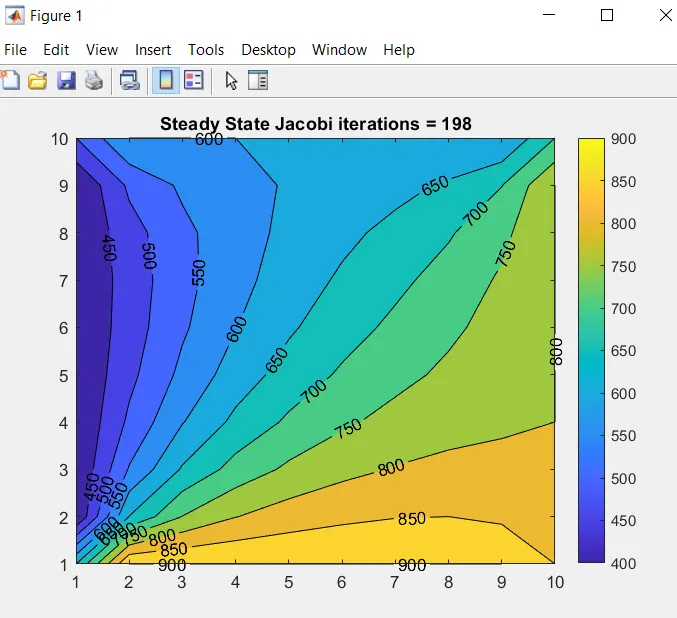
RESULT FROM JACOBI METHOD:
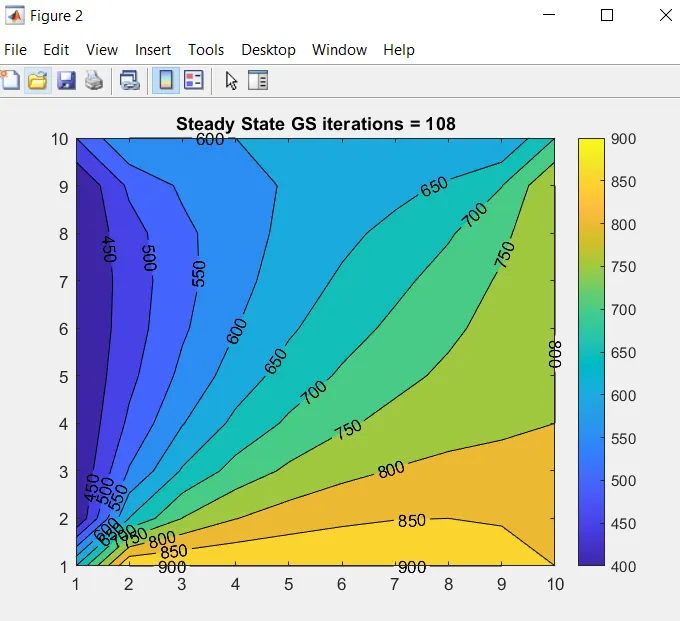
RESULT FROM GAUSS-SEIDEL METHOD:
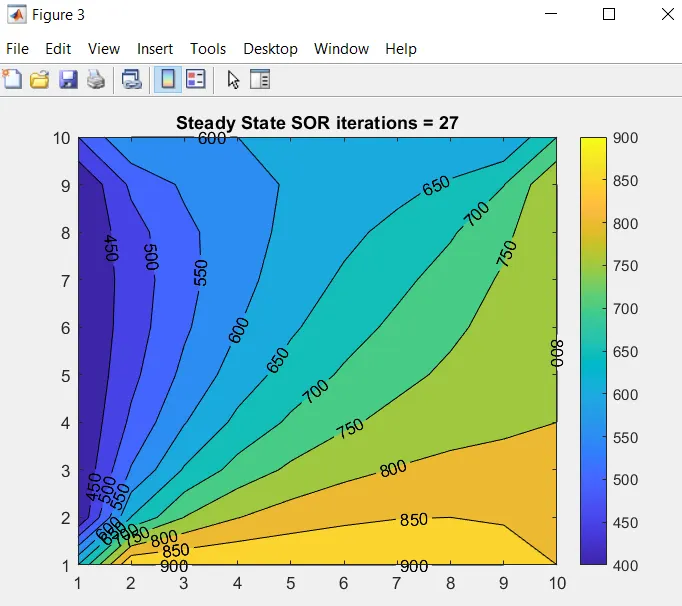
RESULT FROM SUCCESSIVE OVER-RELAXATION(SOR) METHOD:
OBSERVATIONS FROM THE ABOVE RESULTS:
1. No. of Iterations for Jacobi is 198, No. of Iterations for Gauss-Seidel is 108 & No. of Iterations for SOR - 27.
2. No. of grids points are the same for each and every iterative method.
3. Steady-State solutions do not involve marching with respect to time.
4. Here, Temperature gradients won't change with respect to time.
5. The SOR method takes the least duration of time and the lowest number of iterations to reach convergence in the case of the steady-state equation as compared to the Jacobi or Gauss-Seidel method.
ANALYSIS OF TRANSIENT-STATE SOLUTIONS FOR IMPLICIT & EXPLICIT SCHEME:
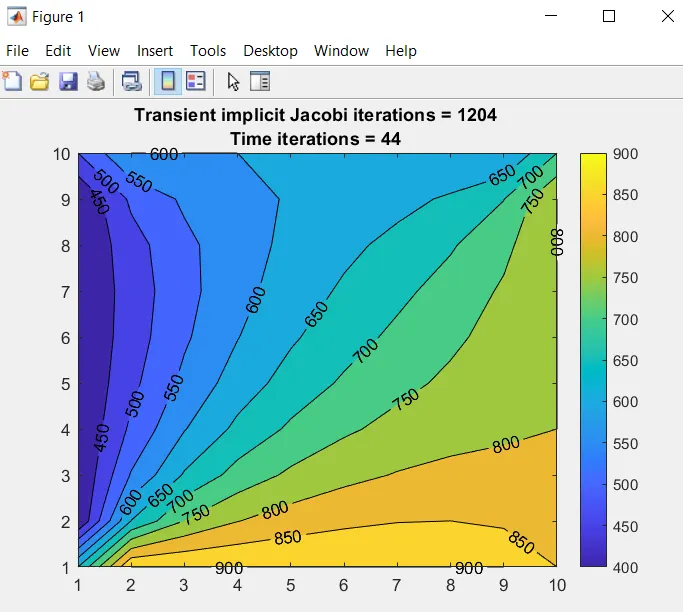
RESULTS FROM IMPLICIT SCHEME USING JACOBIAN ITERATIVE METHOD:
RESULTS FROM IMPLICIT SCHEME USING GAUSS-SEIDEL ITERATIVE METHOD:
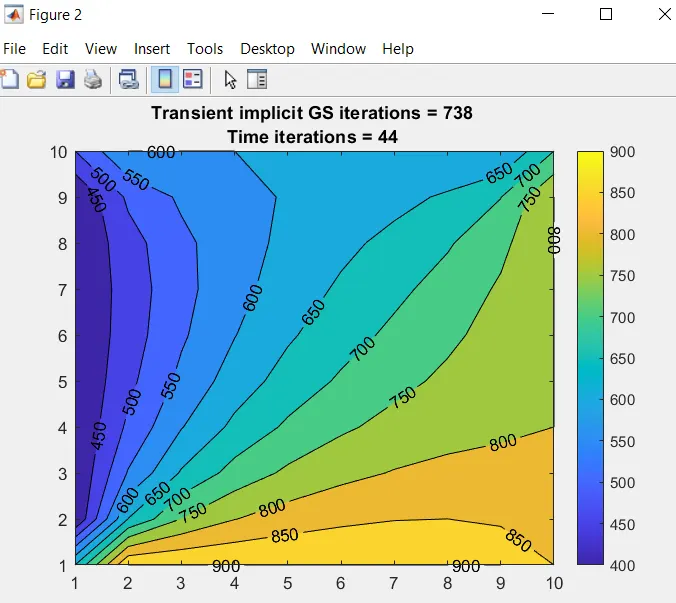
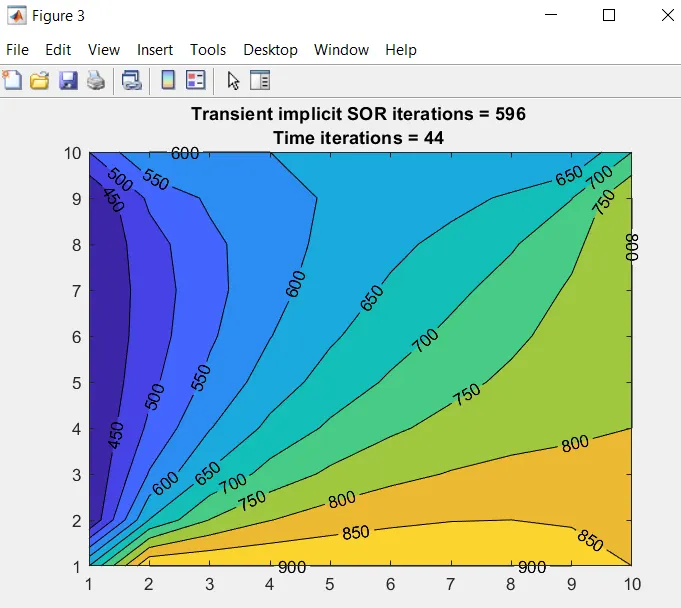
RESULTS FROM IMPLICIT SCHEME USING SUCCESSIVE OVER-RELAXATION ITERATIVE METHOD:
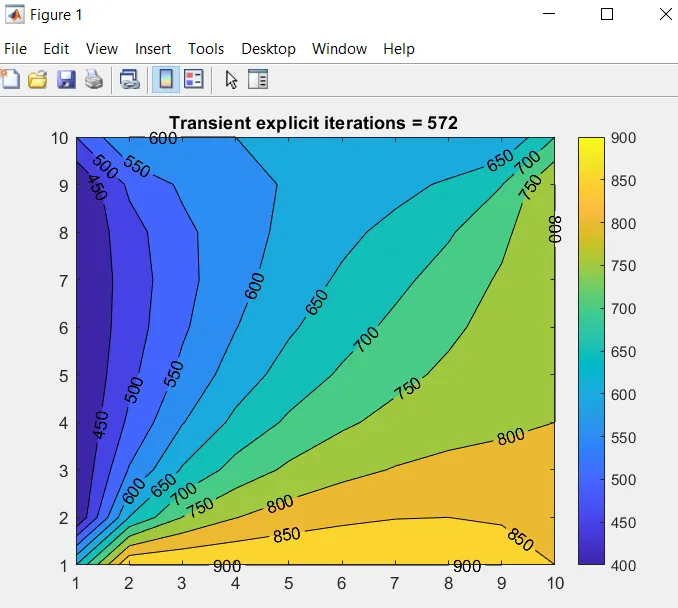
RESULTS FROM EXPLICIT SCHEME:
OBSERVATIONS FROM THE ABOVE RESULTS:
1. Transient state solutions involves 'Time-Marching'.
2. Here, the temperature gradient changes with respect to time.
3. From the above results we can clearly state that the total simulation time in descending order can be given as:
Jacobi Method>Gauss-Seidel>Successive Over-Relaxation.
4. When solving for transient-state explicitly, it takes more no. of iterations to reach convergence as compared to no. of iterations taken by the steady-state iterative solvers because of the involvement of time derivatives in the case of the transient-state explicit scheme.
5. In the case of any transient-solver, we need to consider a new factor: `K = alpha*dt/dx^2` as this term will determine if our transient scheme will eventually lead to convergence or divergence. Here, the value of thermal diffusivity is provided and hence the size of the spatial node and time step must be carefully stated.
The number of nodes considered is based on the geometry and the size of the time steps must be chosen accordingly.
6. Implicit scheme's solutions are unconditionally stable which means that any value of dt doesn't matter how large will result in a stable solution at the end.
7. If we solve the 2D Heat Conduction equation using Implicit-Scheme, it involves higher numbers of iterations as compared to the Explicit Scheme as observed from the above results.
8. Successive Over-Relaxation method produces results faster as it takes less time and a lower number of iterations to reach convergence when compared with Jacobi or Gauss-Seidel method.
9. Explicit method produces results even faster than Successive Over-Relaxation method using the implicit scheme.