Week 5.1 - Compact Notation Derivation for a simple Mechanism
Compact Notation derivation for a simple mechanism
Objective:
To derive a compact notation for the below mechanism;
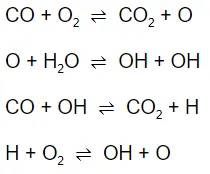
Reaction rate:
The reaction rate or rate of reaction is the speed at which a chemical reaction takes place, defined as proportional to the increase in the concentration of a product per unit time and to the decrease in the concentration of a reactant per unit time.
Compact Notation:
Since mechanisms may involve many elementary steps and many species, a compact notation has been developed to represent both the mechanism, e.g., R.1–R.4 . . . , and the individual species production rates. This helps the computer to solve the mechanism in a more efficient manner.




Rates of change of species in reactions;









Let the reactions be represented by i ;
| i | Reaction |
| 1 | |
| 2 | |
| 3 | |
| 4 | |
Let the species present in the reactions be represented as follows;
| j | species |
| 1 | CO |
| 2 | O2 |
| 3 | CO2 |
| 4 | O |
| 5 | H2O |
| 6 | OH |
| 7 | H |
No.of moles of species j in reaction i on the reactants side;

here, rows represent j and columns represent i
No.of moles of species j in reaction i on the products side;

here, rows represent j and columns represent i
Difference between product and reactant side stoichiometric matrix,

Net reaction rate:

where, kfi, kri - the rate of forward and backward reaction of 'i' th reaction respectively
Xj - concentration of 'j' th species
Net reaction rates of the mechanism are as follows;




Net Production rate:
It is the summation of the product of the reaction rate and stoichiometric matrix.

Production rates of all species are as follows;










 =
= 


Now,

This provides the reaction rates of each and every species. Generally, it is a stiff ODE system where one of the species changes its concentration rapidly while others change at a much slower rate.