Week 5.1 - Compact Notation Derivation for a simple Mechanism
AIM:
To derive the reaction rate ODEs & production of each species for the simple reaction mechanism as shown.
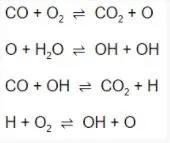
Derivation:
First we will start with the compact notation for the given species and the reaction as shown:
Species Notations:
| j | Species |
| 1 | CO |
| 2 | `underset(2)(O)` |
| 3 | `Cunderset(2)(O)` |
| 4 | O |
| 5 | `underset(2)(H)O` |
| 6 | OH |
| 7 | H |
Reaction Notation:
| i | Reactions |
| `underset(1)(R)` | `CO + underset(2)(O) hArr Cunderset(2)(O) + O` |
| `underset(2)(R)` | `O + underset(2)(H)O hArr OH + OH` |
| `underset(3)(R)` | `CO + OH hArr Cunderset(2)(O) + H` |
| `underset(4)(R)` | `H + underset(2)(O) hArr OH + O` |
Now we will create the reactant side matrix for the compact notation
`v'underset(ji)() = [[1,1,0,0,0,0,0],[0,0,0,1,1,0,0],[1,0,0,0,0,1,0],[0,1,0,0,0,0,1]]`
Similarly the product side matrix will be created as shown:
`v''underset(ji)() = [[0,0,1,1,0,0,0],[0,0,0,0,0,2,0],[0,0,1,0,0,0,1],[0,0,0,1,0,1,0]]`
Thus,
`vunderset(ji)() = v''underset(ji)() - v'underset(ji)() = [[-1,-1,1,1,0,0,0],[0,0,0,-1,-1,2,0],[-1,0,1,0,0,-1,1],[0,-1,0,1,0,1,-1]]`
Now the net reaction rate can be calculated as
`qunderset(i)() = kunderset(fi)()overset(N)(Pi)underset(j=1)()[Xunderset(j)()]overset(v'underset(ji)())() - kunderset(fi)()overset(N)(Pi)underset(j=1)()[Xunderset(j)()]overset(v''underset(ji)())()`
So the net reaction rate for r1 becomes
`qunderset(1)() = kunderset(f1)()[CO][Ounderset(2)()] - kunderset(r1)()[COunderset(2)()][O]`
Similarly net reaction rate for other reactions is
`qunderset(2)() = kunderset(f2)()[O][Hunderset(2)()O] - kunderset(r2)()[OH][OH]`
`qunderset(3)() = kunderset(f3)()[CO][OH] - kunderset(r3)()[COunderset(2)()][H]`
`qunderset(4)() = kunderset(f4)()[H][Ounderset(2)()] - kunderset(r4)()[OH][O]`
Finally the product rate can be defined as:
`wunderset(j)() = overset(L)(sum)underset(i=1)()vunderset(ji)()qunderset(i)()`
THus the product rates for the reactions can be written as
`wunderset(1)() = vunderset(11)()qunderset(1)() + vunderset(12)()qunderset(2)() + vunderset(13)()qunderset(3)() + vunderset(14)()qunderset(4)()`
`wunderset(2)() = vunderset(21)()qunderset(1)() + vunderset(22)()qunderset(2)() + vunderset(23)()qunderset(3)() + vunderset(24)()qunderset(4)()`
.
.
Thus the equation in matrix form becomes:
`[[wunderset(1)()],[wunderset(2)()],[wunderset(3)()],[wunderset(4)()],[wunderset(5)()],[wunderset(6)()],[wunderset(7)()]] = [[-1,-1,1,1,0,0,0],[0,0,0,-1,-1,2,0],[-1,0,1,0,0,-1,1],[0,-1,0,1,0,1,-1]]^TX [[qunderset(1)()],[qunderset(2)()],[qunderset(3)()],[qunderset(4)()]]`