Wire Bending Static Analysis using Ansys
Aim:
To perform a static structural analysis of wire bending operation using ANSYS and present a comparative analysis of results by assigning three different materials to the wire piece.
Material to be used are
1.Copper Alloy NL
2.Aluminium Alloy NL
3.Magnesium Alloy NL
Introduction:
A bending machine is a forming Machine tool. Its purpose is to assemble a bend on a workpiece. A bend is manufactured by using a bending tool during a linear or rotating move. The detailed classification can be done with the help of the kinematics.
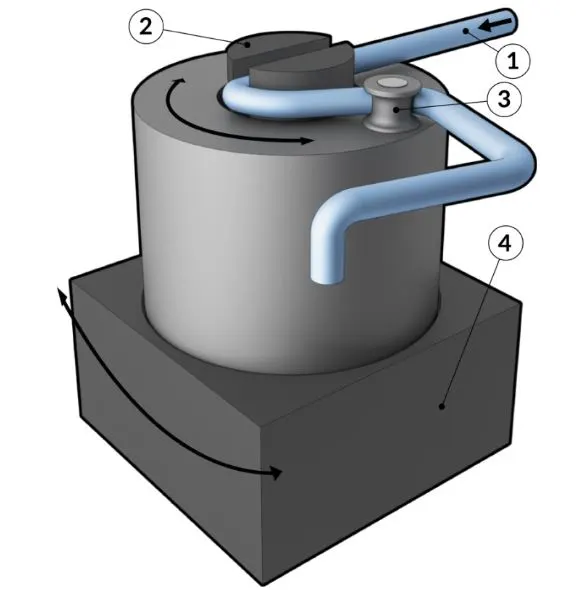
The process
The workpiece consisting of a metal wire [1] is fed through the split die [2] adapted with bending pins suited for the bending shapes. The rotary bending tool [3] bends the wire around the die resulting in plastic deformation. Then, the wire is moved up to the next bending position. The entire bending anvil [4] can be rotated about the wire axis, and thus enabling bending in all directions.
The finished part is released by cutting the wire in the desired location. Many bending machines can switch between different sets of bending tools to be able to vary the bending radius or allow other complex bends.
CNC Bending:
CNC bending machines are developed for high flexibility and low setup times. Those machines are able to bend single pieces as well as small batches with the same precision and efficiency as series-produced parts in an economical way.
Universal bending Machines:
Universal bending machines consist of a basic machine that can be adjusted with little effort and used for a variety of bends. A simple plug-in system supports the quick and easy exchange of tools.
The basic machine consists of a CNC-operated side stop, a workbench, and software for programming and operating. Its modular construction offers an affordable entry into the bending technology because after an initial investment the machine can be customized and extended later without any conversion. That means the basic machine delivers a bending stroke, and the tool determines the kind of bending
Bending tools:
In the case of bending tools, they are classified by the kind of generated bends. They can be constructed to adjust the bending angle by reference, stroke measurement, or angle measurement.
CNC machines usually abstain from a reference part. They grant a high bending accuracy starting with the first workpiece.
Standard bends:
All bends without an extraordinary geometry belong to standard bends. The distance between a bend and the material end is quite high providing an adequate bearing area. The same with one bend to the next. Typical tools are a so-called bending former combined with prisms with electronic angular measurement or an ordinary prism.
U-bending:
For U-bends where tight and narrow bends are necessary, the bending former is replaced by a bending mandrel. A bending mandrel has a narrow geometry.
Offset bending:
Offset bending tools are used to assemble two bends with a small distance between in one step.
Edgewise bending:
Edge bending tools are used if the bending axis is placed parallel to the tight side of the workpiece. Tools for bending on edge may include electronic angular measurement allowing a high bending accuracy.
Torsion bending:
Torsion tools are able to rotate the workpiece on the longitudinal axis. Alternatives are complex assembly groups with standard bends.
Geometry:
To verify the weld in the setup we use the static structural tool in the analysis system tool to define the geometry and other input parameters.
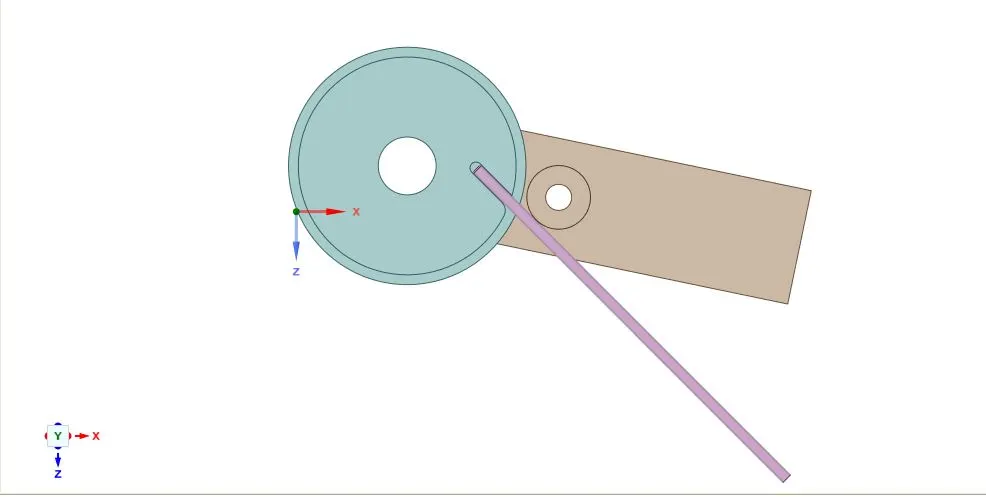
The cad model is imported and viewed in space claim and making sure there are no errors in the geometry.
Materials:
An analysis was conducted for three different materials of the Wire metals namely
- Copper Alloy NL
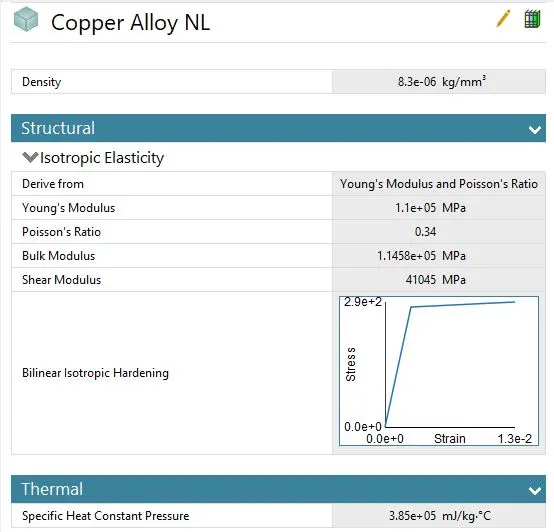
Copper alloys are metal alloys that have copper as their principal component. They have high resistance against corrosion. The best known traditional types are bronze, where tin is a significant addition, and brass, using zinc.
- Aluminium Alloy
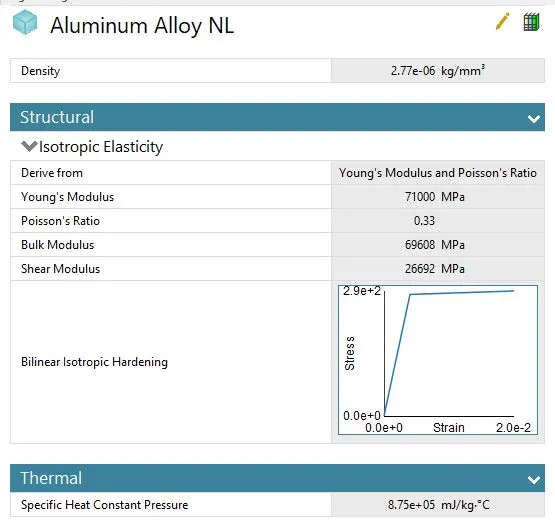
Aluminum alloy is aluminum-based. in the "commercially pure" wrought family. With a minimum of 99.99% aluminum, it is the purest and least alloyed of the commercial aluminum alloys. It is soft and unsuitable for machining. At the same time, it possesses excellent corrosion resistance, electrical conductivity, and thermal conductivity.
- Magnesium Alloy NL
Magnesium alloys are mixtures of magnesium with other metals (called an alloy), often aluminum, zinc, manganese, silicon, copper, rare earth, and zirconium.
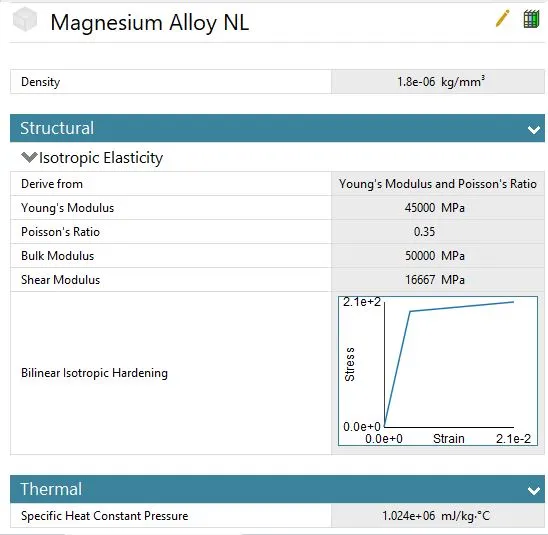
Non-linear materials are considered to account for the regions of plastic deformation.
Meshing:
The summary of mesh controls which are applied to the geometry. All the parts of the geometry have meshed with tetrahedrons elements using the patch confirmation method.
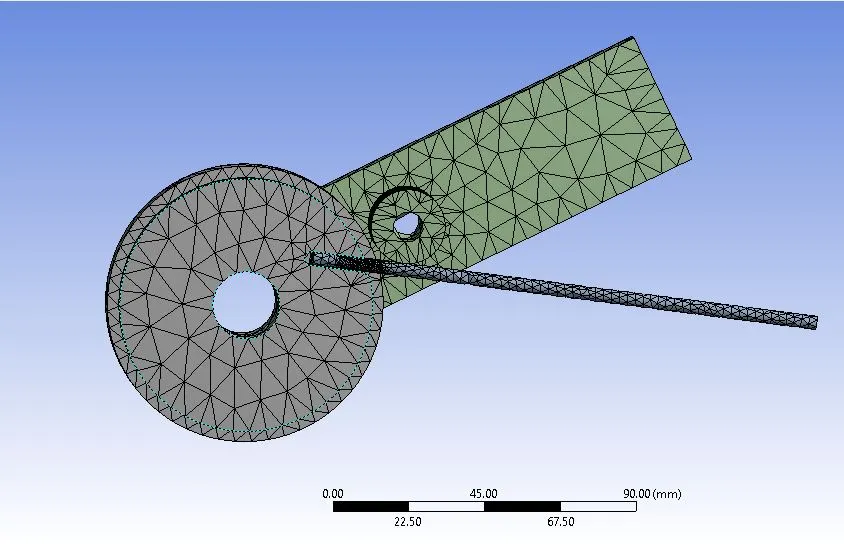
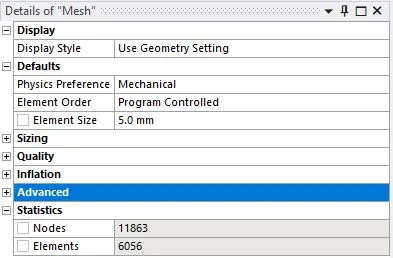
Statistics:
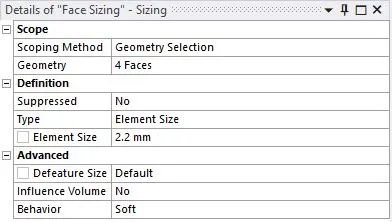
Face sizing is established at critical contact regions that are the areas subjected to excessive loading and deformation.
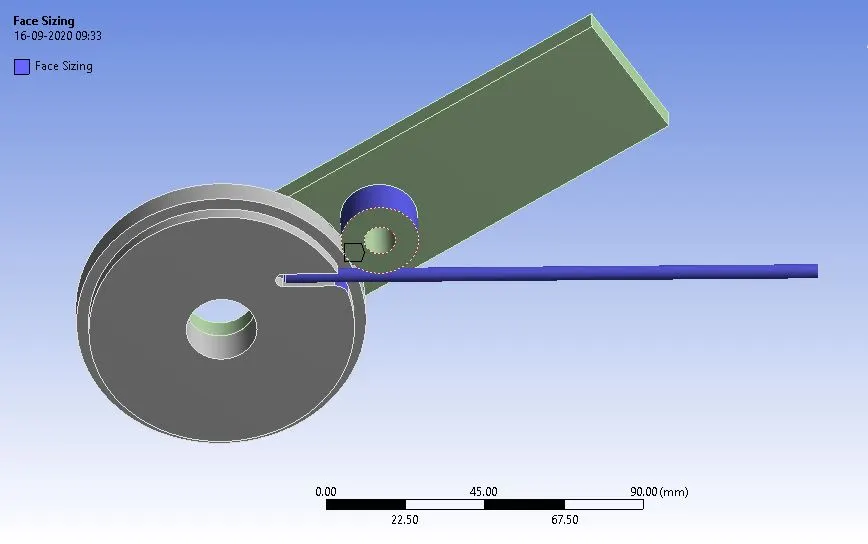
The face sizing meshing details are provided below.
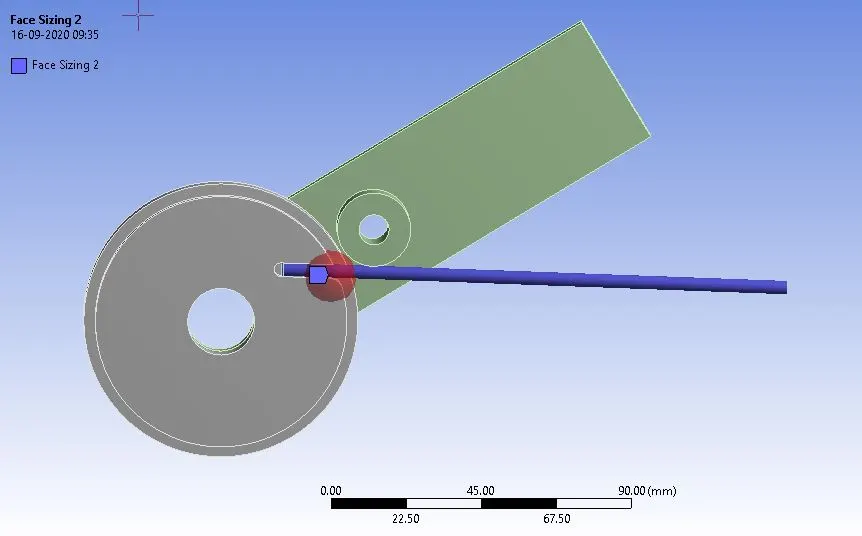
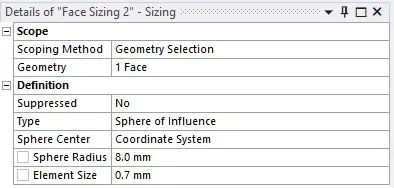
Another face sizing is applied on the wire piece at the region of maximum distortion using a sphere of influence
The face sizing meshing details are provided below.
Mesh-metrics:
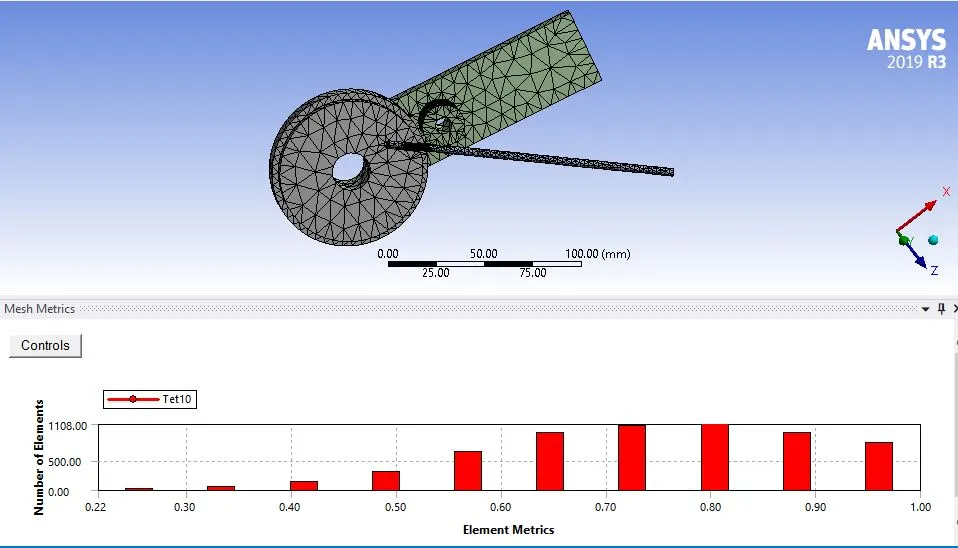
The mesh metric details have been provided below.
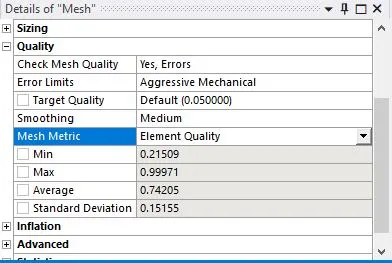
The average element quality was 0.7 for the total domain.
Contacts and joints:
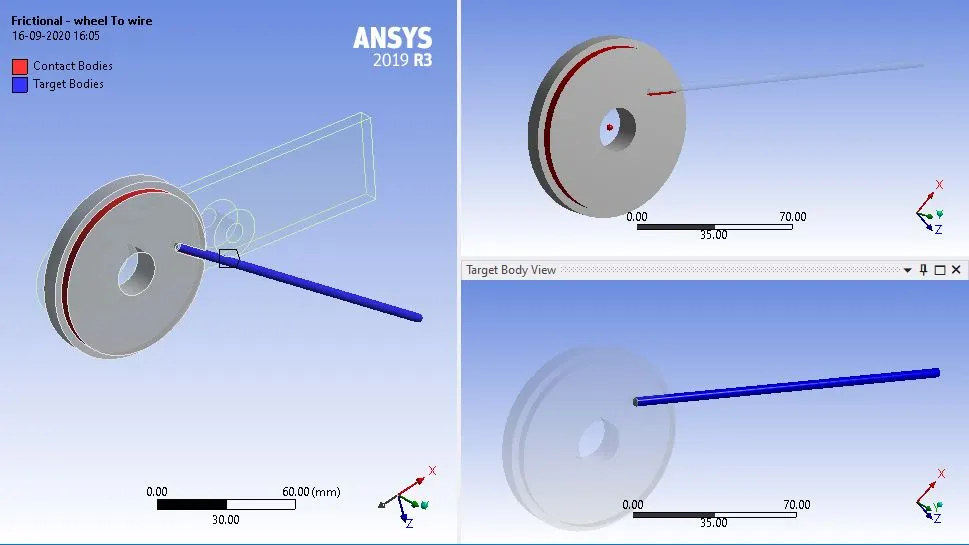
Frictional contacts are established between interfaces of wire pieces and lever with frictional coefficients of 0.2. Similar contact is also made between contact regions of the wire piece and wheel. Below are the details of the contacts which are applied.
Frictional Contact between Wire and lever.
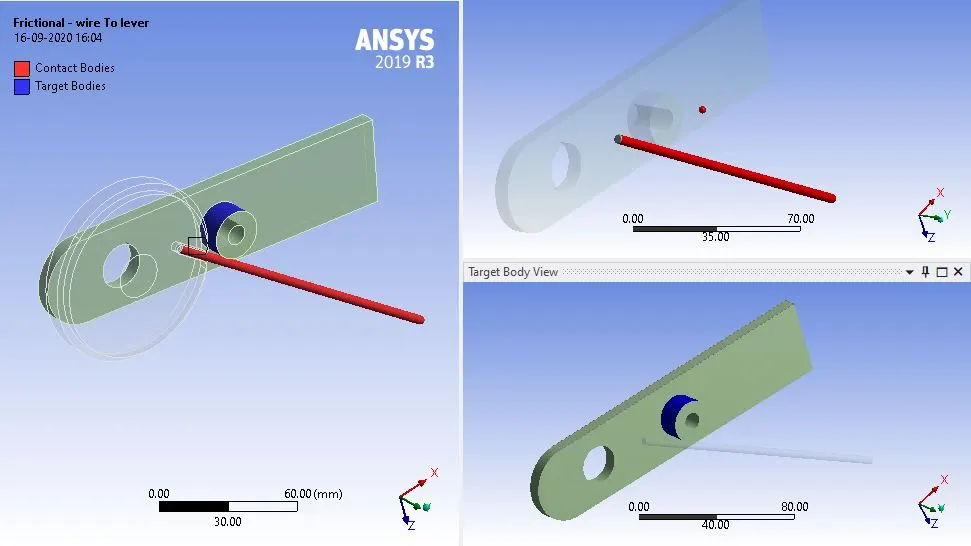
Frictional Contact between Wheel and Wire.
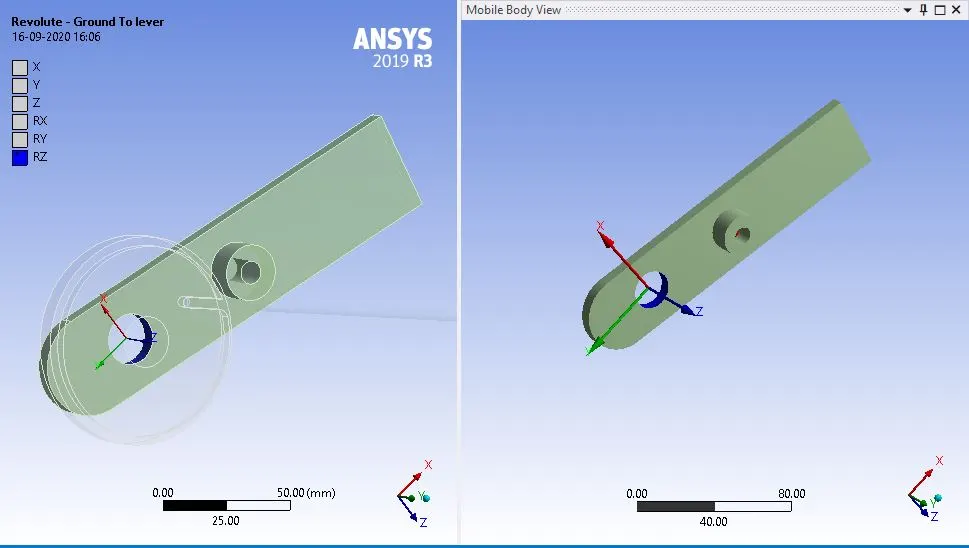
In joints in order to perform bending action, a revolute joint is applied to the lever hence able to rotate in its position and perform bending operations.
Boundary conditions:
In boundary conditions to the holder, the rest of the assembly in place fixed support is assigned individually to the wheel and one end of the wire which is inside the groove portion of the wheel
Fixed joint:
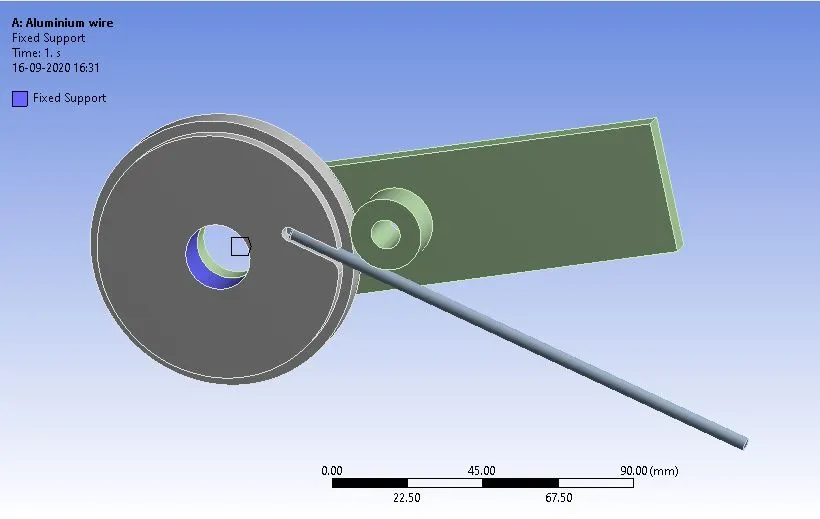
Fixed joint:
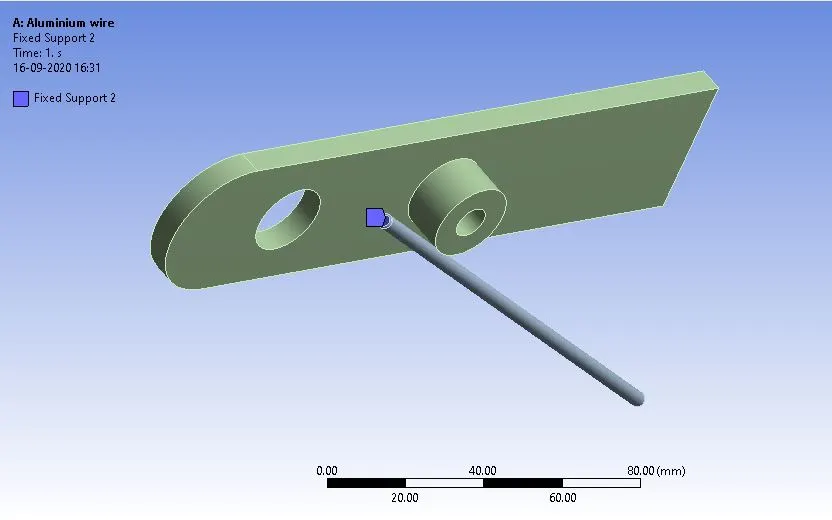
Rotation joint on the lever:
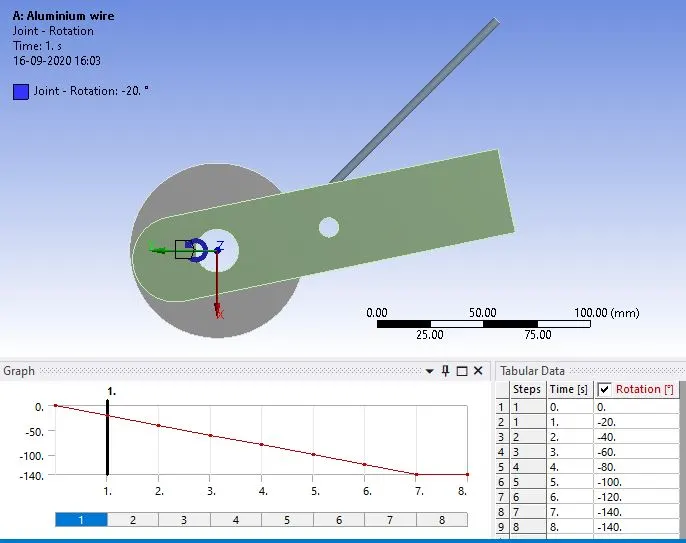
The rotation for the lever has been provided as shown in the picture above.
Analysis settings:
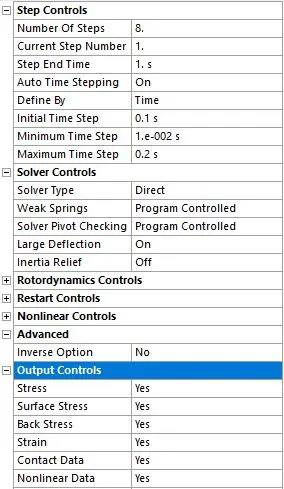
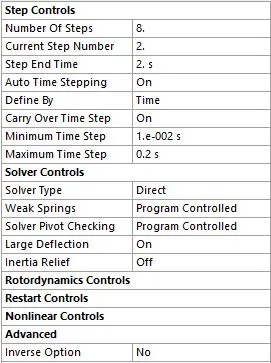
In order to save computational time and aid in easy convergence, various changes have been made and are summarized below
Eight-time steps are used to simulate the bending action.
The solver type is changed to direct rather than iterative.
Weak spring and large deformation settings are enabled to counter unconstrained motion and deformations.
Automatic time settings are also enabled to help in easy convergence by processing the simulation in a small sub time steps increments inside each time steps.
First time-step.
Second to Eight-time step:
Result:
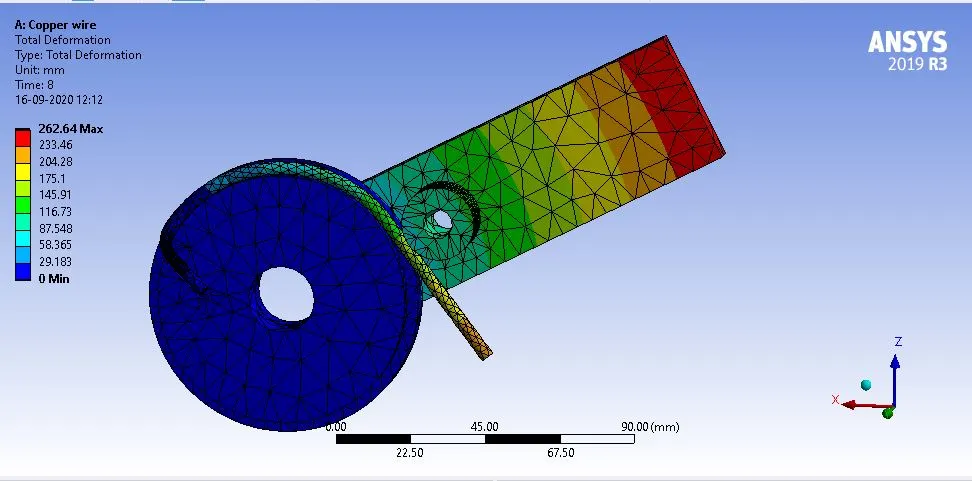
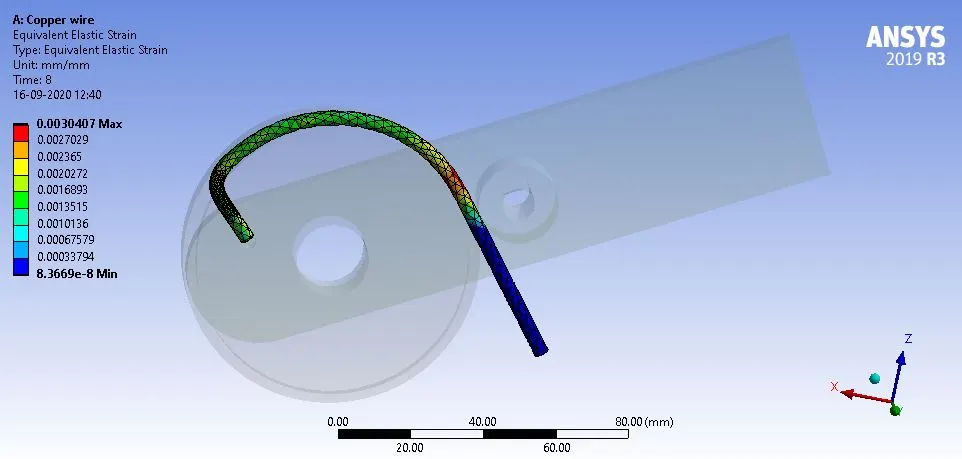
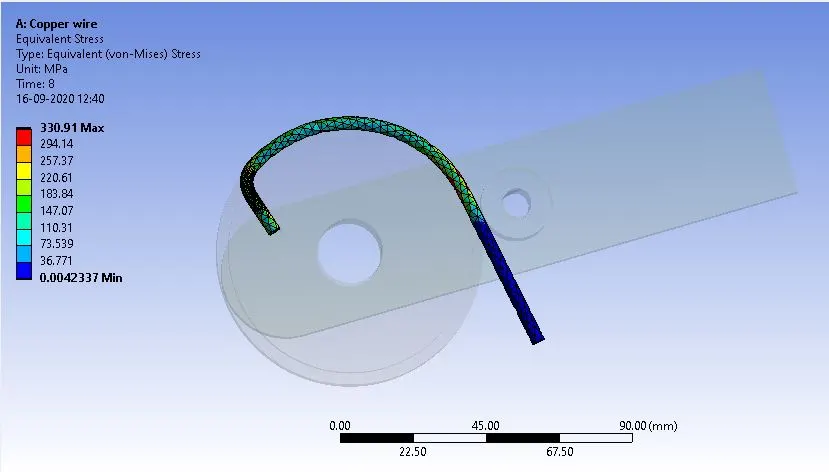
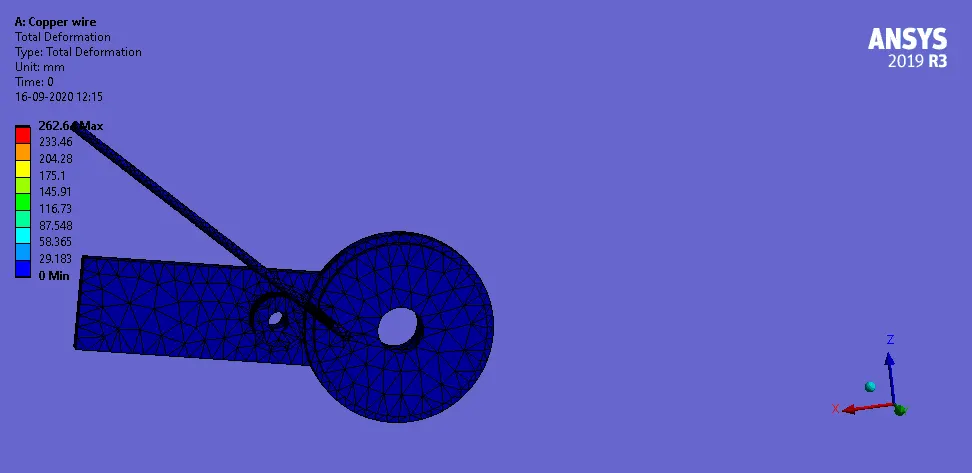
For Copper alloy NL
Total deformation for the total setup:
Equivalent strain:
Equivalent stress:
Animation of Total deformation for the total setup:
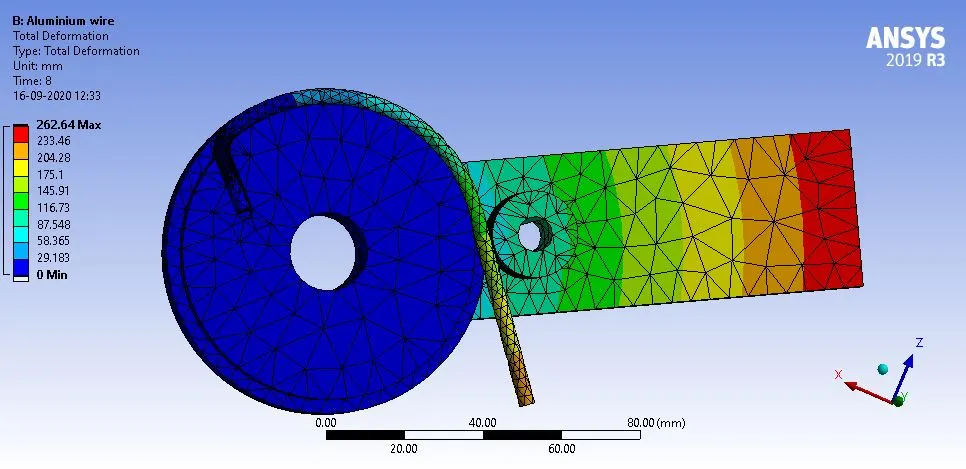
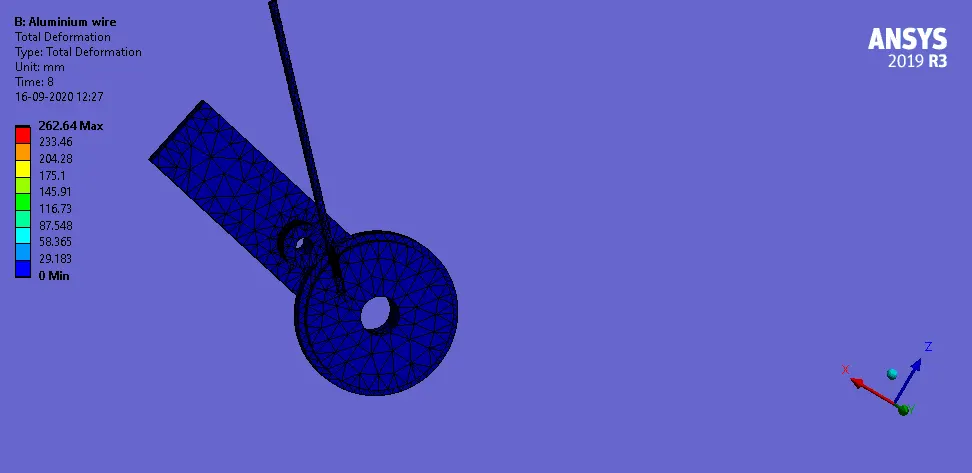
For Aluminum alloy NL
Total deformation for the total setup:
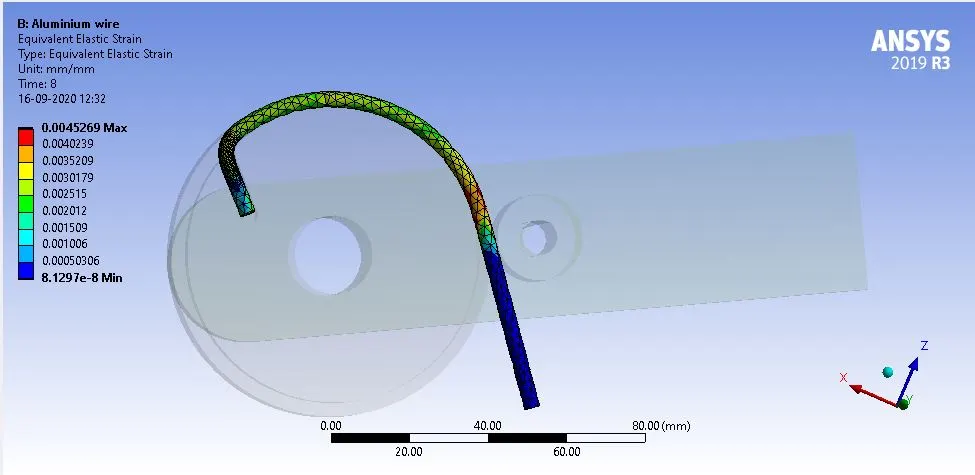
Equivalent strain:
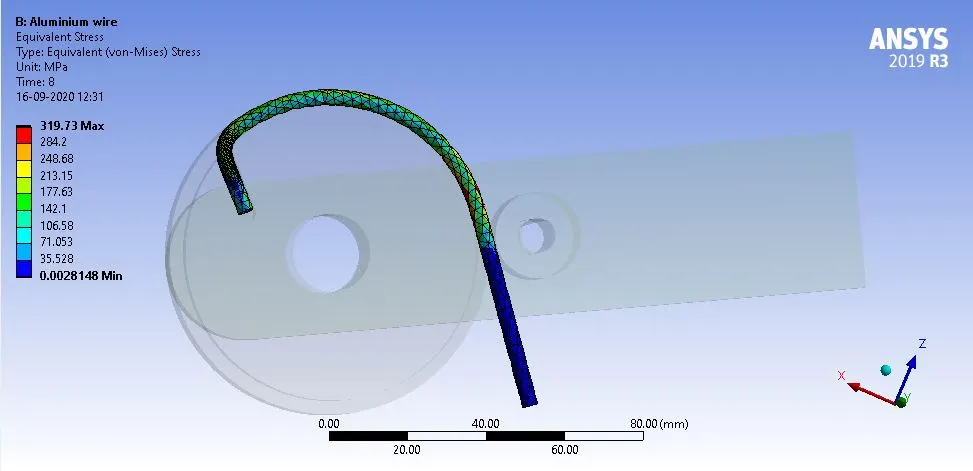
Equivalent stress:
Animation of Total deformation for the total setup:
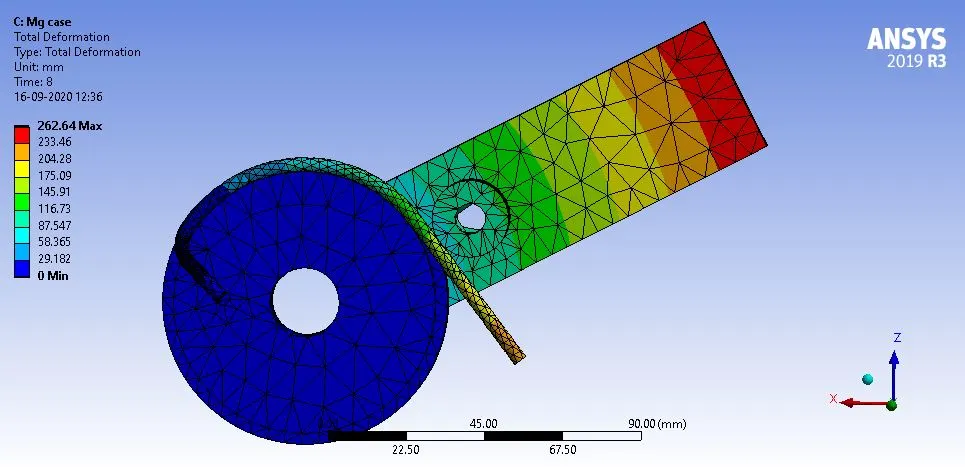
For Magnesium alloy NL:
Total deformation for the total setup:
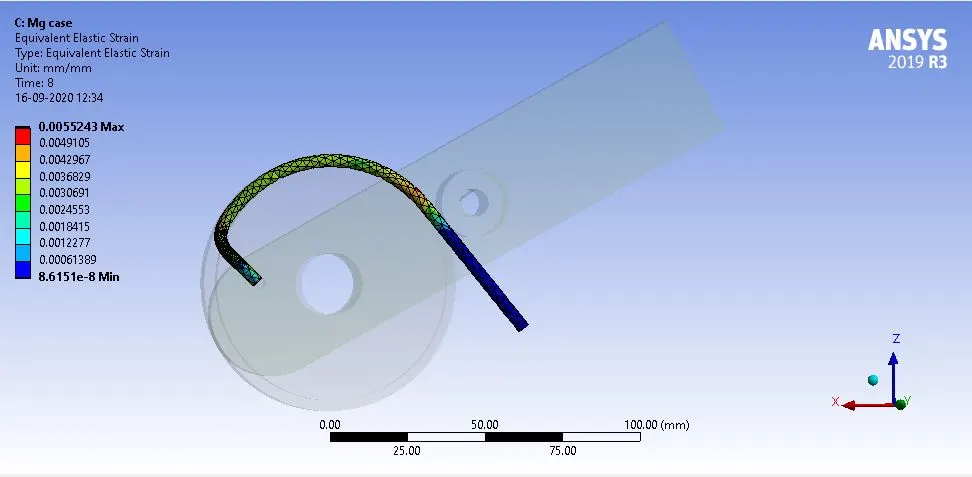
Equivalent strain:
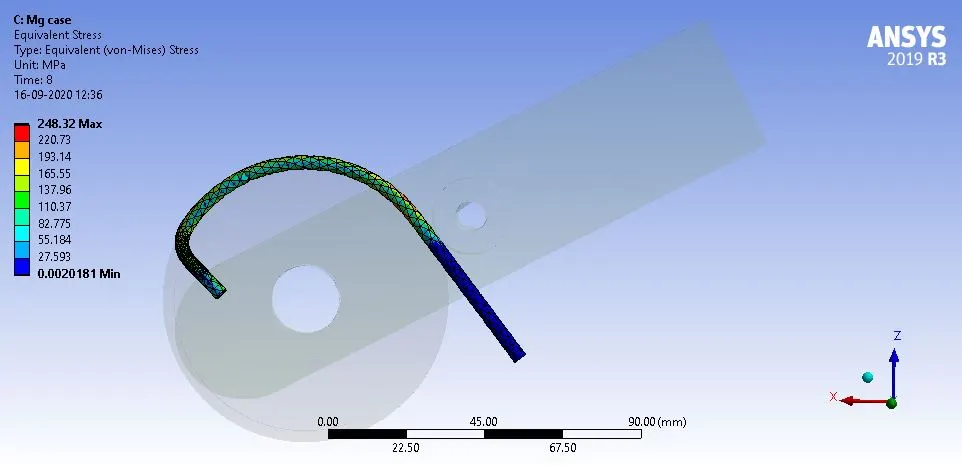
Equivalent stress:
Animation of Total deformation for the total setup:
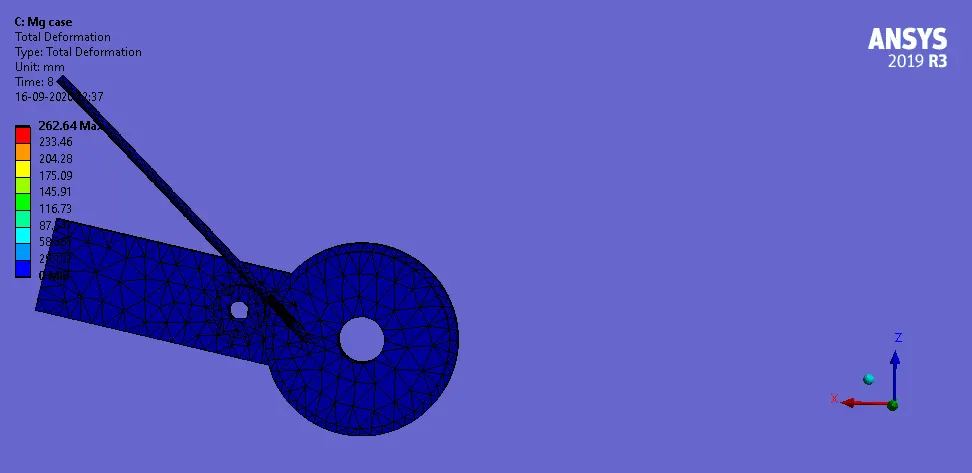
From the above results, it is clear that in all cases the peak region of stress development take place in between First and second-time step after that an almost constant level of stress is maintained. Because in the beginning high force is needed to bend the wire around the region which closes to the grooved portion of the wheel as at this point very sharp bending is taking place. But as bending continues comparatively lesser force is needed because now the wire is only required to bend around the wheel outer circumferential surface.
| Materials |
Total deformation on the total setup |
Equivalent stress |
Equivalent strain |
| Copper Alloy NL | 262.64 | 330.97 | 0.003 |
| Aluminium Alloy NL | 262.64 | 319.73 | 0.004 |
| Magnesium alloy NL | 262.64 | 248.32 | 0.005 |
Conclusion:
Magnesium alloy NL would be the best-suited material as the stress values are lesser when compared with aluminum alloy NL and copper alloy NL.
- DreamingscientistHi, Could you share your model and could you simulate spring back effect? Thanks